Key Takeaways
- The Problem: Precision medicine programs have a high dependency on a manual workforce, which slows down the treatments and increases specialist workload, making personalized care hard to scale.
- The Solution: An AI Agent Precision Medicine Advisor enables the conversion of the patient data into structured, physician-ready insights. It helps to create audit-ready decision trails without replacing clinician judgment.
- How SoluLab Can Help: At SoluLab, AI experts can help healthcare organizations build secure, scalable precision medicine AI agent solutions. We help teams design HIPAA-compliant integrated clinical systems that help to improve care delivery and business growth.
Precision medicine is moving from specialist programs to boardroom strategy. The AI precision medicine market will be worth $3.92 billion in next five years with 30.7% CAGR. Whereas, the AI healthcare will be worth $110.61 billion by 2030. For the healthcare sector, this introduces better opportunities for delivering faster, more personalized treatment and reduces the risks associated with clinical, compliance, and operational issues.
An AI development solution helps healthcare businesses turn complex patient data into decision-ready treatment insights. This guide explores how the AI Agent precision medicine advisor helps the healthcare industry in sharing better healthcare services.
Strategic Business Problem in Precision Medicine and AI
Healthcare leaders face a difficult operating reality. Patient data continues to grow, but clinical teams still rely on fragmented systems, manual interpretation, and slow specialist review cycles. A precision medicine program may need to review:
- Genomic reports
- EHR data
- Lab results
- Imaging summaries
- Medication history
- Family history
- Clinical trial eligibility
- Treatment guidelines
- Risk factors
When teams manage this manually, decision delays increase. Physicians spend more time searching for relevant data. Patients wait longer for personalized treatment recommendations. Hospitals lose revenue opportunities when specialist programs cannot scale. This creates direct business pressure.
An AI agent in healthcare overcomes these limitations by enabling the healthcare teams to convert scattered medical data into structured and actionable recommendations.
Market Forces Driving AI in Precision Medicine
Healthcare organizations can no longer treat precision medicine as a future initiative. Market pressure is already active.
Patients expect digital-first healthcare experiences. Providers need faster diagnosis and treatment support. Pharma companies need better patient stratification for trials. Labs need stronger reporting models. Patients want evidence-based care pathways. Regulators demand the safety, privacy, auditability, and legit use of the patient data.
On the other hand, Artificial intelligence for precision medicine delivers practical outcomes, offering better access to clinical datasets, genomic tools, cloud infrastructure, and secure deployment models to healthcare businesses.
AI Agent Precision Medicine Advisor Platform Overview
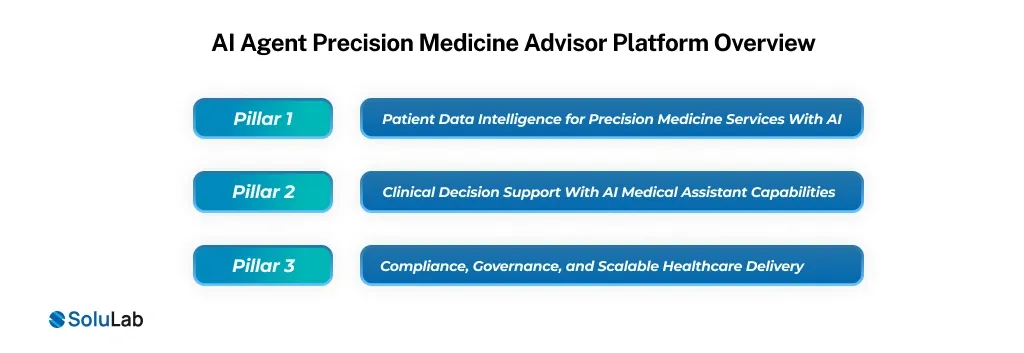
An AI-powered precision medicine platform helps healthcare businesses personalize decisions without forcing teams to replace their existing systems. A strong AI-powered platform works through three business pillars.
Pillar 1: Patient Data Intelligence for Precision Medicine Services With AI
The platform collects patient data from EHRs, lab systems, genomics platforms, imaging reports, and clinical notes, and organizes it into both structured and unstructured formats.
This enables the healthcare team to build a unified patient profile, avoiding repeated manual review. It also provides the physicians with a clear picture of the patient’s condition, risk profile, and treatment history.
Pillar 2: Clinical Decision Support With AI Medical Assistant Capabilities
The AI medical assistant analyzes the patient profile, gathering all scattered information and helping the physicians with faster, better-organized insights. This improves decision speed and maintains consistency across locations.
Pillar 3: Compliance, Governance, and Scalable Healthcare Delivery
Precision medicine AI agent solutions support audit-ready workflows and protect the data against threats. The platform must have access controls, consent management, and traceable recommendations. It must support secure integration with hospital or enterprise systems. This helps healthcare businesses scale safely.
Core Technical Capabilities of a Precision Medicine AI Agent
A precision medicine platform has to support high patient volumes, varied clinical data, and daily use by physicians, care teams, labs, and administrators. The right Healthcare AI Assistant Development should make complex data easier to use, not add another layer of work.
Scalable Architecture for AI Agent in Healthcare
It is not convenient for healthcare organizations to have a platform that works only for one department or one pilot. They need architecture that can support multiple patients, users, and clinical workflows with faster delivery. A well-built system allows convenient precision medicine programs, connects new data sources, and serves different user groups from the same foundation.
Business impact: faster market launch, lower rebuild costs, and smoother expansion across service lines.
Security and Compliance to Build HIPAA-Compliant AI Health Platforms
Precision medicine uses sensitive patient data; having a secure platform design is non-negotiable.
The platform should have limitations on those who have access to patient records, keep track of actions, protect data in transit and storage, manage consent, and keep workflows ready for compliance review.
Business impact: lower compliance exposure, stronger buyer confidence, and fewer delays during enterprise approval.
Interoperability Layer for Healthcare AI Assistant Development
A precision medicine advisor must work with existing healthcare systems, including EHRs, LIS platforms, CRM tools, telehealth apps, genomics databases, and analytics systems. Without these connections, it becomes another disconnected tool.
Business impact: smoother adoption, fewer workflow gaps, and better data continuity across teams.
Clinical Logic for Precision Medicine
The AI agent should support patient matching, treatments, drug response, analyze the genetic risk, and clinical trial eligibility. It should give physicians useful context to make informed medical decisions.
Business impact: faster case review, more personalized care planning, and better specialist productivity.
Data and Analytics Layer for AI-Powered Precision Medicine
Healthcare leaders need to see whether the program is working. The platform should track patient onboarding time, case review time, physician usage, patient conversion, care pathway adherence, and operational efficiency.
Business impact: clearer ROI, better leadership reporting, and stronger investment decisions.
Business Use Cases for Precision Medicine AI Agent Solutions
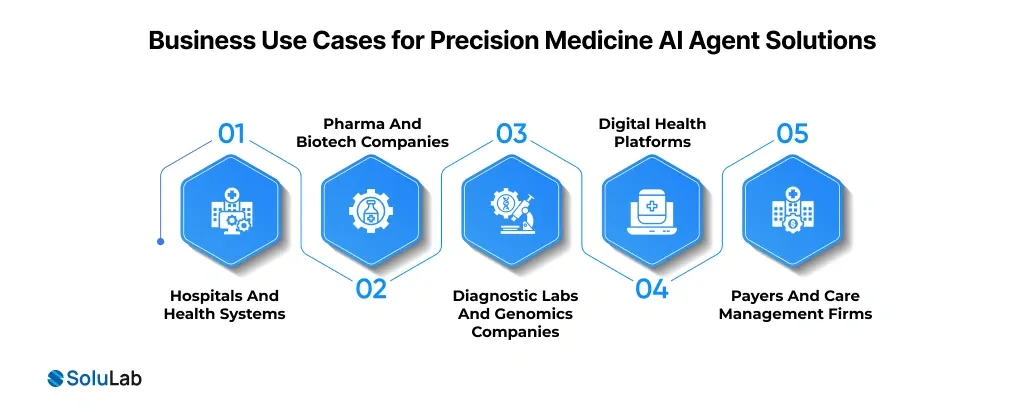
1. Hospitals and Health Systems
An AI Agent Precision Medicine Advisor helps hospitals reduce specialist review time and improve patient-specific care planning. It can support oncology, cardiology, rare disease management, pharmacogenomics, and chronic care programs.
KPI impact: faster treatment planning, better physician productivity, and stronger patient experience.
2. Pharma and Biotech Companies
Pharma companies can use custom AI solutions for healthcare to identify patient cohorts, support trial matching, analyze biomarkers, and improve therapy targeting.
KPI impact: faster trial recruitment, better patient segmentation, and improved research efficiency.
3. Diagnostic Labs and Genomics Companies
Labs can use AI in precision medicine to convert complex reports into physician-friendly insights.
KPI impact: higher report value, faster interpretation, and stronger client retention.
4. Digital Health Platforms
Healthtech companies can embed an AI healthcare advisor into patient apps, provider dashboards, or care management systems.
KPI impact: better engagement, stronger product differentiation, and new subscription revenue.
5. Payers and Care Management Firms
Payers can use AI-powered precision medicine to support risk scoring, preventive care, and personalized intervention plans.
KPI impact: reduced avoidable costs and improved care pathway alignment.
How the AI Agent Precision Medicine Advisor Helps Businesses Scale?
Most healthcare businesses start with B2B adoption but eventually need to serve larger patient populations. This is where the AI-led development becomes a growth engine.
- White-label AI healthcare advisor- It enables hospitals to serve patients, physicians, and enterprise clients under their brand.
- Multi-tenant infrastructure – It enables healthcare organizations to use a single platform for multiple departments, clinics, partners, or customer groups.
- Custom dashboards- It helps healthcare teams to access the right insights.
- Embedded compliance workflows- These are for managing patient consent, access rights, audit trails, and privacy obligations.
This creates a network effect. More users generate more structured workflows. More workflows create better operational visibility. Better visibility helps the enterprise expand services with lower marginal cost.
Business Impact and ROI Projection of AI in Precision Medicine
A well-built precision medicine AI agent can create measurable value across clinical, operational, and commercial functions.
Healthcare enterprises can target:
- 30–50% reduction in manual clinical data review effort
- 40–60% faster patient profile preparation
- 20–35% improvement in care team workflow efficiency
- Faster specialist activation for complex cases
- New revenue streams from premium precision medicine programs
- Lower compliance risk and better patient retention.
Example: AI Agent for Precision Medicine in Oncology
A mid-size oncology network wants to expand precision medicine services across five locations.
Before implementation, each patient case requires manual review of genomic reports, lab results, treatment history, and clinical notes. Specialist teams take several days to prepare a personalized recommendation summary.
After deploying an AI Agent Precision Medicine Advisor, the organization builds structured patient profiles, flags relevant biomarkers, compares treatment pathways, and prepares physician-ready summaries.
The result:
- Review time drops significantly
- Physicians receive cleaner decision support
- Patients move faster from diagnosis to treatment planning
- The network expands precision oncology services without hiring the same ratio of specialists
This is not only a clinical improvement. It is a business model upgrade.
Takeaway
With the AI Agent Precision Medicine Advisor, healthcare businesses can replace manual processes with faster, structured data and can support patient-specific decisions. It combines clinical, genomic, and operational data to offer physicians reliable insights for offering personalized healthcare. The future of AI in healthcare is to improve the care quality and build stronger market differentiation.
Why Choose SoluLab for AI Agent Development Services?
SoluLab helps healthcare organizations build secure, scalable, and business-ready AI solutions. Its team supports AI agent development services, healthcare AI assistant development, custom AI healthcare agents, and HIPAA-conscious platform architecture.
For precision medicine, SoluLab can help enterprises design AI workflows for patient data intelligence, clinical decision support, genomic insight delivery, provider dashboards, compliance controls, and system integrations. The result is a purpose-built healthcare AI advisor that supports business growth, clinical efficiency, and safer digital health innovation.
FAQs
Shipra Garg is a tech-focused content strategist and copywriter specializing in Web3, blockchain, and artificial intelligence. She has worked with startups and enterprise teams to craft high-conversion content that bridges deep tech with business impact. Her work translates complex innovations into clear, credible, and engaging narratives that drive growth and build trust in emerging tech markets.