Key Takeaways
- Agricultural asset tokenization converts farmland, crops, livestock, and commodities into digital tokens that represent fractional, tradable ownership on a blockchain.
- Global agricultural production is worth close to $4 trillion, and most of that value still sits in illiquid, hard-to-finance assets that tokenization could unlock.
- Farmland used to require a full purchase to invest in. Tokenization drops that entry point to a few hundred dollars in some cases.
- Tokenized real-world assets already have serious financial momentum behind them, and agriculture is one of the categories analysts expect to catch up.
- The clearest early wins are farmland investment, commodity-backed tokens, and supply chain financing, not speculative crop-price tokens.
- Regulatory clarity, farmer trust, and reliable on-the-ground verification are the real hurdles here, not the blockchain part.
Take something as physical and slow as a farm, a grain silo, or a herd of cattle, and represent ownership of it as a digital token on a blockchain. That’s agricultural asset tokenization in a sentence. Each token maps to a share of the underlying asset, and it trades roughly the way a stock does, minus most of the paperwork that comes with buying land or commodities the old-fashioned way.
It sounds abstract until you look at the problem it’s actually solving. Farmland is one of the biggest asset classes on earth, and one of the hardest to get into unless you already own a farm or have serious capital sitting around.
Tokenization of agricultural assets chips away at that wall. It also hands farmers a new way to raise money without piling on more debt, and gives buyers, processors, and lenders a shared record of where a commodity really came from, instead of taking someone’s word for it.
This piece covers what agricultural asset tokenization looks like in practice, why the timing works right now, how a business actually implements it, and what still needs sorting out before it goes mainstream.
What Is Agricultural Asset Tokenization?
Asset Tokenization in agriculture means taking something real, land, crops, livestock, warehouse receipts- and issuing a digital token that stands in for legal or economic ownership of it. That token sits on a blockchain, so ownership records remain transparent, timestamped, and genuinely hard to dispute after the fact.
A handful of things get tokenized in agriculture today.
- Farmland, split into fractional shares so more than one investor can own a slice of a single property.
- Crop yields, sold ahead of time through tokens tied to a future harvest.
- Livestock, represented as digital assets tied to health records, feeding history, and ownership.
- Warehouse receipts and commodities, where a token stands in for grain, coffee, or cotton sitting in a verified storage facility.
- Supply chain financing instruments, where a token represents an invoice a farmer is still waiting to get paid on.
This isn’t quite the same as owning a tokenized real estate share in an apartment building, even though the mechanics borrow heavily from that playbook. Agricultural tokens carry extra baggage- harvest cycles, weather risk, spoilage- that a real estate token never has to think about.

Why Agriculture Is Ready for Tokenization Now
Global agricultural production is worth nearly $4 trillion, according to FAO data compiled by Statista, even while the total amount of farmland in active use worldwide keeps shrinking year over year. Rising value sitting on a shrinking base of land is exactly the kind of tension that tends to pull new capital and new financial tools into a sector.
- And most of that value is stuck. Farmland deals close slowly. Ownership records look completely different depending on the country.
- Smallholder farmers, who grow a huge share of the food we eat, often can’t get affordable credit because they don’t have collateral a bank will accept.
- Buyers further down the chain, processors, exporters, retailers, frequently have no dependable way to confirm where a shipment of coffee or wheat actually started out.
- Momentum in nearby asset classes gives a decent preview of where agriculture is headed. Deloitte has projected that the tokenized real estate market could grow from under $300 billion today to somewhere around $4 trillion by 2035, a compound annual growth rate close to 27%.
- Gartner, in its Hype Cycle for Web3 and blockchain, currently places tokenized assets broadly near the peak of inflated expectations, with mainstream adoption expected somewhere in the next five to ten years once the use cases mature past the hype phase.
- Agriculture usually trails financial markets by a few years when it comes to adopting this kind of infrastructure. The direction, though, looks the same.
From Farmland to Digital Assets: How the Process Works
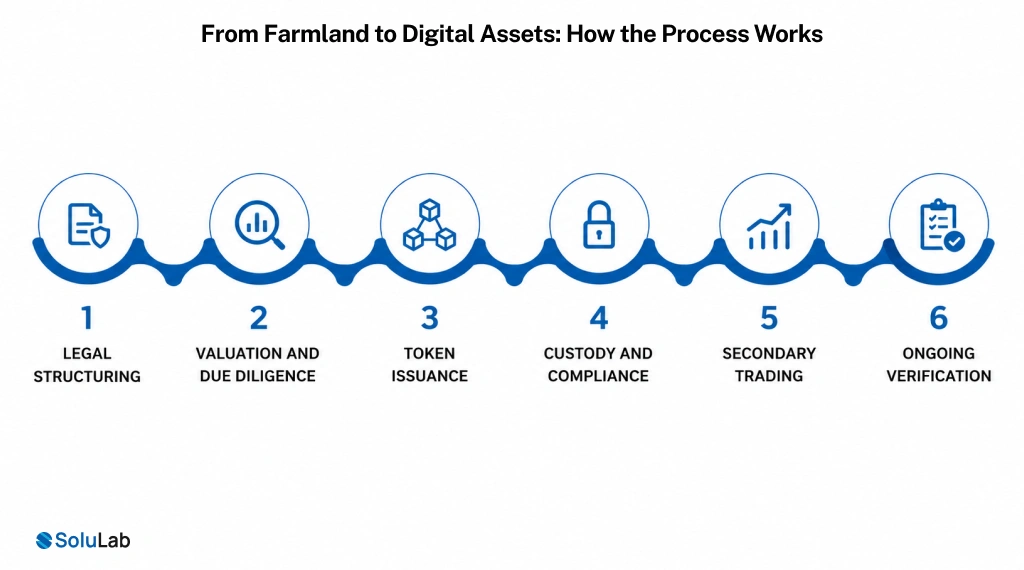
Turning a farm into digital assets isn’t as simple as pointing a blockchain at a piece of land and calling it done. There’s a real sequence behind it, and skipping a step is usually where pilots quietly fail.
- Legal structuring. The physical asset gets placed into a legal entity, often a special-purpose vehicle, that actually holds title. Tokens represent shares in that entity, not a direct claim on the dirt itself.
- Valuation and due diligence. An independent appraisal sets fair value, and any liens, water rights, or zoning issues get documented before anything is tokenized.
- Token issuance. Digital tokens get minted on a blockchain, each one tied to a defined fractional share of the entity.
- Custody and compliance. A regulated custodian or transfer agent tracks who owns what, and KYC/AML checks run before tokens ever change hands.
- Secondary trading. Once issued, tokens can trade on a compliant platform, giving investors an exit that a direct farmland purchase offers.
- Ongoing verification. IoT sensors, satellite imagery, or third-party audits feed real-world data back into the system, so token holders can actually confirm the asset still is what it claims to be.
How to Implement Agricultural Asset Tokenization: A Step-by-Step Guide
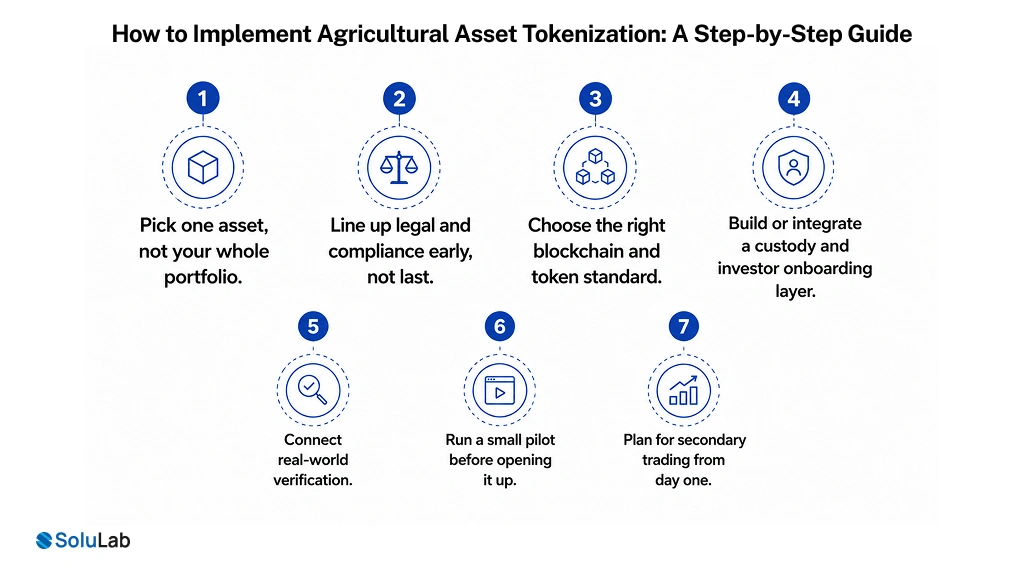
Knowing how tokenization works on paper is one thing. Actually rolling it out inside a business is another, and this is usually where teams get stuck. Whether you’re an agribusiness looking to raise capital or a platform operator building tokenization tools for farmers, the rollout tends to follow a similar arc.
- Pick one asset, not your whole portfolio. Start with a single farm, a single commodity type, or a single receivable pool. Trying to tokenize everything at once is the fastest way to run out of budget before you’ve proven anything works.
- Line up legal and compliance early, not last. Securities law, land title rules, and KYC/AML requirements vary a lot by country and even by state. Bringing in counsel before development starts saves you from rebuilding the token structure halfway through.
- Choose the right blockchain and token standard. Public chains offer more liquidity and visibility. Permissioned chains offer more control and are often easier to get past regulators, at least early on. The right call depends on who you expect to buy the tokens.
- Build or integrate a custody and investor onboarding layer. Someone has to track ownership, verify investor eligibility, and handle transfers. Most teams either partner with an existing custodian or build this piece with a development partner who’s done it before.
- Connect real-world verification. This is the piece agriculture can’t skip. Satellite imagery, IoT soil and weather sensors, or scheduled third-party audits need to feed data back into the platform so the token stays tied to reality.
- Run a small pilot before opening it up. Issue tokens to a limited, known group first, work through the operational kinks, then expand access once the process is proven.
- Plan for secondary trading from day one. A token nobody can resell isn’t much better than the illiquid asset it replaced. Decide early where and how token holders will actually be able to trade.
Tokenization Across the Agricultural Supply Chain
Tokenization in agricultural supply chains goes well beyond who owns the land. It touches everything a crop or animal passes through between the field and the final buyer.
A few applications have already moved past theory.
- Trade finance. A farmer with a confirmed buyer but no cash on hand yet can tokenize a receivable and sell it to investors for working capital right away, instead of waiting 60 or 90 days to get paid.
- Commodity-backed tokens. A token tied to a specific lot of stored grain or coffee lets buyers trade ownership without moving the physical product until it’s actually needed.
- Traceability records. Every step, harvest, processing, storage, shipping- gets logged on-chain, which matters a great deal for food safety recalls and origin claims that used to rely on paper trails.
- Cooperative financing. Smallholder cooperatives can pool assets into one tokenized structure, opening up capital markets that would otherwise ignore farms too small to interest a traditional lender.
None of this requires ripping out existing supply chain software. Most agriculture RWA tokenization projects sit on top of the logistics and ERP systems agribusinesses are already running, rather than replacing them.
Real-World Use Cases: What’s Already Working
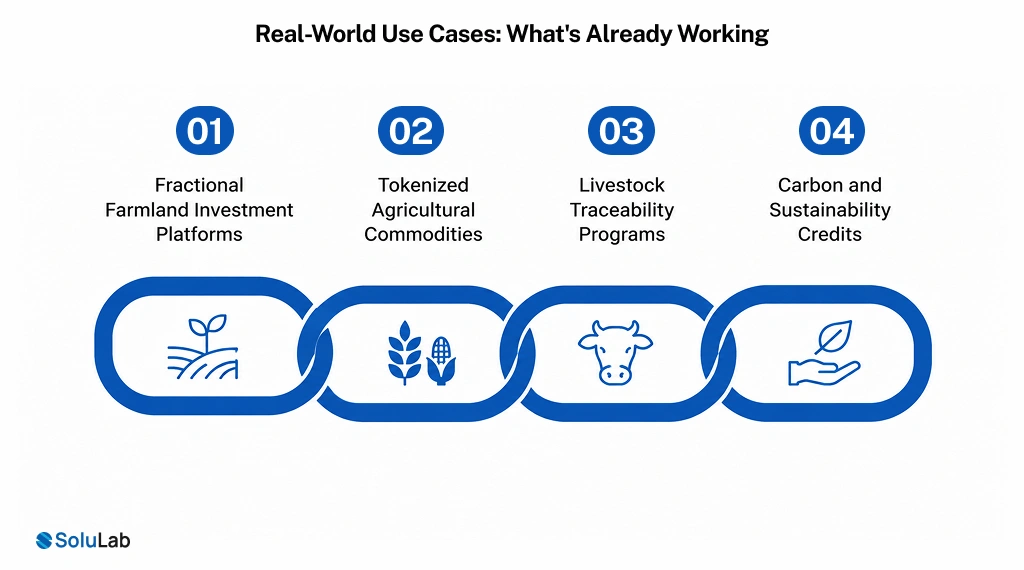
A handful of patterns have moved past pilot and into something closer to routine.
- Fractional farmland investment platforms let retail investors buy small stakes in working farms, collecting a share of lease income or harvest proceeds without ever setting foot on the property.
- Tokenized agricultural commodities, where a warehouse receipt for stored grain or metals gets digitized so traders can settle transactions faster than a paper-based system ever allowed.
- Livestock traceability programs, where each animal’s health records, feed history, and ownership changes get logged on a blockchain, useful for food safety and export compliance alike.
- Carbon and sustainability credits tokenized so buyers can actually verify the underlying claim instead of taking a certificate at face value.
Benefits and Challenges of Agricultural Asset Tokenization
Like any new financial infrastructure, this comes with real upside sitting right next to real friction.
Benefits:
- Fractional ownership opens farmland investing to people who could never afford a full property.
- Farmers get access to capital markets without taking on more traditional debt.
- Tamper-resistant records cut down on fraud in commodity trading and food sourcing claims.
- Liquidity improves for an asset class that’s historically been close to impossible to exit quickly.
- Supply chain transparency speeds up food safety response and recall accuracy.
Challenges:
- Regulatory frameworks for tokenized real-world assets, agricultural ones especially, are still being written in most countries.
- Farmer and investor trust takes time to earn, particularly in regions with limited exposure to blockchain in general.
- Physical verification, confirming the token still matches the real-world asset, means ongoing investment in sensors or audits, not a one-time check.
- Market depth is thin right now. Secondary trading only works if enough buyers and sellers actually show up to trade.
None of that is a reason to skip tokenization altogether. It’s a reason to start narrow, one farm or one commodity type, instead of trying to tokenize an entire agribusiness on day one.
The Future of Blockchain in Agriculture
The broader tokenized real estate investing market offers a decent preview of where agricultural tokenization is headed next. As real estate tokenization platforms mature and regulation catches up, agriculture tends to follow the same path a few years behind, since both asset classes deal with physical property, fractional ownership, and long investment horizons.
Three things are worth watching over the next few years.
- First, clearer regulation in major agricultural economies, which will unlock institutional capital faster than any technical upgrade could.
- Second, tighter integration between IoT sensors and blockchain records, closing the gap between what a token claims and what’s actually happening on the ground.
- Third, growing interest from impact and ESG-focused investors, who see tokenized farmland and sustainability-linked tokens as a real way to fund regenerative agriculture at scale, not just a marketing angle.

Conclusion
Agricultural asset tokenization takes one of the largest, least liquid asset classes in the world and makes it programmable, fractional, and easier to finance.
It won’t replace traditional farmland ownership or commodity trading overnight, and honestly, it shouldn’t try to. But for farmers who need working capital, investors who’ve been priced out of land ownership, and buyers who want proof of where their food actually came from, it’s already solving problems that used to just get lived with.
SoluLab, a tokenization platform development company with hands-on experience building real estate tokenization platforms and blockchain-based financial infrastructure, can help your business figure out where to start and build it right.
FAQs
Neha is a curious content writer with a knack for breaking down complex technologies into meaningful, reader-friendly insights. With experience in blockchain, digital assets, and enterprise tech, she focuses on creating content that informs, connects, and supports strategic decision-making.