Key Takeaways
- Publishing tokenization converts publishing assets, rights, or royalties into blockchain-based digital tokens.
- Books, copyrights, licensing rights, royalties, and exclusive editions can potentially be tokenized.
- Smart contracts can automate ownership transfers, licensing terms, and royalty distribution.
- Tokenization can improve transparency and traceability across publishing transactions.
- Publishers and authors can explore new revenue and reader-engagement models through tokenized assets.
- Legal ownership, copyright, securities regulations, and licensing terms must be addressed before tokenization.
- A publishing tokenization platform typically combines blockchain, smart contracts, wallets, marketplaces, and payment systems.
- Successful implementation requires balancing technical infrastructure with legal, commercial, and user-experience requirements.
Publishing runs on rights and royalties, and both are still tracked in spreadsheets, PDFs, and email threads. A mid-list author signs a contract, waits six months for a statement, then tries to reconcile a number they cannot independently verify. A publisher licensing audio rights into three territories keeps the terms in a contract management system that the sub-licensee cannot see. Nobody is acting in bad faith. The record is just fragmented.
Tokenization fixes the record, not the business model. It gives every rights holder the same ledger, the same ownership entry, and the same payout logic. That is a narrower claim than most blockchain articles make, and it’s the honest one.
This guide covers what publishing tokenization actually is, the seven steps involved, which assets are eligible, where the legal line sits, and what it takes to build a platform. If you’re evaluating this as a business, it sits inside the broader field of real world asset tokenization, and most of the hard parts are the same.

What Is Publishing Tokenization?
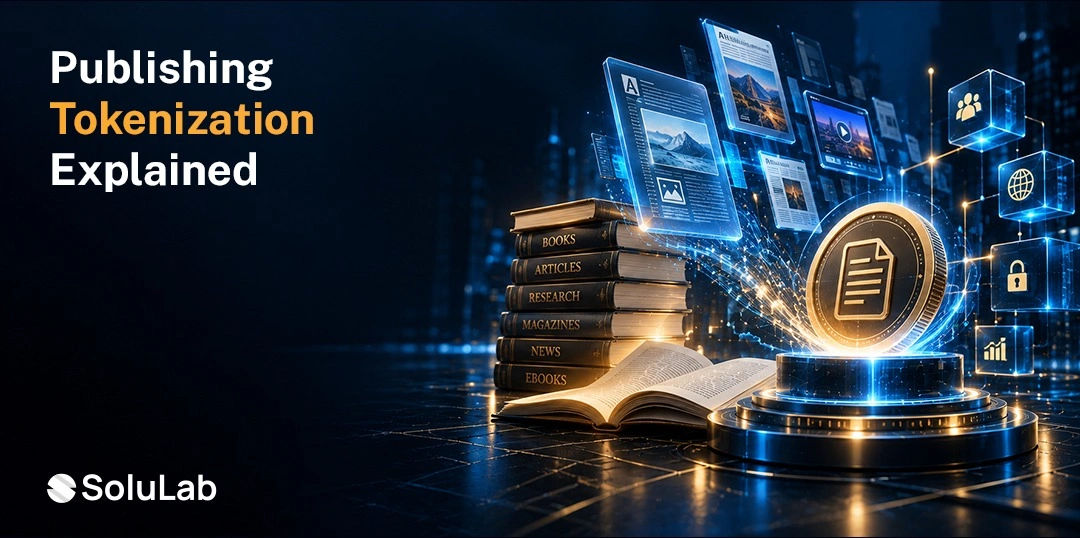
Publishing tokenization is the conversion of a publishing right or revenue stream into a blockchain token whose ownership, transfer rules, and payout logic are enforced by a smart contract.
The token is a record and an instruction set. It says who owns a defined share of something, and it carries the code that acts on that share when money arrives.
Three things get conflated here, so it’s worth separating them.
A token is not a copyright. Under U.S. law, transferring copyright ownership requires a signed written instrument (Minting a token does not satisfy that. In practice, the token represents a contractual entitlement, usually a percentage of income from a work, while the copyright itself stays with the rights holder or transfers through a conventional agreement that the token references.
A token is not automatically a security, and it is not automatically not one. That depends on structure. More on this below.
A token is not the file. The EPUB, the audio master, the cover art: those live off-chain, typically on IPFS or in the publisher’s own storage, with a content hash written on-chain so anyone can verify the file hasn’t changed.
The commercial scope is wider than books. Journals, comics, courses, newsletters, catalogues, and backlists all carry rights and income streams that can be represented the same way. SoluLab has built this pattern across tokenization of IP assets and adjacent creative verticals, including blockchain in media and entertainment.
Publishing tokenization vs AI text tokenization: what’s the difference?
These share a word and nothing else. AI text tokenization splits text into units a language model can process, which is a preprocessing step in natural language processing.
Publishing tokenization represents a legal or economic right on a blockchain. If you landed here looking for the machine learning meaning, see tokenization in NLP. Searchers mix these up constantly, and so do AI assistants, which is why the distinction is worth stating plainly.
How Does Publishing Tokenization Work?
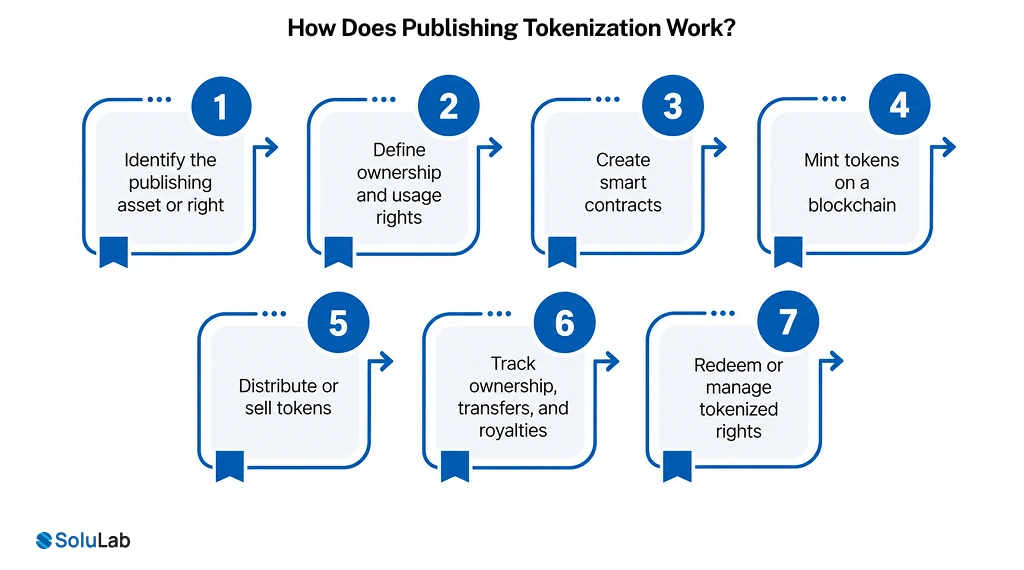
Publishing tokenization works in seven steps: identify the asset, define the rights, encode them in a smart contract, mint the tokens, distribute them, track transfers and royalties on-chain, then redeem or retire the position. Steps one and two are legal work. Everything after that is engineering.
1. Identify the publishing asset or right
Pick the narrowest unit that has a clean title and a measurable income stream. “My backlist” is not tokenizable. “Net receipts from the English-language ebook edition of Title X, ISBN 978-…” is. Ambiguity here becomes a dispute later, and we’ve seen more projects stall on unclear chain of title than on anything technical.
2. Define ownership and usage rights
Write down exactly what a holder gets: what percentage, of which revenue definition (gross, net receipts, or publisher share), from which territories and formats, for how long, with what voting or consent rights, if any. This document is the source of truth. The smart contract is only its executable version.
3. Create smart contracts
The contract layer usually splits into three pieces. A token contract that mints and tracks units. A distribution contract that receives revenue and splits it according to the cap table. A compliance module that restricts who can hold or receive transfers, which matters the moment the token looks like a security.
4. Mint tokens on a blockchain
Minting writes the supply on-chain. Choice of standard follows the use case: ERC-721 for a single unique right, ERC-1155 for limited editions and multi-title catalogues, ERC-20 or ERC-3643 for fungible royalty units with transfer restrictions. Metadata and the file hash get pinned to IPFS or Arweave at this point.
5. Distribute or sell tokens
Distribution can be a private allocation to existing rights holders, a public sale through a marketplace, or a claim flow for readers who bought a physical or digital edition. If the token carries an expectation of profit, this step needs a securities exemption and KYC before a single transfer clears.
6. Track ownership, transfers, and royalties
This is where the value shows up. Sales data from retailers and distributors gets ingested, verified, and pushed on-chain (usually via an oracle such as Chainlink or a permissioned reporting service). The distribution contract splits the payment across every holder in the same transaction. A statement that used to take two quarters becomes a transaction hash anyone in the chain can inspect.
7. Redeem or manage tokenized rights
Rights expire, revert, or get bought back. The contract should support burn, buyback, licence expiry, and reversion from day one. Retrofitting reversion logic into a live contract is expensive and usually means a migration.
Which Publishing Assets Can Be Tokenized?
Six categories cover most of what publishers and authors actually bring to the table.
| Asset type | What the token represents | Common standard | Main constraint |
| Copyright and intellectual property | A contractual interest in a work, referencing an off-chain assignment | ERC-721 / ERC-3643 | Copyright transfer still needs a signed writing |
| Book royalties | A defined share of future income from a title or catalogue | ERC-20 / ERC-3643 | Usually a security; needs an exemption |
| Digital publishing rights | Format, territory, or language licences | ERC-721 / ERC-1155 | Must not conflict with existing contracts |
| Exclusive editions and collectibles | A numbered digital edition, sometimes with perks | ERC-1155 | Consumer protection and refund rules |
| Author memberships and subscriptions | Access rights, not income rights | ERC-1155 / soulbound | Tax and VAT treatment varies by market |
| Licensing agreements | A transferable or sub-licensable right | ERC-721 | Counterparty consent clauses |
Memberships and editions are the easiest place to start because they grant access rather than income, which keeps most of them outside securities regulation. Royalty tokens are the most commercially interesting and the most heavily regulated. That trade-off shapes nearly every roadmap we build.
What Are the Benefits of Tokenization in Publishing?
Here are the main benefits of publishing tokenization:
- New revenue streams. Editions, memberships, and crowdfunded pre-sales monetize audience enthusiasm directly, rather than through a retailer’s cut.
- Royalty transparency. Every holder sees the same ledger. Disputes drop because the arithmetic is public and the inputs are timestamped.
- Fractional ownership where legally appropriate. A £40,000 royalty stream can be held by forty people instead of one. The caveat matters: fractionalizing income almost always triggers securities law, so this only works inside a compliant structure.
- Automated royalty distribution. Payments settle to every holder in one on-chain transaction instead of a semi-annual statement cycle and a batch of bank transfers.
- Simpler rights management. Territory, format, and term live in one queryable record instead of forty PDFs across three systems.
- Provenance and ownership tracking. Every transfer is timestamped. For estates, agents, and backlist acquisitions, that history is the asset.
- Direct author-reader relationships. Token holders are identifiable, reachable, and often willing to fund the next book. That’s a marketing channel most publishers currently rent from a platform.
What Are the Main Publishing Tokenization Use Cases?
Here are the main publishing tokenization use cases:
1. Tokenized book royalties.
A publisher sells 20% of a backlist title’s net receipts to investors, with quarterly on-chain distributions. Compliant structure required.
2. NFT-based limited-edition books.
Numbered digital editions with signed cover art, bonus chapters, or author commentary. Low regulatory friction, strong margin, immediate to launch.
3. Tokenized publishing rights.
Audio, translation, or territory rights held as transferable tokens so a licensee can sub-license without a three-month contract cycle.
4. Author membership tokens.
Holders get early chapters, a Discord tier, and name credits. Access, not income.
5. Crowdfunding and community-backed publishing.
Readers fund a manuscript pre-publication and receive editions or a revenue share depending on the structure chosen.
6. Secondary markets for eligible digital assets.
Editions and collectibles can resell with an enforced creator royalty on each trade, though on-chain royalty enforcement varies by marketplace and chain.
7. Cross-border licensing and royalty management.
One contract, multiple territories, automatic currency-agnostic settlement. This is where large publishers see the clearest operational savings.
How Do You Build a Publishing Tokenization Platform?
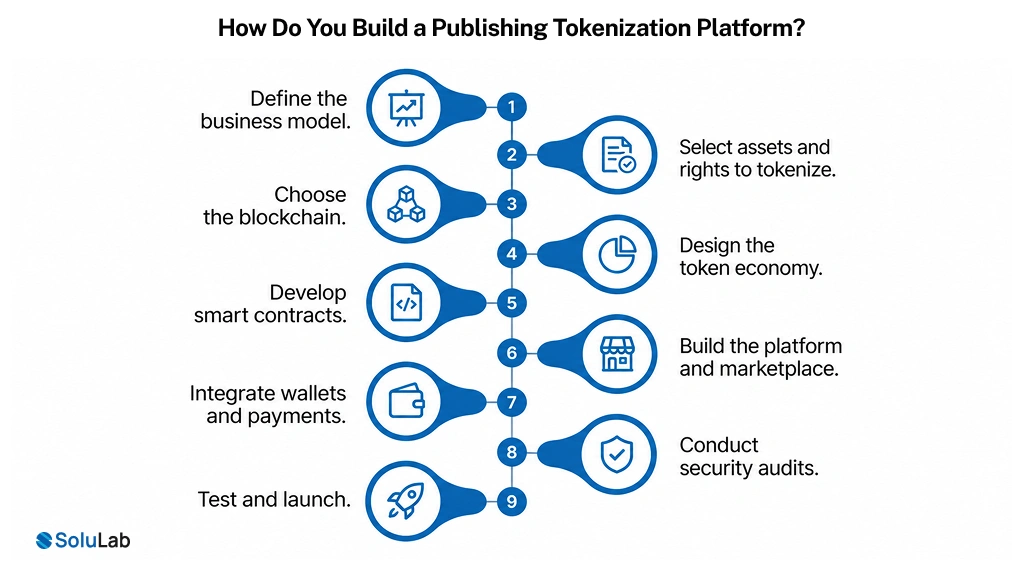
Budget six to nine months for a compliant v1 with a marketplace. Here’s a step by step guide to build a tokenization platform:
1. Define the business model. Decide what you’re selling: editions, memberships, royalty participation, or rights licensing. Each one implies a different regulatory path and a different product.
2. Select assets and rights to tokenize. Audit chain of title first. Confirm no existing contract blocks assignment. This is legal work and it gates everything downstream.
3. Choose the blockchain. Polygon and Base for low-cost consumer editions. Ethereum mainnet where institutional counterparties expect it. Avalanche subnets or a permissioned chain where participant screening is mandatory. Cost per transfer matters enormously when you’re distributing to thousands of small holders.
4. Design the token economy. Supply, denomination, transfer rules, royalty percentage, reversion triggers, and buyback terms. Write the cap table before you write the contract.
5. Develop smart contracts. Token, distribution, and compliance modules, built on audited libraries. Use Foundry for property-based tests on the distribution math. Rounding errors in a splitter across thousands of holders are the most common bug we find in other teams’ code.
6. Build the platform and marketplace. Issuer dashboard, rights holder portal, investor or reader front end, KYC flow, admin and reporting. The off-chain application is roughly 70% of the build. The contracts are the visible 30%.
7. Integrate wallets and payments. Custodial wallets for mainstream readers, self-custody for crypto-native holders, fiat on-ramp via Stripe or a licensed provider, and institutional custody via Fireblocks where the amounts justify it.
8. Conduct security audits. A third-party audit before mainnet, non-negotiable. Independent smart contract audits commonly run $5,000 to $50,000 depending on contract complexity and scope
9. Test and launch. Testnet with real rights holders, then a limited mainnet cohort, then open access. Run a full royalty distribution cycle on testnet with production-shaped data before anyone’s money moves.
Publishing Tokenization vs Traditional Publishing: What Changes?
| Dimension | Traditional publishing | Tokenized publishing |
| Ownership tracking | Contracts held privately by each party | Single shared on-chain record, timestamped |
| Royalty management | Semi-annual statements, manual reconciliation | Automated distribution per settlement cycle |
| Rights licensing | Bilateral contracts, weeks to negotiate and execute | Transferable tokens with encoded terms |
| Reader participation | Purchase only | Ownership, membership, or revenue participation |
| Revenue distribution | Batched, delayed, sequential through intermediaries | Split in a single transaction to all holders |
| Transparency | Each party sees only its own records | All holders see the same ledger |
How SoluLab Can Help With Publishing Tokenization?
SoluLab is an AI and blockchain engineering partner that has delivered tokenization platforms across real estate, commodities, collectibles, fine art, private credit, and creative IP. For publishing clients, the work usually covers:
- Custom tokenization platform development. End-to-end issuance, rights holder portal, marketplace, and admin, designed around your specific rights structure rather than a template.
- Smart contract development and integration. Token, distribution, and compliance contracts in Solidity on audited OpenZeppelin and ERC-3643 foundations, tested with Foundry and prepared for third-party audit.
- Blockchain marketplace development. Primary issuance and compliant secondary trading, with enforced transfer restrictions and creator royalties. Related work: NFT marketplace development.
- Wallet and payment integration. Custodial and self-custody wallets, fiat on-ramps, institutional custody, and multi-currency settlement.
- Rights and royalty management solutions. Sales data ingestion from retailers and distributors, oracle integration, automated splits, and reporting that reconciles against your existing accounting.
If you’d rather not run the infrastructure yourself, tokenization as a service covers the same capability on managed infrastructure. For the broader platform view, see our tokenization platform development work.

Conclusion
Publishing tokenization is worth doing when the record-keeping problem is real and the rights are clean. It gives authors, publishers, agents, and investors one ledger, one payout mechanism, and provenance that holds up years later. It does not fix distribution, it does not create liquidity on its own, and it does not exempt anyone from securities or copyright law.
Start narrow. One title, one clearly defined right, one cohort of holders. Prove the royalty cycle end to end, then widen.
SoluLab, an tokenization development company with deep blockchain engineering experience, can help your business scope, build, and launch a publishing tokenization platform.
FAQs
Neha is a curious content writer with a knack for breaking down complex technologies into meaningful, reader-friendly insights. With experience in blockchain, digital assets, and enterprise tech, she focuses on creating content that informs, connects, and supports strategic decision-making.