Key Highlights
- With Agentic AI for cybersecurity, businesses can reduce alert fatigue and accelerate SOC workflows.
- It helps businesses to detect fraud, phishing attacks and initiate quick responses.
- In 2026, enterprises require governance, identity controls, human approval layers, and secure tool access before deploying agents.
- Solulab can help businesses to build B2B custom platforms that connect SIEM, SOAR, EDR, IAM, cloud, and fraud systems.
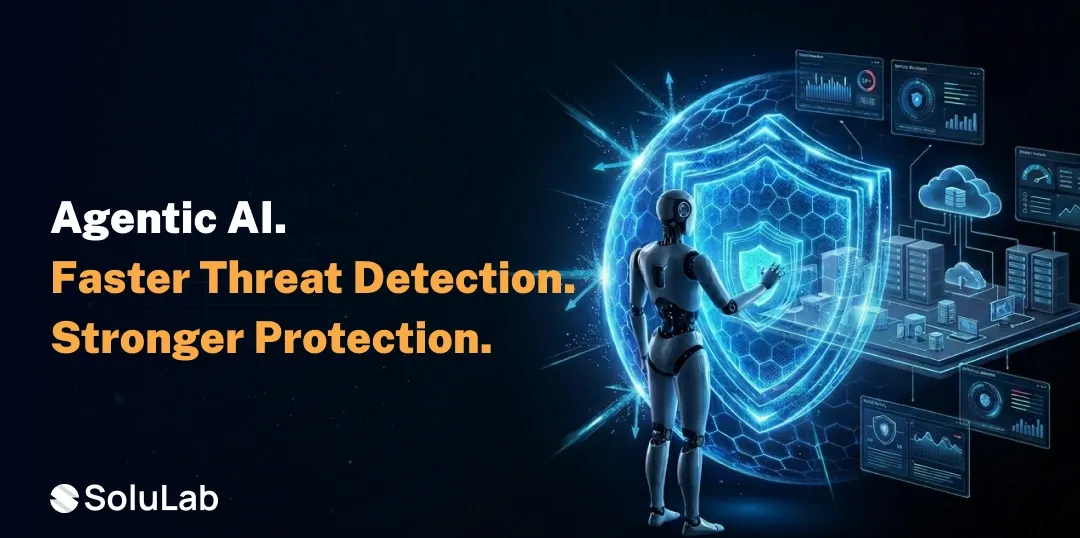
Agentic AI in cybersecurity is changing the face of defence mechanisms in businesses. While Traditional security waits for human intervention to detect errors, Agentic AI systems observe, reason, decide, and act across security workflows with controlled autonomy. Nowadays, attackers are using automation tools, exploiting cloud complexity, and targeting identity systems; therefore, businesses cannot rely upon manual processes. This raises a need for AI development services.
They need AI-powered cyber defense systems for threat investigations, lower response time, and to protect business continuity in real time. Agentic AI is becoming an active defense system in businesses for investigating events, gathering evidence, and intervening quickly. This guide explores how to build autonomous defence systems that stop attacks across operations.
The Role of Agentic AI in Cybersecurity Defense
Agentic AI in cybersecurity is autonomous AI systems that enable businesses to respond to threats in real-time. Unlike traditional AI models which predict performance predictions, agentic systems can execute multiple-step plans to detect, investigate, and respond to security issues.
These systems can reason through a problem, invoke tools, take action, and adapt based on results. It acts like a digital security analyst. It can review suspicious endpoints, create tickets, and escalate high-risk cases.
How Does Agentic AI Work in Cybersecurity?
An AI-driven cybersecurity system usually works through five layers:
1. Perception
The AI agent collects data from SIEM, EDR, XDR, firewalls, IAM, cloud logs, application logs, vulnerability scanners, fraud systems, and threat intelligence feeds.
2. Reasoning
The agent evaluates context. It does not only ask, “Is this alert malicious?” It asks, “What is happening, what could happen next, and what action reduces risk?”
3. Planning
The agent breaks the security task into steps. For example, it may verify user identity, inspect endpoint activity, check geolocation, compare behavior history, and search for lateral movement.
4. Action
The agent performs approved actions. These may include disabling a token, quarantining a device, blocking an IP address, resetting credentials, opening an incident, or notifying the SOC.
5. Learning
The agent improves from analyst feedback, incident outcomes, false positives, and updated threat intelligence.
This architecture reflects the direction described in recent autonomous cyber defense research, where agentic AI combines perception, reasoning, planning, action, and learning for contextual defense.
Why B2B Organizations Need Agentic AI Cybersecurity Solutions?
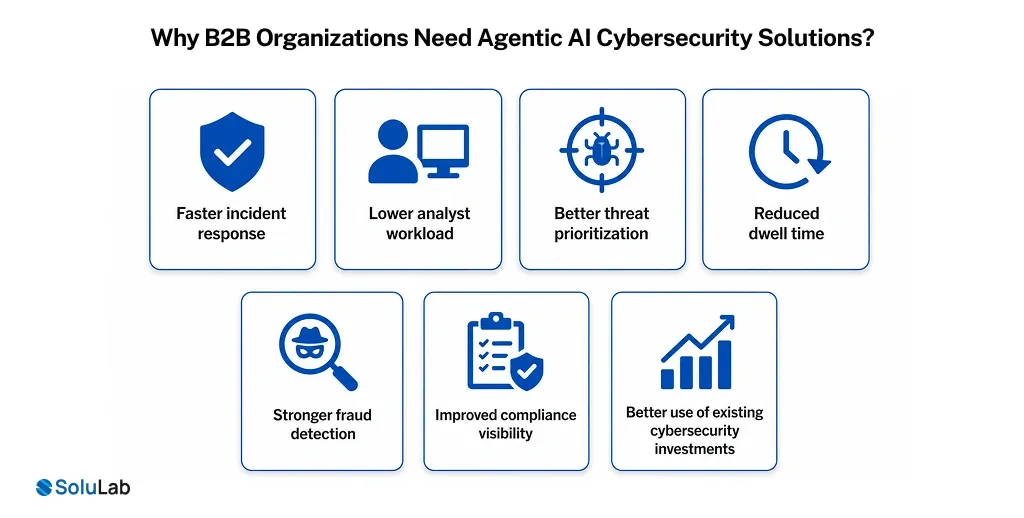
Security teams are now under immense pressure due to increasing cyber threats. However, due to limited skilled analysts, they are unable to deal with the ongoing threats and eventually end up compromising crucial data. Agentic AI cybersecurity solutions help enterprises to fix this issue. With AI automation, businesses remove repetitive tasks, organize the data, and protect it against security threats in real time. This enables businesses to unlock benefits like:
- Faster incident response
- Lower analyst workload
- Better threat prioritization
- Reduced dwell time
- Stronger fraud detection
- Improved compliance visibility
- Better use of existing cybersecurity investments
Read More: Implement Agentic AI in Your Business
Key Aspects of Agentic AI in Cybersecurity
Autonomous Threat Detection
Autonomous AI in cybersecurity continuously monitors endpoints, users, APIs, cloud workloads, and network activity. It detects anomalies that rule-based systems often miss.
Real-Time Incident Response
Agentic systems can act immediately when risk crosses a defined threshold. This is critical for ransomware, account takeover, insider threats, and zero-day exploitation.
Context-Aware Investigation
An agent can connect multiple signals. A suspicious login, unusual data download, privilege escalation, and impossible travel event become one risk narrative.
Human-in-the-Loop Governance
Autonomy does not mean uncontrolled action. Mature AI platforms define approval gates. Low-risk actions can run automatically, while high-impact actions require analyst approval.
Secure Agent Identity
AI agents need identities, permissions, logs, and shutdown controls. Agentic AI risk often comes from what agents do: the APIs they call and the functions they invoke.
Agentic AI Use Cases in Cyber Security
1. AI-Powered Threat Hunting
AI agents in cybersecurity review all the records to figure out attacker activity that might have been hidden previously. It enables security teams to figure out the warning signs earlier and avoid issues.
2. Phishing Detection and Response
With AI agent development, businesses can figure out phishing emails and remove them from inboxes before more employees interact with them.
3. Cloud Misconfiguration Remediation
Agentic AI can detect all kinds of misconfigurations in cloud platforms, and once approved, it begins the remediation workflows to fix the security gaps.
4. Identity Threat Detection
With AI agents for cybersecurity, enterprises can monitor privileged access. This allows the businesses to figure out the identity-based attacks and block attackers from getting the inside details.
5. AI for Fraud Detection in Cybersecurity
AI for fraud detection in cybersecurity helps identify fraud, but Agentic AI prevents it by adding extra authentication methods to flag risky accounts, block suspicious activities, and transfer fraud cases to official teams.
6. Vulnerability Prioritization
Instead of ranking vulnerabilities, Agentic AI allows the business team to fix the risks that matter most first.
7. SOC Triage Automation
Agents can enrich alerts, summarize evidence, assign severity, suggest the next step, and reduce repetitive analyst work. This gives SOC teams more time to focus on real threats instead of sorting through noise.
Agentic AI in Cybersecurity Examples
- A financial services company can use agentic AI for cybersecurity for fraud detection.
- A healthcare enterprise can deploy an agent to monitor medical device networks and block unwanted access.
- A SaaS company can use AI-powered cyber defense systems to detect API abuse.
- A manufacturing firm can apply agentic AI frameworks for detecting lateral movement and preventing production downtime.
Benefits of Integrating Agentic AI and Cybersecurity
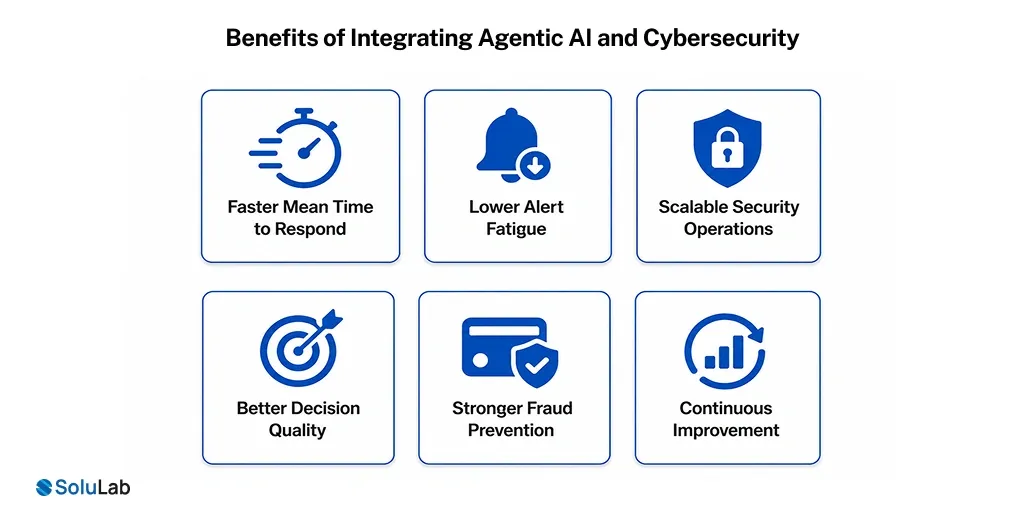
Faster Mean Time to Respond
Agentic AI shortens the gap between detection and action. That helps reduce breach impact.
Lower Alert Fatigue
Agents filter noise, group related alerts, and present clear incident narratives.
Scalable Security Operations
Enterprises can scale defense without scaling headcount at the same rate.
Better Decision Quality
Agents combine real-time telemetry, threat intelligence, and historical behavior.
Stronger Fraud Prevention
Agentic AI connects cybersecurity and fraud signals. This helps organizations detect suspicious behavior before financial loss occurs.
Continuous Improvement
Agentic development systems learn from outcomes, analyst feedback, and new attack patterns.
How to Build AI Agents for Cybersecurity?
To build AI agents in cybersecurity, enterprises need both AI engineering and security architecture.
A strong agent includes:
- A task-specific objective
- Secure access to tools
- Memory with strict controls
- Reasoning and planning logic
- Security policy constraints
- Audit trails
- Human approval layers
- Feedback loops
- Integration with enterprise systems
For example, a phishing response agent may connect to email security, threat intelligence, sandboxing, IAM, SIEM, and ticketing platforms. It reviews suspicious messages, validates risk, removes malicious emails, and writes a case summary.
A fraud detection agent may connect to transaction systems, device intelligence, identity platforms, risk engines, and customer support tools. It can detect suspicious patterns and recommend action.
How to Implement Agentic AI in Cybersecurity Systems?
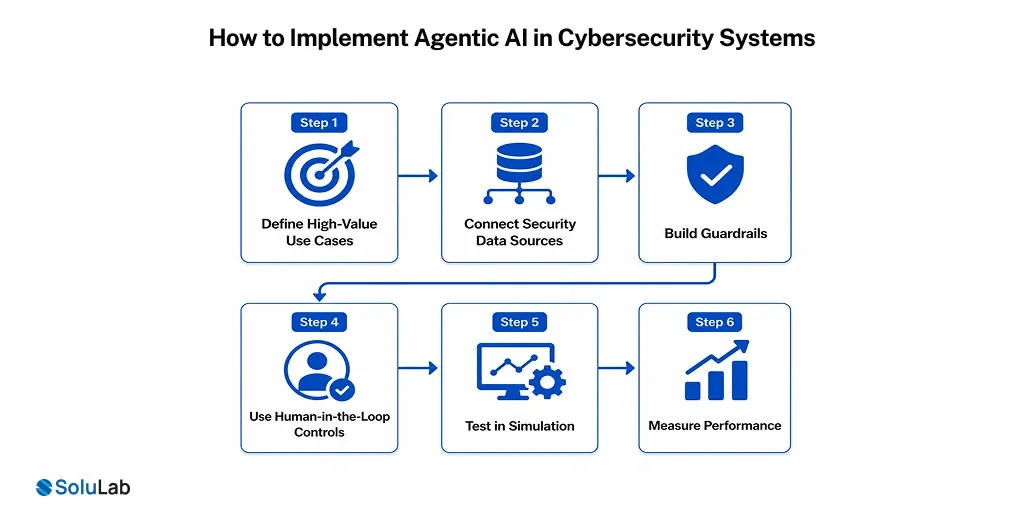
B2B organizations should not deploy agents randomly. They need a phased strategy.
Step 1: Define High-Value Use Cases
Begin with the repetitive workflow. Prioritize response, vulnerability, and fraud for detection.
Step 2: Connect Security Data Sources
Now, integrate all the security data sources, including cloud platforms, asset details, ticketing systems, etc., for Agentic AI to work.
Step 3: Build Guardrails
Decide limitations for Agentic AI to define what requires approval and what they can do. Add rate limits, access controls, audit logs, and rollback workflows.
Step 4: Use Human-in-the-Loop Controls
Add humans in the loop to execute the sensitive actions. Human approval for process execution must be treated as prior.
Step 5: Test in Simulation
Before moving forward with the production process, test AI agents to make sure that they work well in real-time situations.
Step 6: Measure Performance
Track detection accuracy, response time, false positives, analyst hours saved, incidents contained, and business risk reduced.
Risks and Governance Challenges
Agentic AI creates new risks because agents act. They can call APIs, access sensitive systems, and execute workflows. Palo Alto Networks explains that agentic AI security must protect reasoning, memory, tools, actions, and interactions.
Key risks include:
- Excessive permissions
- Prompt injection
- Data leakage
- Tool misuse
- False-positive disruption
- Shadow AI agents
- Poor auditability
- Model drift
- Over-automation
Organizations must treat agents like privileged digital identities. They need least-privilege access, monitoring, kill switches, approval workflows, and continuous validation.
How AI Reduces Cybersecurity Risks?
AI-powered solutions improve speed, context, and consistency. By analyzing big data, they prioritize threats and automate responses. This involves:
- Detecting threats earlier
- Reducing manual errors
- Identifying suspicious behavior patterns
- Accelerating investigation
- Automating containment
- Improving fraud detection
- Supporting compliance reporting
- Enhancing threat intelligence usage
However, AI integration does not replace security teams. It strengthens them. The best model combines autonomous execution with expert human judgment.

Conclusion
Agentic AI in cybersecurity represents the next evolution of enterprise defense. It moves organizations from reactive monitoring to autonomous, real-time protection. For B2B companies, this is not only a technology upgrade. It is a strategic shift toward faster response, stronger fraud prevention, better SOC efficiency, and lower cyber risk. Companies that build governed, integrated, and secure AI agents for cybersecurity will provide the most reliable services in the market.
Why SoluLab for Custom AI Cybersecurity Platform Development?
SoluLab is a leading Agentic AI development company that enables businesses to build custom AI cybersecurity platforms for security automation, fraud detection, and smart governance. Our experts build custom Agentic AI cybersecurity solutions and scalable platforms that integrate with existing SIEM, SOAR, IAM, EDR, cloud, and compliance systems.
Partner with our experts to build an agentic AI strategy into production-ready cybersecurity infrastructure.
FAQs
Agentic AI in cybersecurity provides businesses with protection against security threats by implementing autonomous AI agents that can detect real-time threats and respond.
Agentic AI gathers security data and executes approved workflows. They learn from outcomes and continue improving.
Top use cases include threat hunting, SOC triage, phishing response, fraud detection, cloud remediation, vulnerability prioritization, and ransomware containment.
Yes, Agentic AI is safe for cybersecurity operations with governance, audit logs, human approval, testing, and secure agent identity controls.
Businesses can begin with the high-value use cases, connect security tools, define guardrails, test agents in simulation, and scale gradually.
AI for fraud detection in cybersecurity analyzes user behavior, transaction activity, device signals, and identity patterns to detect suspicious activity and trigger preventive action.
Shipra Garg is a tech-focused content strategist and copywriter specializing in Web3, blockchain, and artificial intelligence. She has worked with startups and enterprise teams to craft high-conversion content that bridges deep tech with business impact. Her work translates complex innovations into clear, credible, and engaging narratives that drive growth and build trust in emerging tech markets.