Key Takeaways
- The Problem: Traditional crypto wallets require human approval, seed phrases, and manual key management. An AI agent can’t enter a password. It can’t confirm a transaction on a phone screen. Yet most teams are still forcing autonomous agents into human-designed wallet infrastructure, and it’s creating security holes, operational bottlenecks, and compliance nightmares.
- The Solution: Agentic wallets built with account abstraction, MPC key management, and programmable spending logic let AI agents transact independently, within defined rules, with full on-chain auditability.
- How SoluLab Can Help: As a leading AI-powered crypto wallet development company and AI agent development company, SoluLab designs and ships agent-native wallet development services for enterprises and startups, from architecture to deployment, compliance-ready and production-grade.
Pause for a second. This changes how money moves.
Changpeng Zhao recently said AI agents will make 1,000,000 times as many payments as humans and will do so using crypto. Not five years from now. Already happening in 2026. Autonomous AI agents are booking services, settling invoices, and negotiating API access without a human approving a single transaction.
Meanwhile, McKinsey & Company estimates agent-mediated commerce could reach $3–5 trillion by 2030, larger than today’s entire crypto market. So here’s the uncomfortable question every founder, CXO, and product leader must answer: If software agents are about to control real capital, execute real transactions, and carry real risk, why are most teams still handing them wallets designed for humans?
That mismatch is precisely what agent-native crypto wallets fix. And in this article, we break down why this shift is inevitable, how the architecture actually works, and what serious teams are building next.
Why Agent-Native Crypto Wallets Are the Future for Autonomous AI Agents?
Think about what a standard crypto wallet actually requires.
- A private key.
- A seed phrase.
- A human can physically confirm a transaction.
- Maybe a hardware device.
That whole setup was designed for you, not for software.
When an AI agent needs to pay an API, settle a trade, or split a payment across multiple chains, it can’t pull out a Ledger and press a button. It needs programmatic signing authority, something a traditional EOA (Externally Owned Account) wallet simply doesn’t offer.
The difference between traditional and agent-native wallets comes down to three things:
- Who can authorize a transaction
- How automation is handled
- What happens when something goes wrong?
Traditional crypto wallets have one answer for all three: a human. Agent-native crypto wallets replace that single point of human dependency with programmable rules like spending limits, session keys, multi-sig thresholds, and gas sponsorship, all encoded directly into the wallet contract.
There’s also the operational cost angle. Processing a single invoice manually runs about $13 on average. Multiply that across thousands of daily micro-transactions an agent executes, and you start to see why manually supervised wallets don’t scale.

What Is an Agent-Native Crypto Wallet?

An agent-native crypto wallet is a programmable, non-custodial wallet designed specifically so software agents, not humans, can control and execute transactions within a defined permission framework.
Unlike a normal wallet tied to a private key a person holds, these wallets are governed by smart contract logic. They can enforce rules like only spending up to 500 USDC per hour, requiring multi-sig above $10,000, or only interacting with whitelisted DeFi protocols. The agent operates within those rules automatically, without needing human sign-off on every single move.
Coinbase’s Agentic Wallets, launched in early 2026 are one of the first production-grade examples, and they’ve already seen the x402 protocol process 107 million transactions since May 2025. That’s infrastructure.
The benefits of agent-native wallets are direct: programmable autonomy, on-chain auditability, gas abstraction, cross-protocol composability, and the ability to build autonomous agent wallets that operate 24/7 without human supervision.
How Agent-Native Wallets Work for Autonomous AI Agents?
Understanding how agent-native wallets work starts with the architecture. These systems combine three layers:
Layer 1 – Identity.
The agent gets a verifiable on-chain identity (think BNB Chain’s ERC-8004 standard), which lets protocols, other agents, and compliance systems know who or what is transacting.
Layer 2 – Programmable Signing.
Instead of a human-held private key, signing authority is managed via MPC (Multi-Party Computation) wallets or embedded in smart contract validation logic. The agent can sign transactions autonomously, but only within the bounds set by the wallet’s rule engine.
Layer 3 – Execution Logic.
Using account abstraction (ERC-4337), the wallet can batch multiple operations, sponsor gas fees in stablecoins, and trigger automated workflows, all in a single on-chain action.
How autonomous agents use crypto wallets in practice looks like this: an AI agent receives a task, evaluates the required on-chain actions, generates a UserOperation, passes it through a Bundler to the EntryPoint contract, and executes it, all within milliseconds and programmed guardrails
The Core Technologies Shaping the Future of Agent-Native Crypto Wallets
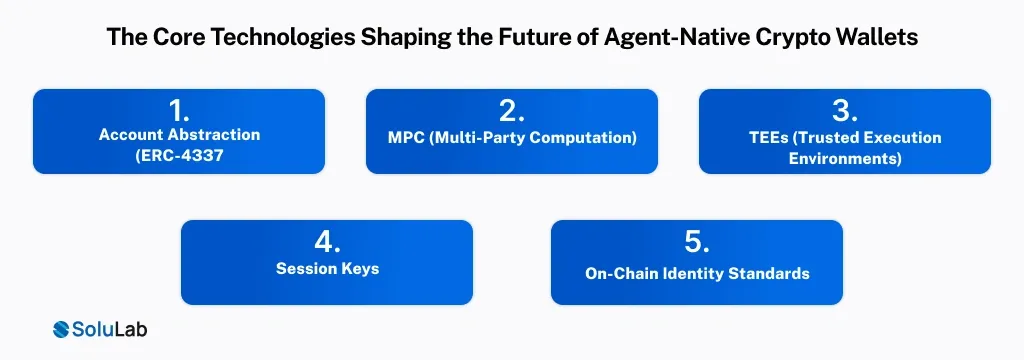
These aren’t buzzwords. These are the actual primitives making AI agent crypto wallet solutions real in 2026:
- Account Abstraction (ERC-4337) – Turns a wallet from a static key into a programmable smart contract, enabling session keys, batch transactions, and custom authorization logic
- MPC (Multi-Party Computation) – Splits private key control across multiple parties or threshold signers, so no single point of failure can drain the wallet
- TEEs (Trusted Execution Environments) – Runs agent logic in isolated, tamper-resistant hardware, protecting signing operations even from the host system
- Session Keys – Time-bound or action-bound signing permissions that let an agent operate autonomously for a defined window, then expire automatically
- On-Chain Identity Standards – Protocols like ERC-8004 give agents verifiable identities, enabling compliance traceability and agent-to-agent authentication
The best AI agent wallet platform providers combine all five layers, not just one or two, which is why enterprise-grade architecture requires experienced hands from an AI development services partner who understands both the blockchain and AI stacks simultaneously.

Real-World Use Cases Already Live Today
This isn’t theoretical. The use cases of agent-native wallets are already running in production across industries.
As a team that builds these systems, here’s what we’re seeing:
1. DeFi Portfolio Management
Autonomous trading agents managing billions in DeFi capital, executing thousands of trades per day without human sign-off. One standout agent, Ethy AI, has processed over 2 million transactions already.
2. B2B Invoice Settlements
AI agents auto-approve invoices, trigger payments on delivery confirmation, and reconcile ledgers across systems by cutting manual finance workload dramatically. Agent-to-agent invoice negotiation is live on several enterprise pilots.
3. API Commerce & Micro-Payments
Agents autonomously paying for API access, data subscriptions, or compute resources metered in real time are settled in stablecoins. Stablecoin volumes hit $46 trillion annually in 2026, and agent-driven transactions are a growing share of that.
4. Cross-Border Supply Chain
A buyer’s procurement agent negotiating directly with a supplier’s invoicing agent, arranging working capital financing mid-conversation.
5. DAO Governance Execution
Agents voting on proposals, executing treasury distributions, and managing governance workflows on behalf of token holders within defined mandates.
These are the benefits of agent-native wallets in practice, not just speed and automation, but entirely new business models that weren’t operationally possible before.
Security, Risk & Compliance Considerations Enterprises Ignore
Let’s be direct about this because most vendor content glosses over it. A secure wallet for autonomous AI agents isn’t just a product feature; it’s the reason most enterprise deployments stall or fail.
1. The risks are real.
A compromised agent can execute mass transactions before detection. Prompt injection attacks can manipulate an agent’s transaction logic. Poorly bound autonomy can route funds through non-compliant protocols – not out of malice, but because the agent was optimizing for yield.
2. KYC and AML compliance gets complicated fast.
A single agent wallet might be funded by one entity, activated by another, and interacting with twenty different protocols simultaneously. Regulators need traceability. Courts need a principal. Your compliance team needs both.
The right architecture addresses this with: real-time transaction monitoring, hard-coded spending limits, multi-sig for large transactions, on-chain identity attached to every agent action, and audit logs that map every on-chain event back to a business decision.
Our blockchain consulting services stack includes all of this as a baseline, not an add-on, and these controls aren’t optional, they’re the difference between a PoC that impresses the board and a production system that passes legal review.
How Companies Should Approach Agent Wallets?
Most companies get this backwards. They start with the AI agent, get it working in a sandbox, and then ask – what wallet do we use?
That sequence creates problems you’ll spend months undoing. The right approach starts with governance design.
Before a single line of wallet code is written, you need to answer:
- What is the agent allowed to do?
- What are the hard limits?
- Who is accountable when something goes wrong?
These answers define your wallet architecture, not the other way around.
From there, blockchain development services and agent infrastructure need to be codesigned. Your AI agent crypto wallet solution needs to integrate with your existing treasury systems, your compliance stack, and your monitoring infrastructure. It also needs to be auditable, as every agent action should trace back to a business rule, not a black box.
This is where working with experienced blockchain solution providers in USA makes a real difference. The teams that have shipped blockchain development use cases across DeFi, supply chain, and enterprise finance bring pattern recognition that in-house teams building for the first time simply don’t have yet.
How SoluLab Designs Agent-Native Wallets for Production Use?
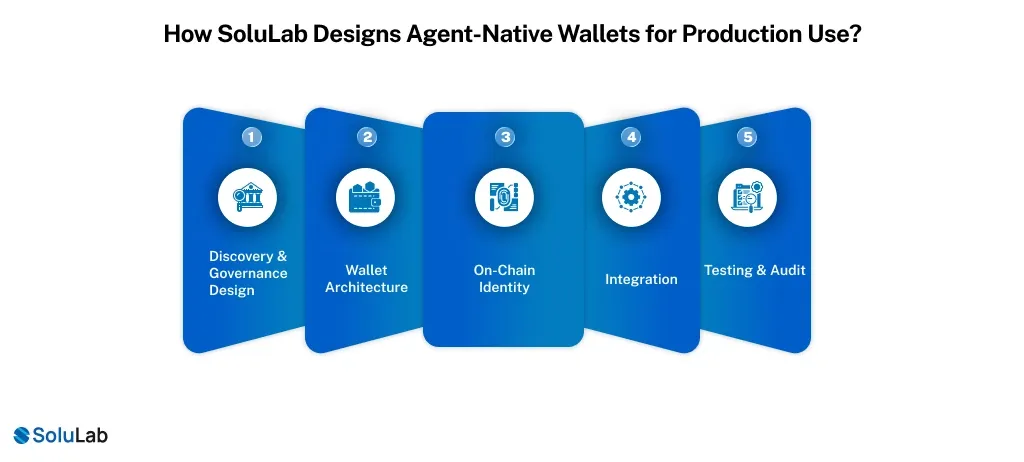
At SoluLab, our crypto wallet development services follow an AI agent-driven framework we’ve refined across multiple enterprise deployments.
Here’s how we approach it:
1. Discovery & Governance Design
We map the agent’s task scope, permission model, and accountability chain before touching any code. This shapes every architectural decision downstream.
2. Wallet Architecture
We design around MPC with account abstraction as the default stack, with TEE integration for high-value or regulated use cases. Session keys define what the agent can do autonomously, and multi-sig thresholds define where human oversight kicks back in.
3. On-Chain Identity
Every agent we deploy gets a verifiable on-chain identity, tied to the operating entity. This is how you pass a compliance review in 2026.
4. Integration
We connect the wallet layer to your existing systems: ERP, treasury management, monitoring dashboards, and audit infrastructure. The agent wallet doesn’t exist in isolation, it’s infrastructure.
5. Testing & Audit
Smart contract audits, adversarial agent testing (including prompt injection scenarios), and compliance review before any production deployment.
We’re an AI agent development company that understands both the AI layer and the blockchain layer, which most dev shops can only claim on one side. Our AI development services extend across the full agentic stack, from agent design and model selection to on-chain execution infrastructure and post-deployment monitoring.
What to Build Next If You’re Serious About AI Agents?
If you’ve read this far, you’re probably already running AI agents in some form or you’re close to it.
Here’s the honest roadmap for what comes next:
1. Start with a single, bounded use case.
Invoice settlement or API micro-payments are ideal first deployments, like high transaction frequency, low individual transaction value, and a clear audit trail. Use these deployments to validate your wallet architecture and governance model before scaling.
2. Don’t build the wallet yourself if you’re not a wallet team.
The blockchain development cost of getting wallet security wrong is orders of magnitude higher than the cost of working with specialists. MPC implementations done incorrectly have drained millions from production systems.
3. Design for compliance from day one.
The application of blockchain technology at enterprise scale always runs into regulatory scrutiny. Build your on-chain identity, audit logs, and accountability mapping before your legal team asks for them.
4. Think multi-agent.
The top blockchain trends for 2026 and beyond aren’t about single-agent systems, they’re about agent networks coordinating with each other, splitting tasks, and sharing resources. Your wallet architecture needs to support agent-to-agent interactions, not just agent-to-protocol.
5. Pick the right partner.
Look for blockchain companies that have shipped both AI infrastructure and blockchain infrastructure, not just one or the other. The intersection is where the hard problems live.
The future of wallets for autonomous agents isn’t a single wallet product, it’s a programmable identity and financial layer that makes agents first-class economic actors. That future is being built right now.
The question is whether your organization is building it with intention or scrambling to catch up later.

Conclusion
The shift is already underway. AI agents are transacting, negotiating, and managing capital, and the infrastructure underneath them will determine who wins and who gets left holding the compliance liability. Agentic wallets aren’t a nice-to-have feature on an AI roadmap, they’re the foundation.
SoluLab has built across the full stack, like enterprise blockchain solutions, agent architecture, smart contract security, and AI development, and we bring that cross-disciplinary depth to every engagement. If you’re building for autonomous agents, the most important decision you’ll make is who designs the wallet layer.
FAQs
With over 3 years of experience, I specialize in breaking down complex Web3 and crypto concepts into clear, actionable content. From deep-dive technical explainers to project documentation, I help brands educate and engage their audience through well-researched, developer-friendly writing.