Banks, fintech companies, payment platforms, and institutional trading desks now operate across crypto spot markets, tokenized assets, and stablecoin liquidity networks. However, one operational issue continues to affect enterprise trading performance: slippage.
- Slippage refers to the difference between the expected trade price and the actual execution price.
- This usually occurs when market prices move rapidly or when liquidity is insufficient to fill large orders immediately.
- For enterprises executing high-value transactions, even small price differences can result in meaningful cost leakage over time.
Therefore, enterprises are increasingly evaluating Crypto Exchange Development as part of their digital asset infrastructure strategy.
Additionally, in August 2025, OSL Group launched a global exchange platform that introduced instant USD–USDC conversion with 1:1 pricing and zero slippage. This addressed major enterprise concerns such as settlement delays, liquidity fragmentation, and price inconsistency.
Key Takeaways
- Slippage in large crypto transactions can gradually increase enterprise trading expenses, making precise execution infrastructure essential for institutional platforms.
- High-liquidity networks and advanced order matching engines enable enterprises to process large trades efficiently while maintaining stable pricing.
- Growing adoption of tokenized assets and institutional digital finance is increasing demand for trading platforms designed to minimize price deviation.
Why Are Enterprises Prioritizing Zero Slippage Infrastructure in 2026?
Enterprises are now integrating digital assets into payment rails, tokenized finance platforms, and cross-border settlement networks.
However, enterprises operate with stricter financial controls compared to retail traders. Price inconsistency during order execution can impact accounting accuracy, risk exposure, and liquidity management.
1. Is Slippage Becoming a Hidden Enterprise Trading Cost?
Technically speaking, slippage happens mainly due to two factors:
- Market volatility
- Low liquidity
When large orders are placed on a platform with limited liquidity, the order book cannot fill the transaction at a single price. The order, therefore, gets executed across multiple price levels, increasing trading costs.
For institutional traders, this becomes a recurring expense.
A slippage-free crypto trading platform helps mitigate this by maintaining deeper liquidity pools and advanced order routing systems.
2. Enterprise Interest in Deterministic Execution
Enterprises prefer top crypto exchange platforms because they offer:
- Predictable trade settlement prices
- Reduced operational trading losses
- Accurate treasury reporting
- Improved institutional liquidity participation
For example, platforms like OSL’s global exchange highlight how compliant trading infrastructure with direct banking rails and liquidity partners can reduce slippage while maintaining transparent pricing.
3. Infrastructure Expectations from Enterprises
When evaluating a high-liquidity crypto exchange platform, enterprises typically require:
- Institutional-grade zero slippage order matching engines
- Multi-provider liquidity aggregation
- Stablecoin settlement rails
- Regulatory compliance layers
Therefore, many financial organizations collaborate with a blockchain development company that can deliver enterprise-grade infrastructure rather than retail-focused trading platforms.
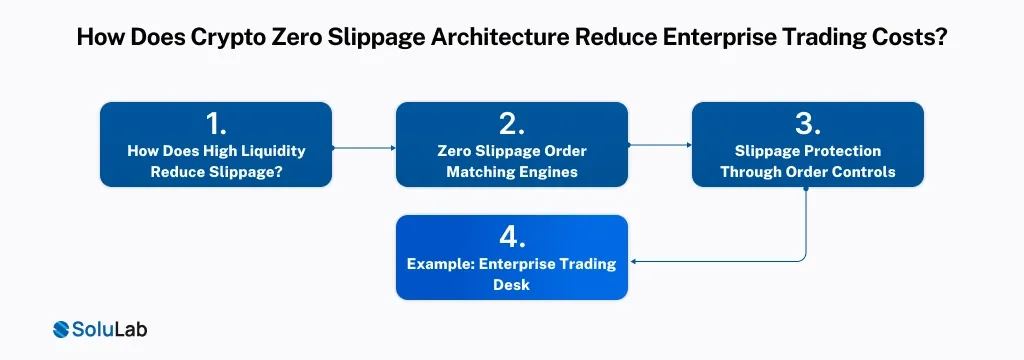
How Does Crypto Zero Slippage Architecture Reduce Enterprise Trading Costs?
Slippage is often underestimated in enterprise trading operations. However, large-volume trading desks execute thousands of orders daily, meaning minor price differences accumulate quickly.
A crypto exchange development with zero slippage addresses this through optimized system architecture, which we see in the following sections.
1. How Does High Liquidity Reduce Slippage?
The first requirement of high liquidity decentralized crypto exchange development is access to multiple liquidity sources.
These may include:
- Market makers
- Institutional liquidity providers
- Aggregated exchange order books
- Stablecoin liquidity pools
When these liquidity channels are combined, large orders can be executed at a consistent price.
2. Zero Slippage Order Matching Engines
Another key component is the zero slippage order matching engine.
This system ensures that:
- Orders are matched instantly
- Price movement during execution is minimized
- Large orders are intelligently distributed across liquidity sources
Technically speaking, this improves execution efficiency and reduces the likelihood of negative slippage.
3. Slippage Protection Through Order Controls
A slippage protection crypto exchange also offers order management features such as:
- Limit orders with defined price boundaries
- Slippage tolerance controls
- Liquidity-aware execution algorithms
These mechanisms help enterprises maintain tighter control over trading costs.
4. Example: Enterprise Trading Desk
Let’s consider a crypto treasury desk executing large BTC–USDT transactions.
If the platform lacks sufficient liquidity, the order may be filled across multiple price levels, increasing the average purchase price.
However, on a zero slippage trading platform, aggregated liquidity ensures the order executes at a stable price point, improving cost efficiency.
What Role Does Tokenization and RWA Growth Play in Zero Slippage Exchange Demand?
Another reason enterprises prioritize zero slippage exchange development is the rapid growth of real-world asset (RWA) tokenization.
Financial institutions are increasingly issuing tokenized assets such as:
- Real estate tokens
- Tokenized bonds
- Digital funds
- Commodity-backed tokens
But this raises an important question- Why is slippage control important for tokenized markets?
1. Institutional Trading Expectations
Unlike speculative crypto assets, tokenized securities operate closer to traditional financial markets.
Therefore, enterprises require:
- Predictable settlement
- Stable pricing
- High liquidity markets
A zero slippage crypto trading platform supports these needs by ensuring price integrity during asset trading.
2. Impact on Enterprise Liquidity Infrastructure
As tokenized markets expand, enterprises must operate exchanges capable of handling multiple asset classes.
This includes:
- Crypto tokens
- Stablecoins
- Tokenized securities
- DeFi liquidity instruments
A zero slippage DeFi exchanges enable these markets to function efficiently by maintaining consistent execution prices.
Example: Tokenized Asset Marketplace
Imagine an enterprise tokenization platform offering tokenized real estate shares.
If liquidity fluctuates during trading, investors may experience price discrepancies, reducing trust in the platform.
However, a slippage-free crypto exchange ensures price stability, improving investor confidence and platform reliability.
Therefore, enterprises developing tokenization infrastructure often integrate zero slippage DEX development models alongside centralized trading engines.
How Are AI and Advanced Infrastructure Enhancing Zero Slippage Capabilities?
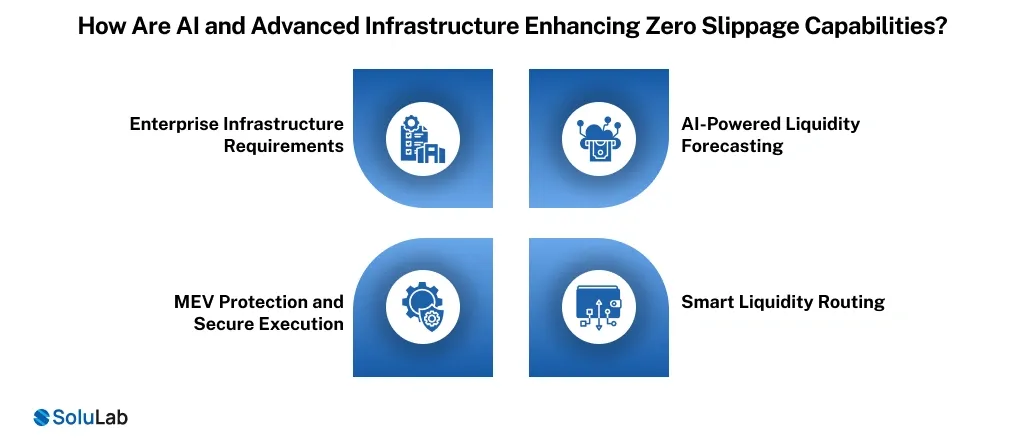
Enterprise exchanges today rely on advanced technology stacks to maintain consistent performance.
Artificial intelligence, predictive analytics, and distributed infrastructure are playing a vital role in improving liquidity efficiency.
1. AI-Powered Liquidity Forecasting
AI systems analyze trading activity patterns to predict future liquidity requirements.
This allows AI powered crypto exchange to:
- Adjust liquidity pools dynamically
- Reduce order book gaps
- Improve execution timing
2. Smart Liquidity Routing
AI-powered routing algorithms identify the best liquidity source for each trade.
This helps:
- Maintain price consistency
- Reduce order execution delays
- Prevent price slippage
3. MEV Protection and Secure Execution
In decentralized markets, MEV (Maximal Extractable Value) attacks can increase slippage.
Some zero slippage DeFi exchange platforms introduce protection mechanisms that secure transaction ordering.
For example, RFQ-based trading models allow traders to receive fixed quotes before execution, enabling zero-slippage trades.
Platforms like Hashflow have demonstrated how RFQ models combined with MEV protection can deliver deterministic trading outcomes.
4. Enterprise Infrastructure Requirements
To support this ecosystem, enterprises often deploy:
- Multi-region cloud infrastructure
- Advanced security frameworks
- Institutional-grade trading APIs
- Cross-chain settlement layers
Therefore, professional DeFi exchange development services increasingly focus on liquidity optimization and AI integration.
What Should Enterprises Consider When Building a Zero Slippage Crypto Exchange?
Before investing in centralized crypto exchange development solutions, enterprises must evaluate several technical and operational factors.
1. Liquidity Strategy
A crypto exchange liquidity solution must ensure deep and consistent liquidity.
This usually involves:
- Market maker partnerships
- Aggregated liquidity pools
- Stablecoin liquidity integration
Without liquidity depth, slippage cannot be effectively controlled.
2. Order Matching Efficiency
The zero slippage order matching engine must process trades with minimal latency.
Key requirements include:
- High transaction throughput
- Real-time order book updates
- Intelligent execution algorithms
3. Regulatory Compliance
Enterprise exchanges must also meet compliance standards.
These include:
- KYC and AML verification
- transaction monitoring
- secure custody frameworks
Therefore, enterprises usually collaborate with an experienced blockchain app development company that understands regulatory expectations.
4. Hybrid Exchange Models
Many enterprises deploy hybrid infrastructure combining:
- centralized crypto exchange development
- zero slippage DEX development
This approach provides the liquidity advantages of centralized platforms while maintaining the transparency of decentralized trading.
5. Scalability for Institutional Volume
A zero slippage trading platform must support enterprise-level activity.
Important considerations include:
- high trading throughput
- cross-chain compatibility
- stablecoin settlement integration
Hence, enterprises investing in digital asset infrastructure increasingly view zero slippage crypto exchange development as a long-term operational investment.

Conclusion
If you are evaluating Zero Slippage Crypto Exchange Development, your checklist must include:
- MEV Protection: Ensure your DEX or Hybrid engine has guardrails against “sandwich attacks” that artificially inflate slippage.
- RWA Compatibility: The engine must handle not just crypto, but tokenized bonds, real estate, and digital securities with high price integrity.
- Deterministic Clearing: Instant settlement layers (like USDC-to-USD 1:1 rails) to ensure that “time-to-settle” doesn’t become “time-to-slip.
To ensure you have all these features in your white label crypto exchange platform, you need an expert partnership. Contact SoluLab today to bring your exchange platform live.
FAQs
Deepika is a content writer who blends storytelling with strategic thinking. She explores topics across digital innovation, emerging tech, and the evolving blockchain industry. She enjoys breaking down complex ideas into simple, engaging narratives in the growing global markets.