South Korea has transitioned from a crypto hotspot to the global blueprint for regulated Security Token Offerings (STOs). With the 2026 legislative amendments now in full effect, the region offers something global enterprises crave: regulatory certainty.
While other markets struggle with legal ambiguity, South Korean Chaebols and Tier-1 banks are already deploying institutional-grade infrastructure to tokenize everything from real estate to intellectual property. For global firms,
South Korea isn’t just a pilot market; it’s the primary destination for Enterprise Tokenization Platform Development. It targets “Regulatory Interoperability” and “Asia Liquidity Gateway.”
Key Takeaways
- For years, global firms faced “legal paralysis” regarding digital assets. Traditional asset markets were too slow for 2026 demands.
- As value moved on-chain, legacy wallets became targets. The 2026 solution is the mandatory adoption of MPC (Multi-Party Computation).
- To survive, enterprises have shifted from experimental pilots to SoluLab-grade platforms that can handle the scale of national supply chains.
Why Is South Korea Emerging as a Regulated Security Token (STO) Market Leader?
South Korea’s tokenization ecosystem accelerated significantly after a major regulatory shift in January 2026.
When the National Assembly approved amendments to the Electronic Securities Act.
This update provided a clear legal structure for security token offerings (STOs) and formally recognized blockchain-based digital securities.
1. Regulatory Momentum Driving the South Korean Market
The revised regulatory framework allows financial institutions and licensed platforms to issue digital assets through asset tokenization.
- Real estate shares
- Infrastructure assets
- Corporate bonds
- Intellectual property rights
Industry analysts estimate that South Korea’s STO market could reach 367 trillion KRW (~$250 billion) by 2030, according to projections from BCG and the Korea Economic Daily.
This projected scale is attracting global enterprises investing in tokenization, especially those looking for regulated environments to launch digital assets.
2. Why Enterprises Need Regulatory Navigation Support
While the regulatory framework is now clearer, the licensing process remains complex. Enterprises must navigate multiple requirements managed by the Financial Services Commission (FSC), including:
- Security token classification rules
- Custody licensing requirements
- Investor protection mechanisms
- Compliance reporting frameworks
Many companies entering the market rely on enterprise tokenization solutions providers to help them:
- Design compliant RWA tokenization platforms
- Integrate regulatory modules
- Operate within South Korea’s regulatory sandbox environments
This combination of regulation and enterprise-ready infrastructure is one of the main reasons why tokenization development in South Korea is accelerating.
How Does South Korea’s Digital Infrastructure Support Enterprise-Scale Tokenization Platform Development?
South Korea already ranks #1 in OECD for adoption of AI among the world’s most digitally advanced economies.
With 95% 5G coverage and strong fintech adoption, the country provides the ideal foundation for enterprise digital assets tokenization platforms.
The key driver pushing this forward is the Bank of Korea’s Central Bank Digital Currency (CBDC) pilot program.
1. Integration Between CBDC and Tokenized Assets
The Central Bank Digital Currency (CBDC) pilot aims to enable atomic settlement, where the transfer of digital securities and payment occurs simultaneously on-chain.
This eliminates settlement delays that traditionally occur in financial markets.
For enterprises building asset tokenization platforms, this means:
- 80% Faster transactions
- Cut 60% settlement risks
- Real-time asset transfers
The integration between CBDC systems and private STO platforms is expected to become a core component of enterprise growth in the coming years.
2. High-Performance Blockchain Infrastructure
Early tokenization platforms often struggled with scalability. Many proof-of-concept systems could not support high transaction volumes.
That is rapidly changing.
Modern tokenization technology in South Korea now uses high-throughput blockchain architecture. This includes Layer 2 networks capable of processing 100,000+ transactions per second.
These systems enable large-scale tokenization use cases such as:
- Fractional real estate ownership
- Tokenized infrastructure funds
- Enterprise bond markets
- Commodity-backed digital assets
For corporations exploring tokenization benefits for enterprises, this infrastructure ensures platforms can operate at institutional scale rather than bookish capacity.
Why are Korean Financial Giants and Chaebols Dominating the STO Industry?
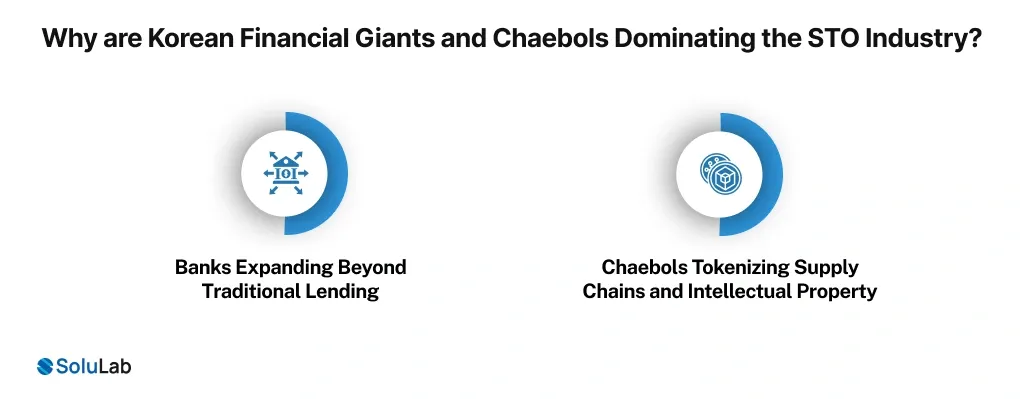
South Korea’s tokenization ecosystem is not being driven by startups alone. It’s never been that way, if you check the history. Some of the country’s largest financial institutions and conglomerates are leading the transformation.
1. Banks Expanding Beyond Traditional Lending
South Korea’s four largest banks:
- KB Financial Group
- Shinhan Financial Group
- Hana Financial Group
- Woori Financial Group
Reported 18 trillion won ($12.6 billion) in 2025 and early 2026. However, traditional lending growth has slowed, forcing banks to look for new revenue streams.
Security token platforms offer opportunities to generate non-interest income, including:
- Custody services
- Asset brokerage
- Tokenized asset issuance fees
- Secondary market trading
This shift is pushing banks to invest heavily in corporate tokenization platforms.
2. Chaebols Tokenizing Supply Chains and Intellectual Property
South Korea’s major conglomerates, known as Chaebols, are also exploring enterprise blockchain tokenization.
Companies such as Hyundai, LG, and SK are experimenting with tokenization models that include:
- Supply chain asset tokenization (LG CNS is developing blockchain platforms for tokenized asset management and Supply Chain Finance (SCF))
- Intellectual property licensing tokens
- Manufacturing equipment financing through tokenized assets
- Energy infrastructure investments
These initiatives create tokenization ecosystems led by major corporations.
How Do STOs Transform Capital Liquidity and Asset Refinancing for Enterprises?
Traditional asset financing often locks capital into illiquid structures. Large assets such as real estate, infrastructure, or intellectual property typically require significant upfront investment and long holding periods.
Therefore, security tokens change the ideology by offering the following.
1. Fractional Ownership Unlocks Liquidity
Tokenization allows fractional ownership of assets that are divided into smaller digital shares that can be traded on regulated platforms.
This provides multiple advantages:
- Increased liquidity for previously illiquid assets
- Access to global investors
- Lower capital entry barriers
- Faster capital raising
For corporations, real world asset tokenization transforms how assets are financed.
Instead of relying solely on bank loans or private equity, enterprises can raise capital through tokenized asset issuance.
2. Real Examples of Enterprise Tokenization Use Cases
Some of the most common tokenization use cases for global corporations include:
Fractional Blue-Chip Real Estate: Giants like Kasa and Lucentblock have moved from sandboxes to the KDX (Korea Exchange), tokenizing Gangnam commercial towers for retail-institutional liquidity.
K-Content & Music IP: Musicow has legalized “Participation Rights,” allowing enterprises to tokenize streaming royalties and webtoon IP as regulated securities.
Shipbuilding & Heavy Assets: Hanwha Ocean is pioneering fractional ship ownership tokens to diversify funding for massive vessel construction.
Supply Chain Commodities: Korea Gold Exchange (Koda) now tokenizes physical bullion and rare earth metals for instant corporate collateralization.
Through these use cases, you can clearly see the rising demand for tokenization platform services.
What are the Mandatory Capabilities for an Enterprise-Grade Tokenization Platform in 2026?
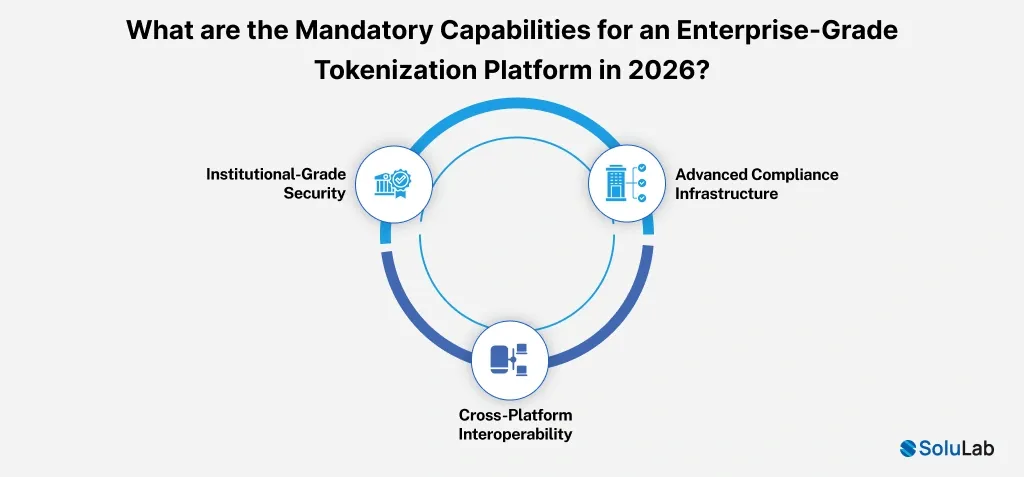
Building a tokenization platform in 2026 requires more than blockchain infrastructure. Enterprises must design platforms that meet strict regulatory, security, and interoperability requirements.
1. Advanced Compliance Infrastructure
Modern tokenization platforms must support dynamic regulatory compliance.
One of the most important features is Dynamic Jurisdiction Whitelisting, which allows token issuers to automatically control where assets can be traded.
This ensures tokens comply with different regulatory frameworks across regions.
Key compliance modules include:
- KYC and AML verification
- Investor accreditation checks
- Jurisdiction-based trading restrictions
- Regulatory reporting tools
These capabilities are essential for the best tokenization service providers for enterprises operating across global markets.
2. Cross-Platform Interoperability
Tokenized assets must interact with multiple financial systems.
In South Korea, platforms must integrate with:
- Korea Exchange (KDX)
- Private financial consortium networks
- Institutional custody systems
This interoperability ensures that enterprise digital assets can move seamlessly between traditional and blockchain-based markets.
3. Institutional-Grade Security
Security remains a top concern for enterprises adopting tokenization.
The industry standard in 2026 is MPC (Multi-Party Computation) custody, which protects private keys by splitting control across multiple parties.
This architecture prevents single-point security failures and ensures enterprise-grade asset protection.For corporations building SEC-compliant RWA tokenization platforms, security infrastructure is just as important as blockchain performance.
Conclusion
As you can see, South Korea has created a “once-in-a-decade” liquidity window for global enterprises. However, the complexity of FSC compliance, KDX integration, and the technical demand for Atomic Settlement means that a standard blockchain approach will fail.
At SoluLab, Asset tokenization company, we specialize in bridging the gap between global corporate vision and South Korea’s rigorous digital asset standards.
- We don’t just build platforms; we engineer institutional-grade ecosystems designed for the 2026 regulatory landscape.
- We ensure MPC-based custody to Dynamic Jurisdiction Whitelisting, matching your tokenization strategy.
The future of RWA liquidity is being settled in Seoul. Let SoluLab be your technical partner for the world’s most structured tokenized economy. Contact us today!
FAQs
Deepika is a content writer who blends storytelling with strategic thinking. She explores topics across digital innovation, emerging tech, and the evolving blockchain industry. She enjoys breaking down complex ideas into simple, engaging narratives in the growing global markets.