Museums are struggling with funding. Monuments need restoration. Cultural collections sit in storage because exhibitions cost money.
At the same time, global investors are moving into tokenized real-world assets (RWAs) solutions. According to the BCG and ADDX study on on-chain asset tokenization, tokenized assets could reach $16 trillion by 2030. Citi estimates $4–5 trillion in tokenized securities alone within this decade.
So the question is simple: Can cultural assets become part of this shift? In 2026, the answer is yes, but only if the model is secure, compliant, and structured properly. Let’s break it down clearly.
Key Takeaways
- Cultural assets like art, artifacts, and monuments are often illiquid, hard to fund, and lack transparent ownership structures.
- Cultural asset tokenization enables fractional ownership, transparent provenance, and new monetization streams for museums, heritage sites, and collections.
- SoluLab builds secure, compliant cultural asset tokenization platforms—integrating audit trails, wallets, and trading infrastructure to unlock liquidity, preserve heritage, and deliver measurable value
What Cultural Asset Tokenization Means?
Cultural asset tokenization means creating a blockchain-based digital representation of a physical cultural asset.
That asset could be:
- A museum painting
- A historical monument
- A rare manuscript
- A sculpture
- A heritage building
- A government-protected site
The token does not replace the physical object. It represents ownership rights, revenue rights, or usage rights linked to it.
Think of it like converting a cultural asset into a programmable digital certificate that can:
- Prove authenticity
- Enable fractional ownership
- Support fundraising
- Automate royalties
- Improve transparency
The global art market alone was valued at $65 billion in 2023 (Art Basel & UBS report). Yet most cultural assets remain illiquid. Tokenization introduces liquidity where none existed.
That’s the core opportunity.
Why Blockchain Technology Matters for Cultural Heritage in 2026?
Blockchain technology is not used here because it’s trendy. It solves specific problems cultural institutions face.
- Provenance and Authenticity
Forgery remains a major issue in the art world. Some studies estimate that up to 20% of artworks circulating in secondary markets may have questionable authenticity.
Blockchain creates a permanent, tamper-resistant ledger that tracks:
- Ownership history
- Transfers
- Restoration records
- Licensing agreements
This reduces disputes and increases trust among buyers and institutions.
- Funding Pressure on Museums
Many museums rely on:
- Government grants
- Philanthropy
- Ticket sales
But global cultural funding remains unstable. Post-pandemic recovery is uneven. Smaller institutions are especially vulnerable.
Tokenized fundraising models allow:
- Community-backed fractional participation
- Digital patron memberships
- Token-based donor rewards
Instead of asking for donations, institutions can offer structured participation.
- Transparency for Governments
Governments managing monuments and heritage sites need transparency in:
- Restoration budgets
- Grant usage
- Public-private partnerships
Blockchain can record financial flows, making reporting clearer and reducing corruption risks.
- Interoperability and Automation
Smart contracts allow automation of:
- Royalty payments
- Revenue splits
- Access permissions
- Usage licenses
This reduces manual administration and legal friction. Blockchain is not replacing heritage institutions. It is modernizing their operational layer.
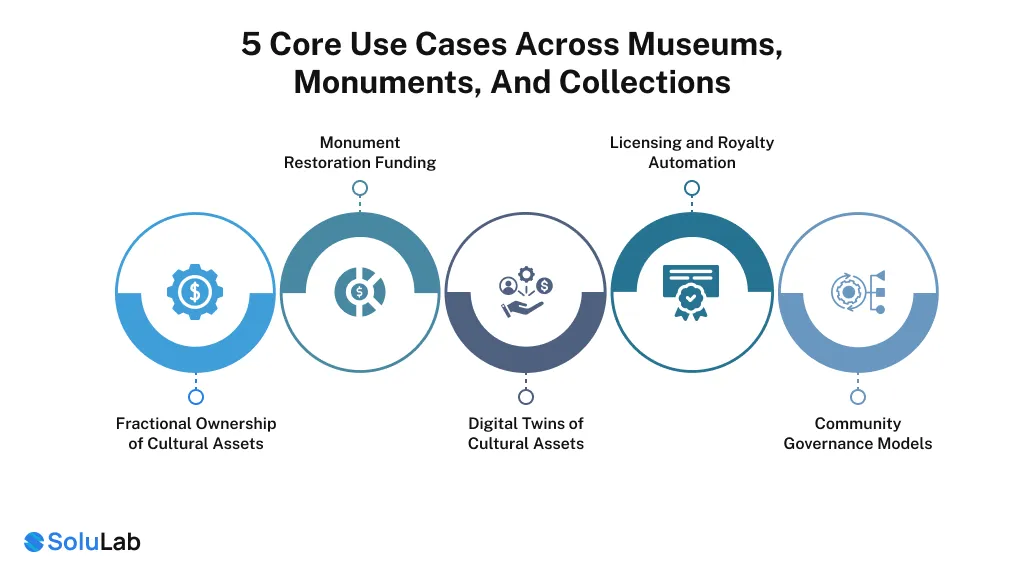
5 Core Use Cases Across Museums, Monuments, and Collections
Let’s move from theory to real application.
1. Fractional Ownership of Cultural Assets
High-value artworks or heritage buildings can be divided into digital shares.
Example use case:
- A $20 million historical building
- 20,000 tokens issued at $1,000 each
- Investors receive revenue from tourism or exhibitions
This increases participation while keeping institutional control intact. This model is similar to real estate tokenization, which is already gaining traction globally.
2. Monument Restoration Funding
Restoration projects are expensive. UNESCO heritage sites often require millions annually for preservation.
Instead of waiting for public funding cycles, institutions can issue:
- Restoration-backed tokens
- Revenue-sharing tokens tied to ticket sales
- Limited digital collectibles tied to the monument
Funds can be raised globally within weeks, not years.
3. Digital Twins of Cultural Assets
3D scanning and high-resolution imaging allow the creation of digital replicas.
These digital twins can:
- Be used in virtual museums
- Power metaverse exhibitions
- Enable remote educational programs
Access can be token-gated, creating subscription or membership models. This expands global access without increasing physical traffic to fragile sites.
4. Licensing and Royalty Automation
Cultural assets are often licensed for:
- Films
- Educational publications
- Commercial exhibitions
Smart contracts can automate royalty splits between:
- Governments
- Museums
- Artists’ estates
- Cultural trusts
Payments can be executed instantly once usage is recorded.
5. Community Governance Models
Some institutions are experimenting with DAO-like governance for:
- Exhibition voting
- Funding allocation
- Cultural programming
Token holders can vote on initiatives while institutions retain operational authority. This increases engagement and accountability.
How Legal and Copyright Issues Factor Into Cultural Tokenization?
To achieve 100% growth globally, you must comply with the regulations of every country. And each country will have different security terms to keep its people safe. Therefore, while building a tokenization platform, you must check the following details.
| Ownership vs Token Rights | Intellectual Property Rights | Securities Regulation | Cross-Border Complexity | Core Compliance Reality |
| Token ≠ physical ownership | Respect reproduction rights | Profit-linked tokens may be securities | Involves multiple jurisdictions | Legal structure must be enforceable |
| Can represent revenue rights | Respect display rights | Revenue share triggers regulation | Laws differ country to country | Traditional courts must recognize agreements |
| Can represent governance rights | Respect commercial licensing | May require KYC onboarding | Government oversight may apply | Regulatory mapping required |
| Can represent usage rights | Define clearly what holder owns | AML monitoring required | Donor agreements may differ | Documentation must be clear |
| Can represent fractional equity | Licensing terms must be embedded | Investor accreditation rules may apply | Local securities laws vary | No compliance = legal risk |
| Legal agreement required behind token | IP ownership must be verified first | Reporting obligations may apply | Token structure may need localization | Compliance is foundational |
How Do Enterprises Design a Secure and Scalable Development Model for Cultural Tokenization?
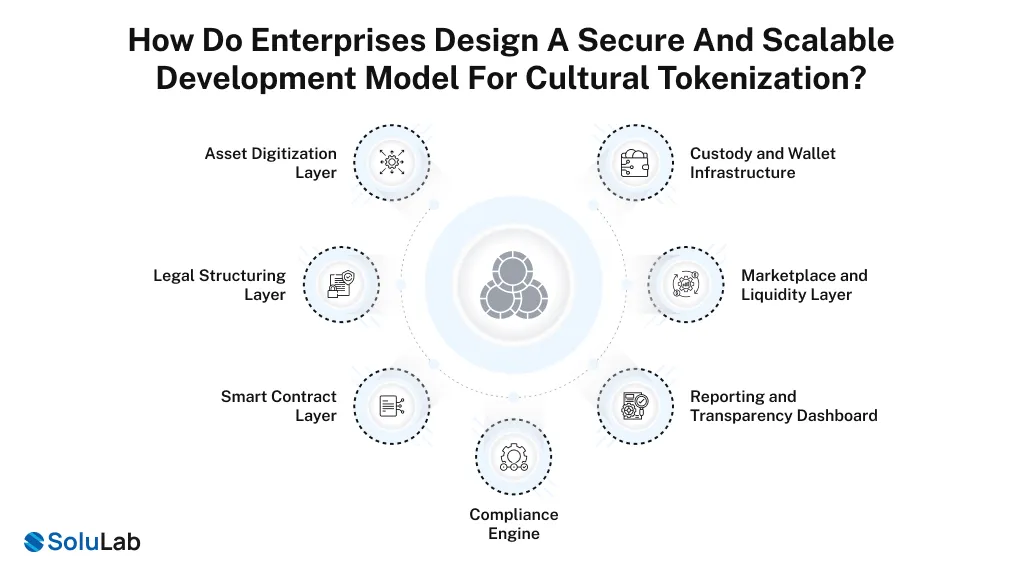
This is the most important section for B2B leaders. Here’s a workable architecture model.
1. Asset Digitization Layer
Before tokenization:
- Conduct a professional valuation
- Capture high-resolution images or 3D scans
- Create standardized metadata
- Document legal ownership
Data must be structured and verified. Garbage data creates future disputes.
2. Legal Structuring Layer
This is not technical; it’s legal engineering.
You define:
- Token rights structure
- Revenue distribution model
- Governance mechanism
- Jurisdiction
Often, this involves SPVs (Special Purpose Vehicles). The token represents shares in the SPV, not direct physical ownership. This makes enforcement easier.
3. Smart Contract Layer
Audited smart contracts manage:
- Token issuance
- Transfers
- Royalty distribution
- Voting logic
Security audits are mandatory. Cultural institutions cannot afford smart contract exploits.
4. Compliance Engine
Enterprise-grade tokenization must integrate:
- KYC onboarding
- AML screening
- Transaction monitoring
- Regulatory reporting
Without this layer, scaling globally becomes impossible.
5. Custody and Wallet Infrastructure
Institutions need:
- Institutional-grade custody
- Multi-signature security
- Role-based access control
Private key mismanagement can destroy trust instantly.
6. Marketplace and Liquidity Layer
Tokens require liquidity to attract participants.
Options include:
- Private secondary trading platforms
- Regulated exchanges
- Permissioned marketplaces
Liquidity design must match regulatory structure.
7. Reporting and Transparency Dashboard
Investors and governments need:
- Real-time asset tracking
- Revenue reporting
- Impact reporting
- Restoration progress updates
Transparency builds credibility.
How the Future of Cultural Asset Tokenization?
We are still early at this point. But three trends are clear:
- Institutional adoption is increasing. Major consulting firms are already building RWA tokenization frameworks for enterprise clients.
- Governments Are Exploring Digital Heritage Preservation. Digital archives and blockchain-backed records are becoming part of a long-term preservation strategy.
- Hybrid Physical + Digital Models Will Dominate Museums will combine:
- Physical exhibitions
- Digital token memberships
- Virtual experiences
- Tokenized fundraising
RWA tokenization will not replace traditional institutions. It will modernize them.
Conclusion
As discussed, cultural asset tokenization is not about turning history into speculation. It is about upgrading how cultural institutions fund, manage, and protect heritage.
If you are exploring asset tokenization development solutions, restoration funding models, or digital heritage infrastructure, connect with SoluLab to evaluate a secure and scalable approach tailored to your institution.
- Increase fundraising efficiency by up to 40–60% through global digital participation
- Unlock fractional participation for high-value heritage assets
- Automate royalty and licensing distribution
- Improve donor transparency and reporting confidence
- Expand digital audience reach without increasing physical strain on assets
This is where experienced blockchain and real-world asset engineering partners matter. Contact us today to discuss your vision for 2026!
FAQs
Deepika is a content writer who blends storytelling with strategic thinking. She explores topics across digital innovation, emerging tech, and the evolving blockchain industry. She enjoys breaking down complex ideas into simple, engaging narratives in the growing global markets.

![Top 10 Asset Tokenization Companies in the USA [2026 Edition]](https://www.solulab.com/wp-content/uploads/2025/10/Asset-Tokenization-Companies-in-USA.webp)