One size does not fit all. Businesses know that now, maybe better than ever. Ten years ago, off-the-shelf software could carry a company a long way. Not anymore. If you want something that scales without falling apart, custom software isn’t optional anymore, it’s the baseline.
In this piece, we’ll walk through what separates off-the-shelf software from something built specifically for you, and why that difference matters more than most founders assume. We’ll also get into what a custom approach actually buys you day to day. By the end, the case for long-term growth and efficiency should be pretty hard to argue with.
Custom software development services have quietly become one of the sharpest tools a company can reach for. Every business wants innovation, efficiency, and an edge over the competitor down the street, and tailored software is often how they get there. This post walks through ten concrete ways custom software development can change how your business runs, not in theory, but in practice.
What is Custom Software Development?
First, a quick definition. Off-the-shelf software is built for a broad user base; everyone gets the same product. Custom software is different: it’s built around your specific requirements, your goals, your workflows, the way your team actually works. Get that right, and the advantages compound fast enough to put you ahead of competitors still running generic tools.
Read Our Latest Blog Post: Building a Competitive Edge with SoluLab’s Custom Software Development Services
Advantages and Benefits of Custom Software Development
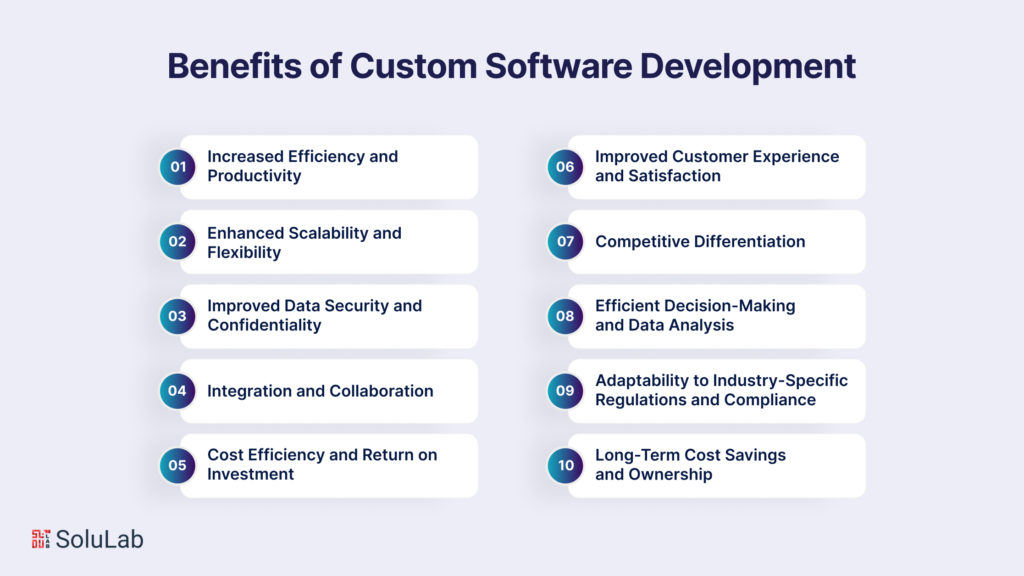
- Increased Efficiency and Productivity
Custom software takes over the workflows businesses used to run by hand. Cut the repetitive, manual tasks and employees get their time back for work that actually moves the needle. Because the software is built to fit how the business already operates, the transition tends to go smoother, and efficiency climbs without much drama. Take a logistics company: build one system that ties together order tracking, inventory management, and delivery scheduling, and manual data entry mostly disappears. Fewer errors. Better operational efficiency across the board.
- Enhanced Scalability and Flexibility
Off-the-shelf software has a ceiling. Businesses grow, needs shift, and eventually the generic tool can’t keep up. Custom software doesn’t have that problem: it flexes as your requirements change, whether that means a bigger user base or a feature nobody had asked for a year ago. Say a software firm decides to expand into mobile app development. With a custom build, they can fold that new offering in, ship a mobile-friendly interface, and reach a wider audience without starting from scratch.
- Improved Data Security and Confidentiality
Data security keeps a lot of people up at night, and for good reason. Custom software lets a company build security measures around its actual risk profile, not a generic template. That means encryption for sensitive data, access controls tied to user roles, and real protection against the kind of breach that ends up in a headline.
A healthcare organization handling patient records is a good example. Build the software around the regulations from day one, and unauthorized access becomes a lot harder; patient privacy stays intact.
Read Also: 10 Reasons Why Your Business Needs Custom Software Development
- Integration and Collaboration
Custom software also plays well with what you already have. CRM, accounting, or project management software, whatever the stack looks like, a custom build can talk to those systems directly. Teams stop working in silos, decisions get made faster, and efficiency follows naturally.
Picture a marketing agency wiring its project management system straight into its creative asset library. Suddenly the creative team can pull files and collaborate right inside the project platform. No more emailing assets back and forth or waiting on a shared drive to sync.
- Cost Efficiency and Return on Investment
Yes, custom software usually costs more upfront than an off-the-shelf license. But look past year one. You own it outright, so recurring licensing fees disappear. And the efficiency gains from a tool built for your exact process tend to push the return on investment well past what a generic package delivers.
A manufacturing company building custom software for its supply chain is a common case. Automate inventory tracking, order processing, and supplier management, and overstocking costs shrink, bottlenecks disappear, and profitability improves in ways a spreadsheet never could deliver.
- Improved Customer Experience and Satisfaction
Custom software lets a business build genuinely personalized experiences, not the generic kind every competitor also offers. Match the software to your actual processes and your customers’ actual needs, and the experience gets sharper. Satisfaction goes up. So does loyalty. And the brand perception that comes with it.
Take an e-commerce company that builds its own recommendation engine, one tuned to actual customer preferences, purchase history, and browsing behavior instead of a one-size algorithm. The shopping experience improves. Engagement climbs. Conversion rates follow.
- Competitive Differentiation
Standing out gets harder every year, not easier. When you innovate in software development, you open the door to features and functionality that simply don’t exist in an off-the-shelf package. That kind of distinctiveness is what pulls customers in, and over time, it’s what turns a company into the name people default to in its space.
A fitness app with its own AI-powered virtual coach, one built for personalized workout plans and live feedback, is a good illustration. That single feature separates it from a sea of generic fitness apps and lets it sit at the premium end of the market.
Read Blog: How to Choose The Right Custom Software Development Company?
- Efficient Decision-Making and Data Analysis
Custom software can hand businesses insight they didn’t have before, through analytics and reporting built for their actual questions. Wire it into your data collection tools and analytics platforms, and you’re reading business data in real time instead of waiting on a quarterly report. Decisions get sharper. Trends show up earlier. Strategy adjusts before it has to.
A financial institution might build software that pulls data from a dozen sources, runs the complex calculations, and produces full financial reports automatically. The reporting process gets faster, the analysis gets more accurate, and decisions start leaning on real data instead of gut feel.
- Adaptability to Industry-Specific Regulations and Compliance
Every industry answers to its own regulators. Off-the-shelf software rarely covers those specifics closely enough, which leaves a business exposed to non-compliance it never saw coming. Build custom, and the relevant regulations, security standards, and compliance measures get designed into the product from the start. That keeps operations on the right side of the law and keeps penalties, and the reputational damage that follows them, off the table.
A healthcare organization building HIPAA-compliant software is the textbook case: security measures, strict access controls, and audit logs built in from day one, all protecting patient data while keeping the organization compliant.
Read Also: Best Custom Software Development Companies in the USA
- Long-Term Cost Savings and Ownership
Again, the sticker price upfront is higher. But full ownership changes the math. No recurring licensing fees. No dependency on a third-party vendor’s roadmap or pricing changes. And because the software can grow alongside the business, you’re not budgeting for a replacement system every few years.
A hospitality chain investing in its own property management software tends to prove this out over a few years. The licensing fees it stops paying, and the ease of scaling that same system to new properties, add up to savings that dwarf what the initial build cost.
Exploring Real-Life Custom Software Development Examples
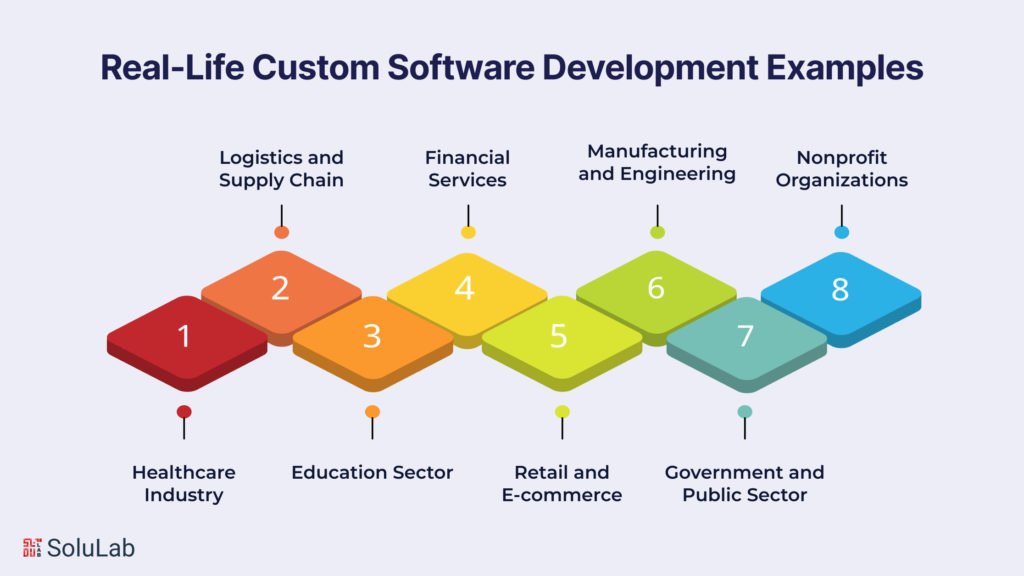
Here’s what this looks like outside of theory, in industries you’d recognize.
Different sectors, same pattern: businesses reaching for custom software and coming out the other side with operations that actually run better.
1. Healthcare Industry:
Healthcare is one of the clearest examples. Custom software has reshaped patient care, cut down administrative overhead, and tightened up data security in ways generic tools couldn’t. Electronic health record systems are the obvious case: purpose-built software that lets providers store, manage, and exchange patient information securely. Paper charts are mostly gone. Access to patient data is faster and more accurate because of it.
2. Logistics and Supply Chain:
Logistics and supply chain companies lean on custom software hard. Purpose-built inventory management systems track stock levels, handle replenishment, and keep order fulfillment moving. Automate those tasks and errors drop, holding costs shrink, and deliveries actually show up when promised.
3. Education Sector:
Custom software development has changed the education sector in ways a lot of students take for granted now, from learning management to student administration to how schools communicate. Learning management systems are the clearest example: platforms built for online course delivery, student tracking, and assessment. They let institutions run flexible, personalized learning, watch student progress closely, and hand back feedback instantly instead of weeks later.
4. Financial Services:
Financial services has felt the impact too. Online banking systems, the ones letting customers check balances, transfer funds, and pay bills from a phone, are custom-built software at their core. Strong security protects the sensitive data running through them, and the user experience holds up under real load.
Check Out Our Blog Post: Top Custom Software Development Companies in 2023
5. Retail and E-commerce:
Retail and e-commerce have been reshaped by custom software just as much. Personalized shopping experiences, tighter inventory management, better customer relationship management: all of it traces back to platforms built for the specific business rather than borrowed off a shelf. Product catalogs, shopping carts, payment gateways, support systems, folded into one custom build, and businesses can shape their online presence and run promotions that actually land.
6. Manufacturing and Engineering:
Manufacturing and engineering tell a similar story, with automation, efficiency, and quality control all improving on the back of custom tools. Computer-aided design software is a good example, built specifically to help engineers model products in 2D and 3D, prototype them, and run simulations before a single part gets manufactured.
7. Government and Public Sector:
Government and the public sector have made real use of this too, tightening up operations, improving service delivery, and getting citizens more engaged in the process. E-governance platforms are the visible result: tax filing, permit applications, license renewals, all done online instead of in a line at a counter. Behind the scenes, the same platforms give policymakers cleaner data to work from when they’re making decisions.
8. Nonprofit Organizations:
Nonprofits benefit too, often more than people expect. Fundraising management systems, built specifically for a given organization, handle donor relationships, track donations, and organize campaigns. Donation processes move faster, donor communication runs on autopilot where it can, and analytics show what’s actually working. All of that time saved goes back into the mission, which is the whole point.
The Custom Software Development Process
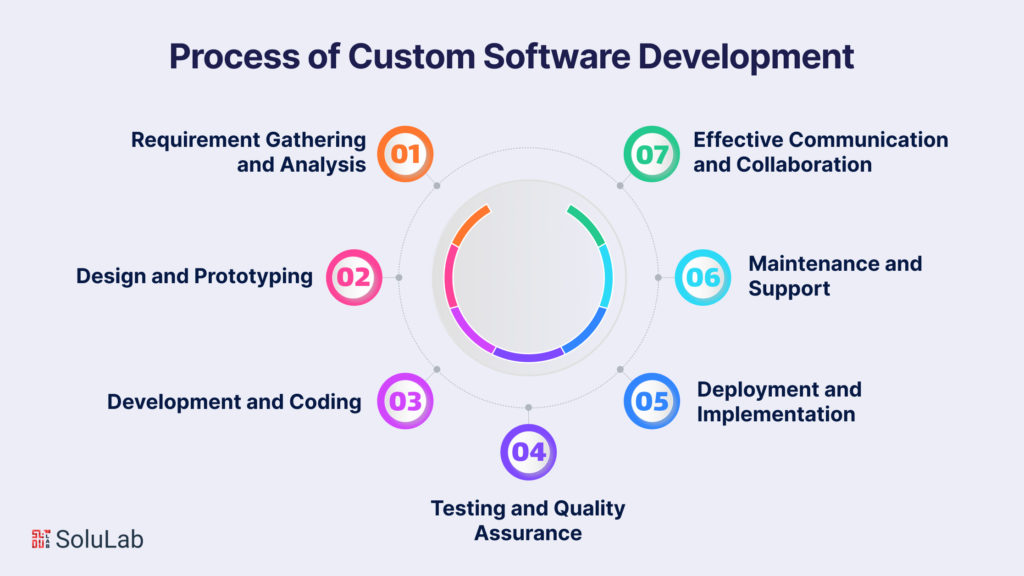
There’s a process behind all of this, and it’s fairly consistent across projects. Here’s how it typically breaks down.
1. Requirement gathering and analysis:
Everything starts with understanding what the business actually needs, not what a template assumes it needs. That means interviews, workshops, surveys, whatever it takes to pull information out of the people who’ll actually use the software. From there, the functionality, features, and scope get defined. Skip this step or rush it, and the whole project wobbles later.
2. Design and prototyping:
Once requirements are locked, design takes over. Designers sit with stakeholders and build wireframes and prototypes that show what the interface and experience will actually look like. Feedback happens early here, which is the point: catching a bad design decision on paper is a lot cheaper than catching it in production. Navigation flows, screen layouts, interactive elements: all of it gets mapped out at this stage.
3. Development and coding:
Now the development team actually builds it. They pick languages and frameworks suited to the project, not whatever’s trendy that year, and get to work: writing code, wiring up databases, implementing the business logic, assembling functional modules. Checkpoints and code reviews happen along the way, which keeps quality in check and keeps the team honest about best practices.
Read Our Blog: Top 10 Custom Software Development Services To Opt-in 2023
4. Testing and quality assurance:
Skimping on testing here is how software fails quietly, then loudly, later. Unit testing, integration testing, system testing, user acceptance testing: the phase covers all of it. Testers dig through the product, flag bugs, and hand them back to development to fix. What comes out the other side is meant to be stable, not just functional.
5. Deployment and implementation:
After testing wraps and the software gets final sign-off, it moves into production. That means setting up infrastructure, configuring servers, installing the software where it needs to live. Data migration and user training happen here too, because a great piece of software nobody knows how to use isn’t worth much.
6. Maintenance and support:
Deployment isn’t the finish line. Ongoing maintenance keeps the software secure, optimized, and in step with a business that keeps changing shape. That means fixing issues as they surface, shipping updates and patches, and building in improvements based on actual user feedback. Do this well, and the software keeps paying for itself years after launch.
7. Effective Communication and Collaboration:
None of this works without communication between the business side and the development team. Open channels, clearly defined expectations, and a methodology like Agile go a long way toward keeping the project on track and the end product actually matching what the business asked for in the first place.
Factors to Consider When Choosing a Custom Software Development Partner
Picking the right partner matters almost as much as the build itself. A few things worth weighing:
- Expertise and experience in relevant technologies: Look at what the company has actually built before, not just what they say they can build. Check their proficiency in the specific languages, frameworks, and databases your project needs. A partner with weak technical footing will struggle the moment the project gets complicated, and most real projects do.
- Client testimonials and references: Past clients tell you things a sales pitch won’t. Testimonials and case studies hint at how reliable a partner is, whether they hit deadlines, and what their finished work actually looks like. Better yet, call a reference directly. A five-minute conversation surfaces things no case study will.
Read Also: How Does ChatGPT Help Custom Software Development?
- Transparency in project management and communication: A partnership falls apart fast without transparency. Look for a company that communicates often, sends regular progress updates, and actually loops you into decisions as the project develops. Transparency builds trust, and trust is what keeps a project moving when things inevitably go sideways.
- Scalability and long-term support capabilities: Think ahead. As the business grows, new features, modules, or integrations will come up, and the partner needs the flexibility to accommodate that instead of treating the original scope as fixed forever. Ask about their long-term support and maintenance too, because software that isn’t maintained degrades quietly.
- Quality assurance and security measures: Data security and quality assurance aren’t negotiable. Ask specifically about their testing methodologies, how they track bugs, and what security protocols they follow day to day. A partner serious about industry standards and compliance will have clear answers here, not vague reassurance.

Conclusion
Add it all up: efficiency, productivity, tighter data security, real cost savings over time, and the case for custom software isn’t really a hard sell anymore. Companies that invest in tailored solutions tend to run leaner operations and hold onto a competitive edge longer than the ones that don’t.
If you’re weighing whether custom software makes sense for where your business is headed, talk to our team. We can walk through what it would actually look like for you.
The real value here is simple: technology built around your business, instead of your business bending around someone else’s software.
As a prominent custom software development company, SoluLab builds solutions around the specific problems each business actually faces, not a generic template. Developers and designers work closely with clients to understand the business first, then find where technology can move growth and efficiency forward. Whether that’s a new website, a mobile app, or a full enterprise system, the goal is the same: something that sets the business apart. Contact SoluLab today to talk through what that could look like for you.
FAQs
Shipra Garg is a tech-focused content strategist and copywriter specializing in Web3, blockchain, and artificial intelligence. She has worked with startups and enterprise teams to craft high-conversion content that bridges deep tech with business impact. Her work translates complex innovations into clear, credible, and engaging narratives that drive growth and build trust in emerging tech markets.