Key Takeaways
- Custody for tokenized assets covers both the digital layer (private keys, wallets) and the legal layer (ownership records, investor rights).
- Sub-custodians extend a primary custodian’s reach into markets or asset types it can’t service directly, often for regulatory or geographic reasons.
- Custodian and sub-custodian roles differ most in compliance ownership, reporting, and who investors actually deal with.
- Choosing a provider comes down to regulatory coverage, asset support, and how well it integrates with existing infrastructure, not just brand name.
- Cross-border tokenized asset programs almost always need a network of local sub-custodians, not one custodian trying to cover every jurisdiction alone.
Ask a fund manager who’s tokenized a real estate portfolio what keeps them up at night, and it’s rarely the blockchain part. It’s who’s actually holding the keys.
What happens if that party gets hacked, goes bankrupt, or simply can’t operate in the country where an investor lives? Custody and sub-custodian solutions for tokenized assets exist to answer exactly that question.
Get the answer wrong, and it’s expensive in ways that are hard to undo once investor money is already committed. Statista’s digital assets market forecast puts global user penetration at 9.90% in 2026, climbing to 9.99% by 2027, which gives a sense of how fast the pool of investors expecting proper custody is growing.
What Is Tokenized Asset Custody?
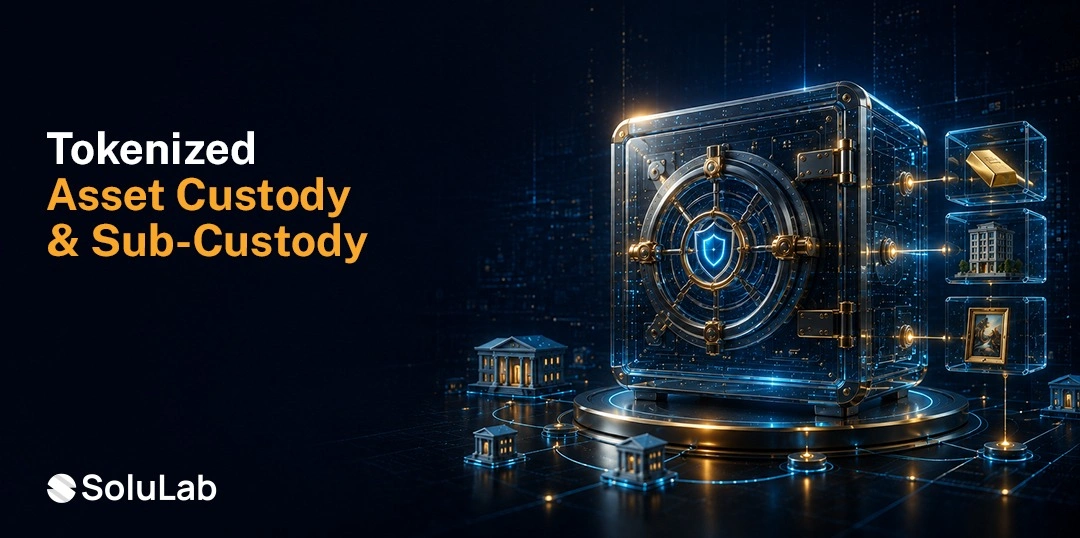
Tokenized asset custody is the safekeeping of the private keys, wallet infrastructure, and legal ownership records tied to a digital token representing a real-world or financial asset. It’s not just about locking a private key in a vault, though that’s part of it. A custodian for real-world asset tokenization also has to maintain the legal chain connecting the on-chain token to whatever it represents: a share of a building, a slice of a private credit fund, a fraction of gold in a vault somewhere.
That dual responsibility, technical and legal, is what separates tokenized asset custody from plain crypto custody. Holding Bitcoin securely is a solved problem at this point.
Holding a security token that carries dividend rights, voting rights, and regulatory reporting obligations is a different animal entirely, and it’s happening at scale.
What Assets Can Be Held in Custody?
Custody providers don’t, and shouldn’t, treat every tokenized asset the same way. A gold bar and a loan repayment schedule have almost nothing in common operationally, even once they’re both sitting on the same blockchain.
1. Tokenized Real Estate
Real estate tokens represent fractional ownership in physical property. Custody has to track both the digital token and the underlying property title, usually through a special-purpose vehicle holding legal title on investors’ behalf. Miss that legal linkage and the token is just a number on a ledger with no claim behind it.
2. Tokenized Securities
Bonds, equity, and other securities tokens fall under securities law wherever they’re offered, so custody overlaps heavily with transfer agent functions, dividend distribution, and shareholder record-keeping.
3. Tokenized Funds
Money market funds and private credit funds need custody built for subscription and redemption cycles, not just static holding. Investors move in and out; the custody layer has to keep up.
4. Tokenized Commodities
Gold, silver, and other physical commodities require custody providers to reconcile on-chain token supply against actual vaulted inventory. That reconciliation usually happens through regular third-party audits, and it’s non-negotiable, since a mismatch there is essentially fraud.
5. Tokenized Private Credit
Private credit tokens carry cash flow rights tied to loan repayments, so custody needs to track payment schedules alongside the token itself.
6. Stablecoins and Other Digital Assets
These are the simplest case. Mostly private key management and reserve verification, without the extra layer of physical or legal asset reconciliation the other categories need.
What Is a Sub-Custodian in Tokenized Asset Markets?
A sub-custodian is a licensed entity that a primary custodian appoints to hold assets or service investors in a market, jurisdiction, or asset class the primary custodian can’t reach directly. It’s a local partner, brought in because regulatory licensing, banking relationships, or operational presence in a given country make it impractical for one custodian to cover everything alone.
This matters more in tokenization than it did in traditional finance. Tokenized offerings tend to pull in investors across far more borders, far faster, than a typical fund ever did. A platform issuing tokenized real estate might land subscriptions from Singapore, Germany, and Brazil in the same week, and no single custodian holds licenses everywhere at once.
Custodian vs. Sub-Custodian
A custodian and a sub-custodian aren’t interchangeable, even though investors rarely notice the difference. Here’s how the two roles actually split responsibility.
| Function | Custodian | Sub-Custodian |
| Asset ownership | Holds the primary legal relationship with the issuer | Holds assets on behalf of the custodian, not the issuer directly |
| Safekeeping | Bears ultimate responsibility for asset security | Executes safekeeping under the custodian’s oversight |
| Transaction processing | Coordinates settlement across the full investor base | Processes transactions within its local market or asset scope |
| Compliance responsibilities | Owns the overarching compliance framework | Complies with local rules, reports up to the custodian |
| Reporting | Consolidates reporting across all sub-custodians | Reports asset-level activity to the primary custodian |
| Investor access | Sets the overall access and eligibility policy | Often the investor’s direct point of contact locally |
Why Do Tokenized Assets Need Custody and Sub-Custody Solutions?
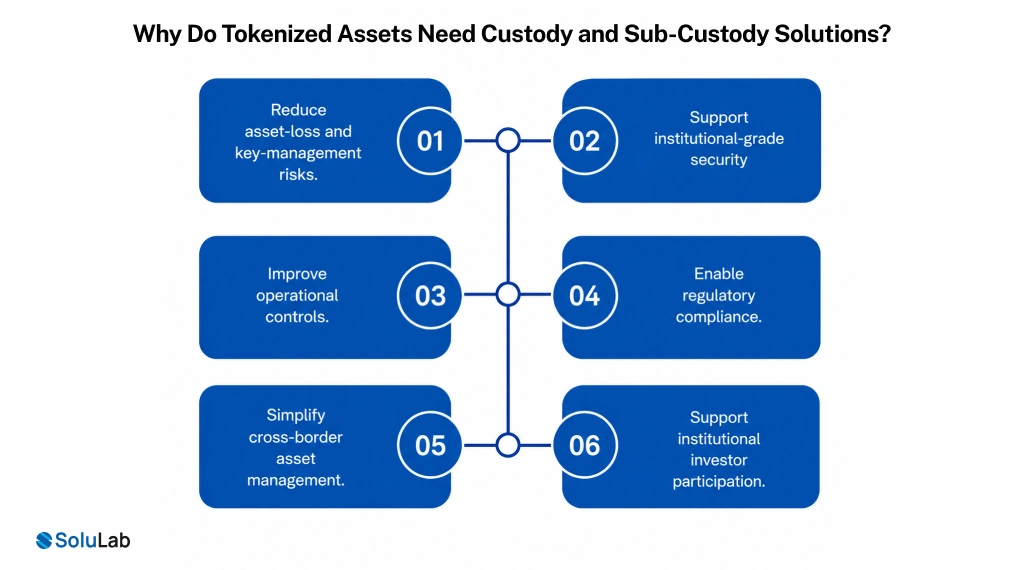
A Deloitte survey found that 64% of financial institutions had delayed tokenization initiatives specifically because of regulatory uncertainty, and custody risk sits near the top of what makes regulators nervous about approving these programs. A few reasons this keeps coming up.
- Reduce asset-loss and key-management risks. A lost or compromised private key isn’t recoverable the way a forgotten bank password is. Custody providers build in multi-signature approvals and hardware security modules to ensure that a single point of failure never matters.
- Support institutional-grade security. Institutional investors won’t allocate significant capital to a platform that relies on a single hot wallet.
- Improve operational controls. Clear custody roles mean fewer manual handoffs. Fewer manual handoffs mean fewer places for something to quietly go wrong.
- Enable regulatory compliance. Most securities regulators require a licensed, qualified custodian before a tokenized security can even be offered to investors. This isn’t optional in most markets, whatever the pitch deck says.
- Simplify cross-border asset management. Sub-custodians give a platform local compliance coverage without needing a license in every country it touches, which is the only realistic way to scale past two or three markets.
- Support institutional investor participation. Pension funds, insurers, and asset managers typically have internal policies that flat-out require third-party custody before they’ll invest in anything, tokenized or not. No exceptions, no matter how good the yield looks.
How to Choose a Tokenized Asset Custody and Sub-Custody Solution?
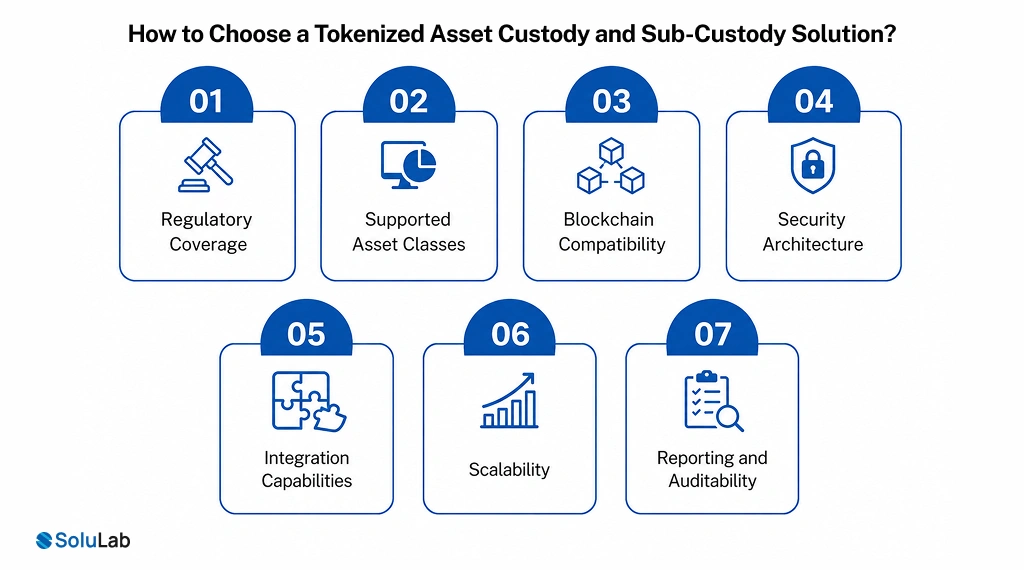
Picking a provider is less about brand recognition and more about whether the specific combination of asset type, jurisdiction, and technical setup actually lines up. A few factors matter more than the rest.
1. Regulatory Coverage
Check exactly which licenses the custodian holds, and in which countries, before assuming they can service your target markets. A provider licensed in the US doesn’t automatically clear you to onboard EU investors under MiCA.
2. Supported Asset Classes
Not every custodian handles every asset type well. A provider built primarily for crypto custody may not have the transfer-agent capabilities a tokenized security actually needs.
3. Blockchain Compatibility
Confirm the custodian actually supports the chains and token standards the platform runs on. That includes permissioned or private chains, which some custodians quietly don’t handle well despite what the sales deck says.
4. Security Architecture
Look for multi-party computation or hardware security module-based key management, cold storage for the bulk of assets, and clear incident response procedures, not just marketing language about “bank-grade security.”
5. Integration Capabilities
A custodian needs to plug into the platform’s smart contracts, KYC systems, and reporting tools through APIs that are actually documented and stable, not a promise of “custom integration” that turns into a six-month project.
6. Scalability
Ask how the provider handles volume spikes, since a custody setup that works fine for a hundred investors can buckle at ten thousand if the architecture wasn’t built for it.
7. Reporting and Auditability
Confirm the custodian can produce the transaction-level, audit-ready reporting regulators and auditors will eventually ask for, ideally without a lengthy manual request process every time.
How to Build a Tokenized Asset Custody Platform?
Building custody infrastructure from scratch is a serious undertaking. Most teams underestimate how much of it is compliance and key management, and how little of it is actual blockchain engineering. Here’s the core build sequence.
Step 1: Define the Asset and Custody Model
Decide exactly what’s being custodied and whether the model is self-custody, third-party custody, or a hybrid before any architecture decisions get made.
- Confirm the target asset classes
- Choose custody model type
- Document legal ownership structure
Step 2: Design the Wallet Architecture
Map out hot, warm, and cold wallet tiers based on how frequently assets need to move versus how much needs maximum protection.
- Define hot and cold wallet split
- Set multi-signature approval thresholds
- Plan wallet segregation by client
Step 3: Implement Key Management
Build the key generation, storage, and rotation processes that everything else depends on, since a weak link here undermines the whole platform.
- Select MPC or HSM key management
- Define key rotation schedules
- Build key recovery procedures
Step 4: Build Compliance Workflows
Wire compliance checks directly into custody operations instead of treating them as a separate manual process running alongside it.
- Automate KYC and AML checks
- Build jurisdiction-based access rules
- Set up sanctions screening workflows
Step 5: Integrate Blockchain Networks
Connect the custody platform to every blockchain network the tokenized assets actually run on, with proper node infrastructure behind it.
- Deploy nodes for supported chains
- Test transaction signing flows
- Confirm gas and fee handling
Step 6: Add Custodian and Sub-Custodian APIs
Build the integration layer that lets sub-custodians report activity back to the primary custody system in near real time.
- Define sub-custodian data standards
- Build reporting API endpoints
- Test cross-custodian reconciliation
Step 7: Implement Monitoring and Reporting
Set up continuous monitoring for wallet activity, plus the reporting dashboards investors and regulators will actually use.
- Deploy real-time transaction monitoring
- Build investor-facing reporting dashboards
- Set automated anomaly alerts
Step 8: Conduct Security and Compliance Testing
Bring in independent auditors before launch, not after something goes wrong.
- Commission a third-party security audit
- Run compliance controls testing
- Remediate findings before go-live
How Can Custody Solutions Support Cross-Border Tokenized Assets?
Custody gets noticeably harder once investors are spread across borders. That’s exactly where sub-custodian networks earn their keep. A well-known name among top asset tokenization development companies usually has this pattern figured out already, which is worth checking before building from zero.
- Multiple regulatory jurisdictions. Every market an investor sits in can bring its own custody licensing requirement. A platform needs a plan for each one, not a one-size-fits-all assumption that quietly falls apart at the third country.
- Local sub-custodians. Appointing sub-custodians in key markets means investors interact with a locally licensed entity, even when the primary custodian sits somewhere else entirely.
- Currency and settlement considerations. Cross-border custody has to account for currency conversion and local settlement rails. These don’t always move at blockchain speed, and that mismatch trips up more launches than people expect.
- Investor verification. KYC standards differ by country, so custody workflows need tiered verification built around the strictest applicable jurisdiction, without over-verifying everyone else in the process.
- Regulatory reporting. Sub-custodians typically handle local regulatory filings, then roll that data up to the primary custodian for consolidated reporting.
- Asset segregation. Client assets need to stay legally segregated from the custodian’s own balance sheet in every jurisdiction. Regulators check this closely, especially after the custody failures traditional finance has already lived through.
- Cross-chain settlement. When tokenized assets move across different blockchains for different regional platforms, custody infrastructure needs settlement logic that bridges those chains without breaking the audit trail.
Conclusion
Custody isn’t the flashy part of a tokenized asset program. It’s usually the part that decides whether institutional investors show up at all. Get the custodian and sub-custodian structure right from the start, clear roles, solid key management, jurisdiction-aware compliance, and a platform saves itself from rebuilding trust after something breaks.
SoluLab, a tokenization platform development company, can help your business design and build custody infrastructure that holds up as your platform scales into new markets and asset classes.
Talk to SoluLab about building a compliant custody and sub-custody architecture for your tokenized assets.
FAQs
Neha is a curious content writer with a knack for breaking down complex technologies into meaningful, reader-friendly insights. With experience in blockchain, digital assets, and enterprise tech, she focuses on creating content that informs, connects, and supports strategic decision-making.