Key Takeaways
- A DAML smart contract audit examines authorization logic, privacy boundaries, and upgrade paths on the Canton network, not just arithmetic bugs like a typical Solidity review.
- Choice-level authorization mistakes, template key collisions, and unsafe contract upgrades are the three vulnerability classes auditors flag most often in DAML codebases.
- A complete audit blends manual review of DAML Ledger Model logic with automated Daml Script and property-based testing, then closes with a re-audit of every fix.
- Regulated financial institutions running Canton in production should budget for both a pre-launch audit and periodic re-audits tied to every major model upgrade.
- Picking the right DAML smart contract audit company matters more here than in most chains, because so few firms have real, hands-on Canton experience.
A DAML smart contract audit is a structured security review of code written for the Canton Network that checks contract logic, party authorization rules, privacy partitioning, and upgrade paths for flaws before real assets move through the ledger. Unlike a typical Ethereum audit, it has to account for DAML’s unique authorization model, where a transaction is only valid if every party with a stake in it has actually signed off.
That distinction matters more than it sounds. Canton was built for banks, custodians, and market infrastructure providers who cannot tolerate the kind of public, trial-and-error security culture that DeFi grew up with. When JPMorgan’s Onyx network or a national central bank digital currency pilot runs on Canton, a missed authorization check is not a forum post and a bug bounty. It is a regulatory incident.
This guide walks through what a DAML audit actually covers, the vulnerability classes that show up again and again, how the review process runs end to end, and what to look for when you are hiring outside help. If you are a founder, CTO, or compliance lead evaluating smart contract security audit vendors for a Canton project, this should give you enough to ask sharper questions in your first vendor call.
What Is a DAML Smart Contract Audit?
DAML is a functional smart contract language built by Digital Asset and used almost exclusively on the Canton Network, a privacy-preserving distributed ledger designed for regulated finance. A DAML Contract Audit checks whether the templates, choices, and workflows written in that language behave exactly as intended once deployed, including in edge cases the original developers never tested.
How It Differs From a Standard Smart Contract Audit?
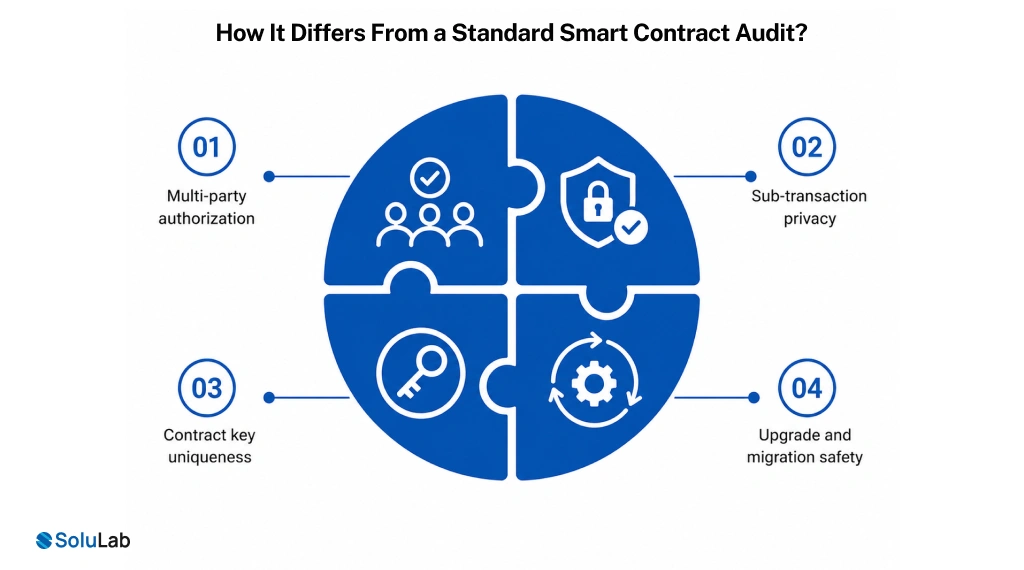
Solidity auditors spend most of their time hunting for reentrancy, integer overflow, and access-control bugs in a single, globally visible ledger. DAML auditors deal with a different set of problems entirely:
- Multi-party authorization. Every DAML transaction requires signatures from all parties with authority over the resulting contract state. Auditors verify that signatory, observer, and controller declarations match the actual business logic, not just the happy path.
- Sub-transaction privacy. Canton splits data across synchronizer domains so counterparties only see what they need to see. Auditors trace data flows to confirm sensitive fields never leak to a party who should not have visibility.
- Contract key uniqueness. DAML’s contract keys can create subtle collision or lookup bugs that have no real equivalent in EVM-based chains.
- Upgrade and migration safety. Canton supports package upgrades in place, and a poorly designed migration can silently orphan active contracts or break interoperability with contracts still on the old template version.
If your team already understands smart contract development on Ethereum or another EVM chain, expect DAML review to feel familiar at a high level and genuinely different once you get into the authorization graph.

Why DAML Smart Contract Security Can’t Be an Afterthought
Institutional blockchain adoption has moved from pilot projects to production infrastructure faster than most security budgets have caught up.
- Gartner projects worldwide IT spending will exceed $6.08 trillion in 2026, a 9.8% increase over 2025, with security and infrastructure investment climbing alongside it as enterprises push more mission-critical workloads onto distributed systems.
- That growth curve applies directly to institutional DLT projects, where Canton has become a default choice for anything related to tokenized securities, repo markets, or cross-border settlement.
- Once an institution commits to that stance, the ledger it chooses stops being an experiment. It becomes core infrastructure, and core infrastructure gets audited the way a bank audits its core banking system, not the way a hackathon team audits a weekend project.
- The cost of skipping that step is not theoretical. Statista’s tracking of information security spending, sourced from Gartner data, shows worldwide security spend climbing steadily year over year as breach costs and regulatory penalties both rise.
- A single missed authorization check in a tokenized bond settlement workflow can freeze positions worth far more than any audit invoice, and it can trigger the kind of regulatory scrutiny that no compliance team wants to explain to a board.
Who Actually Needs a DAML Audit
- Banks and custodians running tokenized asset issuance or settlement on Canton.
- Market infrastructure providers building repo, clearing, or collateral management workflows.
- Fintechs launching regulated stablecoin or deposit-token products.
- Consortiums deploying shared Canton domains across multiple competing institutions.
- Any team preparing for a regulatory review, SOC 2 audit, or investor due diligence process.
Common Vulnerabilities Found in DAML Contract Audits
Every DAML codebase is different, but the same handful of mistakes recur in DAML smart contract vulnerability assessments. Here are the ones worth checking first.
- Broken or over-permissive authorization. A choice marked nonconsuming when it should archive the contract, or a controller list that quietly includes a party who should never have unilateral authority.
- Contract key collisions. Two logically distinct contracts sharing a key structure, which can cause lookups to resolve to the wrong record under load or during concurrent workflows.
- Unsafe archive-and-recreate patterns. Workflows that archive a contract and recreate it without preserving the full authorization chain, opening a window where state can be manipulated between the two steps.
- Privacy leakage across domains. Data embedded in a contract payload that becomes visible to an observer who only needed to see a summary field, not the underlying detail.
- Upgrade logic that orphans contracts. A package upgrade that changes a template signature without a migration path, leaving live contracts stuck on a deprecated version.
- Insufficient DAML Script test coverage. Business logic validated only through the happy path, with no scripted tests for rejected transactions, expired contracts, or concurrent choice exercises.
- Weak integration boundaries. Off-ledger services (APIs, JSON Ledger clients, custom triggers) that trust ledger data without re-verifying party identity or contract state.
Finding these before mainnet deployment is the entire point of a DAML smart contract review. Finding them after is a production incident.
Inside a DAML Smart Contract Audit: The Process
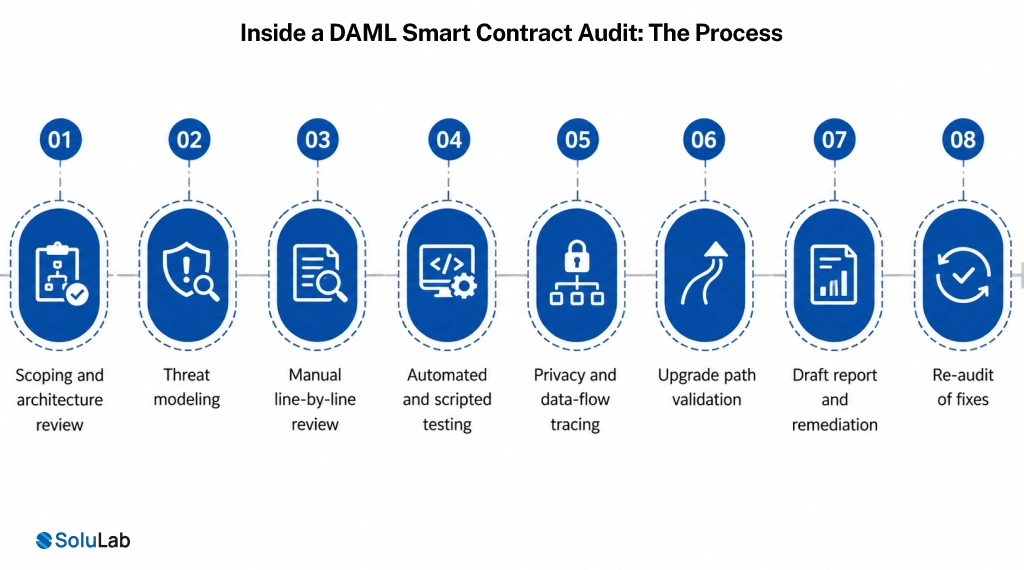
A serious DAML ledger security audit follows a defined sequence rather than an ad hoc code read-through. Here is roughly how SoluLab structures the engagement, and how most credible firms in this space run theirs.
- Scoping and architecture review. The audit team maps out every template, choice, and party relationship in the application, plus how it connects to off-ledger systems and any external triggers or automation.
- Threat modeling. Auditors identify the specific parties, assets, and workflows where a failure would cause the most damage, and prioritize review time accordingly rather than treating every line of code equally.
- Manual line-by-line review. Senior DAML engineers walk through authorization logic, contract key design, and choice implementations by hand, since automated tools still miss most business-logic errors.
- Automated and scripted testing. Daml Script suites simulate real transaction sequences, including adversarial ones, to confirm the ledger rejects transactions it should reject.
- Privacy and data-flow tracing. The team confirms that sensitive fields never propagate to a synchronizer domain or observer beyond what the design intends.
- Upgrade path validation. If the application uses package upgrades, auditors test the migration against contracts created under the prior template version.
- Draft report and remediation. Findings get ranked by severity (critical, high, medium, low, informational) with concrete fix recommendations, not just a description of the bug.
- Re-audit of fixes. Once the development team patches the issues, auditors verify each fix independently before issuing a final report.
Deloitte’s research on emerging technology governance has consistently pointed to the same pattern across industries: organizations that build review checkpoints into the development lifecycle, rather than bolting security on at the end, ship fewer critical incidents and recover faster when something does go wrong.
DAML projects are no exception, and the eight-step process above works best when it starts during design, not after code freeze.
Tools and Techniques Used in DAML Security Testing
DAML tooling is narrower than the Solidity ecosystem, so experienced auditors lean on a specific stack rather than a general-purpose scanner.
Native DAML Tooling
- DAML Script for scenario-based testing of multi-party workflows, including rejection paths.
- Daml Studio and the DAML IDE for static inspection of template and choice definitions.
- Sandbox and Canton Console for running the application against a local or test synchronizer to observe real transaction behavior.
Manual and Process-Based Techniques
- Authorization graph mapping, tracing every signatory and controller across the full contract lifecycle.
- Adversarial scripting, where auditors write scripts specifically designed to break assumptions the developers made.
- Data classification review, tagging every field in a template by sensitivity and checking it against the observer list.
- Upgrade dry-runs against a snapshot of production-like contract data.
There is no substitute for auditors who have actually shipped Canton applications. Blockchain security audit work on newer or lower-adoption languages depends heavily on pattern recognition built from real engagements, not just familiarity with the specification documents.
How to Choose a DAML Smart Contract Audit Company
Not every firm that lists “blockchain audits” on its homepage has touched DAML. Here is what actually separates a capable DAML smart contract audit company from one that will learn on your dime.
- Verifiable Canton experience. Ask for specific examples of DAML applications the team has audited or built, not general blockchain security credentials.
- Manual review depth, not just tooling. Since automated DAML scanners are still immature compared to the Solidity ecosystem, the quality of the engagement depends heavily on senior engineer time.
- Clear severity methodology. The firm should classify findings using a consistent framework (critical through informational) so your team can prioritize fixes realistically.
- A defined re-audit step. A firm that hands over a report and disappears is not finishing the job. Insist on a verification pass after fixes ship.
- Familiarity with your regulatory context. Financial institutions need auditors who understand SOC 2, DORA, or relevant regional frameworks well enough to phrase findings in language your compliance team can use.
- References from institutional clients. A firm serving banks and market infrastructure providers should be able to point to that track record, even if specific client names are confidential.
If you are comparing quotes, ask each vendor directly how many DAML-specific engagements they have completed. A generalist smart contract development company can often handle EVM work well and still be a poor fit for Canton, purely because the language and threat model are different enough to require dedicated expertise.
Best Practices to Prepare for Your DAML Audit
Going into an audit with clean documentation and reasonable test coverage shortens the engagement and improves the findings.
- Document the authorization model for every template before the audit starts, including who signs, who observes, and who controls each choice.
- Write DML script tests for failure cases, not just successful transactions, so auditors see how the system behaves under stress.
- Freeze the codebase for the duration of the review whenever possible, since scope creep mid-audit dilutes coverage.
- Separate business logic from integration code so auditors can distinguish ledger-level bugs from off-chain client issues.
- Plan the upgrade path in advance rather than treating package migration as an afterthought once the audit is underway.
- Budget time for remediation, not just the audit itself. Fixing a deep authorization flaw can take longer than finding it.
Teams that treat a DAML smart contract testing cycle as a one-time gate before launch tend to under-invest in the follow-up. Canton applications evolve, templates get upgraded, and every meaningful change deserves at least a targeted review, even if it falls short of a full re-audit.
Conclusion
DAML and Canton were built specifically for the kind of regulated, multi-party financial infrastructure where a security failure carries real institutional and regulatory weight, not just a headline. That is exactly why a generic smart contract review, built around EVM assumptions, will miss the authorization and privacy issues that matter most in this environment.
A proper DAML Smart Contract Security Audit has to account for signatory logic, sub-transaction privacy, contract key design, and upgrade safety as first-class concerns, backed by auditors who have actually worked inside the Canton ecosystem.
SoluLab, a Smart Contract Development Company with hands-on experience across DAML, Canton, and broader enterprise blockchain infrastructure, works with financial institutions and fintechs to secure Canton-based applications before they touch real assets or regulatory review.
Whether you need a pre-launch audit, a Smart Contract Consulting engagement to shape your architecture from day one, or ongoing Smart Contract Development Services as your Canton application grows, our team brings the DAML-specific depth this work actually requires
FAQs
Neha is a curious content writer with a knack for breaking down complex technologies into meaningful, reader-friendly insights. With experience in blockchain, digital assets, and enterprise tech, she focuses on creating content that informs, connects, and supports strategic decision-making.