In the early days of DeFi, earning yield was surprisingly messy. Every protocol built its own vault logic, accounting rules, and deposit mechanisms. For users, this meant navigating different interfaces across platforms. For developers, it meant integrating with a patchwork of smart contracts that rarely followed the same structure.
As yield strategies evolved from automated vaults to liquidity farming and structured DeFi products, the limitations of this fragmentation became clear. DeFi development solutions had powerful financial primitives, but they lacked a universal standard for yield-bearing vaults.
That gap led to ERC-4626, a tokenized vault standard that introduces a consistent framework for managing deposits, shares, and asset accounting. In this guide, we explore how ERC-4626 vaults work, why the standard matters for DeFi infrastructure, and what developers should know when implementing it.
Key Takeaways
- Featured Snippet / AEO Snippet Content
- ERC-4626 is an Ethereum token standard designed for tokenized yield vaults. It defines a common interface that allows DeFi protocols to manage deposits, withdrawals, and asset accounting in a standardized way. By issuing vault share tokens that represent a user’s ownership in pooled assets, ERC-4626 makes yield strategies easier to integrate across DeFi applications.
The Problem Before ERC-4626: Why DeFi Needed a Vault Standard
Before ERC-4626, yield vaults already existed across DeFi, but there was no common standard behind them. Each protocol designed its own vault logic, deposit mechanisms, and accounting models. While these systems worked individually, they created a major challenge for the ecosystem: lack of interoperability.
For developers, integrating vaults became unnecessarily complex. Every protocol exposed different functions and interaction patterns, forcing teams to build custom integrations for each vault system. This slowed development and limited DeFi’s ability to scale through composability.
Users experienced the friction as well. Vaults behaved differently across platforms:
- some issued share tokens
- others tracked balances internally
- yield accounting was often inconsistent
As a result, moving assets between protocols or comparing strategies required understanding entirely different vault mechanics.
This highlighted a clear architectural gap. DeFi had already standardized tokens through ERC-20 and NFTs through ERC-721, but one of its most widely used primitives – yield-bearing vaults—still lacked a unified interface.
As yield strategies became central to products like yield aggregators, automated asset managers, and structured DeFi strategies, the need for a standardized vault framework became increasingly clear.
ERC-4626 was introduced to fill that gap, providing a universal interface for tokenized vaults so that protocols, wallets, and aggregators could interact with yield-bearing assets in a consistent and predictable way.
What Is ERC-4626? Understanding the Tokenized Vault Standard
At its core, ERC-4626 is an Ethereum token standard designed for yield-bearing vaults. It defines a common interface that allows DeFi protocols to manage deposits, withdrawals, and yield distribution in a standardized way.
In simple terms, ERC-4626 turns a yield strategy into a tokenized vault. Users deposit assets into the vault and receive tokens that represent their ownership in the pooled funds. As the vault deploys those assets into yield-generating strategies, the value associated with those vault shares grows over time.
Instead of every protocol building its own vault logic, ERC-4626 introduces a unified structure for how vaults handle assets, shares, and accounting. This consistency makes it much easier for wallets, aggregators, and DeFi applications to integrate with yield vaults across the ecosystem.
A Simple Way to Think About ERC-4626
You can think of ERC-4626 vaults as on-chain asset management funds.
- Underlying assets → the capital deposited by users
- Vault shares → tokens representing ownership of the pooled assets
- Strategies → mechanisms that generate yield from those assets
- Vault contract → the smart contract managing deposits, withdrawals, and accounting
By standardizing these components, ERC-4626 turns vaults into interoperable building blocks that other DeFi protocols can easily integrate and build upon.
How ERC-4626 Tokenized Vaults Work
ERC-4626 vaults are designed to make yield strategies easier to manage and integrate across DeFi. Instead of every protocol inventing its own vault mechanics, the standard provides a predictable structure for how assets enter, generate yield, and exit a vault.
At a high level, an ERC-4626 vault acts as a smart contract that pools user deposits and allocates them to yield-generating strategies.
The Basic Vault Flow
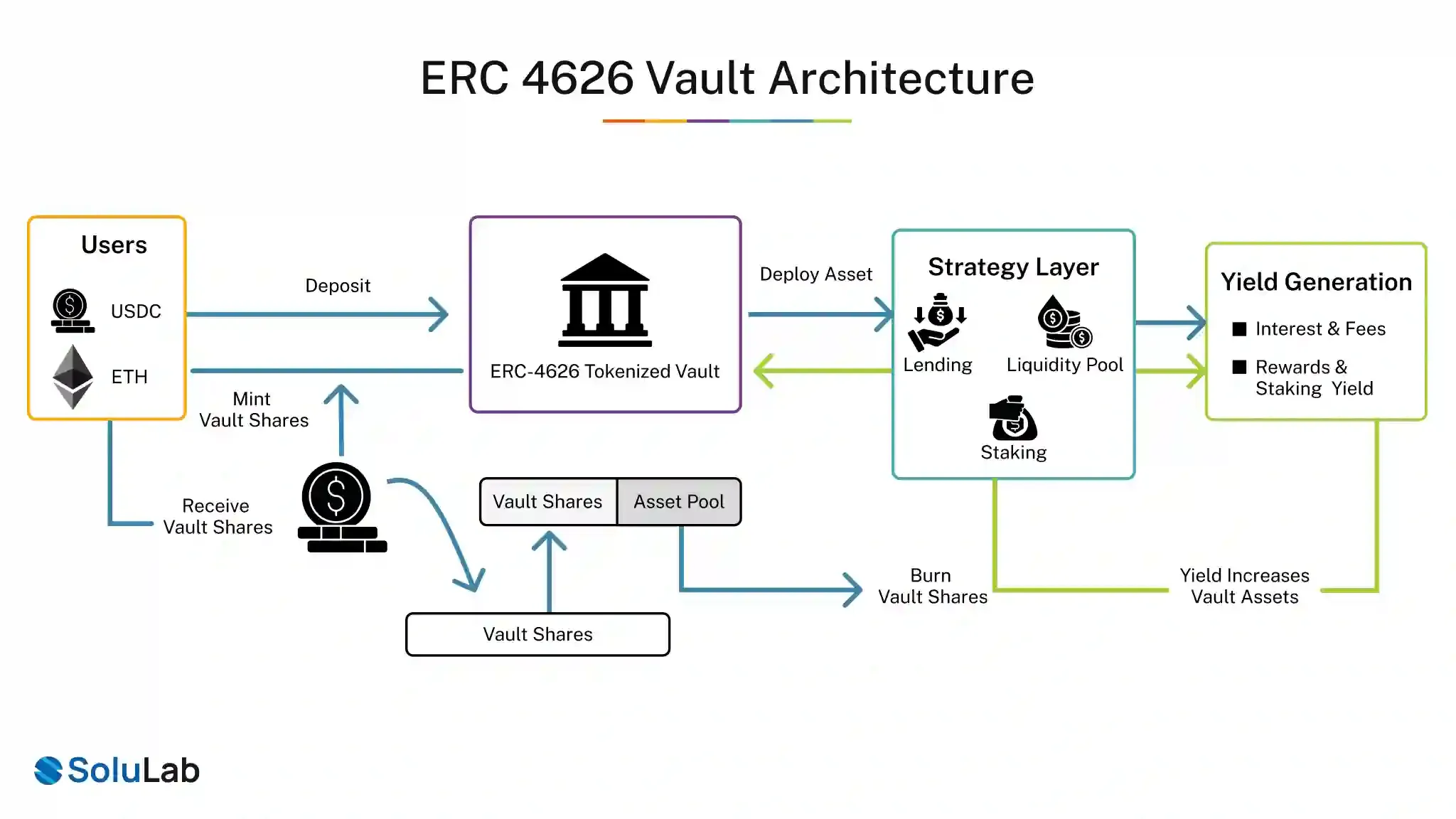
Most ERC-4626 vaults follow a simple lifecycle:
- User deposits an asset – A user deposits an underlying token such as USDC, DAI, or ETH into the vault.
- Vault mints share tokens – The vault issues ERC-4626 share tokens representing the user’s ownership in the pooled assets.
- Funds are deployed into strategies – The vault allocates capital to yield strategies such as lending markets, liquidity pools, or staking systems.
- Yield accumulates inside the vault – As strategies generate returns, the total assets held by the vault grow.
- Users redeem their shares – When users withdraw, their shares are burned, and the vault returns the underlying asset along with the accumulated yield.
Instead of distributing yield through reward tokens, the value of each vault share gradually increases as the vault earns returns.
Vault Shares: The Key Accounting Mechanism
ERC-4626 vaults track user ownership using shares rather than individual balances.
Each share represents a proportional claim on the vault’s total assets.
| Scenario | Vault Assets | Shares Issued | Value per Share |
| Initial deposits | 1,000 USDC | 1,000 shares | 1 USDC |
| After strategy yield | 1,200 USDC | 1,000 shares | 1.2 USDC |
Even though the number of shares stays the same, their value increases as the vault generates returns.
This model keeps accounting simple while allowing vaults to scale across large numbers of users.
The Architecture Behind an ERC-4626 Vault
Behind the scenes, most vault systems are structured into a few clear layers:
- User Layer – Users interact with the vault by depositing assets and redeeming shares through wallets or DeFi applications.
- Vault Contract – The vault contract manages deposits, share issuance, withdrawals, and overall accounting.
- Strategy Layer – Strategies deploy pooled assets into external DeFi protocols to generate yield.
- Underlying Asset – All vault operations ultimately revolve around a base token such as USDC, DAI, or wrapped ETH.
What makes this design powerful is its separation of responsibilities. The vault handles user interactions and accounting, while strategies focus purely on generating returns. This allows protocols to evolve their strategies without changing how users interact with the vault itself.
Once this structure is in place, the standard becomes even more powerful through the specific functions that every ERC-4626 vault must implement.
Read more – ERC-7943 Explained: Ethereum’s Official uRWA Standard
Core Functions in the ERC-4626 Standard
ERC-4626 works through a small set of standardized vault functions. These define how assets enter the vault, how shares are issued, and how users withdraw funds—making integrations easier for crypto wallets, aggregators, and DeFi protocols.
Key vault actions include:
- deposit() – Users deposit assets (e.g., USDC or ETH) and receive vault shares.
- mint() – Users request a specific number of shares; the vault calculates the required assets.
- withdraw() – Users withdraw a chosen asset amount by burning the corresponding shares.
- redeem() – Users redeem shares for their equivalent underlying assets.
Supporting functions like totalAssets(), convertToShares(), and convertToAssets() help protocols estimate vault value and simulate transactions.
Benefits of ERC-4626 Implementation in DeFi Protocols
ERC-4626 did not introduce the concept of yield vaults – those already existed across DeFi. What the standard brings is consistency in how vaults handle deposits, shares, and asset accounting.
By defining a common interface, ERC-4626 reduces the integration complexity that previously existed between vault protocols and the broader DeFi ecosystem.
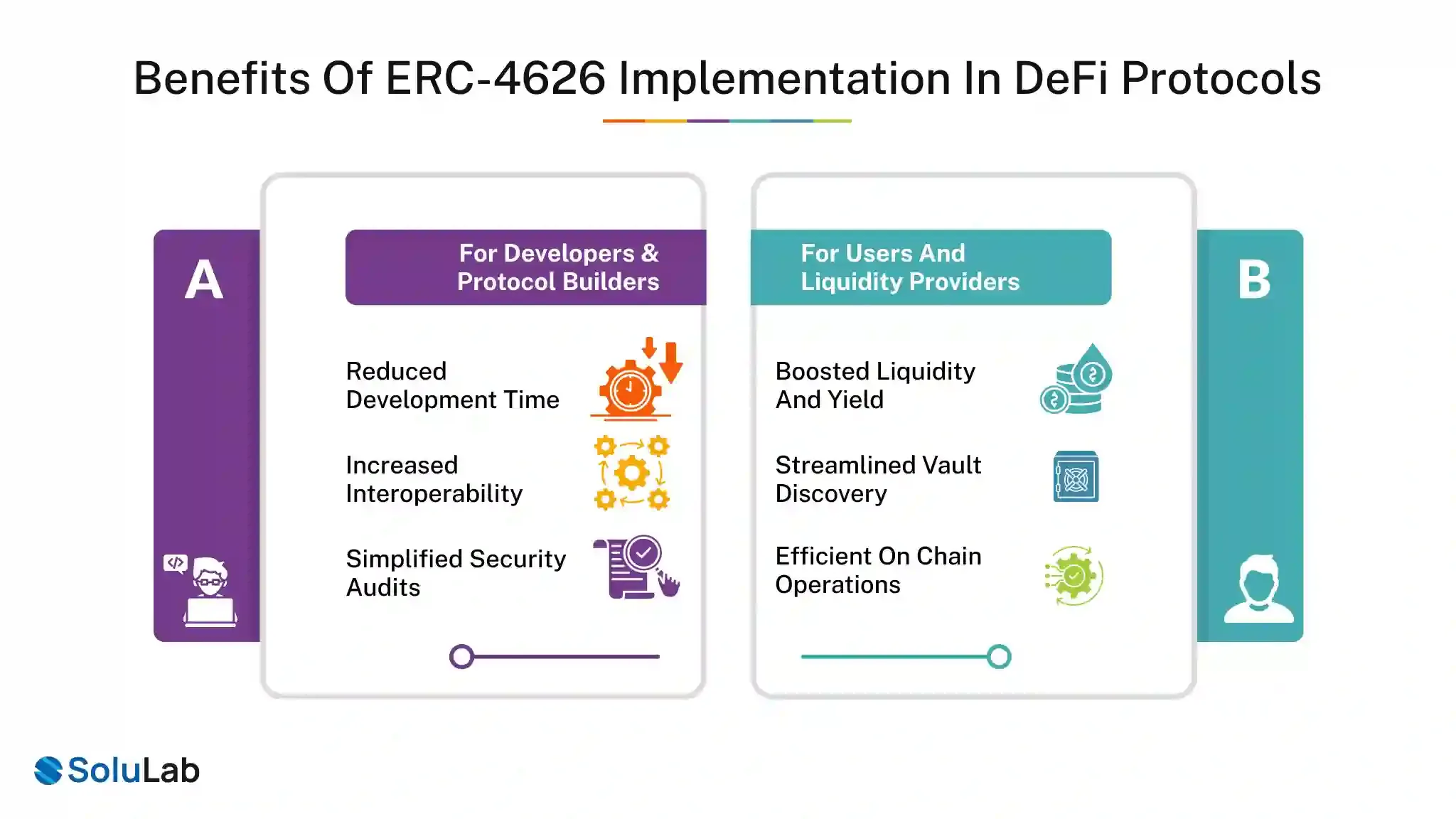
For Developers and Protocol Builders
For developers, the biggest advantage of ERC-4626 is standardized integration. Instead of adapting to different vault implementations, protocols can interact with vaults using a predictable set of functions.
This enables:
- faster integrations with vault protocols
- easier composability across DeFi applications
- simpler architecture for new yield products
- reduced development overhead when adding strategies
As a result, vault strategies become modular infrastructure that multiple protocols can build around.
For Users and Liquidity Providers
Standardized vault mechanics also improve the user experience across DeFi platforms.
ERC-4626 vaults provide:
- consistent deposit and withdrawal processes
- transparent accounting through vault share values
- easier comparison of yield strategies across protocols
For users, this reduces friction when moving assets between different DeFi platforms.

ERC-4626 vs Traditional ERC-20 Tokens
At a glance, ERC-4626 vault shares may look similar to regular ERC-20 tokens. Both are transferable tokens that exist on the Ethereum network. But their roles inside DeFi are very different.
A typical ERC-20 token represents a standalone digital asset. Its value is usually determined by market supply and demand.
An ERC-4626 token, on the other hand, represents ownership in a vault that holds and deploys underlying assets.
Instead of functioning as a simple asset, ERC-4626 tokens act more like shares in a pooled investment strategy.
The Key Concept
When users deposit assets into an ERC-4626 vault:
- the vault receives the underlying token (such as USDC or ETH)
- the vault issues share tokens representing ownership
- the deposited assets are deployed into yield strategies
- the vault’s total assets grow as strategies generate returns
As the vault earns yield, the value of each share increases, reflecting the performance of the underlying strategy.
ERC-4626 vs ERC-20: Quick Comparison
| Feature | ERC-20 Token | ERC-4626 Vault Token |
| Purpose | Fungible digital asset | Share of a yield vault |
| Yield generation | Not built into the token | Generated through vault strategies |
| Value model | Market price | Share of vault assets |
| Asset backing | Optional | Backed by vault deposits |
| Use cases | Payments, governance, utilities | Yield strategies and asset management |
Why ERC-4626 Extends ERC-20
Rather than replacing ERC-20, the ERC-4626 standard builds on top of it. Vault shares remain compatible with the ERC-20 interface, which means they can interact seamlessly with the broader Ethereum ecosystem.
This compatibility allows vault shares to be:
- transferred between wallets
- integrated into DeFi dashboards
- used as collateral in lending protocols
- combined with other financial primitives
In practice, this means ERC-4626 vaults don’t just generate yield and they also create portable assets that can move across the DeFi ecosystem.
ERC-4626 in Yield-Bearing DeFi Vaults: Real-World Use Cases
With a standardized vault structure, ERC-4626 makes it easier for DeFi protocols to build and integrate yield strategies. Instead of developing custom vault logic, projects can reuse a common framework across different products.
Some common use cases include:
- Yield Aggregators – Platforms that automatically allocate funds across multiple DeFi protocols to optimize returns. ERC-4626 allows aggregators to interact with different vaults using a consistent interface.
- Automated Asset Management – Protocols that function like on-chain asset managers, allocating pooled capital across strategies while keeping deposits and accounting standardized.
- Structured DeFi Products – Advanced strategies such as automated yield portfolios, multi-strategy vaults, or risk-managed investment products built on top of standardized vault infrastructure.
ERC-4626 allows these systems to focus on strategy design instead of rebuilding vault mechanics.
Risks and Security Considerations in ERC-4626 Vaults
ERC-4626 standardizes how vaults interact with users and protocols, but it does not eliminate the risks associated with DeFi strategies. The standard defines the interface, while the safety of a vault still depends on how its contracts and strategies are designed.
Understanding these risks is important when evaluating any ERC-4626 vault.
Smart Contract Risk
ERC-4626 vaults rely on smart contracts to manage deposits, shares, and strategy execution. Vulnerabilities in these contracts could expose funds to loss.
Common risks include:
- coding errors in vault contracts
- vulnerabilities in integrated protocols
- flawed or poorly tested strategy logic
For this reason, most production vaults undergo independent smart contract audits.
Strategy Risk
Vaults often deploy assets into external DeFi protocols such as:
- lending platforms
- liquidity pools
- derivatives protocols
If these systems experience exploits, liquidity shocks, or extreme market volatility, the vault’s assets may be affected.
Liquidity Risk
Some strategies lock funds into protocols with limited liquidity. Large withdrawals may require unwinding positions or using liquidity buffers.
Oracle Risk
Strategies that rely on price feeds may be exposed to oracle manipulation or delayed data, which can affect trading or asset valuation.
Understanding these risks highlights the importance of careful vault design, auditing, and strategy management.
ERC-4626 Implementation: What Developers Should Consider
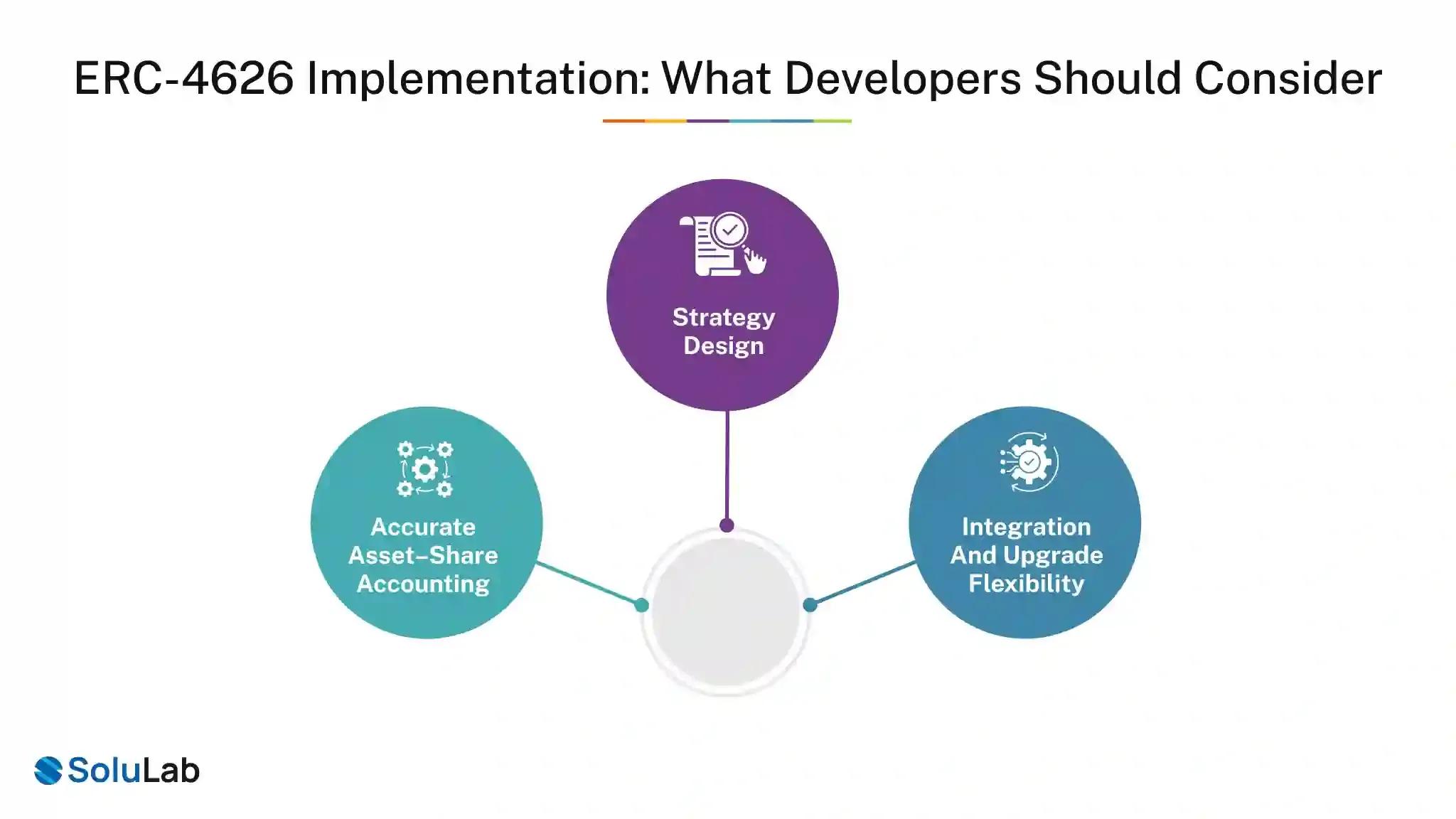
Implementing ERC-4626 is relatively simple at the interface level, but building a production-ready vault requires careful design. While the standard defines how vaults interact with users and protocols, the implementation determines the vault’s security, efficiency, and scalability.
Developers typically focus on three key areas:
- Strategy Design – Vaults generate yield through strategies that deploy assets into DeFi protocols such as lending markets or liquidity pools. Developers must decide where funds are deployed, how strategies rebalance capital, and how risk exposure is managed.
- Accurate Asset–Share Accounting – ERC-4626 vaults rely on precise conversion between assets and shares. Proper share minting, burning, and rounding logic ensures deposits and withdrawals remain fair for all users.
- Integration and Upgrade Flexibility – Vaults often interact with external protocols, so designs must allow strategies to be upgraded or replaced without changing the vault interface.
This separation between vault accounting and strategy execution helps protocols adapt strategies while keeping user interactions stable.
The Future of ERC-4626 and Tokenized Yield Infrastructure
Although ERC-4626 is still relatively new, it is quickly becoming an important part of DeFi infrastructure. As more protocols adopt the standard, vault-based strategies are becoming easier to integrate across different platforms.
One major impact of ERC-4626 is improved DeFi composability. When vaults follow the same interface, other protocols such as lending platforms, aggregators, and portfolio managers can interact with them more easily.
This opens the door for new types of financial products built on top of standardized vault systems, including:
- automated portfolio management platforms
- multi-strategy yield aggregators
- tokenized investment funds
- structured DeFi yield products
Another emerging direction is the connection between vault frameworks and tokenized real-world assets (RWAs). As financial instruments move on-chain, vault standards like ERC-4626 could help manage tokenized credit products, treasury strategies, and other yield-bearing digital assets.
As DeFi continues to mature, standards like ERC-4626 are likely to play a key role in shaping how yield strategies are built, integrated, and scaled across the ecosystem.
ERC-4626 and the Rise of Standardized DeFi Vaults
As DeFi continues to mature, standards are becoming essential to how protocols connect and scale. ERC-4626 brings structure to one of the most important components of decentralized finance, yield-generating vaults.
By standardizing how deposits, withdrawals, and vault shares are handled, the ERC-4626 tokenized vault standard makes it easier for developers to build interoperable yield strategies and for users to interact with vaults more predictably.
As adoption grows, ERC-4626 is steadily turning vault strategies into composable financial primitives, enabling protocols to integrate yield infrastructure more seamlessly across the DeFi ecosystem.
FAQs
Shipra Garg is a tech-focused content strategist and copywriter specializing in Web3, blockchain, and artificial intelligence. She has worked with startups and enterprise teams to craft high-conversion content that bridges deep tech with business impact. Her work translates complex innovations into clear, credible, and engaging narratives that drive growth and build trust in emerging tech markets.