Key Takeaways
- Payment tokenization swaps sensitive card data for a token that’s meaningless to anyone who steals it, reducing what a business needs to protect in the first place.
- Tokenization and encryption solve overlapping but different problems. One replaces data permanently; the other scrambles it reversibly with a key.
- Network tokens, issued directly by Visa or Mastercard, now handle a growing share of card-not-present transactions and update automatically when a card is reissued.
- Tokenization reduces PCI DSS audit scope. It does not make a business automatically compliant on its own.
- Most implementation headaches come from token lifecycle management and vendor lock-in, not from the core tokenization technology itself.
Payment tokenization replaces a customer’s actual card number with a randomly generated substitute, called a token, so the real card data never has to sit on a merchant’s servers or travel across the internet in a usable form.
If someone intercepts the token, it’s worthless outside the specific system that issued it.
This is a different mechanism from asset tokenization, where real-world assets like real estate, securities, or commodities get represented as digital tokens on a blockchain to fractionalize ownership and enable trading — payment tokenization protects a data field, asset tokenization digitizes ownership itself. Both borrow the same core idea (swap something sensitive or illiquid for a token that stands in for it), but they solve different problems.
Deloitte’s 2026 payments industry outlook points to regulatory pressure, faster settlement rails, and rising AI-driven fraud as the dominant forces reshaping payment infrastructure this year.
This guide walks through how tokenization actually works step by step, the different types merchants use, how it compares to encryption, and what it takes to implement it properly.
What Is Payment Tokenization?
Payment tokenization is the process of substituting a sensitive payment credential, typically a card’s primary account number, with a unique, non-sensitive token that has no exploitable value on its own. The token looks similar in format to a real card number, so existing systems can still process it, but it can only be reversed back into the original data by the specific tokenization system that generated it.
Think of it like a coat check ticket. The ticket itself doesn’t get you into a fancy restaurant, but the attendant holding the actual coat can match your ticket number to the real item. A stolen ticket is useless to anyone who doesn’t control that matching system. That’s the entire premise behind payment tokens: replace something valuable with a reference that only makes sense inside a controlled environment.
What Data Does Payment Tokenization Protect?
Tokenization typically covers:
- Card numbers (the primary account number, or PAN)
- Bank account and routing information for ACH and direct debit transactions
- Payment credentials stored for recurring billing or one-click checkout
- Personally identifiable payment data, such as billing addresses tied to a stored payment method
How Does Payment Tokenization Work?
The mechanics are consistent across most providers, even though the underlying vaults and token formats differ.
- The customer enters payment information at checkout, either typing a card number or using a saved payment method.
- That raw payment data is sent, typically over an encrypted connection, to the tokenization provider rather than staying on the merchant’s own servers.
- The provider securely stores or processes sensitive data within a protected environment, typically a token vault.
- A unique token is generated and returned to the merchant in place of the real card number.
- The merchant stores this token, not the card data, in its own database for any future reference.
- When the customer returns for a repeat purchase or a subscription renewal, the merchant sends the token instead of asking for card details again.
- The payment processor receives the token, maps it back to the original credentials inside its secure vault, and completes the authorization.
Payment Tokenization Example
Here’s what that looks like end-to-end: a subscription box company charges a customer every month. On the first purchase, the customer’s card gets tokenized. Every month after that, the merchant’s billing system sends the stored token to the processor, which detokenizes it internally, checks that the card is still valid, and charges it. The merchant’s database, if ever breached, only ever contained a token that no attacker can turn back into a working card number.
What Are the Main Types of Payment Tokenization?
Not all tokens are created by the same party or work the same way.
1. Merchant Tokenization
The merchant, or their payment service provider, generates and stores its own tokens. This is the most common setup for smaller businesses using a hosted checkout page, where the provider handles both the tokenization and the storage.
2. Network Tokenization
Card networks like Visa and Mastercard issue their own tokens directly, tied to the specific device or merchant relationship. Network tokens carry a real advantage: when a customer’s card expires or gets reissued, the network updates the token automatically behind the scenes, so a subscription doesn’t fail just because a physical card changed.
3. Vault-Based Tokenization
A dedicated token vault stores the mapping between tokens and the real payment data, usually managed by a specialized security provider rather than the merchant itself. There’s also a vaultless tokenization approach that uses cryptographic algorithms to generate and reverse tokens mathematically instead of storing a lookup table, which removes the vault as a single point of failure. We’ve covered the trade-offs between these two approaches in detail in our vaultless tokenization guide, worth a read if you’re choosing between architectures.
4. Acquirer or Processor Tokenization
The bank or payment processor handling a merchant’s transactions issues tokens as part of its own gateway service, often bundled into standard processing fees, which makes this the lowest-friction option for businesses that don’t want to manage a separate vendor relationship.
This bundled model is often what people mean by tokenization as a service: the processor handles generation, storage, and lifecycle management, and the merchant never has to touch the underlying infrastructure directly.
Payment Tokenization vs Encryption and Other Security Methods
Tokenization and encryption get lumped together often, but they solve the problem differently.
| Factor | Payment Tokenization | Encryption |
| Data replacement | Replaces sensitive data with a token | Scrambles the original data mathematically |
| Reversibility | Requires token-to-data mapping in a vault or algorithm | Uses a decryption key to reverse |
| Primary use | Payment-data protection at rest and in storage | Broad data protection, including data in transit |
| PCI DSS scope | Can reduce audit scope significantly | Depends heavily on implementation and key management |
| Typical payment use | Card credentials, stored payment methods | Data transmission and storage generally |
The short version: encryption protects data everywhere it travels, but the encrypted data is still technically the original data, one key away from being readable. Tokenization removes the original data from the environment entirely once it’s been swapped out, which is why it tends to shrink compliance scope more aggressively for payment-specific use cases.
We go deeper into this distinction, including where hashing fits in, in our full tokenization vs encryption comparison. PCI tokenization vs encryption decisions usually come down to whether you need to reverse the data broadly (encryption) or just need a safe stand-in for storage and repeat transactions (tokenization).
Why Payment Tokenization Matters
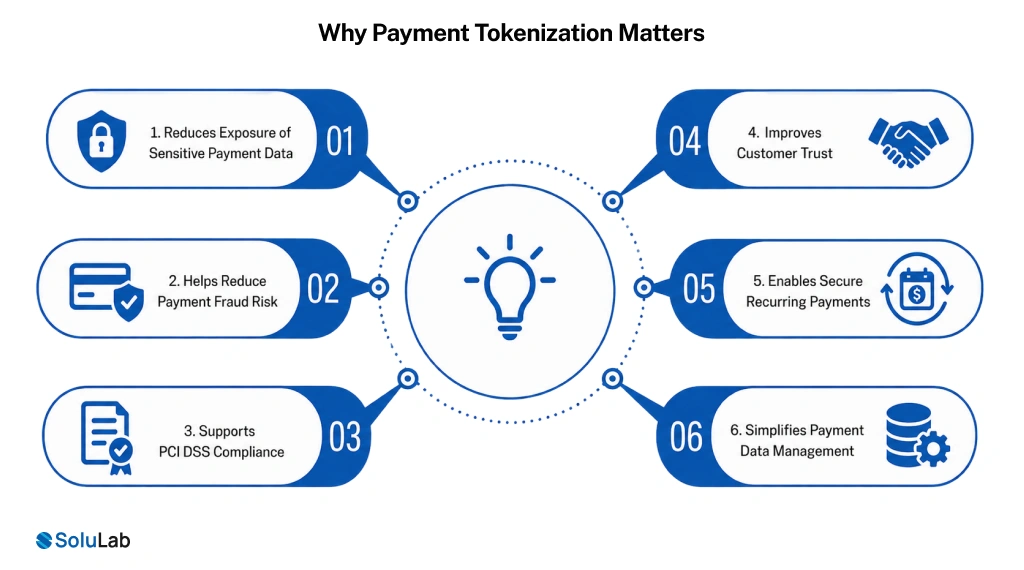
Here are some benefits of payment tokenization:
1. Reduces Exposure of Sensitive Payment Data
If a token is stolen, there’s nothing for a fraudster to do with it outside the exact system that issued it. That single property eliminates most of the downstream damage from a data breach.
2. Helps Reduce Payment Fraud Risk
Card-not-present transactions, the kind that happen online or over the phone, have historically driven the bulk of card fraud losses. Statista’s aggregation of European Central Bank data shows card-not-present fraud has accounted for roughly 73% of total card fraud value in recent reporting years, up from a smaller share a decade earlier, as commerce shifted online faster than fraud controls could keep pace. Tokenized payments directly target this exposure, since a token intercepted in a CNP transaction carries no usable value.
3. Supports PCI DSS Compliance
Systems that only ever handle tokens, never the real card number, can often be excluded from PCI DSS assessment scope entirely, cutting audit time and cost.
4. Improves Customer Trust
Customers increasingly notice when a checkout flow feels secure, even if they can’t articulate why. Fewer stored-card breaches in the news for a brand translates into fewer hesitant customers at checkout.
5. Enables Secure Recurring Payments
Subscription businesses need to charge a card repeatedly without re-asking for details every time. Tokenized transactions make that possible without keeping the real card number on file anywhere in the merchant’s own systems.
6. Simplifies Payment Data Management
Fewer systems touching raw card data means less to secure, audit, and monitor, which adds up to a smaller attack surface across the whole payment stack.
What Are the Benefits of Payment Tokenization for Businesses?
- Reduced sensitive-data exposure across every system that touches a transaction
- Better payment security without slowing down the checkout experience
- Lower compliance burden and smaller PCI DSS audit scope
- Safer recurring and subscription transactions
- Improved customer experience through faster, saved-card checkouts
- Greater flexibility across payment channels, from web to mobile to in-app
- Reduced impact of data breaches, since stolen tokens have no resale value
Juniper Research’s analysis, cited via Statista, projects cumulative merchant losses to online payment fraud will exceed $343 billion globally between 2023 and 2027. That’s the kind of number that turns tokenization from a nice-to-have into a business continuity decision, not just a technical checkbox.
Where Is Payment Tokenization Used?
- eCommerce payments — protecting stored cards for guest and returning checkout flows
- Mobile wallets — Apple Pay and Google Pay both run on network tokenization under the hood
- Subscription payments — recurring billing that survives card reissuance without customer intervention
- Buy Now, Pay Later — installment providers tokenize the underlying payment method across multiple future charges
- Banking and fintech — internal systems tokenize account numbers for safer data sharing between services
- In-app payments — mobile apps store a token instead of asking users to re-enter card details each session
- Omnichannel payments — a single token can sometimes work across a retailer’s online store, mobile app, and in-store terminal
- Crypto and digital asset payments — the same tokenization logic underpins crypto payment gateway builds, where wallet addresses and transaction credentials get tokenized instead of card numbers
How to Implement Payment Tokenization
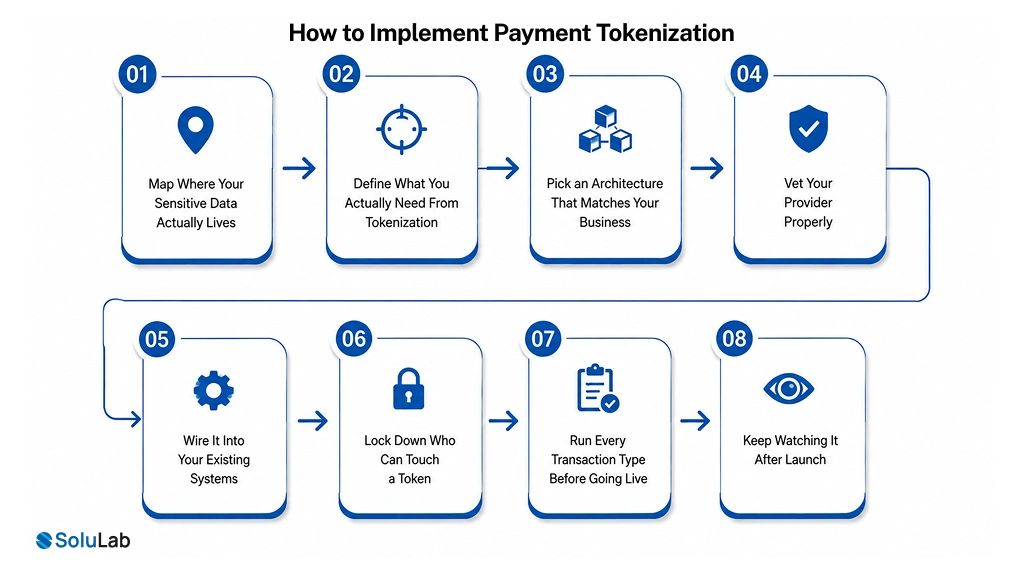
Getting tokenization live isn’t a single switch you flip. It’s a sequence of decisions, most of which get harder to undo the further along you are, so it pays to get the order right.
1. Map Where Your Sensitive Data Actually Lives
Before anything else, walk through every system that touches a card number, a bank account detail, or a stored credential. Checkout pages are the obvious one. CRMs, billing tools, customer support platforms, and old database backups tend to be the ones teams forget, and they’re usually where an audit turns up a surprise.
2. Define What You Actually Need From Tokenization
Not every business needs the same thing here. Figure out which data has to be tokenized, which regulations apply to your industry and geography, and, just as important, what happens if your provider goes down or shuts up shop. That last question gets skipped constantly, and it’s the one that causes the most pain later.
3. Pick an Architecture That Matches Your Business
Vault-based, vaultless, network-issued, or bundled into your acquirer’s gateway. There’s no universally “best” option here. A high-volume subscription business has different needs than a small shop running occasional card-not-present sales, so let your transaction volume and existing processor relationship do most of the deciding.
4. Vet Your Provider Properly
Don’t just check the PCI compliance box and move on. Look at uptime history, how detokenization requests get logged, and how transparent the provider is when something goes wrong. This is the relationship you’re stuck with if you ever need to switch, so treat the evaluation like it matters.
5. Wire It Into Your Existing Systems
This is where most of the real engineering time goes, especially if you’re running custom billing logic or an older CRM that wasn’t built with tokens in mind. Budget more time for this step than you think you need.
6. Lock Down Who Can Touch a Token
A token isn’t sensitive the way a raw card number is, but it still shouldn’t be freely accessible. Apply role-based access controls to the tokens themselves, not just the vault sitting behind them.
7. Run Every Transaction Type Before Going Live
Test the full lifecycle, not just a happy-path purchase. Refunds, partial captures, and subscription renewals all behave a little differently, and it’s much cheaper to catch a broken renewal flow in staging than after your first billing cycle in production.
8. Keep Watching It After Launch
Tokenization isn’t a project with an end date. Review logs regularly, and reassess your provider on some kind of cadence rather than assuming day-one performance holds forever.
Tokenization sits at the intersection of all three. It’s a regulatory-friendly control, it doesn’t slow down real-time payment rails the way heavier encryption workflows can, and it takes the raw data off the table that AI-assisted fraud tooling would otherwise have to defend.
Payment Tokenization Best Practices
- Never store payment credentials you don’t have a clear, ongoing business need for.
- Use secure, independently audited token vaults rather than building your own from scratch.
- Apply strict, role-based access controls to every system that can request detokenization.
- Monitor token activity continuously, treating unusual detokenization patterns as a security signal.
- Define clear token expiration and lifecycle policies tied to the underlying card’s actual status.
- Regularly test integrations, especially after any changes to processors or providers.
- Evaluate third-party payment providers carefully before committing, since their security posture becomes yours.
- Keep compliance requirements current, since PCI DSS itself continues to evolve.

Conclusion
Payment tokenization has moved from a nice-to-have security layer to close to table stakes for any business handling recurring or card-not-present transactions. The mechanics are straightforward once you’ve seen them mapped out: replace the sensitive data, keep the token, let a controlled system handle the reversal.
The harder part is choosing the right architecture for your transaction volume, integrating it cleanly across existing systems, and maintaining the token lifecycle discipline that keeps the whole approach effective over time.
SoluLab, an asset tokenization development company, can help your business design and implement a payment tokenization solution that fits your existing payment stack, whether that means a payment tokenization API integration, a full PCI-compliant tokenization solution build, or advisory work choosing between vault-based and vaultless architectures.
The same team also handles crypto payment gateway development for businesses looking to accept digital assets alongside traditional card payments. Book a free consultation to walk through your current payment flow and where tokenization fits, or talk to a payments engineer about integration timelines for your specific processor.
FAQs
Neha is a curious content writer with a knack for breaking down complex technologies into meaningful, reader-friendly insights. With experience in blockchain, digital assets, and enterprise tech, she focuses on creating content that informs, connects, and supports strategic decision-making.