Key Takeaways
- Tokenized gaming converts in-game items, currencies, and characters into blockchain-based tokens that players can own, trade, and move across platforms.
- Fungible tokens usually represent in-game currency, while non-fungible tokens represent unique items such as skins, weapons, or land parcels.
- A tokenized gaming platform depends on three moving parts: a token standard, a smart contract layer, and a wallet or marketplace where players transact.
- Studios adopt gaming tokenization to unlock new revenue models, deepen player retention, and build economies that outlast a single game title.
- Regulatory uncertainty, gas fees, and player onboarding friction remain the biggest hurdles to mainstream adoption.
- Working with an experienced gaming tokenization development company shortens the path from concept to a compliant, working platform.
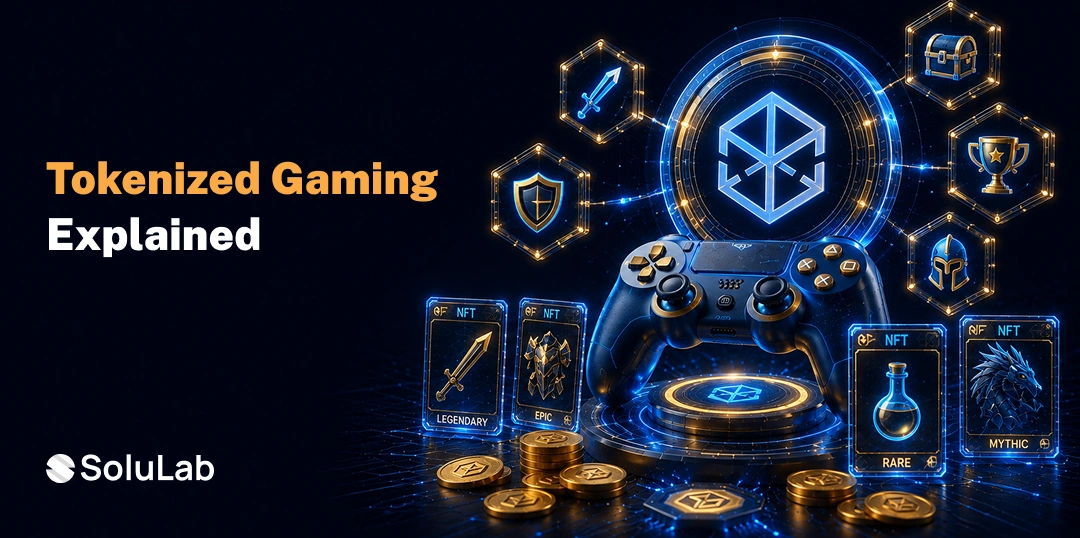
Tokenized gaming is the practice of converting in-game assets, currencies, and even player achievements into blockchain-based tokens that carry real, verifiable ownership. Instead of a sword skin sitting in a publisher’s database, it becomes a token in a player’s wallet, tradable on-chain and, in many cases, usable outside the original game.
That shift sounds small. It isn’t. Traditional games treat every purchase as a license, not an asset. You buy a skin, and the moment you stop playing, that skin has no life outside the app. A blockchain development approach flips that model: the asset lives on a public or permissioned ledger, independent of any single game server, so it survives even if the game itself shuts down.
This guide breaks down what tokenized gaming actually means, how the technology works under the hood, and why studios, publishers, and investors are paying closer attention to it heading into 2026. We’ll also cover the risks nobody talks about at the pitch-deck stage, and what it takes to actually build one of these platforms.
What Is Tokenized Gaming?
Tokenized gaming is a model where digital game assets, weapons, land, characters, currency, or achievements are represented as tokens on a blockchain rather than as rows in a centralized database. Ownership is recorded on-chain, which means it can be verified independently of the game studio’s servers.
In fact, the global games market will climb to $206.5 billion in 2028, reflecting a +3.0% CAGR. Players will expand to nearly four billion worldwide.
This is different from simply “adding crypto” to a game. Gaming tokenization is an architectural decision. It determines who controls the asset, how it can be transferred, and whether it can move between different games or platforms at all.
Fungible vs. Non-Fungible Game Tokens
Most tokenized games use two token types side by side:
- Fungible tokens (FTs): Interchangeable units, typically used as in-game currency, crafting materials, or governance tokens. One unit is identical to another, similar to how one dollar equals another dollar.
- Non-fungible tokens (NFTs): Unique, one-of-a-kind assets such as a specific character skin, a rare weapon, or a plot of virtual land. No two are exactly alike, even if they look similar on the surface.
A well-designed tokenized gaming platform usually runs both types in parallel, using fungible tokens for the economy and non-fungible tokens for ownership of specific items.
How Does Gaming Asset Tokenization Work?
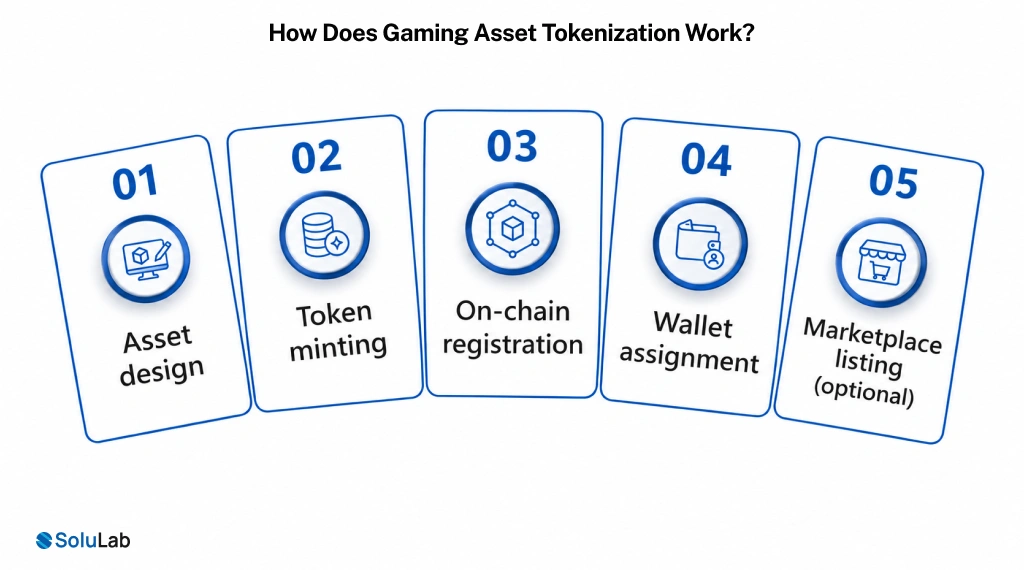
Game asset tokenization is a fairly specific technical pipeline. Here’s how a typical tokenized in-game asset moves from creation to a player’s wallet.
- Asset design: The studio defines what the asset represents (a weapon, a skin, a plot of land) and its metadata (rarity, stats, image).
- Token minting: A smart contract development team writes and deploys the contract that mints the token, following a standard such as ERC-721 or ERC-1155 on Ethereum, or an equivalent standard on chains like Polygon, Solana, or Immutable.
- On-chain registration: The minted token is recorded on the blockchain ledger, permanently tying the asset’s metadata to a unique token ID.
- Wallet assignment: The token is transferred to the player’s wallet, either automatically (in-game achievement) or through a purchase transaction.
- Marketplace listing (optional): Players can list the token for trade or sale on an in-game or third-party marketplace, with the smart contract enforcing royalty splits back to the original creator.
Gas fees and transaction speed matter a lot here. A game minting thousands of items per hour on a congested mainnet will frustrate players fast, which is why most tokenized gaming projects lean on Layer-2 networks or gaming-specific chains that keep costs near zero.
Tokenized In-Game Assets vs. Traditional Gaming NFTs
People often use “tokenized gaming” and “gaming NFTs” interchangeably, but there’s a real distinction worth making.
A traditional gaming NFT project usually treats the NFT as a static collectible, something you own, display, maybe resell, but with limited in-game utility beyond cosmetic value. Tokenized gaming, in the broader sense, extends further. It includes fungible currency tokens, governance tokens for community-run game economies, and NFTs that carry functional stats affecting gameplay, not just appearance.
In practice, this means a tokenized gaming platform often needs more than a simple NFT marketplace development build. It needs an economy layer: token issuance rules, inflation controls, and a marketplace that can handle both fungible and non-fungible transfers without breaking game balance.
| Aspect | Traditional Gaming NFT | Full Tokenized Gaming Platform |
| Asset type | Mostly NFTs (collectibles) | FTs + NFTs (currency + items) |
| Utility | Cosmetic, resale value | Gameplay-affecting, cross-title use |
| Economy design | Minimal | Requires inflation/deflation controls |
| Interoperability | Rare | Often a stated goal |
Why Tokenized Gaming Matters in 2026
The interest in tokenized gaming isn’t just hype carried over from the 2021 NFT boom. Statista’s market outlook notes that the NFT space has cooled significantly since the 2021 to 2022 peak, but is showing early signs of structural maturity.
- With brands increasingly using NFTs for collectibles, ticketing, and loyalty programs, and gaming platforms creating new utility-driven use cases beyond speculative art sales.
- That cooling matters more than it sounds. It means the studios still building in this space are doing it for utility, not speculation, and that’s a healthier foundation for Web3 development long-term.
- Player appetite for games in general hasn’t slowed down either. Deloitte’s Digital Consumer Trends research found that a large majority of adults already play games on some device, putting the addressable audience for any gaming-adjacent technology, tokenization included, in the billions. When even a small percentage of that base engages with tokenized economies, the transaction volume adds up fast.
- There’s also a structural argument from Gartner, which has long framed tokenization as one of the five defining elements of blockchain technology, alongside encryption, immutability, decentralization, and distribution.
- Gaming happens to be one of the few consumer categories where all five elements are visible to an everyday user in a single product, which is part of why gaming is often the entry point for people’s first real interaction with blockchain technology.
Key Benefits of a Tokenized Gaming Platform
Studios don’t adopt tokenized gaming assets for novelty. The business case usually comes down to a handful of concrete advantages.
- True asset ownership. Players hold the token in their own wallet, not in a database row the studio can revoke or wipe.
- New revenue streams. Secondary-market royalties, primary sales of rare items, and token-based season passes all create income beyond the initial purchase.
- Cross-title utility. A well-architected blockchain game development strategy lets assets move between titles from the same studio or partner network, extending the lifespan of every item sold.
- Stronger retention. Players who’ve invested real value into an economy tend to stick around longer, since walking away means leaving value on the table.
- Transparent economies. On-chain transactions are auditable, which reduces disputes over duplication, fraud, or unauthorized item generation.
- Community governance. Token-based voting lets active players influence game updates, item drops, or economic parameters, turning players into stakeholders.
Challenges and Risks in Tokenization in Gaming
It would be dishonest to present tokenized gaming as a solved problem. Several real risks show up in almost every project.
- Regulatory ambiguity. Depending on the jurisdiction and how a token is structured, regulators may classify certain in-game tokens as securities, which triggers a very different compliance path than a standard cosmetic NFT. This is exactly where asset tokenization development services with legal and compliance experience earn their keep, because getting the token structure wrong at design time is expensive to fix later.
- Player onboarding friction. Asking a casual gamer to set up a wallet, buy crypto, and manage gas fees before they can play is still a major drop-off point. Games that hide this complexity behind custodial wallets and fiat on-ramps tend to convert better.
- Economic design failures. Play-to-earn titles from 2021 to 2022 showed what happens when token emissions outpace demand: the token collapses, and player trust collapses with it. Digital asset tokenization in gaming only works long-term if the economy is modeled with the same rigor as a real financial system.
- Security exposure. Smart contracts holding real value are a target. Audits aren’t optional; they’re the minimum bar before any token goes live.
How to Build a Tokenized Gaming Platform?
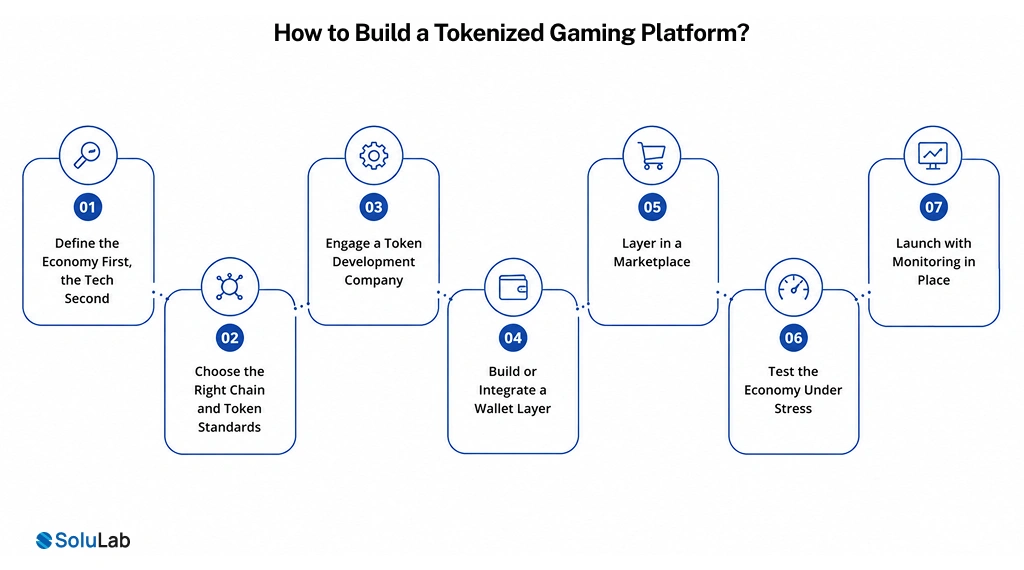
There’s no single “correct” way to build one of these platforms, but most successful projects still follow a similar arc, whether it’s a mobile puzzle game or a full AAA title. Here’s roughly how it plays out.
1. Define the Economy First, the Tech Second
This is the step everyone wants to skip, and it’s the one that decides whether the whole thing works. What’s actually being tokenized? How much supply exists, and who controls it? What happens the day demand triples, or the day it dries up? Studios that jump straight to code usually end up retrofitting these answers later, and by then the economy is already live and hard to change.
2. Choose the Right Chain and Token Standards
Ethereum mainnet sounds like the obvious choice until you see the gas fees for minting ten thousand items in a single afternoon. That’s why most teams end up on a Layer-2 network or a gaming-focused chain instead, where fees stay low enough that a player buying a $2 skin doesn’t pay $5 just to receive it.
3. Engage a Token Development Company
Somebody has to actually write and audit the smart contracts that handle minting, transfers, and royalty splits, and this isn’t the place to cut corners. A capable token development company does more than write code; a good one will push back on economic assumptions that don’t hold up, before those assumptions turn into a live problem.
4. Build or Integrate a Wallet Layer
Most players don’t want to think about seed phrases or gas. If they have to, they’ll bounce. The better approach hides that complexity behind custodial wallets or a familiar social login, so the blockchain part happens quietly in the background while the game just feels like a game.
5. Layer in a Marketplace
Give players a token and sooner or later they’ll want to trade it. That marketplace, whether it lives inside the game or connects out to a third-party one, needs royalty logic baked directly into the smart contract. Otherwise, the studio watches secondary sales happen without seeing a cent of them.
6. Test the Economy Under Stress
Nobody enjoys this part, which is probably why it gets rushed so often. Run the economy through bot activity, sudden demand spikes, and high-volume trading before real players ever touch it. Whatever breaks under pressure will break; it’s just a question of whether that happens in testing or in front of your entire player base.
7. Launch with Monitoring in Place
Launch day isn’t the finish line. Token supply, price swings, and player behavior all shift once real money and real people are involved, and the studios that stay ahead of trouble are the ones watching those numbers daily, not the ones scrambling once players start complaining on Discord.
Most custom builds take several months from the first economy sketch to a live launch, and that timeline stretches further if the project also needs its own custom tokenization platform development layer instead of borrowing existing infrastructure. It’s tempting to compress that timeline. It’s also exactly how most failed play-to-earn economies got that way.
Choosing the Right Gaming Tokenization Development Company
Not every blockchain vendor understands game economies, and not every game studio understands token engineering. The gap between those two skill sets is exactly where most tokenized gaming projects stumble.
When evaluating a gaming asset tokenization company, look for a few specific signals:
- Prior gaming-specific work, not just generic blockchain projects. Token economies for games behave differently than token economies for DeFi or supply chain use cases.
- In-house smart contract auditing, or a documented relationship with a third-party auditor.
- Experience across multiple chains, since the “right” chain for a mobile casual game is rarely the right chain for an AAA title.
- A clear point of view on compliance, since tokenized gaming development services that ignore regulatory exposure are setting clients up for future problems.
- Willingness to push back on bad token design, rather than just building whatever the client asks for.
A short Web3 consulting services engagement before full development often surfaces economic design flaws while they’re still cheap to fix, rather than after tokens are already circulating.
Conclusion
Tokenized gaming is no longer a speculative side project bolted onto a game for headlines. It’s a legitimate architectural choice for studios that want players to genuinely own what they earn, and it opens revenue and retention paths that traditional in-app purchases can’t match.
The technology carries real trade-offs around regulation, onboarding, and economic design, but none of them are unsolvable with the right planning.
SoluLab, a tokenization development company with hands-on experience across gaming, DeFi, and real-world asset projects, can help your business design and build a tokenized gaming platform that holds up under real player load, not just in a demo.
FAQs
Neha is a curious content writer with a knack for breaking down complex technologies into meaningful, reader-friendly insights. With experience in blockchain, digital assets, and enterprise tech, she focuses on creating content that informs, connects, and supports strategic decision-making.