Key Takeaways
- Traditional treasury systems lock capital in slow, illiquid structures. Tokenization brings these assets on-chain, enabling real-time liquidity, transparency, and programmable yield opportunities
- Fintechs struggle with fragmented infrastructure and compliance complexity. On-chain treasury platforms unify asset issuance, yield generation, and investor access within a single, automated ecosystem
- Scaling yield platforms requires more than just smart contracts. AI-native tokenization platforms enable intelligent asset allocation, risk monitoring, and optimized yield strategies
- SoluLab helps fintechs move from concept to compliant execution. With end-to-end tokenization architecture, multi-chain infrastructure, and built-in compliance, we enable scalable, revenue-generating on-chain treasury platforms.
Capital has quietly changed its expectations.
For years, crypto-native yield came from volatility, leverage, and incentive programs. Today, institutional capital is looking for something far simpler: predictable, regulated return. US Treasury exposure, historically accessed through banks and funds, is now being restructured into programmable financial infrastructure.
This shift is not about speculation. It is about access, settlement speed, transparency, and distribution. Fintechs are recognizing that a tokenized T-bill investment platform is no longer experimental infrastructure. It is becoming a new yield layer that can sit inside wallets, exchanges, neobanks, and embedded finance ecosystems.Launching a tokenized treasury platform, however, is not a smart contract exercise. It is a systems problem. And increasingly, it is a strategic one.
What Does It Actually Take to Launch a Tokenized Treasury Platform?
When founders say they want to launch a tokenization platform, they often mean one of two things:
- Offer a stable, regulated yield to users
- Add a yield-as-a-service infrastructure to their existing fintech stack
The reality is more layered.
A production-grade tokenized T-bill investment platform requires five coordinated systems operating together:
1. Legal Structure and Asset Wrapper
Before anything goes on-chain, the underlying asset must be legally structured. This typically involves:
- An SPV or fund vehicle holding US Treasury bills
- Defined investor eligibility rules
- Securities classification clarity
- Jurisdictional compliance mapping
The token is a digital representation. The legal wrapper defines the rights.
2. Custody and Asset Management Layer
Treasury bills must be:
- Acquired through regulated brokers
- Held with qualified custodians
- Marked to market on a defined cadence
This layer determines how NAV is calculated and how redemptions are funded.
3. Tokenization and Transfer Control Module
On-chain representation requires:
- Mint and burn logic
- Transfer restrictions based on investor eligibility
- Whitelisting infrastructure
- Compliance gating
A white-label RWA yield platform cannot operate as a free-transfer token if it represents regulated securities.
4. Investor Onboarding and Compliance Stack
KYC and AML are not optional.
An on-chain treasury management solution must integrate:
- Identity verification
- Accreditation checks were required
- Ongoing monitoring
- Wallet whitelisting logic
Without this layer, distribution becomes legally fragile.
5. Yield Accrual and Distribution Engine
Yield mechanics differ by structure. Platforms must define:
- How NAV updates are reflected on-chain
- Whether yield accrues via token price appreciation
- Whether yield is distributed periodically
- How redemption calculations are reconciled
This is where many early platforms oversimplify. Yield distribution is an accounting system first and a blockchain event second.
Launching a tokenized treasury platform is therefore an orchestration problem across legal, operational, custodial, and technical domains.
Structural Components of a Tokenized T-Bill Investment Platform
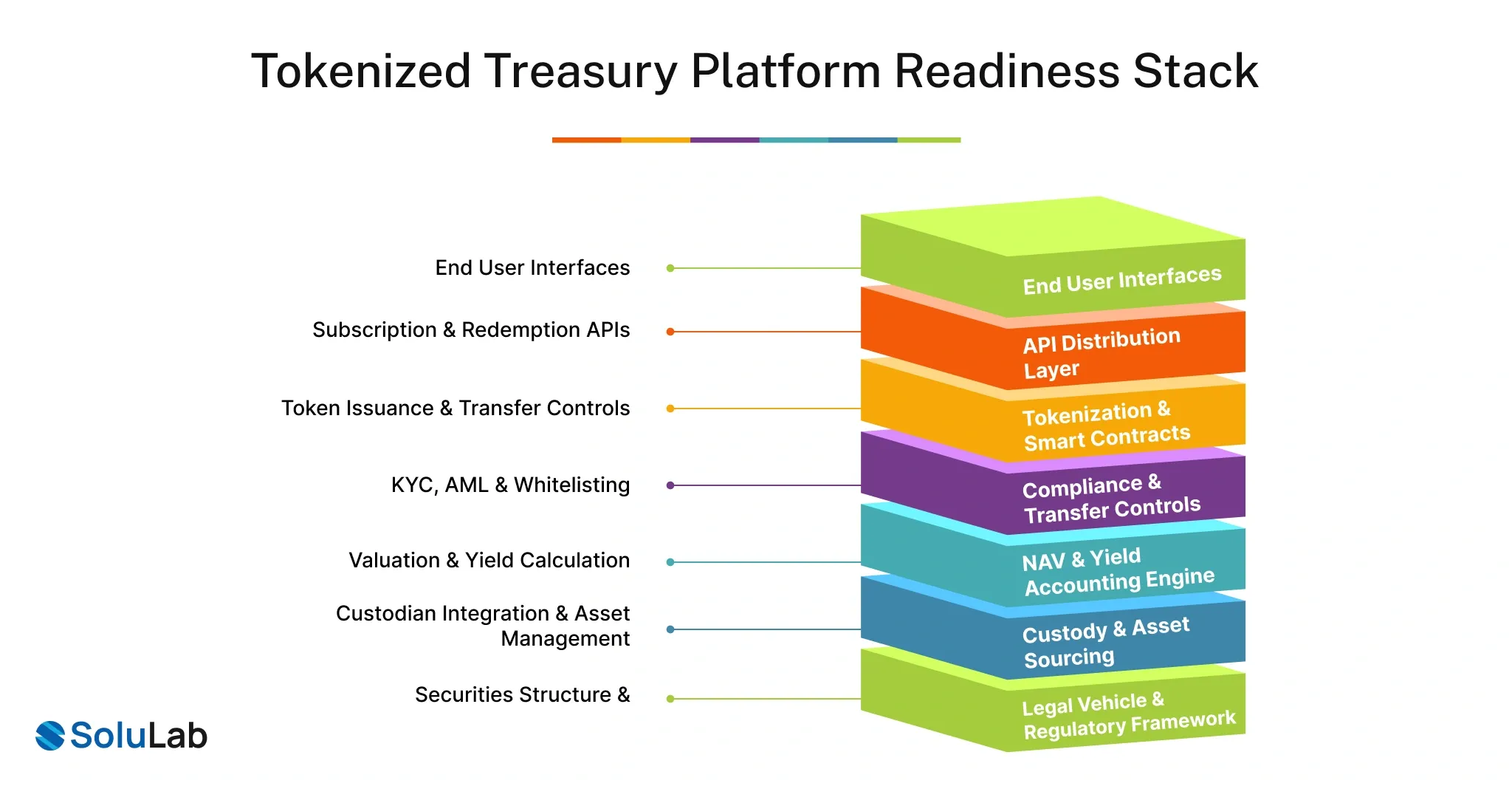
If we strip away branding and marketing, every serious tokenized treasury platform shares a common structural architecture.
Understanding these components clarifies what must be built internally versus sourced through yield-as-a-service infrastructure.
Asset Sourcing Layer
The foundation begins off-chain.
This layer includes:
- Broker relationships
- Treasury bill acquisition workflows
- Maturity ladder strategy
- Cash management controls
The performance of the product depends entirely on disciplined asset management at this level.
Legal Vehicle and Governance Framework
Typically structured as:
- A regulated fund
- A bankruptcy-remote SPV
- A note issuance vehicle
This layer defines:
- Investor rights
- Redemption policies
- Governance authority
- Reporting obligations
The token mirrors this structure but does not replace it.
Custody Integration Layer
Treasuries are held with institutional custodians. The platform must integrate:
- Custody confirmations
- Daily holdings data
- NAV feeds
- Audit trails
Without real-time reconciliation, the tokenized representation can drift from the underlying asset value.
Token Issuance and Ledger Synchronization Module
This module connects off-chain asset value with on-chain supply.
Core components include:
- Mint logic tied to subscription events
- Burn logic tied to redemption requests
- Supply cap enforcement
- Ledger synchronization between custody system and blockchain
This is the heart of a compliant white-label RWA yield platform.
Compliance and Transfer Restriction Layer
Because treasury-backed tokens are typically securities, platforms must enforce:
- Whitelisted wallet transfers
- Jurisdictional restrictions
- Investor eligibility tiers
- Lock-up rules
Transfer logic becomes programmable compliance.
Yield Accounting and NAV Update Engine
Yield may be reflected through:
- Daily NAV adjustments
- Periodic distributions
- Rebasing token mechanics
- Hybrid accounting models
The decision affects user experience, tax treatment, and reporting complexity.
Reporting and Transparency Interface
Institutional users expect:
- Portfolio breakdown
- Duration exposure
- Yield-to-maturity visibility
- Redemption status tracking
- Audit documentation access
An on-chain treasury management solution that lacks robust reporting will struggle with institutional adoption.
Architecture Patterns for Building Yield-as-a-Service Infrastructure
When fintech founders discuss adding treasury-backed yield, it may sound simple. Offer stable returns. Integrate it into the app. Ship.
But what they are actually building is regulated financial infrastructure. Yield-as-a-service infrastructure is not a feature layer. It is a structural bridge between capital markets and digital distribution.
If that bridge is poorly layered, it cracks under stress.
Separation of Regulated Operations from On-Chain Distribution
The most resilient tokenized T-bill investment platforms follow a core principle:
Keep regulated asset management separate from programmable distribution.
In practice, that means:
- Legal vehicle and custody sit at the base
- NAV and portfolio accounting operate off-chain
- Compliance enforcement gates access
- Smart contracts mirror ownership state
The blockchain is the access layer not the accounting engine.
Why Modularity Matters?
When fintechs launch a tokenized treasury platform without modularity, they create future rigidity.
Modular architecture allows:
- Custodian replacement without contract rewrites
- Jurisdiction-specific compliance overlays
- API-based distribution expansion
- Additional asset classes later
Without separation, scaling becomes expensive.
The Practical Architecture Pattern
Production-grade systems typically follow this structure:
- Off-chain asset valuation
- Daily NAV reconciliation
- Compliance engine validation before mint and transfer
- Smart contracts reflecting validated ownership
- API layer exposing subscription and redemption flows
This design makes a white-label RWA yield platform operationally viable.
Because most fintechs do not want to manage Treasuries.
They want to distribute yield responsibly.
That difference defines architecture.
How Does Yield Flow in a White-Label RWA Yield Platform?
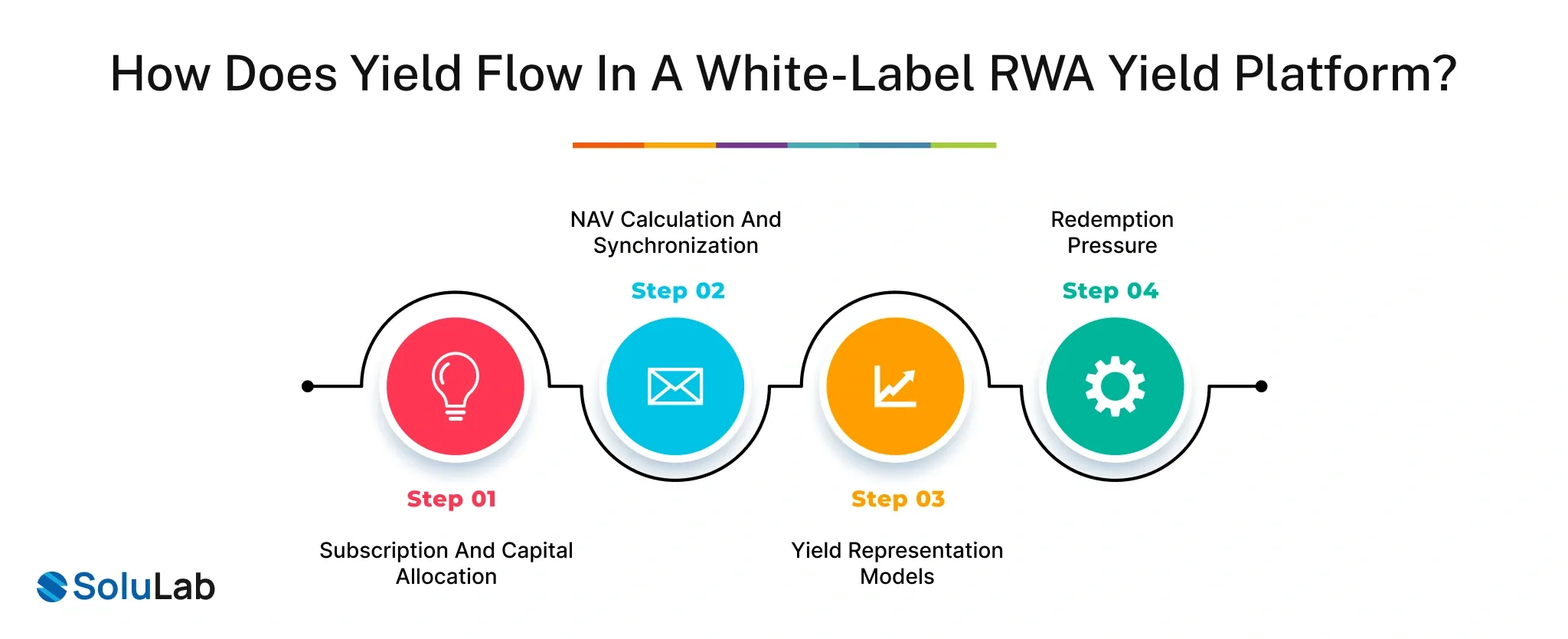
Yield feels abstract until you break it down. In reality, it is disciplined accounting mirrored on-chain.
Step 1: Subscription and Capital Allocation
An investor:
- Completes KYC
- Connects a verified wallet
- Submits fiat or stablecoin
Funds move into the treasury vehicle. The asset manager allocates capital into T-bills, often using laddered maturities.
Yield begins accruing at the portfolio level.
Not on-chain.
Step 2: NAV Calculation and Synchronization
Each day, portfolio value is recalculated based on:
- Accrued interest
- Market pricing updates
- Cash balances
- Maturing instruments
That NAV is then synchronized with the token supply. Precision matters. Even small discrepancies create trust erosion in a tokenized T-bill investment platform.
Step 3: Yield Representation Models
Most platforms choose one of three models.
Model A: NAV Appreciation
Token price increases gradually.
Model B: Periodic Distribution
Yield paid out separately, often in stablecoin.
Model C: Rebasing
Token balances increase proportionally.
Each model affects:
- Tax implications
- Reporting complexity
- User perception
- Regulatory interpretation
There is no universally superior option.
Step 4: Redemption Pressure
This is where infrastructure is tested.
When redemptions spike, the system must manage:
- Liquidity buffers
- T-bill liquidation timing
- NAV snapshot accuracy
- Settlement windows
Launching a tokenized treasury platform without liquidity planning is architectural optimism. And optimism is not infrastructure.
Legal and Regulatory Foundations of On-Chain Treasury Management Solutions
This section determines viability. Treasury bills are conservative instruments. But once tokenized and distributed digitally, regulatory obligations expand.
Securities Classification
Most tokenized T-bill investment platforms fall under:
- Fund regulations
- Investment contract frameworks
- Structured note classifications
The classification determines:
- Who can invest
- Transfer restrictions
- Disclosure requirements
- Licensing obligations
This decision must precede smart contract deployment.
Fund vs SPV Structures
Two common models dominate.
Fund Structure
- Regulated investment vehicle
- Ongoing reporting
- Broader compliance oversight
SPV or Note Structure
- Defined exposure via issued notes
- Potentially narrower scope
- Different licensing implications
Choosing structure impacts scalability and jurisdiction reach.
Compliance Is Not an Add-On
On-chain treasury management solutions must embed compliance directly into architecture.
That includes:
- Wallet whitelisting
- Jurisdiction mapping
- Accreditation verification
- Ongoing KYC refresh
- Transfer gating logic
If compliance is layered on later, contracts often require redesign. If embedded from the start, expansion becomes policy-driven instead of code-driven.
Cross-Border Complexity
Fintechs often underestimate this.
Consider:
- Marketing restrictions across jurisdictions
- Stablecoin regulatory overlap
- Custody localization requirements
- Tax reporting differences
Launching a white-label RWA yield platform globally without regulatory mapping invites operational friction. Compliance-first architecture reduces that friction.
Risk Considerations When You Launch a Tokenized Treasury Platform
Every fintech exploring how to launch a tokenized treasury platform eventually reaches the same realization:
The asset may be low-risk. The infrastructure is not.
US Treasury bills are considered among the safest instruments in global finance. But once exposure is wrapped, tokenized assets, distributed, and redeemed through digital rails, new risk vectors emerge.
Understanding these risks is what separates a white-label RWA yield platform experiment from institutional-grade infrastructure.
1. Custody and Counterparty Risk
The yield comes from Treasuries. But the exposure depends on:
- Broker execution
- Custodian solvency
- Settlement reliability
- Operational controls
If custody confirmations lag or counterparties fail, token holders feel the impact even if the underlying asset is sovereign debt.
Tokenization does not eliminate counterparty risk. It adds another operational layer on top of it.
2. NAV Drift and Reconciliation Risk
Because NAV is calculated off-chain and mirrored on-chain, synchronization must be precise.
If:
- Portfolio valuation updates are delayed
- Token supply updates are mistimed
- Redemption snapshots are misaligned
Then NAV drift can occur. In a tokenized T-bill investment platform, even small discrepancies erode institutional trust. Daily reconciliation processes are not optional. They are core operating discipline.
3. Liquidity and Redemption Risk
Treasury bills are liquid but not instant.
When you launch a tokenized treasury platform, you must design for:
- Redemption surges
- Market volatility
- Settlement delays
- Cash buffer depletion
Yield-as-a-service infrastructure must include liquidity planning logic. That often means maintaining a percentage of capital in short-duration instruments or cash equivalents.
Liquidity design is product design.
4. Smart Contract and Transfer Logic Risk
Because these tokens typically fall under securities regulation, transfer restrictions are embedded in code.
Errors in:
- Whitelisting logic
- Jurisdiction filters
- Freeze mechanisms
- Mint/burn permissions
Can create compliance breaches at scale.
In an on-chain treasury management solution, the smart contract is not just a ledger. It is regulatory enforcement infrastructure.
5. Regulatory Reclassification Risk
Regulation evolves.
Stablecoin policy shifts. Securities interpretation expands. Cross-border restrictions tighten. If architecture is rigid, adapting to regulatory updates becomes costly.
If architecture is modular, compliance layers can be updated without rewriting the entire platform.This is why infrastructure-first design matters before you launch a tokenized treasury platform.
Operating Model for a Tokenized Treasury Yield Platform
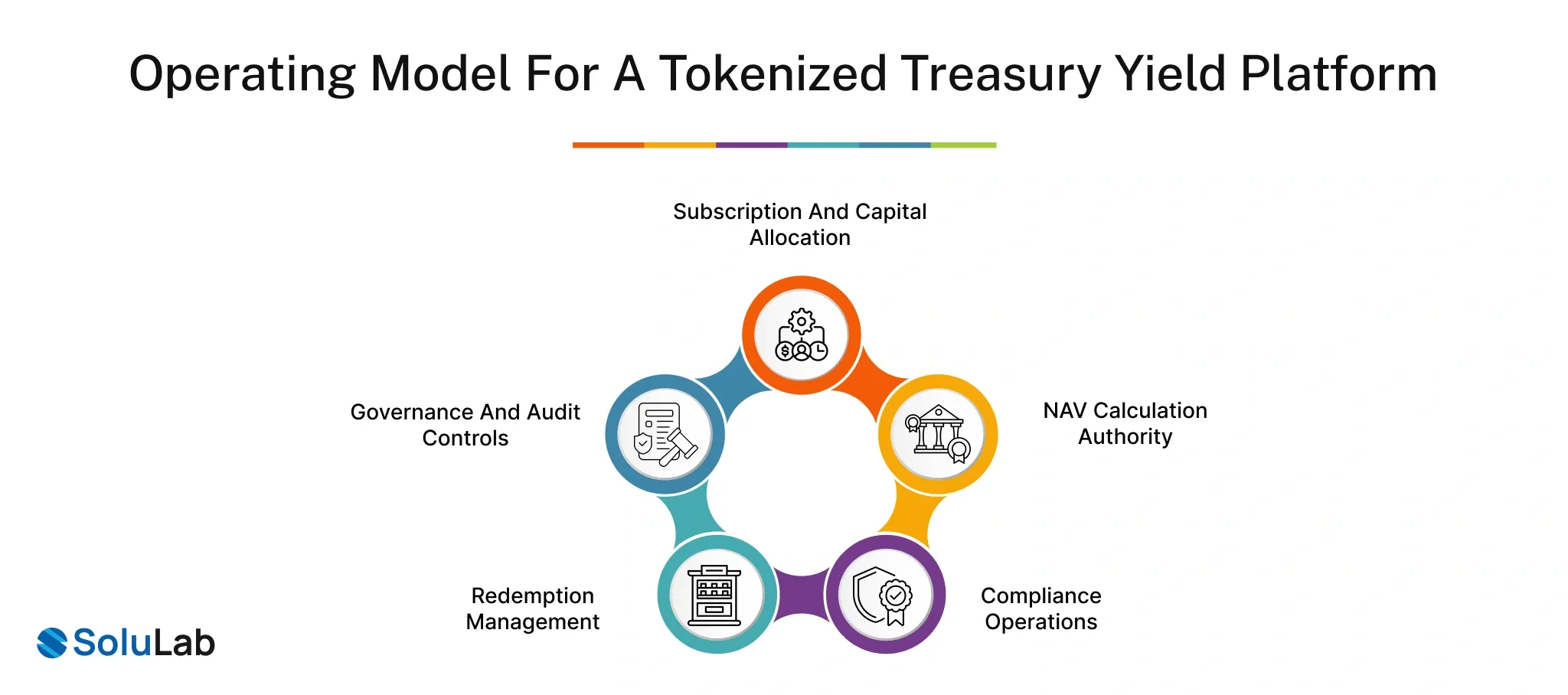
Architecture defines structure. The operating model defines sustainability. Many fintechs underestimate this layer. They focus on product launch mechanics and overlook ongoing operational discipline.
A tokenized T-bill investment platform requires clear role allocation across five domains.
1. Asset Management Responsibility
Who:
- Selects Treasury maturities?
- Manages duration exposure?
- Decides on laddering strategy?
If outsourced, governance oversight must still exist internally. If internal, licensing and compliance burdens increase.
Yield performance is operational, not algorithmic.
2. NAV Calculation Authority
Who calculates NAV?
- Internal accounting team?
- Third-party administrator?
- Custodian-provided valuation feed?
NAV integrity is the backbone of any white-label RWA yield platform.
Without clear ownership and audit trails, scale becomes fragile.
3. Compliance Operations
Onboarding is not a one-time process.
An on-chain treasury management solution must support:
- Ongoing KYC refresh cycles
- Transaction monitoring
- Sanctions list updates
- Jurisdictional eligibility checks
Compliance becomes a living system.
If automated poorly, risk compounds quietly.
4. Redemption Management
Redemption workflows must define:
- Cutoff times
- NAV snapshot logic
- Liquidity sourcing hierarchy
- Settlement windows
Clear communication reduces investor anxiety during volatility. Operating discipline reduces panic during stress.
5. Governance and Audit Controls
Institutional users expect:
- Independent audits
- Asset verification reports
- Policy documentation
- Transparent governance processes
If you plan to launch a tokenized treasury platform targeting serious capital, governance is not a marketing layer. It is a prerequisite.
Build vs Partner: Should You Develop or Use a White-Label RWA Yield Platform?
Eventually, every fintech arrives at this decision. Do we build full-stack infrastructure, or do we integrate existing yield-as-a-service infrastructure?
There is no universal answer. But there is a structured way to evaluate it.
When Building In-House Makes Sense
You may consider full-stack build if:
- You control significant distribution capital
- You plan multi-asset tokenization beyond T-bills
- You have internal compliance and asset management expertise
- You require deep customization of transfer logic
Building offers maximum control.
It also introduces:
- Longer regulatory review timelines
- Higher capital expenditure
- Operational complexity
- Ongoing compliance staffing requirements
Launching your own tokenized treasury platform from scratch is a multi-layered commitment.
When a White-Label RWA Yield Platform Makes Sense
White-label structures are compelling when:
- Speed to market matters
- Regulatory scaffolding already exists
- Asset sourcing is externalized
- The fintech’s strength is distribution, not asset management
In this model, yield-as-a-service infrastructure acts as the regulated backend, while the fintech controls user experience and capital flow.
This reduces build complexity but limits structural flexibility.
The Strategic Trade-Off
Control vs speed.
Flexibility vs regulatory delegation.
Capital efficiency vs infrastructure ownership.
The right decision depends on:
- Target investor base
- Geographic scope
- Long-term product roadmap
- Regulatory appetite
The question is not simply how to launch a tokenized treasury platform.
The deeper question is: what kind of financial institution are you trying to become?
Decision Framework for Fintechs Planning to Launch a Tokenized Treasury Platform
By this stage, the technical architecture for white label tokenization platform is clear. The compliance requirements are mapped. The risk vectors are visible. The remaining question is strategic.
If you plan to launch a tokenized treasury platform, evaluate your position across five dimensions.
1. Do You Control Distribution?
If you already have:
- A wallet user base
- An exchange ecosystem
- A neobank customer base
- Embedded finance partnerships
Then treasury yield can become an engagement layer. If distribution is weak, infrastructure alone will not create demand.
2. Are You Prepared for Regulatory Scrutiny?
Tokenized T-bill exposure may seem conservative. But once offered digitally, it attracts regulatory attention.
Ask:
- Do you have legal counsel experienced in securities law?
- Can you handle multi-jurisdiction compliance?
- Are you comfortable with audit transparency?
If not, integrating a white-label RWA yield platform may reduce complexity.
3. What Is Your Long-Term Asset Strategy?
Is this:
- A single-product treasury offering?
- The beginning of a broader RWA tokenization roadmap?
- A yield-as-a-service infrastructure expansion?
Your ambition should determine architecture depth.
4. Can You Operate as an Asset-Backed Infrastructure Layer?
Launching a tokenized T-bill investment platform is not a marketing event. It is an operational commitment.
Consider:
- Ongoing NAV management
- Liquidity buffers
- Redemption policy governance
- Smart contract maintenance
- Compliance monitoring
If these capabilities are not core strengths, partnership becomes strategic.
5. What Does Phased Deployment Look Like?
The most successful on-chain treasury management solutions do not launch globally on day one. A disciplined rollout may include:
- Limited jurisdiction pilot
- Accredited investor phase
- Single maturity exposure
- Gradual liquidity scaling
Infrastructure maturity should precede aggressive growth.
Where Infrastructure Partners Fit in On-Chain Treasury Deployment?
Not every fintech wants to become a regulated asset manager. Many want to distribute yield safely without absorbing full-stack complexity.
This is where infrastructure-focused partners play a role.
An experienced architecture partner does not simply deploy smart contracts. They:
- Map regulatory frameworks before token design
- Architect modular compliance layers
- Design reconciliation logic
- Plan phased deployment models
- Build audit-ready reporting infrastructure
Asset tokenization firms like SoluLab, for example, position themselves not as product vendors, but as compliance-aware infrastructure builders supporting fintechs in launching tokenized treasury platforms without compromising institutional standards.
The distinction matters.
Because institutional capital does not reward experimentation. It rewards reliability.
Conclusion: The Infrastructure Shift Toward Regulated On-Chain Yield
The conversation around tokenization has matured. It is no longer about speculative assets. It is about restructuring access to conservative financial instruments through programmable rails.
To launch a tokenized treasury platform is to merge capital markets discipline with digital distribution logic.
The winners will not be those who tokenize fastest. They will be those who design infrastructure carefully compliance-first, modular, and audit-ready.
Yield is simple. Infrastructure is not.
And in regulated markets, infrastructure defines trust.
FAQs
Shipra Garg is a tech-focused content strategist and copywriter specializing in Web3, blockchain, and artificial intelligence. She has worked with startups and enterprise teams to craft high-conversion content that bridges deep tech with business impact. Her work translates complex innovations into clear, credible, and engaging narratives that drive growth and build trust in emerging tech markets.