A few years ago, RWA-backed stablecoins were a footnote. Now they are one of the loudest stories in the stablecoin market. What changed? Real backing. Instead of leaning on fiat sitting in a bank, these coins sit on top of tangible things: U.S. Treasury bills, real estate, commodities. That mix gives holders something the older designs struggled with all at once, which is yield, on-chain transparency, and steadiness. And it is pulling in two very different crowds, big institutions and everyday users, at the same time.
One projection from Ripple and Boston Consulting Group (BCG) puts the tokenized real-world asset market at $0.6 trillion in 2026, then climbing to $18.9 trillion by 2033. That works out to a 53% compound annual growth rate.
So what is actually behind the attention? This post walks through it. We will look at why investors around the world keep circling back to RWA-backed stablecoins in 2026, what is really pushing the growth, and which platforms are out front.
Let’s get into it.
What Are RWA-Backed Stablecoins?
Think of RWA-backed stablecoins as a newer breed of digital currency. Each one is secured by real-world assets: U.S. Treasury bonds, real estate, gold, or other physical holdings. Regular stablecoins take a different route. USDT and USDC lean on fiat reserves. DAI leans on crypto collateral. RWA stablecoins pull their value and their stability from off-chain assets that carry legal recognition, get tokenized, and then live on the blockchain.
The appeal is the blend. You get the credibility of traditional finance sitting next to the speed, openness, and reach of decentralized finance (DeFi). When an issuer backs a stablecoin with something tangible, income-producing, or genuinely liquid, they can offer a dependable store of value and bolt on a yield mechanism too. That second part is exactly where a lot of crypto-native designs have historically fallen short.
Key Characteristics of RWA-Backed Stablecoins
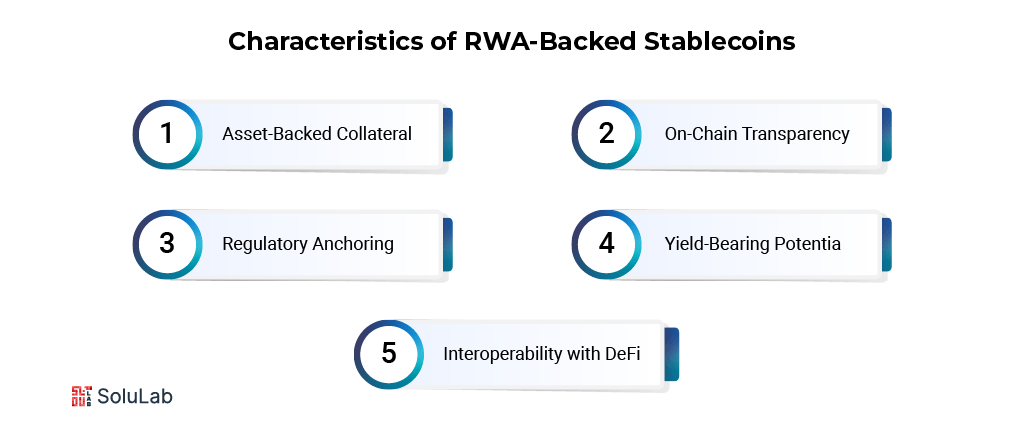
Here is what sets these tokens apart:
- Asset-Backed Collateral: Every token is secured 1:1, or through a diversified basket, by physical assets. Think government bonds, real estate, or commodities, held by custodians with a real reputation to protect.
- On-Chain Transparency: RWA stablecoins are minted and tracked on public blockchains. You can see the circulation and the reserves in real time, not on a quarterly delay.
- Regulatory Anchoring: Many of them follow financial rules and sit for periodic audits. That matters a lot to institutional users.
- Yield-Bearing Potential: Because the underlying assets can throw off passive income, say interest from Treasury bills or rent from real estate, holders can share in that yield.
- Interoperability with DeFi: Plenty of RWA stablecoins are built to slot straight into DeFi ecosystems, where they get used for lending, staking, or as a stable trading pair.
The fact that these coins are spreading tells you something bigger about where digital assets are heading. As the crypto sector matures, people keep asking for the same three things: reliability, transparency, and yield. RWA crypto coins answer all three. They carry the liquidity and programmability you expect from blockchain technology, and they lean on the dependability of physical, real-world assets underneath.
Read Also: How to Create A Stablecoin?
Why RWA-Backed Stablecoins Are Gaining Momentum in 2026?
Investors want more than a steady price. That is the short version. RWA-backed stablecoins give them real returns from tangible assets, government securities and real estate among them, and they still trade on-chain the moment you need them to. Institutions, private investors, and DeFi protocols are all leaning into this shift toward asset-backed currencies.
So what is fueling the run in 2026? A handful of things:
- Macroeconomic Tailwinds: When central banks tighten and old-school markets go quiet on returns, money goes looking. RWA crypto currencies open a door to real-world yield through blockchain technology.
- On-Chain Yield from Real Assets: Fiat-backed stablecoins just sit there. RWA-backed coins do not. They can route the income from yield-generating assets, U.S. Treasury bills for instance, straight to the people holding the token.
- Institutional Adoption: Big finance is warming to tokenized Real-World Asset models. Names like BlackRock, Franklin Templeton, and Ondo Finance have launched or backed RWA cryptocurrencies, and that alone lends the whole idea some weight.
- Regulatory Clarity: The U.S., Singapore, and the UAE are all drafting frameworks for RWA tokenization. That gives these coins legitimacy and a legal spine, something crypto-native assets often go without.
- DeFi Utility and Interoperability: Real-world asset stablecoins are increasingly accepted as collateral inside DeFi protocols. That gives users a calm on-chain currency, low volatility, steady returns.
- Global Accessibility: Markets that used to be gated, U.S. Treasuries or high-end real estate, open up. Anyone with a crypto wallet can hold a slice of asset classes that were once out of reach.
Top RWA-Backed Stablecoins in 2026
In 2026, RWA-backed stablecoins are changing how people actually use digital assets, because they fuse real-world value with the efficiency of a blockchain. Backed by things like U.S. Treasuries, real estate, and commodities, they deliver yield, security, and transparency in one package. Institutions and DeFi protocols keep reaching for them. And with good reason.
A few names stand out this year:
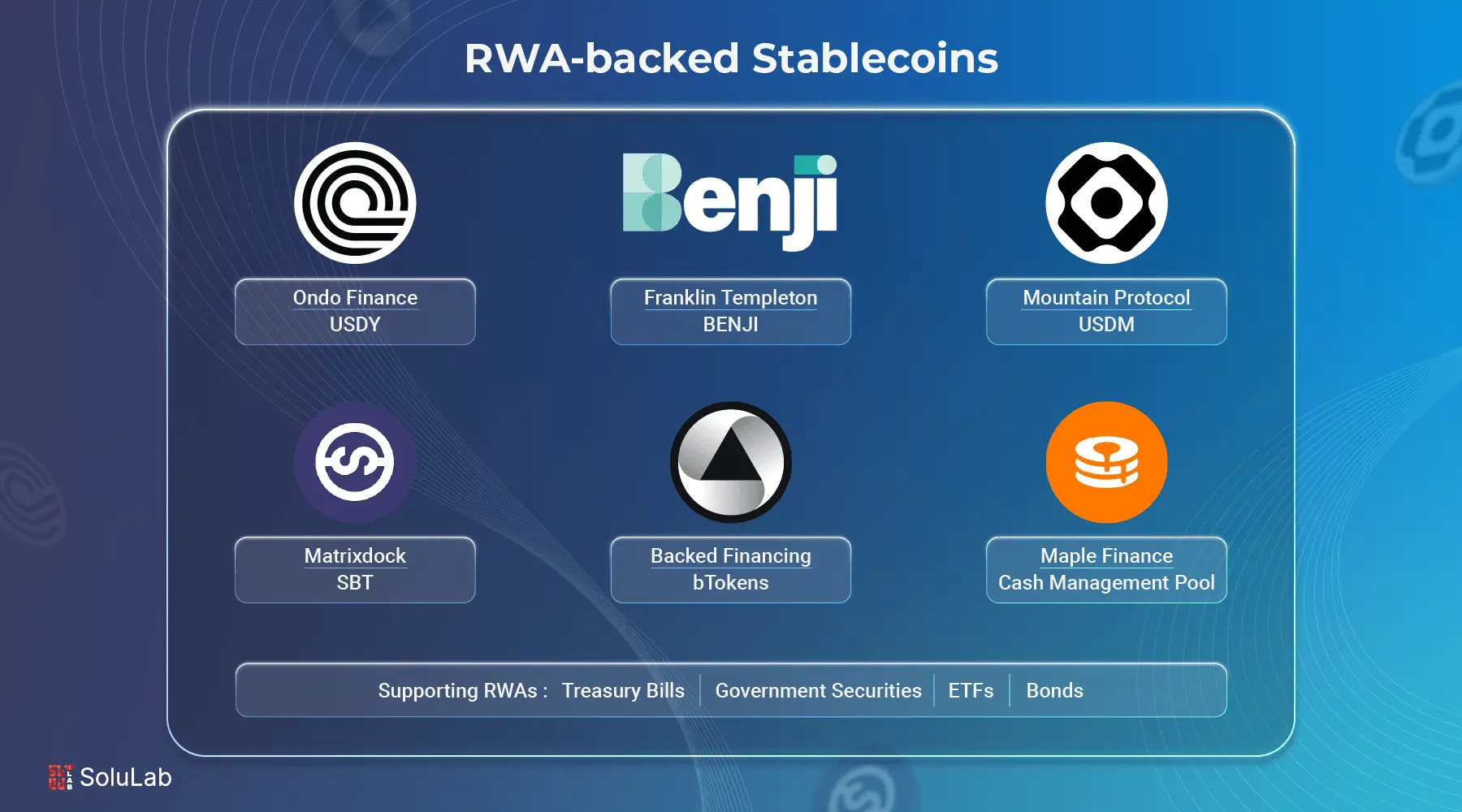
Ondo Finance – $USDY
Ondo’s $USDY has turned into one of the go-to yield-generating stablecoins. It sits on short-term U.S. Treasuries and bank deposits. The pitch leans hard on transparency and staying inside SEC rules, and it lets investors earn a real payout without giving up on-chain liquidity.
Franklin Templeton – BENJI Token
The BENJI token is Franklin Templeton’s tokenized take on its U.S. Government Money Fund. It is SEC-registered, and in 2026 it has drawn a lot of eyes for one reason: it gives traditional investors a clean, auditable way into tokenized U.S. government debt that is fully backed.
Mountain Protocol – USDM
USDM is a regulated risk-weighted asset stablecoin that pays holders daily by tokenizing U.S. Treasury bills. It runs under a license from the Bermuda Monetary Authority, which has made it a favorite for careful investors who want crypto exposure without stepping outside compliance.
Matrixdock – SBT (Short-term Bond Token)
Matrixdock built its SBT token for professionals and institutions. Every token is backed 1:1 by short-term government securities, and the whole thing is issued inside a Hong Kong-regulated framework. Safe, predictable returns are the point.
Backed Financing – bTokens
Backed Finance issues bTokens, tokenized versions of real financial products like ETFs and bonds. They follow European securities regulations and are aimed at institutions that want varied real-world asset exposure on-chain.
Maple Finance – Cash Management Pool
Maple runs an RWA-backed stablecoin pool that lets protocols and DAOs park idle money in premium off-chain assets. The funds earn a real return, and smart contracts keep the whole process out in the open.
Benefits of RWA-Backed Stablecoins
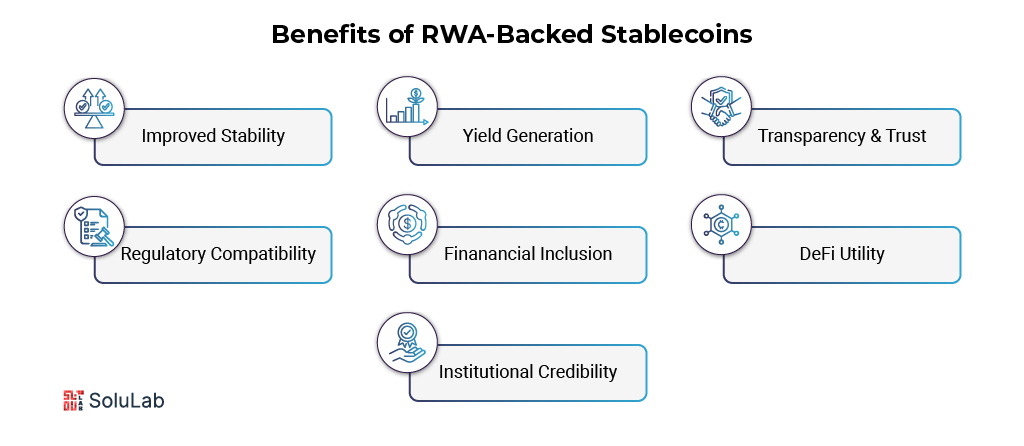
As the digital asset space grows up, RWA-backed stablecoins are getting treated as the safer, more compliant, more productive cousin of the older crypto-collateralized or fiat-backed designs. Tie a token to a real asset, a government bond, a piece of property, a commodity, and you give it a floor of trust and genuine value. That is what draws in institutions and regular investors alike.
Here is where they really earn their keep:
1. Improved Stability
Algorithmic and crypto-backed stablecoins can wobble, and they can dry up on liquidity fast. RWA-backed stablecoins are anchored to real, physical assets instead. That anchor acts as a buffer when markets get rough, and it lets holders sleep a little easier about their value holding up.
2. Yield Generation
Government bonds and real estate share two traits: they are solid, and they produce income. RWA-backed stablecoins hand that income straight to users, no middlemen skimming the middle. It turns out to be a tidy way to earn passive income on-chain.
3. Transparency and Trust
Most RWA-backed models come with third-party audits, on-chain monitoring, and clear paperwork on what actually backs the token. That builds trust. Set it against opaque reserves or an unaudited stablecoin design, and the contrast is stark. Risk-averse investors notice.
4. Regulatory Compatibility
RWA stablecoins tend to live inside clearer legal lines, especially when they are tied to regulated securities like U.S. Treasuries. That fit with the rules is the thing institutional money looks for, and it keeps issuers away from the compliance messes that tripped up earlier stablecoins.
5. Enhanced Financial Inclusion
These stablecoins knock down the walls around high-value markets. Someone halfway across the world can buy fractional ownership of tokenized real estate or government debt. A few years back, that was next to impossible without a trusted middleman or a foot in the local market.
6. DeFi Utility
DeFi is folding RWA-backed stablecoins in quickly, as steady collateral, as liquidity pairs, as savings vehicles. Low volatility plus built-in yield makes them a natural fit for lending, borrowing, and staking.
7. Institutional-Grade Credibility
Backed by real assets, audited on a schedule, and often issued alongside qualified custodians, RWA-backed stablecoins are quietly becoming the tool institutions reach for when they want to use blockchain.
Read Also: Hong Kong Stablecoin Regulation
Use Cases of RWA-Backed Stablecoins
By 2026, these coins are not just theory anymore. People and institutions use them in real, everyday ways. Sometimes called asset-backed stablecoins, they are not simply pegged to fiat. They sit on tangible assets like government bonds, real estate, and commodities. That gives them an unusual spot inside digital finance, one that carries stability, yield, and real meaning at the same time.
Here are the cases that make the strongest argument:
1. Decentralized Lending and Borrowing
On DeFi platforms, these stablecoins work as dependable collateral because their reserves are public and audited. That trims loan risk and opens up financial access worldwide.
2. Cross-Border Transactions
Businesses use them to move money across borders fast and cheap, skipping the lag and the fees that come with traditional banking.
3. Yield-Generating Savings
Since they are often backed by interest-bearing assets like U.S. Treasuries, just holding or staking them on-chain can earn you passive income.
4. DAO & Enterprise Treasury Management
Organizations park idle money in RWA-backed stablecoins to keep liquidity handy while still earning yield. It marries financial discipline with the flexibility of a blockchain.
5. Real Estate Tokenization
On tokenized real estate platforms, they handle rental agreements, dividends, and purchases. High-value deals, done entirely in a digital frame.
6. Stability in Emerging Economies
Where inflation eats savings, these stablecoins hold their ground. They become a reliable store of value and a way to trade, reachable with nothing more than a cryptocurrency wallet.
The Future of RWA-Backed Stablecoins
Where does this go next? RWA-backed stablecoins look set to sit at the core of both decentralized and traditional finance. As legal rules firm up and tokenization keeps maturing, these coins should grow into programmable financial instruments, ones that can automate compliance, taxes, and yield payouts on their own. Tools like AI stablecoin development are already sharpening risk assessment, tracking assets in real time, and managing collateral on the fly. That makes the tokens smarter and quicker to react when the market moves.
And the role of stablecoin in DeFi keeps widening. Used as collateral, as liquidity pairs, as yield-bearing assets, RWA-backed stablecoins offer a notably safer and more transparent alternative to algorithmic models. As DeFi protocols mature and pull in institutional money, expect these stablecoins to lead on on-chain lending, treasury management, and tokenized trading infrastructure. In short, they bridge Web2 value and Web3 execution.
Final Thoughts
RWA-backed stablecoins are fast becoming the base layer of a safer, more transparent, yield-first digital economy. Demand for real-world asset integration keeps rising, and these coins answer it with stability that is grounded in actual value and real usefulness across DeFi, payments, and treasury work. In 2026, this is not just a passing trend. It is a shift. A real one, in how finance operates day to day.
SoluLab is proud to be out in front of that shift as a well-regarded stablecoin development company. We recently launched our new project, Stablecoin Ecosystem, building its network from the ground up. Our team owned every piece of it: community architecture, growth initiatives, liquidity support, and exchange listings. With careful marketing and solid engineering, the client went from complete obscurity to a rising challenger squaring up against giants like USDT and USDC.
Need a go-to-market strategy? A community engine? End-to-end ecosystem development? We can help with all of it. If you are building the next category-defining stablecoin, let’s talk.
FAQs
Shipra Garg is a tech-focused content strategist and copywriter specializing in Web3, blockchain, and artificial intelligence. She has worked with startups and enterprise teams to craft high-conversion content that bridges deep tech with business impact. Her work translates complex innovations into clear, credible, and engaging narratives that drive growth and build trust in emerging tech markets.