
Talk to an Expert
Get in Touch

Top Real Estate Tokenization Development Companies in 2025

Real Estate Tokenization Development Companies

Due to several technological developments made in this field, the blockchain industry is growing very quickly. These quick-fire developments caught everyone off guard. Among these developments, the Real Estate Tokenization Development is one that is gaining popularity with investors.

The real estate sector has also been affected by the expanded reach of this industry. Due to entry obstacles and the complicated concerns that arise when purchasing any property, there were formerly many restrictions on the real estate market. But since the idea of tokenization was introduced to the real estate sector, everything has changed because even tiny investors with limited resources can now invest and acquire assets.

We are here to help you through this blog if you need clarification on real estate tokenization. Let’s continue the In-depth discussions on real estate tokenization and also real estate tokenization companies for 2025 will be covered in this blog.

How does real estate tokenization work?

Real estate is fractionalized into tokens and maintained on a decentralized database through the process of real estate tokenization. The term “blockchain” refers to this decentralized database, which functions as a kind of electronic ledger for information storage. NFTs and real estate tokens are comparable. A real estate token might stand for any of the following:

  • ownership of a portion of real estate
  • ownership of the whole piece of real estate
  • an ownership stake in a company that manages real estate
  • a stake in a loan with real estate as security
  • a claim to a portion of the earnings derived from real estate

Real estate tokens differ from Real estate investment trusts (REITs) in that tokens allow a specific investment to link a specific real property, as opposed to REITs which typically support investment into pools of varied real estate assets. In a security token offering, the digital tokens are produced and distributed on a blockchain (STO). To award ownership, each ownership portion is transformed into a token and then encrypted.

The sale of Aspen Coins, one of the first profitable commercial real estate STOs raised almost US$18 million in 2018. These digital tokens represented fractional ownership of the opulent St. Regis Aspen Resort in Colorado, USA.

There are numerous such instances, like a project in the United States that aims to fund $100 million by issuing 100 million tokens at $1 each for a 24-story, 374-unit multifamily residential building in downtown San Jose that is being constructed by Alterra Worldwide.

Benefits of real estate tokenization platform

  • Lower barrier to entry

Real estate tokenization facilitates small-scale investor engagement and decreases entry barriers for retail investors by permitting investing in fractional pieces of real estate.

  • Ability to create liquidity

Blockchain technology makes it simple and safe to transfer real estate tokens, enabling investors to diversify their portfolios, lower risk, and increase liquidity in the real estate market.

  • Lower transactional costs

Blockchain technology offers the ability to simplify investment transactions and reduce transaction costs through automated procedures and a permanent, unchangeable digital record.

  • More transparent and efficient transactions 

Blockchain transactions are transparent and irreversible because of the decentralized nature of blockchains, which makes them perfect for the real estate industry with its many parties and intricate processes. Smart contracts that are automatically generated do not include any humans in the transaction process, which makes unfair trades impossible. There is no paperwork or waiting period for transaction completion in a blockchain-based system. Quick decisions and transactions are the outcomes of this. When using blockchain for real estate transactions, there are no set office hours like there are in traditional banking. Instead, the system operates transparently and continuously.

  • Opportunity for small-scale investors 

Real estate is typically regarded as an exclusive class of investment. However, tokenization has made real estate investment possible for smaller investors as well. If investors don’t have vast funds, the excessive cost of real estate assets sometimes discourages them from participating. But things have changed since real estate is now available to small-scale and individual investors thanks to the tokenization of the industry. Tokenization breaks up enormous assets into smaller fractions, making them more inexpensive and available to individuals who are interested.

  • A free-flowing market 

Overly regulated and frequently prejudiced centralized banking systems are harmful to market freedom. The real estate industry now has access to a decentralized, bias-free financial system thanks to blockchain-based tokenization. Each stakeholder has some degree of control over the outcome, and they decide as a group. A market that is streamlined and offers all players an equal chance to flourish results from the removal of unjustified barriers.

  • Decrease in counterparty risk 

It is difficult to track longer transaction chains. The pre-tokenized real estate age presented a dilemma since third parties complicated and distorted the situation. Things are improved from a regulatory standpoint by smart contracts, a crucial component of blockchain-based transactions. The chain of transactions is kept short and free of hazards brought on by weak links with minimal human involvement. Because of this, there is a greatly diminished, if not entirely gone, the danger of counterparty participation.

Read more: 15 Blockchain Companies Shaping the Real Estate Industry

Limitations of real estate tokenization platform

  • Smart contract security loopholes

The blockchain network is well secure. But in smart contracts, you can find loopholes that need to be fixed. Hackers are always trying to sneak into the code and steal money from smart contracts. If the smart contract has been diligently audited, the money isn’t secure. A simple hack or a system glitch could rob the assets of real estate investors. In the worst case, once these assets are lost, their recovery is impossible.

  • Complex licensing requirements 

The tokenization of real estate assets needs licensed platforms for the operations and management of STOs (security token offerings) to be regulated. The process of achieving a license is a bit complex. Even before the licensing stage, you need to go through multiple phases of trial and error and recurrent tests so they can be successful.

  • Regulatory issues

Many people who are working in regulatory authorities and real estate employees have no idea how blockchain technology works and eliminates the issues the sector is facing. These things lead to a poor regulatory environment and generate hurdles for all stakeholders. Regulatory uncertainty dampens the investors’ trust, resulting in poor growth.

  • Tax complexities

Many Tax regimes haven’t clear cryptocurrency tax legislation, which is an issue for stakeholders. Despite the fact that the benefits of tokenization are acknowledged on a worldwide scale, a sound taxation system has not been implemented. Everyone concerned has doubts because there isn’t a single tax system in place.

Some points to be considered!

  • Securities law implications

Generally, the tokenization of real estate will be considered security but an analysis of each specific token should be considered at the outset. If the token is a security, the issuance of such a token will be subject to the applicable prospectus requirements or reliance on an exemption, such as the “accredited investor” exemption.

In addition to the prospectus requirements, the issuer must consider the applicable registration requirements.

  • Reconciliation with the land registries

Real estate tokenization companies requires reconciling the applicable transaction with the current systems of land registration. Each jurisdiction of Canada has its land registration system, and an issuer of a real estate token will be required to reconcile the transaction with the land registration systems of the jurisdictions where the underlying real estate is located.

Top 5 real estate tokenization companies

Blockchain App Factory
Blockchain App Factory

One of the first businesses to tokenize real estate as more than just a qualified Web3 service was Blockchain App Factory. The company is among the top tokenization platforms in real estate across both the physical world and virtual worlds. The business is present throughout the world, it should be noted. Since the company’s professionals are familiar with the real estate tokenization factors, they make sure that all necessary procedures are followed before distributing client project tokens. The business is a wonderful fit for any startup hoping to succeed in the Web3 real estate sector because it has expertise in consultation, legal matters, programming, testing, and promotions.

Appwrk

Appwrk

A Web3 company called Appwrk is engaged in tokenization of real estate among other real estate token platform. The company has established a professional strategy to its real estate asset digitization projects that guarantees the project turns out as planned for clients. The business offers its skills in transaction structure, digitization, technology, distribution, marketing, as well as post-launch assistance to tokenize real estate. If desired, one might even acquire a platform like a token marketplace in addition to tokens. The company’s blockchain developers have completed a number of noteworthy projects on Web3 real estate, and as a result, they have established a solid name in the rapidly increasing Web3 community.

SolidBlock

SolidBlock real estate tokenization

SolidBlock is a unique company that mostly operates in Israel and provides real estate tokenization services. It describes itself as a company that offers tokenization as a service. The company helps entrepreneurs turn their real estate in to the blockchain-based tokens and makes it possible for them to raise money using those tokens. SolidBlock has quickly expanded in a specialised industry thanks to the ideal group of luminaries in development, analysis, legal issues, marketing, and leadership. These services are offered in an admirable manner. For asset fractionalization & security token offering campaigns, the company excels in producing real estate tokens.

Somish

Somish real estate tokenization

For startup enthusiasts looking to tokenize real estate assets, Somish has been another option. Young people with extensive experience working with Web3 apps make up the organisation. Commercial, residential, & trophy real estate tokenizations are the company’s areas of expertise. Additionally, it provides partner networking services, compliance insurance, Web3 real estate advice, and security token offering (STO) services. Additionally, Somish has received other honours, such as hackathon victories, ongoing open-source programming partnerships, as well as technological contributions to the Web3 community.

Blockchain Firm

Blockchain Firm real estate tokenization

Blockchain Firm, a seasoned player in the Web3 market, provides excellent real estate tokenization services. The business offers a wide range of services on the domain, such as the creation of platforms for real estate listings, hybrid tokenization, fractional tokenization, crowdfunding, leasing and rental assistance, and loan & mortgage facilitation. For Web3 real estate, teams at the Blockchain Firm also work on planning, smart contracts, NFT development, website development, platform development, & marketing services. The company has offices across a few nations, a substantial global presence, and extensive expertise working on certain well-known Web3 projects.

Conclusion

The top 5 real estate tokenization companies in 2025 have been explained, along with real estate tokenization itself. Currently, there has been a rapid rise in public awareness of digital real estate, which has made it easier for these enterprises to connect with communities and generate long-term reputation and financial success. Web3 startup enthusiasts can contact one of the aforementioned top tokenization platformsto actualize their ideas in order to launch a business based on the domain in the real world via metaverses. Additionally, blockchain technology may make it simpler for people to access real estate in the following ten years, and firms who launch early may benefit from establishing a reputation.


 

How to Find the Best ICO Service Provider?

How to Find the Best ICO Service Provider

There is a tonne of ICO service providers available, and each one of them promises enormous returns and beneficial benefits for potential investors. But before you start giving your hard-earned money to every project you see online, keep in mind that many, if not most, of them, will ultimately fail or turn out to be a fraud.

Remember that the Ethereum platform in general and all cryptocurrencies are essentially experimental technologies. The great majority of ICO service providers depend on Ethereum, and they are a fairly experimental mechanism in and of itself. Overtop of an experiment, it’s an experiment.

A typical ICO project will have a website as well as a white paper with as much information as possible about the project as well as its objectives. These will give information about the team and their relevant experience, the concept and the execution plan, the rough objectives and methods for achieving them, and so on.

It’s crucial to note, though, that sometimes taking a risk pays off. For instance, EOS managed to generate approximately $185 million within only five days during an ICO campaign despite not having a single operational product or even a platform. Additionally, their coin began trading at $0.925 and traded at roughly $5 for a short period of time after an ICO. If you were an early investor & decided to sell your tokens now, your gains would have been almost ten times greater because EOS is currently selling at $8.3. Let’s take a deep dive into how to find the ICO to better understand and identify the finest service provider. However, blockchain is showing signs of being a very disruptive technology. There will undoubtedly be a blockchain startup ICO with the potential to generate enormous profits. So, how do investors recognize and find the ICO? Here are six ideas for you to begin.

Find out everything you can about the development team

Verify that the devs are not anonymous before anything else. If they are, that should raise as big a red signal as possible. If there are individuals listed, thoroughly Google them, paying close attention to the advisory board and development team in particular. Make careful to always double-check that information because many fraudulent ICOs will indicate that a notable person—often Vitalik Buterin—is involved.

Verify the team members’ educational background, including their courses of study and previous projects they have worked on. Pay attention to their prior participation in ICOs, relevant cryptocurrency experience, and effects on the project. Whether their prior experience will be sufficient for the accomplishment of this specific project is what you are searching for here.

If the team members have linked to their GitHub, LinkedIn, or Twitter accounts on the ICO’s website, this is very encouraging. Even so, take caution to verify the validity of the linked accounts by finding out when they were created and also how frequently the team members used them. Making a phony social media account is actually rather simple.

Check Community and Media

A vast and, most importantly, open supporting community is a must for every ICO service provider. Generally speaking, a public Slack / Telegram discussion for all investors is a positive sign. When assessing an ICO, additional sources like Facebook, Twitter, or Reddit can be quite helpful.

Be on the lookout for “bounty” postings and threads. To draw more media and public attention to the initiatives, it is a very frequent practice to offer awards in exchange for people spreading favorable information about them.

Instead, check to see if they are conducting interviews, generating publicity for the initiative, and sending out press releases. Another very positive sign is the team’s social media activity and ongoing interactions with investors.

Check the Stage of the project and VC investments

There is no set standard for what degree of development a project needs to be in order to host an ICO. There will occasionally only be a white paper as well as a hazy roadmap. There may occasionally be a beta version or even a released product with a few functionalities.

Investing in initiatives that are as close to the release of a finished product as feasible is, of course, always safer. Investors typically give initiatives with at least a few lines of functional code a higher priority. Despite this, there have been numerous instances of successful ICOs service providers that involved no written code at all.

Venture capital investments are yet another positive sign. Since well-known VCs are typically powerful and seasoned players, they won’t trust or invest in companies that they believe have even the remotest possibility of failing. But mistakes happen to everyone. The presence of VCs in the project will almost certainly be mentioned on the landing page of an ICO, especially if one of the VCs is a well-known participant in the cryptocurrency industry. However, it wouldn’t hurt to confirm this.

Read the ANN thread on BitcoinTalk

The largest forum devoted to Bitcoin and all things crypto-related is BitcoinTalk.org. This website will be quite helpful when it comes to ICOs because that’s where the announcements (denoted [ANN]) are issued. If the ICO you’re thinking about investing in is missing, forget about it.

If you don’t have the skills required to comprehend a project’s technical features, be sure to carefully study the thread devoted to find the ICO. In essence, those threads represent a group effort to assess the reliability of an ICO.

The reputation of a person is crucial in the Bitcoin world, and in this forum in particular. The user’s current rank as well as the total number of previous messages are included in each post in a thread. In general, a user’s trustworthiness increases with rank.

Also, a fantastic location to see how responsive the developers are to those announcement posts. It’s a warning sign if they aren’t responding to specific inquiries or are otherwise not participating in the post. Additionally, you may always try contacting the devs directly to see how responsive they are.

Read the white paper

Knowing exactly what you’re investing in is the key message of this entire course. And reading the project’s white paper is the best method to understand as much as you can about it.

An ICO is a crowdsale, which means it involves raising money from unaffiliated investors. Therefore, developers should be able to clearly and simply describe the project’s objectives and the methods for attaining them. 

A good white paper also will define the legal structure that will govern the relationship between investors and developers. This should, first and foremost, incorporate the ICO’s terms and conditions. Additionally, a thorough explanation of how and when the tokens will be distributed to investors should be included. Given that a specific amount of cash is needed for each stage of the project, it is a good sign whenever the token distribution is connected to the roadmap.

Why exactly the project requires its own dedicated token is a fundamental point that the white paper has to address. Why specifically can’t Bitcoin or Ethereum, two well-known crypto giants, be used? The application of blockchain technology raises the same query.

As was previously noted, a reputable project will give potential investors at least a rough plan. The fact that the roadmap includes a thorough breakdown of the pricing strategy, the value being placed on the company, and the precise way the funds raised will be used is quite encouraging.

The last and possibly most crucial step is to confirm that the money is being kept in an escrow wallet. The ideal situation, in this case, would be for Ethereum smart contracts to be used to automatically perform the escrow service rather than an individual or business providing it.

Evaluate the quality of the code

A key warning sign is when a project has no working code at all prior to an ICO or even if it has but it isn’t open source. You should definitely read the source code while analyzing an ICO if you possess even a little knowledge of programming. Simply examining a project’s source code might reveal a lot about its creators.

Bonus tip: Determine your level of risk-taking

It’s crucial for investors to assess their risk tolerance before pursuing any investment opportunity. Many of these firms are in their very early phases and aren’t yet operational, unlike initial public offerings where businesses have often been established for several years, which implies a lot of risk for investors. Investors could potentially lose money if a project doesn’t work out.

Additionally, ICO stats aren’t a reliable predictor of the venture’s success. Some businesses that have collected substantial sums of money are currently being examined for their development—or lack of development since their ICOs. ICO investments carry a high level of risk and profit. Before taking part in one, it’s critical to understand how much you’re willing to risk and maybe lose.

Conclusion

One can always follow the SEC’s lead and find the ICOs similar to any other investment opportunity. An ICO service provider is still a good option for businesses, so long as they are registered in a jurisdiction that permits them and all rules are followed. An ICO allows investors to participate as early stakeholders in interesting projects. Even while not all cryptocurrencies will appreciate to the same level as the leading coins like bitcoin and ether, making the proper investment in one can yield enormous gains.

Read also: What are Some of the Benefits of an ICO?

To determine whether a company has the ability to prosper and generate a healthy return for its investors, it is important to conduct due diligence and comprehend the market, the firms, and their solutions.


Top 15 White Label NFT Marketplace Companies in 2025

Top 15 White Label NFT Marketplace Companies in 2023

NFTs have received a lot of attention during the past several years. Following the development of blockchain technology, this tendency occurred. A new technology called blockchain has been getting a lot of interest. Numerous businesses and industries are employing this technology because they understand how important it is for protecting data and transactions. The NFTs’ triumph did not come about overnight. Over time, it has amassed a powerful market empire. Now, a horde of business owners are swarming to the NFT area to launch their new ventures. For all of those business owners, developing a white label NFT marketplace is among the best approaches to launch a company.

White Label NFT marketplace Overview

White-labeling is the process of redesigning an already existing product. It’s more equivalent to changing the name of an already-existing product. In the business sector, this behaviour is quite legal. You can customise the platform using the white-label nft marketplace in order to suit your unique ideas and interests.

Above all, the white-label nft marketplace development offers a ready-made answer. You are not required to put out immediate time and effort as an entrepreneur in building the platform. Pre-built solutions are easily customizable to look precisely how you want them to. They are readily available. White label nft marketplace versions of the popular NFT markets, including OpenSea, Rarible, & Foundation, are available.

Due of its low cost, this choice is the most preferred by business owners. On a tight budget, you might be able to get this solution for your company.

What Makes White Label NFT Marketplace Special?

A white label-based NFT marketplace platform is the most well-liked platform in the crypto sector for generating billion-dollar gains. As a result, the most popular justification for business owners to pick it is to build a white-label NFT marketplace.

Cost-effective Platform

The biggest benefit of a white-label NFT marketplace is its much cheaper cost when compared to creating a custom solution. The early development expenditures of creating an NFT marketplace from scratch will be reduced, to start. With a white-label NFT marketplace, you won’t have to pay continuing maintenance fees as you would with such a custom marketplace because your service provider will look after the platform and be accessible anytime you need them.

Built-in Security

Due to the unique nature of each NFT token, more care must be taken when establishing ownership of these NFT tokens. As a result, when creating security measures for the NFT market, extra consideration must be given. Data security and integrity, for instance, could be compromised by subpar data encryption techniques. On the other side, a white-label NFT marketplace has built-in security and doesn’t require any more work. Furthermore, you won’t have to worry about the effort and price of security auditing because the development company thoroughly tested & audited the white-label NFT marketplace platform.

Seamless Customizations

You may get the customization & flexibility of a custom NFT shop with a white-label NFT marketplace without the expensive cost or protracted development time. To guarantee to ensure your NFT marketplace properly reflects the branding of your game, it contains specific features dedicated to your NFT project as well as a configurable design and domain name. By personalizing your NFT marketplace, you may stand out from other gaming projects, give your customers more value, and boost your revenue per transaction & conversion rate.

Read more: White Label NFT Marketplace – The Best Way of Launching NFT Platform

Top 15 White Label NFT Marketplace

1. Appdupe 

A notable creator of white-label NFT markets is AppDupe. Finest white label NFT marketplace have been developed and delivered by the company at the leading edge of the industry.

The end-to-end functionality of their specialised NFT marketplace platform will be catered to your unique business requirements.

They have a youthful, talented staff of experts who can design your ideal solution in accordance with your requirements. When selecting an NFT marketplace development company, this ought to be at the top of your list.

2. Askgalore

Additionally, Askgalore Digital is a white label NFT marketplace development company that aids business owners in creating their own NFT marketplaces. By offering a practical and secure solution, they assist young business owners in launching their own enterprises in the NFT sector.

The company is knowledgeable with a variety of blockchain technologies, including TRON, Solana, PolkaStarter, Ethereum, and Binance Smart Chain. Additionally, their partnerships with top security companies ensure that you may provide a secure white-label NFT marketplace platform.

3. TurnkeyTown

When it comes to delivering high-caliber services, TurnkeyTown is like Picasso. The business focuses in providing top-notch services for the development of NFT markets.

Their clients have gained the finest earnings and return on investment as a result. The white-label NFT marketplace platform will support the NFT marketplace’s operations with personalisation and best-in-class features.

4. Netset Software

Another leading NFT marketplace development business with many years of experience is Netset Software Company. They have offered thorough solutions based on numerous blockchain networks throughout the years, including Ethereum, Polygon, Solana, Cardano, Binance Smart Chain, PolkaStarted, and many others, including Ethereum, Polygon, Solana, Cardano, and others.

The most widely used White-label options include OpenSea clones, Foundation clones, Rarible clones, SuperRare clones, and others. You may get any of these choices, though, if you get in touch with them.

5. Clarisco

Spend money on their white-label NFT marketplace  to earn a sizable income. They provide full-service NFT development, giving you the option to decide what kind of blockchain network to utilise to create your NFT marketplace.

Additionally, they offer special services if you wish to construct a multi-chain NFT marketplace. To find out more about them, you ought to speak with them at least once.

6. Chaincella

Due to their enormous advantages, businesses are being driven to use white-label solutions. Chaincella, a different renowned NFT marketplace development firm, offers white-label fully prepared NFT marketplace development.

Personalization and their user-centric approach set them apart from the competitors. They are wholly committed to helping their clients get the best services available. You may quickly learn all about them simply by visiting their attractive website.

7. INORU

INORU is an established company that provides a variety of services to assist business owners in starting their NFT Company. They start by thinking ideas for their white-label NFT marketplace, and they’ll thoroughly evaluate the platform before making it public.

They ensure that the client obtains the best services available and offer exceptional customer service. Additionally, their ready-to-use, affordable white-label solution makes it simple for you to launch an NFT marketplace.

8. Coinfactory

The top white label development services for blockchain and NFT markets are provided by Coinfactory.

They offer the most straightforward method for immediately starting an NFT marketplace. Why spend more than six hours building an NFT marketplace when you have a readily available solution? is the company’s guiding principle.

They respect your time and help you by providing a script that has already been written for launching your NFT business.

9. Sellbitbuy

Using blockchain networks including Ethereum, Flow, Matic, BSC, and many others, a top NFT marketplace development business provides NFT marketplace development services.

Any of the following blockchains will be integrated to produce your fully functional NFT marketplace. Their improved security, which is suited even for next-generation devices, is a key aspect of their services.

Therefore, if maintaining the trust of your consumers is still a top priority for you, this is a great option for growing your NFT market.

10. Sofocle

Another well-established white label NFT marketplace developer that prioritises offering security services to its clients is Sophocles.

Their primary objective in developing their white-label NFT marketplace platform is to deliver services that are secure and technically sound.

Their pre-built NFT solution enables you to create a solid foundation for your NFT business. You can visit the website to find out more about their products and services since it is accessible to the general public.

11. BitDeal

As evidenced by its enhanced security requirements, which include a cyber security check, penetration test, bug bounty, as well as other new components in the Crypto Exchange Script process, BitDeals satisfies the needs of the global market.

They also make it easy for business owners to build up their NFT trading platforms by offering more straightforward source codes for Bitcoin exchanges.

12. Maticz

Maticz offers startups and other businesses wishing to enter the global digital trade sector high-quality blockchain development services.

Their white-label solutions are effective in a wide range of industries, providing dependable solutions to broaden the company universe.

13. Knownorigin

KnownOrigin is one of the oldest and biggest NFT Marketplaces in the world and is built on the Ethereum Blockchain. enabling the discovery, collection, purchase, and sale of NFTs of digital art. Artists can create unique, one-of-a-kind digital treasures in the form of NFTs using the KnownOrigin platform. Blockchain technology enables an innovative method of defining digital ownership.

14. Blockchain apps Developer

The Blockchain app developer wants to restructure your company to be much more profitable and favourable on the NFT platforms. They work in the most reliable way possible to assist their client in developing their exclusive secondary market. They are committed to expanding your business by offering technology solutions that are compatible with the blockchain.

15. CryptoCurrency Exchange Script

The CryptoCurrency Exchange Script is a script development company that offers top-notch services in creating a marketplace for clone scripts to support NFT markets. They offer a large number of clone scripts available that may be modified and launched. They lay the foundation for better NFT marketplace development strategies that incorporate cutting-edge technology elements.

The programming language is a fantastic option for developing your NFT Marketplace, and the Cryptocurrency Exchange script is one of the best.

Final Thoughts

There is no indication that the white-label NFT marketplace is slowing down or declining. There is no doubting the popularity and profitability of online markets.

These platforms have exceeded the $700 million deal as predicted, and their current prices are in the billions, showing that the market is becoming extremely promising. This encourages everyone, even commoners, to take part in the service. Because of increasing sales and tradability, NFT white label markets have a promising future.

Your firm may be able to expand its horizons as it explores the new market opportunity of digital trading in the modern tech world if you invest in a white-label NFT Marketplace development alongside your convenient company.

Smart Contract Development Guide: Step-by-Step Guide 2026

Smart Contract Development Guide

Have you ever wanted that contracts could operate without any delays, middlemen, or problems with trust?

In 2026, smart contracts are changing industries like finance, supply chain, healthcare, and real estate by automating transactions with pinpoint accuracy and full transparency. But building a smart contract requires an understanding of blockchain, coding, and security best practices. Learning how to create smart contracts will open up new possibilities for anybody involved with technology, be it a developer, company founder, or tech enthusiast.

In this step-by-step guide, we’ll walk you through everything you need to know to build secure and functional smart contracts in 2026—from choosing the right platform to deploying your first contract. Let’s begin!

What are Smart Contracts?

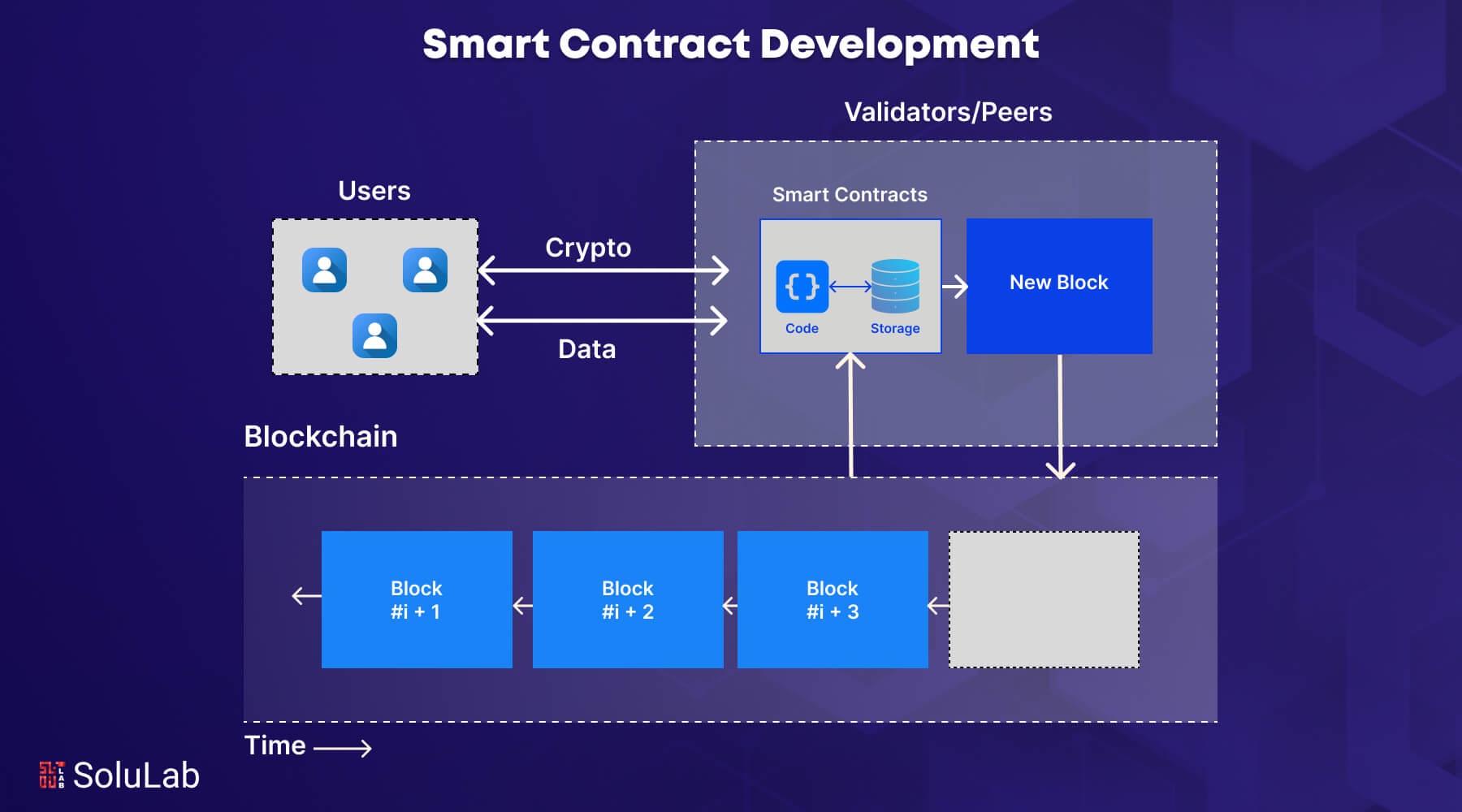
Smart contracts are self-executing digital agreements written in code that automatically carry out the terms of a contract when predefined conditions are met. Built on blockchain technology, they remove the need for intermediaries like lawyers or banks, making transactions faster, cheaper, and more secure. Once deployed on a blockchain network, like Ethereum, these contracts are immutable and transparent, meaning they can’t be altered or tampered with, and everyone on the network can verify them. 

For example, a smart contract could be used to automatically transfer ownership of a digital asset once payment is confirmed. Because the process is governed by code, it reduces the chances of fraud or disputes. From finance and insurance to real estate and gaming, smart contracts are changing industries by enabling trustless and efficient digital interactions.

How Do Smart Contracts Work?

A smart contract is a legally enforceable agreement between two parties, just like any other contract. It utilizes the benefits of blockchain technology to increase effectiveness, transparency, and privacy. These are steps that are required for smart contracts to operate.

1. Agreement: The terms and conditions of the arrangement must be agreed upon by the parties wishing to transact business or trade goods, or services. They also have to decide how a smart contract will work, including what needs to happen in order for the agreement to be completed.

2. Contract creation: There are several ways for participants in a transaction to construct a smart contract, such as working with a smart contract provider or developing it oneself. A programming language is used to code the contract’s terms. It is crucial to thoroughly confirm the contract’s security at this point.

3. Deployment: The contract has to be posted on the blockchain after it is finalized. The code is entered into the exchange’s data field, and the smart contract is posted to the blockchain in the same manner as other cryptocurrency transactions. The transaction is considered active on the blockchain after verification and cannot be undone or changed.

4. Conditions monitoring: A smart contract operates by keeping an eye on the blockchain or another trustworthy source for preset prompts or conditions. Any digitally verifiable event, such as a date reached or a payment completed, can serve as one of these triggers.

5. Execution: The smart contract is activated per the “if/when…then…” statement when the trigger criteria are satisfied. This may include registering the buyer’s control over an asset or transferring money to a vendor, among other things.

6. Recording: The blockchain instantly publishes the outcomes of contract execution. The completed agreement is stored on the blockchain after the blockchain system confirms the acts conducted and records their completion as an exchange. This document is always accessible.

Read More: What Problems Do HTLC Smart Contracts Solve in Crypto Payments?

Role of Blockchain in Smart Contract Execution

The global smart contracts market is projected to reach $3.21 billion in 2025, growing from $2.63 billion in 2024, with a CAGR of 22%. Blockchain plays a crucial role in how smart contracts work and execute smoothly. Here’s how blockchain supports smart contract execution:

  • Decentralized Environment: There’s no central authority controlling the contract. Blockchain ensures that everyone sees the same version of the contract and its outcome.
  • Immutability: Once a smart contract is deployed, it can’t be changed. Blockchain locks the code in place, which helps build trust between all parties involved.
  • Automatic Execution: When the conditions coded into the contract are met, the blockchain triggers automatic execution. No manual input, no delays.
  • Transparency: All parties can verify the contract details and their execution history because everything is recorded on a public ledger.
  • Security: Blockchain’s cryptographic features protect smart contracts from tampering or unauthorized changes, making them extremely secure.
  • Auditability: Since every transaction is recorded, it’s easy to track and conduct smart contract audit for behavior anytime in the future.
  • Cost-Effective: By removing middlemen like lawyers or brokers, blockchain helps reduce operational costs in contract management.

Benefits of Smart Contract Development 

In recent years, smart contracts—self-executing computer programs that operate on a blockchain—have grown in popularity. The following are some benefits of developing smart contracts for your company:

  • Enhanced Effectiveness

Numerous tasks associated with carrying out a contract, including identity verification, payment execution, and contract enforcement, may be automated using smart contracts. Because it streamlines the contract execution process and does away with the need for middlemen, this may save firms both money and time.

Read Blog: Benefits of Blockchain-as-a-Service?

  • Increased Safety

Once smart contracts are implemented on a blockchain, they cannot be changed and are impervious to tampering. They become far more secure as a result, and the possibility of fraud or other interference is decreased. Furthermore, smart contracts employ encryption to safeguard contract data and guarantee that only authorized parties may access it.

  • Higher Transparency

Blockchain consulting offers an open and unchangeable record of all transactions, is used to carry out smart contracts. Since all parties to the contract have access to the same information and records, this promotes accountability and transparency.

  • Lower Expenses

Smart contracts may drastically lower the expenses involved in carrying out a contract by doing away with the need for middlemen like bankers, attorneys, and other intermediaries. Furthermore, smart contracts can lower the possibility of mistakes and disagreements, which will cut expenses even more for companies.

  • Enhanced Reliability

Because smart contracts are automatically performed in accordance with predefined circumstances, they are extremely dependable. This guarantees that the contract is carried out precisely as planned and lowers the possibility of mistakes or omissions.

  • Accelerated Speed

By automating many of the necessary stages, smart contracts may greatly accelerate the contract execution process. This can shorten the time needed to carry out an agreement, which is especially advantageous for contracts with tight deadlines.

  • Better Precision

Because smart contracts operate automatically in response to preset parameters, there is less chance of mistakes or omissions. This can lessen the possibility of disagreements or misunderstandings and increase the precision with which contracts are executed.

  • Adaptable Contract Conditions

Smart contracts may be tailored to your company’s unique requirements. This saves you from using pre-made contract templates and enables you to customize the terms of the agreement to your own needs.

  • Getting into a Global Marketplace

On a blockchain network, smart contracts may be carried out, giving users access to a worldwide market. By enabling you to sign contracts with people all around the world, this can increase the potential for your firm.

  • Improved Trust

As an unchangeable and transparent record of every transaction, smart contracts may foster more confidence between parties. By doing this, the chance of disagreements or miscommunications can be decreased and trust between the parties can grow.

Use Cases of Smart Contract 

Digital contracts are being cleverly used by supply chains, insurance companies, and many more to cut expenses on administration and services. Let’s examine the many industry use cases for smart contracts:

  • Real Estate

The procedure of purchasing and selling flats is changing due to real estate smart contracts. They integrate the roles of brokers and notaries into a single, self-contained system. It is not required to negotiate a price, make changes to the title, or do any other tasks that are normally performed by attorneys and real estate investment agents.

Read Also: Why AI Smart Contracts Are the Future of Business?

  • Payment Services

Digital contracts can handle a lot of loan-serving tasks, including paying taxes, insurance companies, and collecting and disbursing payments. Each operation is independent, publicly responsible, and completely encrypted. They can be applied to banking processes both inside and outside the company. Furthermore, by simplifying the procedure, they have eliminated the possibility of human error.

  • Healthcare

The introduction of an Electronic Health Record System (EHR) transformed healthcare delivery in a regional healthcare system that was beset by ineffective paper-based patient records. The health institution prepared its medical staff to ensure a seamless adoption after choosing a reliable EHR vendor and negotiating a thorough contract that prioritized data security and interoperability.

  • Insurance

The current insurance system is costly and does not inspire confidence among stakeholders. Using digital assets for insurance rather than creating a ton of paper agreements might be the solution to this issue.

  • Supply Chain

In addition to other critical points in the supply chain and procurement automation, smart contract technology may be integrated into a product as soon as it is loaded into a truck or transported to its final destination. Payments are made in compliance with the document’s parameters to each party in the supply chain upon delivery of the goods. A corporation may also receive a notification from the system if its stock falls below a certain level, indicating the need for a product reorder.

Related: Top 10 Smart Contract Development Companies

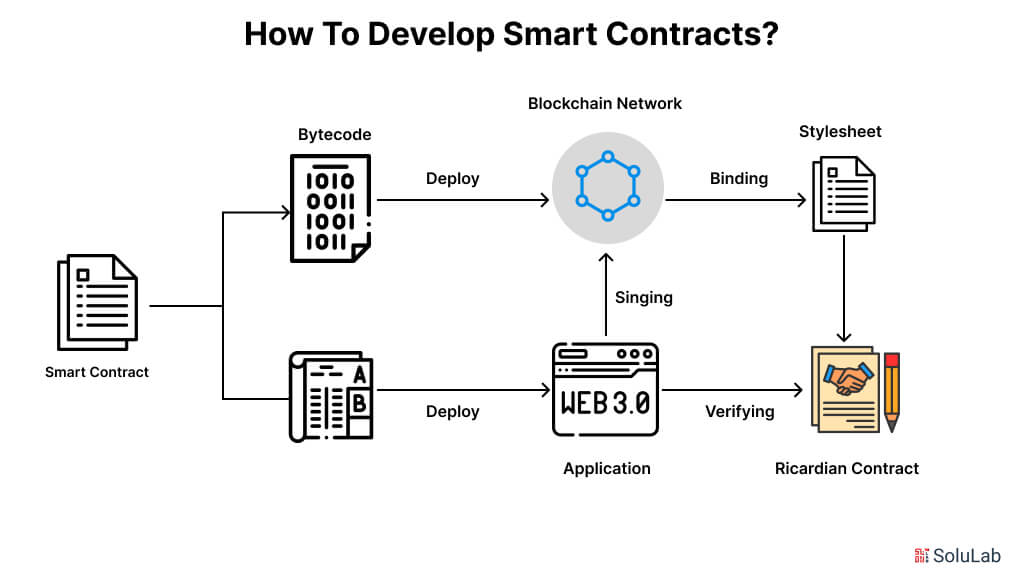
How to Develop Smart Contracts?

How to develop Smart Contracts

The creation of smart contracts is a difficult process that calls for a thorough grasp of blockchain technology, encryption methods, and programming languages.

  • Determine the Business Requirement

Determining the business requirement for a smart contract is the first stage in the development process. This entails determining the contract’s parties, the operations that can be automated, and the advantages of automation.

  • Specify the Contract Terms

Determining the contract’s terms is the next stage. This entails stating who is who, what the terms are, and what has to happen in order for the contract to go into effect. To make sure the smart contract deployment appropriately represents the conditions of the agreement, this stage is essential.

  • Select the Blockchain Network

Selecting a blockchain platform to implement the smart contract on is the next stage. This entails comparing and contrasting systems according to attributes including usability, security, and scalability. The blockchain systems Ethereum, Hyperledger Fabric, and EOS are well-liked for developing smart contracts.

  • Choose a Programming Language

Choosing a programming language to create the smart contract is the next stage. Solidity, the programming language used on the Ethereum platform, is the most often utilized for creating smart contracts. Additional programming languages utilized in the creation of smart contracts are Simplicity, Chaincode, and Vyper.

  • Create the Smart Contract Code

The smart contract must then be coded using the programming language and contract terms chosen in the earlier stages. This entails writing the code that, in accordance with the parameters specified in the contract terms, will carry out the agreement. To make sure that the contract works as planned, the code has to be designed very precisely.

  • Test the Smart Contract

It is crucial to properly test the smart contract after it has been decided on how to design a smart contract to make sure it functions as planned. This entails assessing the contract’s performance as well as checking the code for mistakes and defects. To make sure the smart contract works as planned, testing is an essential stage in the development process.

  • Deploy the Smart Contract

The smart contract may be implemented on the selected blockchain platform after it has been tested. This entails running the smart contract code after uploading it to the blockchain. The parties to the contract can oversee and control the smart contract once it has been implemented.

  • Monitor and Manage the Smart Contract

Monitoring and maintaining the smart contract is the last phase in the creation process. This entails keeping an eye on how the contract is being carried out, handling any problems that come up, and revising the contract as necessary. To make sure the contract is safe and keeps working as intended, it is crucial to keep an eye on it and manage it.

What Is The Standard Time To Complete A Smart Contract Development?

Creating a smart contract would typically take seven to fifteen days depending on the framework and complexity, the developer’s experience. However, this is not the precise amount of time needed to create a smart contract. The following are some possible variables that might affect how long it takes to establish a smart contract: 

  • Expertise of the developer in programming languages
  • Resources 
  • Testing and fixing the issues 
  • To ensure precision and safety

It won’t take more than a month to create a smart contract. Once everything is finished, you may start using your smart contract right away. We are grateful for the abundance of modern innovations that have made the production of smart contracts easier. 

Conclusion

Smart contracts are changing how digital agreements are created and enforced, offering speed, security, and automation without the need for intermediaries. In 2026, understanding the step-by-step process of smart contract development is essential for developers, businesses, and tech enthusiasts alike. 

From choosing the right blockchain platform to writing, testing, and deploying secure code, every stage plays a vital role. With growing adoption across industries, smart contract skills are becoming increasingly valuable.

SoluLab, a top smart contract development company, can help you build a smart contract from ideation to deployment and maintenance. Contact us today to discuss further. 

FAQs

1. How does a smart contract execute a transaction?

A smart contract executes a transaction automatically when predefined conditions are met, using blockchain to validate, record, and enforce the agreement without any manual intervention.

2. What are the 4 major parts of a smart contract?

The 4 major parts are the contract address, state variables, functions, and events. These components handle the contract’s identity, store data, execute logic, and record actions.

3. What are the components of a smart contract?

Smart contracts comprise data storage, functions, conditions, and interfaces for interactions. Together, they automate transactions on the blockchain.

4. What Is the Timeline for Smart Contract Development?

Development timelines depend on complexity, usually ranging from 2 weeks to 2 months. Factors include functionality, testing, and security audits.

5. How much does smart contract development cost?

Costs vary based on scope and expertise, typically ranging from $5,000 to $50,000, covering design, coding, and auditing.

White Label NFT Marketplace – The Best Way of Launching NFT Platform

White Label NFT Marketplace The Best Way of Launching NFT Platform

In today’s digital age, technology and the most recent breakthroughs are increasing exponentially. NFTs have received a lot of criticism, similar to any other Web3-based technology. The transformation and development of the white label NFT marketplace from an exotic phrase to a watchword for 2022 is just amazing.

These criticisms were unfounded because the NFT market crossed the billion dollar threshold in 2021. For Web3 firms hoping to cash in on the NFT boom, NFT-based business models seem to be the next “big thing.”

According to them, the development of the NFT market is more promising than that of other models. This blog will examine the growth of the white label NFT marketplace and explain why it’s thought to be a wise move for business owners to enter the profitable NFT industry. Let’s spend some time getting to know the white label NFT marketplace development before going into more detail about the subject.

Importance of NFT Marketplaces?

The “NFT marketplace” is a digital platform that allows NFT trading, where members have unlimited freedom to buy, sell, or exchange digital assets according to the forum’s structure. Some of the best NFT marketplaces available at the moment include Foundation, OpenSea, Rarible, Binance, Nifty Gateway, and Axie Infinity.

Business Model of NFT Marketplace

Owners of NFT marketplace platforms make money by charging commissions on all transactions that are successful on those platforms. Its ability to produce significant revenue has been the primary impetus for startups and business owners to launch their NFT ventures.

NFT Marketplace Development 

Your strategy will determine the actual cost of creating a feature-rich NFT marketplace. The quantity of features, tech stacks, integration with both a third-party API, development time, developer cost, and amount of customisation are a few noteworthy aspects. To start the process of developing your NFT marketplace, there are two options.

Development From Scratch

Starting a full-fledged NFT marketplace company from scratch is difficult and technically challenging. However, creating such platforms needs ongoing financial support and technical know-how. It might cost between $80K and $100K to construct the market from the ground up (even more). For existing business owners for whom investing extra money is not a concern, this solution is suitable. But this approach is unsuitable for business owners looking for a cost-effective answer. Keep trying; a right fit substitute is out there in the form of the “white label NFT marketplace.”

Using White-label Solutions

A pre-made and scalable system, the White Label NFT Marketplace enables the trading of NFTs, including a wide range of collectibles & digital assets. For business owners and entrepreneurs who wish to quickly enter the market with their NFT endeavour, these options make the process simpler.

By selecting this option, one can create a platform that is similar to a well-established NFT marketplace (such as OpenSea, Rarible, etc.), receive all of its features and functionalities, adapt it to suit their company’s needs, and launch it to great success.

Essenstial Features of a White label NFT Marketplace

Your NFT marketplace must undoubtedly include eye-catching features if you want it to stand out among industry titans like OpenSea and others and make a good impression on the target market. The following features are a must-have when using the white label NFT marketplace:

  • Enticing storefront
  • Enhanced filter option
  • Advanced token search
  • Wallet integration
  • Bidding option
  • Multiple payment gateways
  • Fund management
  • NFT ranking
  • Fiat currency support
  • Multi-device compatibility

Read more: White Label NFT Marketplace: Find Out Its Pros And Cons

Why White Label NFT Marketplace is the Right Pick for you

Now let’s examine each of the advantages of the white label NFT market individually. Let’s begin:

Time and Cost 

By choosing white-label technologies, you can establish an NFT marketplace while saving money and resources. As a result, building a white-label NFT market is less expensive than starting from scratch.

Customizable as per Specifications

The ability to customise it is the key bonus feature that lends white-label NFT marketplace creation more credibility. The platform owner can adjust the platform with the assistance of the development team in accordance with the latter’s business requirements. In the eyes of users, the platform becomes much more distinctive as a result.

Impeccable Security Layers are Assured

The white-label NFT marketplace solution has robust security mechanisms (by default) that safeguard it from all kinds of cyberattacks and other vulnerabilities. Moreover, the users who visit your platform feel elated to use it for conducting NFT trading.

Tested Multiple Times

Since the white-label NFT marketplace is a pre-made solution, it would have been tested by subject matter experts thoroughly multiple times, and there is no chance for any bugs and technical hiccups.

Integration Of wallet

The white-label NFT marketplace completely satisfies the platform users by integrating a wallet by default. The feature saves entrepreneurs from shedding more dollars from their pockets to develop a new wallet and integrate it into the platform.

Best White-label NFT platforms of 2023

The white label NFT marketplace solutions that might simplify your marketplace launch procedure must be known in order to leverage the spectacular NFT marketplace business model. The following is a list of white label NFT marketplace solutions available in different countries that consumers highly esteem for their potential and ability to make business operations simpler. Let’s get going:

OpenSea Clone

OpenSea

With increasing user traffic and a comparatively high level of market tradability, OpenSea continues to be one of the biggest decentralised NFT marketplace whitelabel ever. It was the first NFT marketplace to cross the $1 billion threshold in the digital arena thanks to an expanding user base. The platform generated well over $3.5 billion in NFT trading in August 2021, shocking NFT enthusiasts around the world. Popular investors like Mark Cuban, Kevin Durant, and others have contributed to the marketplace’s valuation reaching over $1 billion, placing it above rival NFT platforms. Due to OpenSea’s unparalleled fame, the 20th Century Fox partners produced and marketed an unique edition of Deadpool Two exclusive virtual posters.

Rarible Clone

Rarible

Developed on the Ethereum blockchain, Rarible launched CryptoKitties in 2017 to enter the cryptocurrency industry. It is also recognised as the world’s first and most well-known NFT marketplace. It gave makers and collectors an additional preference and area to collaborate in order to comprehend and adjust to their distinct demands. In addition to that, but despite stiff competition from other marketplaces, Rarible has up until now managed to keep its originality. Technology can advance quickly because to the platform’s user-friendly design. Rarible Clone is the most exclusive NFT marketplace with a variety of domains. The Rarible clone has alluring features, such as finding collections, sophisticated filter choices, tailored feeds, etc.

Enjin Clone

enjin marketplace

Similar to the Enjin platform, an exclusive White Label NFT platform dubbed Enjin Clone enables trading of digital assets from other domains through the Ethereum Blockchain Network. It is a fully-customizable asset trading solution that has the best features. The execution of the required changes by businesspeople with the idea of successfully operating the NFT marketplace as Enjin in the blockchain space will make this ready-made, completely tested solution deployable.

Foundation Clone

Foundation

The third item on the list is Foundations clone, an easily available option that enables hassle-free buying, selling, and minting of digital assets. It is a practical option for business owners due to the inclusion of major features including digital asset listing, trade performance tracking, & multi-currency compatibility. Additionally, the solution aids business owners in developing an ideal community-focused NFT platform that is comparable to the Foundation NFT marketplace. In terms of choices for producing income, business owners can expand their clone’s revenue stream by including new revenue models like service fees, listing fees, as well as sales, which might make their enterprise a complete success.

Create Your Own White label NFT Marketplace In Just 48 Hours With us Solulab

You receive a fully customized NFT marketplace platform with support for different blockchains when you use Solulab’s custom NFT marketplace. where you may exchange your NFTs and give the purchasers a seamless bidding and purchasing experience. The main characteristics of the marketplace & reasons for integrating them into your own nft marketplace are listed below:

Features:

Launching an White-label NFT platform can help you increase your online visibility in the world of cryptocurrency trading. Utilize the integrated NFT marketplace to create, list, and sell your favorite works of art.

  • Admin Dashboard: Keep track of your buyers & NFT collections, and use powerful analytics to completely control transactional reporting.
  • Buyer Website and Application: Centralised setting for viewing and bidding on NFTs. Simple NFT transactions using FIAT money.

Versatility:

Solulab’s White-label NFT Marketplace target Tailor-made Solutions for almost Every Business around the market:

  • Art 
  • Sports
  • Digital Collectibles
  • Games
  • Accessories
  • GIFs

Development process

Extend the functionalities of the NFT marketplace platform with various tools to shine bright in the digital asset industry.

  • Blockchain Networks: Most stable and reliable multiple blockchain platforms to aid money transfer, process smart contracts, etc.
  • Smart Contracts: Implement swift sale agreements with your buyers using different smart contract techniques.
  • Wallets: Allow payments for your NFTs through various payment options.

What makes us different?

There are several key attributes of our feature-packed White-label NFT marketplace:

  • Minimal Gas Fees
  • Customizable (Centralised & Decentralised)
  • Royalties
  • Multiple Blockchain Support
  • Lazy Minting
  • Rent Ecosystem
  • Variable Platform Fees
  • Multi-Wallet Support

Conclusion

Today, there is a growing acceptance of the possibilities of non-fungible tokens. They have shown themselves to be adaptable and effective, able to inspire and determine the future of practically any business. We haven’t even begun to scratch the surface of NFTs’ remarkable superpowers, therefore it is reasonable to say that they will be with us for a very long time, possibly forever.

The necessity for as well as interest in the creation of more NFT marketplace platforms to expedite transactions and unite NFT evangelists will also be sparked by the NFTs’ increasing popularity. Numerous factors need to be considered while developing an NFT platform, including the target market, key features, development stages, marketplace security, the details and potential of the underlying blockchain technology, etc.


Top 10 Software Development Companies in Los Angeles 2025

Looking for the best software development companies in Los Angeles, this guide will help you know the best ones. Companies in Los Angeles are becoming increasingly aware of the value of customs compared to software licenses. But let’s say that custom software is not properly designed, that is, it is not customized to fit the company’s unique needs. It not only accomplishes nothing but also negatively affects the company’s budget and production. 

Therefore, you should only choose the best software development firm in Los Angeles to guarantee that the software solution you have prepared is outstanding. To assist you, we have compiled a list of the best software companies in Los Angeles.

Why Partner With a Software Development Company?

To keep up with the competition, organizations need to constantly create. Working with a software engineering business gives you access to professional solutions that are customized to meet your specific demands, which has several important benefits. 

First, software development firms contribute specialized knowledge of various industries, frameworks, and technologies. Their skilled teams can create, build, and deliver software that is specifically customized according to your company’s goal. They guarantee effective, high-quality solutions whether they are developing scalable web applications, user-friendly mobile apps, or automation tools. 

Second, hiring a software development company for outsourcing helps you save time and money. Investing heavily in hiring, training, and infrastructure is necessary when creating an internal team. By removing these expenses, a trustworthy partner guarantees on-time project delivery while freeing up you to concentrate on your main business. 

Software development firms also keep up with emerging trends and technology, guaranteeing that your solutions continue to be creative and competitive. Additionally, they offer continuing maintenance and support, making sure the program changes to meet your changing requirements. You may drive digital transformation and achieve corporate success with the help of a software development company. 

Top 10 Software Development Companies in Los Angeles

Businesses in Los Angeles are starting to realize how much more valuable custom software is than ordinary software licenses. We’ve put together a list of the top 10 software development companies in Los Angeles to help you choose one according to your needs and preferences:

1. SoluLab

Solulab, is the most widely recognized company, for facilitating digital transformation using technologies such as Blockchain, AI, Machine Learning, NFT, and IoT. SoluLb was established by two creative thinkers (a former chief software architect at Citrix and a former vice president at Goldman Sachs), and it adheres to the contemporary method of creating solutions from several spectrums. This covers DevOps, SaaS, web, and mobile app development, and custom software development, among other things. 

With more than 8 years of expertise, SoluLab can provide clients flexible flexibility and various engagement methods for the highest level of agility in every development. Presently, SoluLab has completed more than 15,000 projects for more than 500 clients globally, spanning nearly every industry. 

  • $25-$49/hr
  • 250-999
  • 2014
  • Expedia Group, UnitX, CommerceIQ
  • Los Angeles, CA

2. Endertech

Endertech is another business that appears on the list of the top 10 software development companies in Los Angeles. Endertech was founded in 2000 with the dual goals of assisting web experts in finding rewarding employment and using web technology to benefit humanity. It started as a web development company, but over time was able to expand its areas of competence to include software development, cloud services, e-commerce, content creation, and research.

It has a solid reputation in the industry as California’s leading B2B company and has won numerous awards throughout the years. With over 21 years of experience, Endertech has added numerous companies across a wide range of industries, such as consumer goods, and services, e-commerce, and business services.

  • $100-$149/hr
  • 10-49
  • 2000
  • Doyle, Thrasio, California New Business Bureau, iS Clinical
  • Los Angeles, CA

3. Unified Infotech

Unified Infotech is a 14-year-old partner in digital transformation that has won numerous awards. It is committed to using modern technologies and optimized Digital procedures to accelerate company growth. For specialized web, mobile, and custom software solutions, they are the all-inclusive technology partners of Fortune 500 companies, be they small-sized businesses or MNCs. 

Their values are transformative, reliable, confident, and unified. They specialize in the creation of software solutions that not only promote smooth integration but also provide success in this digital era, and a vision and execution are united. Every project is fuelled by our confidence which guarantees strong and creative results. They alter sectors with a thorough mentality, enabling companies to achieve unmatched growth and creativity.

  • $50-$99/hr
  • 50-249
  • 2010
  • Explorator Media, VOZ Advisors, IA Corporation
  • Los Angeles, California

4. Goji Labs

Based in Los Angeles, Goji Labs is a digital product agency that has won numerous awards. Their team has been assisting Fortune 500 companies, start-ups, and huge non-profit organizations in launching numerous digital products across a range of industries for more than a decade. Online, mobile, IoT development, study of user experience, user interface, design, and market strategy are among the services that we offer.

They think technical execution shouldn’t be a barrier to any great endeavor. To put this fundamental principle into practice, It closely collaborates with our partners to start any new project and expand current ones. Before designing, developing, and launching your product, they try to grab your vision. They have assisted our partners in raising more than $1 billion in venture capital.

  • $100-$1499/hr
  • 10-49
  • 2014
  • World Health Organization, World Wildlife Fund, PredictionStrike
  • Los Angeles, CA 

5. GearHeart

It is a unique product development studio that focuses on business-to-business SaaS platforms for engineering, productivity, analytics, marketing, and sales. To generate time through new products, we collaborate with CTOs at industrial firms, start-ups, founders, and serial entrepreneurs. They make use of machines for making a better life, it has to do with our enthusiasm for creating goods that are quick, effective, and productive. Furthermore, they think that by establishing time, they advance the world toward a brighter future.

For more than 12 years, we have created ready-market products and unique MVPs from the ground up. They have introduced more than 70 items that improve team and individual productivity. We operate with equity requirements as your tech co-founder, and our experience with start-ups is unique. A team, of which they are proud, was founded in Ukraine and currently consists of 40 members spread across six nations and time zones. Our procedures have been developed over the years to guarantee smooth syncing among the client’s team and our team despite time zones and great distances.

  • $50-$99/hr
  • 10-49
  • 2012
  • Wellbub, CodeRiver, Growth Capital Services
  • Los Angeles, CA 

6. Topcone Inc.

Searching for unique ERP solutions? You don’t need to search any further. Here they start by posing the following three W’s: what worries and difficulties do you face? What makes them significant? When and why do you require the answers? They provide three H’s: how we are going to do it, how much you’ll save, and how much you will need to spend on the answer. 

Customized ERP systems are made to fit your particular requirements and are intended to support your company’s objectives. While collaborating with them, you may anticipate and simplify your operations by automating your business processes which will not only save time but cut down on possible errors along with increasing your productivity and effectively boosting your profitability with our products that are made to assist you in finding areas where you may save costs and maximize your potential income. Don’t allow worries and difficulties to prevent you from accomplishing your company’s objectives.

  • $24-$49
  • 2-9
  • 2011
  • Digital Dogma, Wells frago, AppSo
  • Los Angeles, CA

7. VentureDevs

Leading start-ups and multinational corporations, offer a plan of action, design, and development services, along with product strategy, web and mobile apps, UX/UI design, front-end web development, back and infrastructure, and assistance with servers our mainstays. Our fundamental methodology is a zero-waste, client-centric development process with an agile foundation that produces both short-term and long-term commercial benefits.

It takes a team that is not scared of obstacles and to create goods that contribute to your growth. They based their strategy on their years of experience starting, expanding, funding, and selling their own company as well as assisting others in making their enterprise market leaders. They prioritize problem-solving approaches for each business. They collaborate as if it were our own, and prioritise long-term results above immediate ones. It reduces modern technology that boots your competitive edge and optimizes your company’s performance.

  • $50-$99
  • 50-249
  • 2016
  • Music.com, TrueFace.ai, LifeCents
  • Los Angeles, CA

8. Groove Jones

They are a technological business driven by creativity. Groove Jones was established in 2015 and has since grown to be the most acclaimed AI, AR, XR, and VR studio in the world. Most recognized for disguised work in the fields of augmented reality, virtual reality, machine learning, and artificial intelligence, they have developed applications for enterprise training, sales, enablement, advertising, and marketing.

The multidisciplinary team consists of project managers, engineers, fabricators, Aitor, technicians, Designers, planners, graphic designers, interface specialists, interior designers, and content producers. Their team has experience in a variety of fields, including producing enterprise apps and video games, directing broadcasts, commercials, features, films, and designs based on location, entertainment, and amusement park rides. They concentrate on developing fresh, creative solutions for our client’s problems on many platforms.

  • <$25/hr
  • 50-249
  • 2015
  • Toyota, Mcdonalds, IBM
  • Los Angeles, CA

9. Dreamers Inc.

A development and research consultancy, dreamers focuses on creating technical solutions for challenging issues. We work with clients who have amazing ideas and use our years of expertise to make them a reality. Although they are skilled in practically every computer-related technology, projects involving excessive volumes of data are our area of expertise. They specialize in scalable, minimal latency systems, which are easy to use and intuitive as well as machine learning and security.

We enjoy working on projects that have a mission we support, such as using technical advancements to advance education, advance medicine, and preserve the planet. Their team consists of autodidacts, problem solvers, and geeks who are at the forefront of web and mobile apps. According to Richard Feynman, they have a history of solving challenging problems for the “pleasure of finding things out” Additionally, because we are engineer-owned and run, you will receive prompt responses and individualized attention without having to navigate convoluted administration levels. Simply put, the skills of their staff or what makes us valuable.

  • $150-$199/hr
  • 2-9
  • 2013
  • HyperCite, Montana, Local Amazon
  • Los Angeles, CA

10. Salt Technologies

With one goal in mind to provide businesses of all kinds focused on value sites and marketing solutions, Tech Technologies is happy to be one of India’s top web development companies. We have unrivaled experience and unstoppable dedication to excellence. 

A dedicated team of professionals creates digital solutions that go above and beyond industry norms and provide outcomes. All of their technologies are developers of online success, not just scorers. Come along on a journey where impact and creation collide, where each project demonstrates our commitment to giving companies the additional digital push that they might need all under the direction of salt technologies.

  • $25/hr
  • 10-49
  • 2012
  • Sarda Farms, Estelle Chemicals Pvt. Ltd, Pinnacle Industries Ltd
  • Los Angeles, CA

Custom Software Development Company

How is SoluLab Helping Companies With the Digital Development They Require?

In the present world, which keeps growing in the digital realm, selecting the proper development partner might make the difference between success and failure. The list of leading Los Angeles software development companies demonstrates the know-how and creativity available to assist Enterprises in turning their ideas into reality. As a reliable partner, SoluLab disguised itself by providing creative solutions that use modern technologies like Blockchain, artificial intelligence, and the Internet of Things to push company expansion.

SoluLab, a custom software development company, has a track record of successfully finishing projects for more than 500 clients worldwide, its dedication to quality, flexibility, and customer-focused solutions requires the use of sophisticated digital tools or custom software, solar labs, and knowledgeable staff. Make sure that your particular needs are satisfied accurately and with high quality.

Are you ready to advance your business operations? Join SoluLab now to help your business reach its full creative and technological potential. 

FAQs

1. What are software development companies?

The term software company or software corporation is named for a software development company that refers to a business specializing in creating, developing, and providing software solutions, products, and services to individuals. 

2. What role do software development companies play?

Creating and developing custom software programs, frameworks, and tools that assist in the resolution of issues or the accomplishment of a certain goal is the responsibility of a software development company. 

3. What distinguishes a software company from an IT company?

The primary difference between an IT company and a software company is that the former develops, modifies, or maintains beneficial products. IT companies make sure that all software, hardware, and systems cooperate to enable individuals to complete tasks. 

4. Why partner with a software development company?

Selecting a software development company guarantees that the project will be managed by professionals committed to providing effective, specialized, and high-quality software solutions. 

5. What is an example of a software house?

Businesses that develop consumer apps or SaaS solutions are two examples of software houses. These businesses, which are frequently called “software houses”, focus on offering specialized services for developing custom software.

How to Promote your ICO Effectively?

How to Promote your ICO Effectively

A fun and convenient approach to financing a digital firm is through an initial coin offering (ICO). At first appearance, it appears straightforward and transparent, which is why it was usual practice to almost completely forgo marketing help while launching ICOs in 2017–2018. the 2018 surge, but it was tarnished by fraudulent ICO schemes. Is ICO now extinct? No, ICO seems to be more vibrant and well-liked than ever thanks to effective ICO marketing techniques. Startups raised $4 billion through ICOs in 2017, while the funding totaled $17.8 billion from the start of 2017 to the middle of 2018. ICOs recovered in 2019 after hitting a low point by the end of 2018, reaching a high of nearly $14 billion. Additionally, by 2021, ICOs had already raised roughly $21 billion.

Although ICOs have decreased since the outbreak, it appears to be a positive indicator for cryptocurrencies & digital technology in general. The quality is improving, there are fewer scammers, and the greatest ideas are more prevalent as there are fewer ICOs.

Read also: Key Points to Keep in Mind while Creating an Initial Coin Offering

But in the modern era, an ICO cannot be considered effective without an ICO marketing plan. To stimulate demand, it wants to develop a market-driven ICO marketing strategy. Given the current trend, promoting an ICO is often required for ICOs to be accepted as legitimate by investors. The best technique to promote ICO, in the opinion of further than 80% of brands, is through content marketing.

ICO promotion: how to advertise ico

Advertising of ico is a major step towards its promotion  it helps to a better understanding of your promoting ico in this below section we deeply explained how you can market your ico:

Whitepaper

A whitepaper promotes your cause for popularity by proving that your ICO project is legitimate. Writing the Whitepaper containing all of the (ICO)information is essential for marketing cryptocurrencies. It serves as your project’s “Mission Statement” in the eyes of possible investors. Everything from the overview of your team’s experience and credentials to the amount of funding required for the project, token distribution strategy, and corporate social responsibility should be covered in an effective whitepaper.

Be careful to emphasize how you’ll deal with illegal activity as well. Last but not least, none of these particulars should overwhelm or jeopardize the whitepaper’s design. A good whitepaper must have a stunning design and use visual components.

Website

90% of potential investors check out the project’s website to learn more. Therefore, it follows that your website will be the focal point of your ICO digital marketing plan. Choose a design that works best for your ICO. Select a web hosting business that has a quality domain name and website builder. To create your online store, choose a store builder. Creating a quality website is one thing, but promoting it is quite another. You wouldn’t want your initial coin offering project to vanish in the sea of cryptocurrencies. Therefore, optimization for search engines is essential in putting a website in the public eye. Therefore, pick an SEO company that can improve your website’s search engine ranking.

Your website’s design components should receive more consideration than just the text.

 ICO Calendar Websites

One of the finest locations to look for investors is via ICO directories. These calendar websites make it easier to keep track of many businesses’ operations in advance. You get exposure while demonstrating to potential investors how transparent your business is. These websites are reasonably priced, simple to use, and typically ask for information such as your ICO project name, token specifics, and contact data.

So try to list your ICO on as many calendars as possible to gain maximum exposure. Some of the best ones are:

  • CoinSchedule
  • CoinGecko
  • ICOCalendar.Today

Conferences, Trade Shows, Podcasts & Interviews

Being a part of the Leading Events can have a huge impact on your project because it essentially brings together the best businesses. Podcasts, trade exhibitions, conferences, and interviews are very beneficial for building your ICO’s reputation and brand. When you’re starting and trying to spread the word about or create hype for your ICO, you should attend at least some of these events. Take advantage of the chances they present because most of these programs have low enrollment rates. Try to take advantage of podcasts and the opportunity they provide to enlighten potential customers about the specifics and features of your product. Audio material has always been effective. Regularly producing podcasts and reaching out to influencers for interviews will help you engage your audience.

Press Releases

A press release is a written, concise news item or document that announces something noteworthy that the public must be aware of and is delivered through a network of news sites as well as the media. In your press releases, you should highlight crucial details about the offers you make to investors.

Bounty Programs/Airdrop campaigns

In essence, these programs allow you to provide a variety of incentives to encourage behaviors that will boost your initial coin offerings and produce insightful data. similar to how some blockchain networks give away free tokens to entice investment. An airdrop campaign is a tried-and-true strategy that consistently succeeds since it not only increases awareness of your recently established ICO but also increases the value of your tokens.

Email Marketing

It is one of the easiest but most effective ways to promote. Making a good email marketing strategy is crucial since these communications work as compelling newsletters that can draw in new investors and keep your current ones interested. So, To reach the right audience quickly and accurately, using an email finder helps identify valid contacts and expand your reach For optimum impact, your email should address every step of the purchasing process. It must convey the ideas behind your company, present alluring deals, and offer sufficient assistance to paid users. At the same time, implementing proper DMARC policy options ensures your emails are authenticated and trusted, reducing the risk of them landing in spam folders.

Crypto Influencer Partnerships

Due to the spike in registrations and subscriptions, influencers advocating your ICO boost the project’s legitimacy and conversion rate. Partnering with reputable financial institutions and businesses will do wonders for trust-building. However, make sure the influencer you work with has a strong belief in your business; else, it could have negative consequences.

Community Management

Building a strong community and enabling it to do so should be your long-term objectives. Go above and beyond while creating networks and forming, maintaining, and developing relationships. It is crucial to understand that how you present your ICO to your target audience will determine whether it succeeds or fails. Networking on sites like LinkedIn, Reddit, Telegram, Quora Channels, and Specialized Forums is one approach to developing a community. It will be easier for you to ensure the growth and promotion of your ICO if you have a reliable community update channel.

  • Network with LinkedIn: You must be prepared to go above and above when creating networks and forming and fostering relationships, just like in a business. Look for any chance to do this, and don’t be afraid to take it. The fact that there is already a reliable platform where you can conduct the majority of your networking is advantageous. According to statistics from 2021, LinkedIn presently has more than 740 million users. Up to 55 million businesses have been listed on the site, and about 25% of that amount are senior-level influencers.In a fast-paced digital world, traditional business cards are being replaced by digital alternatives that enable seamless networking. Virtual business card allows ICO founders, investors, and crypto professionals to share their details instantly via a QR code. Unlike physical cards that can get misplaced, digital business cards ensure quick follow-ups and sustained engagement, making them an essential tool for ICO marketing and investor relations.
  • Facebook: There are numerous Facebook pages and groups that talk about cryptocurrencies, ICOs, and blockchains. This is a wonderful route for informing the public and promoting your initial coin offering.
  • Reddit: This makes the largest cryptocurrency community aware of your ICO. Subreddit creation and thread commenting are two ways to take use of this exposure.
  • Telegram: Telegram has the potential to become the next leading messaging and community-building platform. This platform is expanding every day and has gained support from the cryptocurrency community. Because of this, you must use it as a platform for ICO marketing.
  • Quora Channels: By contributing valuable information to Quora and participating in frequently updated conversations like https://www.quora.com/topic/Initial-Coin-Offerings-ICO, you stand a chance of gaining more exposure.
  • Specialized Forums: Most investors and cryptocurrency enthusiasts frequent the specialized sites to learn more about cryptocurrency and the available opportunities. Marketing on such sites provides you with a better chance to communicate your ICO to the right audience. The majority of social media platforms do not require much capital to run and therefore the best channels to use if you have a small budget.

Paid Promotions and Advertising

If you want to seriously promote anything, advertising is nearly always a given. You must hunt for venues that permit ICO adverts because they are not permitted on well-known ad networks like Google and Facebook. Some websites that specialize in Bitcoin advertising are successful in this regard. As an illustration, consider https://bitmedia.io/, which offers solutions that enable you to give a variety of ad targeting options & simple tracking at reasonable prices. If you’re pursuing a multi-pronged strategy, give each one enough time to enhance your campaigns. If not, you can always use services for online promotion.

SEO

It should be at the top of your list of priorities because it serves as the foundation for your digital marketing. These days, appearing higher in search results is automatically associated with reliability and reputation. Because of this, it’s just as effective just like any PR tactic that has previously been successful. As you presumably already know, there are several factors involved in search engine optimization. You should concentrate on the keywords you choose in your business listings if you want to promote your ICO. Don’t overlook the comments, social media shares, and mentions you receive as well. Partnering with a premium digital marketing agency can also give you an edge, helping you refine strategies, strengthen visibility, and maximize the impact of comments, social media shares, and mentions you receive. Working with an experienced marketing agency in Atlanta can further localize your efforts, ensuring your brand resonates with the right audience in a competitive regional market.
ICO marketing strategies: Key to Success

Whatever ico marketing strategy you choose to promote your ICO, you are bound to face stiff competition. You, therefore, have to be the best to beat the competition. To stand out in the competition here are some essential ico marketing strategies to help you:

Read also: How to Reap Profits from White Label Initial Coin Offering

Target the right audience

Despite the rising popularity of cryptocurrency, it doesn’t mean you should market your ICO to the masses. You will end up spending a lot of time and resources without achieving meaningful conversions. So, to be on the right track, ensure you understand your target audience and direct your efforts to that specific group. Segmenting your audience will help you in choosing the right marketing campaign for each group. This way, you will realize better conversions.

Seek the services of an ICO advisor

An ICO expert has the required experience to help you promote your ICO. You should, therefore, retain an ICO advisor to assist you to oversee the project. Such an expert understands the Dos and Don’t in the crypto industry. They will be able to tell you which marketing strategy will work and which will not. This will reduce the losses that come with putting efforts into non-productive ventures.

Make your offer to be transparent

The most important thing to make your ICO successful is to make it transparent. Transparency creates trust and confidence in the buyers which increases the funds collected during the initial offering. To create confidence among buyers, give information to all team members behind your project. You should also give all the financial information. People will also have questions to ask about your ICO. So, make sure you have a very responsive team on all the online platforms to respond to potential buyers’ questions and concerns.

Have an inspiring story

Backers like to associate with ICOs whose mission and vision they can relate to So if you have an interesting story to tell about your ICO, chances are, you will turn your potential customers into supporters. This increases the chances of success for your ICO.

Make your ICO compliant

Since ICO is a relatively new business, compliance is a key concern. Any ICO must be compliant for potential investors to consider participating in it. Ensure that your ICO complies with all SEC regulations right away if you want to succeed in this industry. This will contribute to the success of your ICO strategy. Choosing a combination of effective ICO marketing methods is the final step in promoting an ICO. A thorough investigation and plenty of time are needed to develop a successful approach. Therefore, take your time to research what is most effective, and on top of that, make sure your ICO is reliable and compliant.

Conclusion

The growing acceptance of cryptocurrencies will not help you in your ICO promotion to the appropriate target population. Therefore, picking the appropriate marketing strategy will enable you to achieve higher conversion rates. Use ico marketing plans and ICO  advisor’s services to minimize losses.

How to Develop an NFT Marketplace in 2023

How to Develop an NFT Marketplace in 2023

Unquestionably, the NFT (Non-Fungible Token) market is expanding rapidly. Particularly in the field of art and collectibles, NFTs are quite common. However, they have more promise than just digital art. They can be used to buy event tickets, access limited-edition digital goods, publish and license next-generation music, access gaming elements like avatars, and buy digital lands in virtual worlds. You’ll be astounded to learn what the data reveal regarding the task of how to develop NFTs.  The size of the global NFT market is anticipated to increase from 1894.4 million USD through 2021 to 5093.3 million USD by 2028, growing at a CAGR of 17.9% from 2022 to 2028.

As an outcome, NFT-based marketplaces have developed throughout the crypto industry and are now widely used. Companies are looking into ways to interact with the NFT market in response to this type of multifold increase.

Are you considering designing and establishing your own NFT market? Are you interested in learning how to develop NFT marketplace can help you? Yes? Here is a step-by-step instruction manual that will address all of your concerns. Let’s start now!

What is an NFT?

First, let’s define the word NFT. Infusible Token is referred to as NFT. It is a blockchain-based digital asset with a special identification code that keeps it distinct. The inability to copy or tamper with NFTs is another intriguing aspect of them.  Similar programming is utilized to create NFTs as it is for cryptocurrencies. Both, yet, are distinct.

Cryptocurrencies represent fungible tokens with equal values that are similar. However, NFTs stand out. Each NFT can only exist in a single instance at any one time. Thus, if you hold 50 Ethereum tokens (cryptocurrencies), for instance, they will all be the same, yet if you own 50 CryptoKitties (NFTs), they will all be distinctive and different.

Simply described, NFTs are virtual representations of real-world objects like artwork, gaming assets, & real estate. Because of this, tokenizing them reduces the likelihood of fraud within the transaction while also making it simple to buy, sell, and trade them.

Now that we’ve discussed what NFTs are, let us discuss how they function

NFT management happens on a blockchain. One of the most used blockchains for non-fungible tokens is Ethereum, which you might take into consideration. These blockchains serve as a distributed ledger that may be used to track each NFT’s ownership and transaction history. Additionally, the NFT’s coding and distinctive ID ensure that no other token can imitate it.

The last step is to acquire digital currency, like ether (ETH), and store it in a wallet like Trezor or Electrum. On an NFT platform/marketplace like the OpenSea platform or SuperRare, users can create and trade their digital assets. Here are some interesting NFT statistics that you should be aware of.

The NFT market is valued at $100 million in 2020. This increased 30 times to $3 billion by mid-2022.

  • The millennial population in America is 23% NFT collectors.
  • The Merge sold for 91.8 million USD and was the most expensive NFT ever.
  • On the OpenSea platform, about 2,50,000 people trade NFTs each month.

NFT Marketplace and How Does It Work?

NFTs cannot be directly traded, unlike Bitcoins or any other fungible tokens. Instead, you must use a unique system called NFT marketplace. NFT marketplaces are online or virtual markets where anyone can buy and trade NFTs.

An NFT marketplace can be compared to the “Amazon of the crypto world.” Users can register, add digital artwork or other items, and sell or buy things using their accounts.

The tokens or digital assets can be easily auctioned, bought, and sold here for a defined price. To store and exchange NFT tokens within to develop NFT marketplace, you will need crypto wallets.

Benefits of NFT Marketplace

The emergence of NFT marketplaces is changing how people conduct business online by providing a faster, safer, and more efficient means of exchanging assets. Here is a summary of the main advantages of NFT marketplaces that demonstrates why they are the ideal choice for you and the greatest approach to doing online business.

1. Transparency

The majority of traditional markets fall short of gaining the confidence and trust necessary for business transactions. NFTs are built on blockchain technology, which guarantees that all NFT transactions remain transparent to their users. This increases users’ trust in a distributed database by providing them with error-free payment processes and a smooth transacting experience.

2. Increased Security

Blockchain technology is used to secure every transaction made in the NFT marketplace. You can enjoy all the advantages of highly secure transactions, which protect you from transaction loss and guarantee that no one can steal your digital assets or engage in fraud. Your assets won’t be deleted, changed, or lost from the blockchain network because it is immutable.

3. Liquidity

There is a growing market for cryptocurrencies and NFTs, so you should invest in one. Decentralization also encourages active investment in digital assets. As a result, the NFT now has more liquidity. NFT marketplaces also have built-in liquidity capabilities that make it simple to exchange or trade NFTs for other assets. Simply said, you may quickly convert your NFTs into other assets without having to wait for purchasers to materialize.

4. Easy Transfer of Assets

The NFT marketplace enables you to possess a genuine item and offers integrated authentication as proof of ownership. You can also tokenize your assets & market them on the NFT platform.

5. Decentralization

The key to developing an NFT marketplace is developing a decentralized platform. Users can freely exchange assets here without relying on regulators, conventional financial institutions, etc. With the help of blockchain technology, this is doable.

6. Instant Payments

On the NFT marketplace, cryptocurrency transactions and payments can be done without a user’s full name, address, or credit card number. This enables making rapid payments for anyone simple, quick, and private.

7. Decreased Fees

It is well known that NFT marketplaces have cheaper fees than conventional marketplaces. This is because they do not require a middleman or agents to complete deals.

8. Greater Independence

NFT marketplaces are not subject to the same laws and restrictions as conventional internet marketplaces because of their decentralized structure. Users now have the choice and flexibility to buy, sell, and trade digital goods.

9. Growth Potential

The increasing excitement around NFTs and cryptocurrencies puts the NFT sector in a great position to draw attention from investors all over the world. This may facilitate its rapid growth.

10. Traceability

You can trace & verify the ownership of NFTs thanks to blockchain technology, which underpins the NFT market. Users can confirm the NFT’s uniqueness and determine its value because of the traceability feature of the NFT. Celebrities and fashion brands can sell NFTs worth millions of dollars because of this.

Read more: Create Your Own NFT Marketplace In Just 48 Hours With This Nft Website Builder

Must-Have Features in an NFT Marketplace

Make sure your NFT platform has all the essential elements required to enable the smooth operation of the market. Here is a list of every characteristic your NFT solution must have.

1. Storefront

The majority of NFT markets provide a capability similar to a dashboard called a storefront. By giving them access to all the information about an NFT, including its owners, offers, transactions, previews, price history, etc., it draws users to the site.

2. Advanced Token Search

Users can quickly search for available NFT assets with this functionality, according to their preferences. To do that, all assets must be arranged according to several categories. This fantastic feature improves the user experience.

3. NFT Rankings

Here, traders can rank and review NFTs based on their price, trading volume, as well as other characteristics. Other users will benefit from knowing more about the NFTs’ ratings and standards thanks to this.

4. NFT Listings

The platform allows all users (creators) who have registered to mint their assets and list them. Customers can then sort assets based on a variety of criteria after this is completed. The prices of their NFTs can be mentioned, and the creators can include descriptions.

5. Listing Status

For someone who offers NFT items and completes their verification process, listing status is crucial. It assists with NFT verification and keeps track of the status of the confirmation procedure.

6. Crypto Wallet Integration

Your NFT platform should provide crypto wallet integration to store & trade NFTs since customers must sign up with a crypto wallet.

7. Selling and Auctioning

Bidding always improves the likelihood of sales and secures the greatest price. As a result, consumers should have access to real-time bidding on your marketplace for NFT assets. The winner of the auction will take possession of the digital asset. They can choose to sell their NFTs for a set price.

How to develop an NFT Marketplace

If you’re thinking about developing an NFT marketplace for your company, you must do the following actions:

1. Focus On Your Niche

Your bespoke NFT marketplace design must first match the niche you have chosen. It might be based on video game characters, sports memorabilia, other collectibles, digital artwork, or even a soundtrack. Remember that you’ll be in a better position to attract more traffic and expand your client base if you tailor the structure of your NFT platform to meet the needs of your particular target audience.

2. Select the Right Blockchain Network

As we are all aware, a blockchain is a distributed system that records all information related to NFT transactions. NFT creators use NFT platforms and marketplaces to sell their NFTs & collect royalties. In a similar vein, other users purchase, store, & resell NFTs via NFT platforms. These NFT marketplace transactions are all documented on the pertinent blockchains. Blockchain networks must be reliable, secure, scalable, & interoperable for NFT marketplaces. Making the right decision for your blockchain network is therefore the first step in developing the NFT platform. You should take into account some of the most popular blockchain networks, such as Ethereum, Polkadot, Stellar, and Tezos, as well as others. Ethereum is one of the most well-known blockchain networks out of all of these. Before choosing a blockchain, you might consider the following points.

  • Transaction and NFT development cost
  • Robustness of smart contracts
  • How fork-proof is the blockchain
  • Speed of transaction

3. Choose the Most Advanced, Top-Notch Features

Make sure to integrate all the best features into your NFT platform & enhance its performance. Your NFT marketplace’s value in the market can be increased by offering distinctive features that set it apart from competing platforms. Because of this, you must give considerable thought to the features you intend to include while developing your NFT marketplace. Be very clear about the features you wish to include depending on the specifications of your project. Use a range of alternatives in addition to the required capabilities, such as 3D display, interoperability, social media involvement, and others.

4. Build an Intuitive User Interface

You absolutely must have an appealing, simple, and intuitive user experience for your NFT marketplace. To enable secure and trouble-free trading of NFTs without glitches or problems, this is crucial. Additionally, a strong user interface can enhance the perception of your NFT marketplace. Therefore, the secret is to maintain its aesthetic appeal while making sure that it is uncomplicated, responsive, and user-friendly. You can choose to incorporate tutorials and signposts in addition to an intuitive user interface to help new users.

5. Build IPFS & Database Storage

The next step is to create a secure, immutable database that will house all of the user & admin profile’s private and sensitive information. Additionally, the database has details regarding their NFTs. Data is stored and shared in distributed files & database systems by the IPFS, or Interplanetary File System. NFTs can represent data in any format and size using IPFS in a distributed, secure manner that will stand the test of time.

6. Integrate Other Third-party Services

Integration with payment gateways, cryptocurrency wallets, social media, and email services are all necessary for an NFT marketplace to be successful. Verify whether these are the only tools you require or whether your platform calls for additional integration. Everything is based on the demands of your business.

7. Build Smart Contracts

You should construct smart contracts at this time to launch transactions & mint NFTs automatically when sales requirements are satisfied. The creation of smart contracts is necessary for several reasons. They are first supported by their dependability and trustworthiness. The smart contract your design needs to be compatible with the tasks that your NFT marketplace is supposed to handle.

8. Testing and Deploying

On a platform, faults and bugs frequently ruin the user experience. Testing is therefore an essential step in ensuring a hassle-free user experience. Once your NFT platform is operational, you can test various parameters. For instance, you can use quality testers to verify the usability, functionality, as well as other components of an NFT marketplace. A thoroughly tested solution that closes all real-time gaps and inconsistencies, both anticipated and unanticipated, is ready for release.

Conclusion

It is not surprising that NFT-verse is growing beyond anyone’s wildest dreams. The range of the NFT collectibles, its artists, and most importantly, the desire to promote creativity, are all rising enormously as a result of the best marketing services supporting the NFT marketplace development. Even well-known brands like Nike, Gucci, & Starbucks are joining the stream due to the booming NFT sales volume & tokenization of many new assets. The blog that was mentioned is only the very beginning. The market is considerably more exciting after development, though. If you want to write your own captivating account of the NFT journey because you’re an ambitious NFT enthusiast? Hold on tight and start developing nft markletplace!

Want to Create your Own NFT? Check these 8 Platforms

Want to Create your Own NFT Check these 8 Platforms

Non-fungible tokens are NFTs. They are special products that are incomparable to other things. For instance, a unique trading card seems to be an NFT since you cannot just swap it out for another card. Your card will become different if you exchange it for another card. These are distinct from fungible things, which are frequently interchangeable. For example, if you exchange one bitcoin for another, you remain in the same situation as when you started. On the other hand, you’ve done extremely well for yourself if you trade a nearly useless mass-produced baseball card from the late 1980s for one 1909 American Tobacco Company T206 Honus Wagner card, which is worth over $1 million. Nowadays, NFTs platforms are the norm and you can create your own NFT platform For creators, this makes it especially simple to give their supporters something special and rare. In the same way that people have long collected actual paintings, some NFTs, like digital artworks, is now the subject of collectors’ interests. Furthermore, a few of these NFTs have sold for astronomical prices. A digital artist by the name of Beeple sold one NFT piece at Christie’s for $69 million.

CryptoKitties is an easier-to-understand variation of a contemporary digital NFT. They are a game on the Ethereum blockchain where players may purchase, trade, and breed virtual “cats.” Every “cat” is different (just like your real-life pet).

NFTs resemble Bitcoins as well as other cryptocurrencies in some aspects, with the obvious exception that they are non-fungible & non-divisible. The initial NFTs were a part of the Ethereum blockchain, which further maintains digital data to identify their singularity. Now, other blockchains also support NTFs. Not every NFT marketplaces sell and buy every type of NFT since different NFTs use different blockchain technologies. It’s common for creators to base their decision on how to create their own NFT platform and support a certain NFC token standard. ERC-721 and ERC-1155 are the two standards that Ethereum has so far produced. Since then, the rival Binance has published standards BEP-721 & BEP-1155. The two “1155” standards are different from the original “721” standards in that they permit the bundling and transaction of numerous NFTs. Now let’s see how you can create your own nft platform while walking through some other current options.

1. OpenSea

OpenSea Create your Own NFT

OpenSea boldly describes itself as being the largest NFT marketplace. It offers a wide range of non-fungible tokens, including art, censorship-resistant domain names, virtual worlds, trading cards, sports, and collectibles. It includes ERC721 and ERC1155 assets. You can buy, sell, and discover exclusive digital assets like Axies, ENS names, CryptoKitties, Decentraland, and more. They feature over 700 different projects, including trading card games, collectible games digital art projects, and name systems like ENS (Ethereum Name Service).

OpenSea adamantly claims to be the largest NFT marketplace. A broad variety of non-fungible tokens are available, including collectibles, censorship-resistant domain names, art, trading cards, sports, and virtual worlds. ERC721 & ERC1155 assets are included. Axies, ENS names, CryptoKitties, Decentraland, and other unique digital assets are available for purchase, sale, and discovery. They offer more than 700 distinct projects, such as digital art projects, trading card games, collectible games, as well as name systems like ENS (Ethereum Name Service).

When selling products on OpenSea, you have the option of setting a fixed price, falling pricing, or an auction price. the largest digital market in the world for non-fungible tokens (NFTs), such as ERC721 and ERC1155, and crypto collectibles. Axies, ENS names, CryptoKitties, Decentraland, as well as other unique digital assets are available for purchase, sale, and discovery.

2. Rarible

Rarible Create your Own NFT

The ERC-20 RARI token is what “owners” of the community-owned NFT marketplace Rarible use to transact. Active platform users that buy or sell on the NFT marketplace receive the RARI token from Rarible. Every week, it delivers 75,000 RARI.

The platform gives art materials special attention. Books, music albums, digital artwork, movies, and other types of productions can all be sold by creators using Rarible to “mint” fresh NFTs. Even better, the creator can restrict access to the finished product to the buyer while giving everyone else who visits Rarible a sneak peek.

Rarible buys & sells NFTs in a variety of fields, including memes, metaverses, music, art, photography, games, and more.

3. SuperRare

SuperRare Create your Own NFT

SuperRare is primarily a marketplace where users can purchase and sell one-of-a-kind, limited-edition digital artworks. Each work of art is truly produced by one of the network’s artists & tokenized like a crypto-collectible digital object that you can buy, sell, and possess. They position themselves as a new way to engage with art, culture, & collecting online, as Instagram and Christie’s met. Each piece of art on SuperRare is a digital collectible—a digital item protected by encryption and monitored on a blockchain. A social network has been created by SuperRare on top of the marketplace. Digital collectibles are ideal for social settings because they have a transparent ownership history.

Ether, the Ethereum network’s native cryptocurrency, is used for all transactions. Currently, SuperRare only collaborates with a select group of carefully chosen artists; however, you can fill out a form to register your artist profile and be included in their list of potential collaborators for their impending full launch.

Read more: NFT Marketplaces and Platforms: A List of the Best

4. Foundation

Foundation

To further culture, Foundation is a specialized network created to connect digital producers, crypto natives, and collectors. The phrase “new creative economy” describes it. Digital art is its main area of interest.

They made an open invitation for creators to experiment with cryptocurrencies and play with the idea of value in their first blog post on their website, which went live in August 2020. To “hack, disrupt, and alter the value of creative work,” they invited creators.

Every time an NFT trades on Foundation, the artist receives 10% of the secondary transaction’s value, i.e., they get paid every time a collector sells their piece to someone else for more money.

5. AtomicMarket

AtomicMarket

Numerous websites use AtomicMarket, a shared liquidity NFTmarket smart contract. When something is listed on one market, it appears on all other markets as having shared liquidity.

It is a marketplace for Atomic Assets, an eosio blockchain standard for non-fungible tokens. Anyone can develop digital assets using the Atomic Asset standard, tokenize them, and use the Atomic Assets marketplace to purchase, sell, and auction them.

On AtomicMarket, you can both create your own listings and search through those that are already there. NFTs from well-known collections are marked with a verification tick, making it simpler to identify genuine NFTs. Collections that are harmful are blacklisted.

6. BakerySwap

BakerySwap Create your Own NFT

BakerySwap is a decentralized exchange (DEX) and automated market maker (AMM) on Binance Smart Chain (BSC). It makes use of a local BakerySwap token (BAKE). A variety of decentralized financial (DeFi) services are available at BakerySwap, which also functions like a crypto launchpad & non-fungible token (NFT) market. In its NFT supermarket, users can purchase digital art, meme contests, and NFT-based games with BAKE tokens. You can utilize NFTs in “combo meals to obtain additional BAKE tokens.” Additionally, minting & selling your own artwork is a basic, easy process.

7. KnownOrigin

KnownOrigin

A market where you can find and acquire unique digital art is called KnownOrigin. Every piece of digital art available on KnownOrigin is genuine and unique. The platform allows creators to sell their products to collectors who value authenticity. The Ethereum blockchain serves as its security.

The KnownOrigin gallery accepts submissions of digital art as JPG or GIF files with all files stored on IPFS.

8. Enjin Marketplace

enjin marketplace

You can research and exchange blockchain assets using Enjin Marketplace. It serves as the official market for NFTs with an Enjin base. To date, it has made it possible for Enjin Coin transactions totaling $43.8 million and 2.1 billion NFTs to be made on digital assets. There have been 832.7K trades. The Enjin Wallet makes it simple to list and buy collectibles and video game merchandise.

The Projects page showcases Enjin-powered blockchain projects, ranging from gamified reward schemes like Microsoft’s Azure Heroes, community-created collectibles, & NFTs by businesses like Binance and Swissborg, to game item collections like the Multiverse as well as games like Age of Rust and The Six Dragons.

Conclusion

NFT is simpler than it might seem, as you can see. The NFT community is expanding daily, indicating that people recognize the true worth of digital art. Everyone is free to test out any new trend or ownership culture to see if they can take advantage of it.

Use the aforementioned platforms to make your digital artwork if you consider yourself a creator. Simply compare the download rates of any NFT platform using tools to see which app is the most popular with consumers. Display your NFT on the market once you have finished your artwork. OpenSea and Rarible are the two most widely used NFT marketplaces. These are the venues where buyers and sellers can connect and exchange information. Utilize the greatest apps to explore the potential of the cryptocurrency world!


How to Create your Own NFT Marketplace with Zero Code?

How to Create your Own NFT Marketplace with Zero Code

Blockchain technology and its advanced utilization, such as non-fungible tokens (NFTs), have been increasingly popular over the past few years, transforming the purchasing, selling, and trading of digital assets. NFTs provide permanent digital asset ownership records built on blockchain technology such as Ethereum offers real value. NFTs have many advantages, which benefit a wide range of industries (arts, entertainment, games, and music). Follow our guide to create your own nft marketplace with zero code. 

What is NFT Marketplace?

NFT marketplace enables users to create, purchase, sell, and trade non-fungible tokens (NFTs) that have some actual value in the decentralized NFT marketplace. An NFT marketplace enables NFT minting and trading globally while blockchain (a technology) ensures disclosure and immutable record of digital asset tokenization and transaction.

  • The shortcomings of NFT interoperability are being addressed by the features of NFT markets. Cross-chain bridging, niche-specific NFTs, NFT shifting, and interoperability with multiple metaverse initiatives are examples of advanced features of contemporary NFT marketplaces.
  • It is a mandatory task to select a niche before creating an NFT marketplace. There are several things to take into account, including the architecture design, NFT storage, and the blockchain protocol. This insight explains the growth of the NFT market in full.

Is there any need to create your NFT marketplace

Creating new NFTs is neither experience nor difficult. Moreover, no coding expertise is needed. NFTs are great for upholding exclusivity and establishing ownership of both digital and tangible goods. It provides a level of flexibility unavailable in the conventional creative sector while also allowing digital artists a chance to commercialize their work. Similar to how they have disrupted practically every other industry, NFTs have opened up new opportunities globally for individuals. Moreover, making NFTs grants you unrestricted access to a worldwide community of NFT makers, collectors, and like-minded individuals.

Anyone with zero code can create an NFT marketplace 

You can access many NFT generators online to make your own NFT marketplace. 

NFT creators are becoming more prevalent in video game and digital art cultures. You can start creating and selling NFT to make money online. NFTs are highly coveted in the cryptocurrency sector. Once you have completed your digital token, you are eligible to sell it or host an auction for it on several websites.

Read more: How to Build an NFT Marketplace from Scratch

Steps to create your own NFT marketplace with zero code

The no-code marketplace platforms have revolutionized the NFT marketplace. And, now, more people are inclined towards no code NFT marketplace to build or create their platforms. Follow these simple steps to make your own NFT marketplace with zero code:

  • The importance of selecting a niche

Selecting your NFT marketplace niche is the first step to creating your marketplace. Your niche can be anything from a piece of art, photograph, or music. Thinking about real estate assets, or branded shoes? Yes, it is also a viable niche.

An NFT is a unique cryptocurrency asset that serves as ownership proof of digital assets in the NFT marketplace.  The value of an NFT is concluded from its rarity. Therefore, be sure you are the sole owner of the digital item you are converting to an NFT, including Intellectual property rights. Plagiarism in the NFT marketplace (digital assets) can lead you into legal trouble.

  • The need to select a Platform for the NFT Marketplace

Always choose an NFT platform that has the required framework, tools, and templates to create a no-code marketplace. This is a crucial stage since you need to pick a platform that reinforces the features and style of your no-code NFT marketplace. You can easily find the best options for a user-friendly NFT marketplace through online consultation.

  • Assembling NFT rarities & traits in order

Before starting your NFT collection, you must plan and consider a few things. Since the rarity of each NFT is determined by how unique and distinctive they are; try to enforce them as much as you can. Since, characteristics include things like the subject matter, size, style, backdrop, resolution, and any additional features.

  • Select a blockchain

You must choose blockchain technology for your NFT. Although Ethereum has been widely used to fulfill the mandate of security and transparency by NFT creators; you can go for any renowned blockchain such as Binance Smart Chain, etc.

  • Build Your MVP

The NFT marketplace’s MVP (minimum value product) includes the “wireframe” or essential components of the NFT marketplace infrastructure. For purchasing, selling, and trading NFTs on its platform, it provides advanced features. This MVP requires data fields for users, collections, categories, descriptions, and prices. UX/UI testing will assist you in managing the fundamentals of the code marketplace, such as whether your features need to be updated, upgraded, or improved based on the input. Before going to market, you will also be able to locate and fix issues in the no-code NFT market.

  • Wallet

Users should be able to send, receive, and store non-fungible tokens via having access to a wallet on the NFT Marketplace Platform. The easiest method for implementing this feature is to offer users access to a connected wallet that they already use. You can incorporate the most widely used wallets, such as Coinbase, Formatic, or MyEtherWallet

  • Linking the wallet

You must link your cryptocurrency wallet to the NFT marketplace after selecting a marketplace. The process can then be finished by selecting your wallet from the list of eligible wallets. Other NFT systems should also follow a similar procedure.

  • Launching your NFT marketplace

Now, your no-code marketplace can be downloaded by users by offering them incentives. By including more premium features, you can choose to make money off of your no-code NFT marketplace. And, now users must have to pay to access or subscribe to have your plans.

  • Now, comes to streamlining workflow & data

For the most effective workflow, your NFT marketplace app will need to be organized in a logical order. According to the setup of the NFT marketplace, developers would need to organize the data processing patterns. This is required to establish a consistent information flow throughout the NFT marketplace app.

User registration, NFT minting, and wallet connection will be easier to operate with the right plugins. Additionally, this will increase the effectiveness of your no-code NFT marketplace. Additionally, it will make it easier to purchase, list, and sell NFTs on your no-code NFT marketplace.

Where to mint your NFT?

Yes, this is how a real NFT of your artwork is created and made available for purchase. Selecting the blockchain on which to mint your NFTs will help you determine their mint pricing, which will be based on the rarities, you’ve chosen for the NFT qualities.

To turn digital art tokens into NFTs, you would need to find a trustworthy NFT marketplace where you could perform legitimate NFT art sales.

Take into account the blockchain on which the NFT collection would be minted, the marketplace’s reputation, and the platform’s level of popularity when choosing an NFT marketplace.

What are NFT generators? 

To create an NFT quickly, with zero code, you can rely on the best NFT generators available today.  Users of the AI NFT app can now create original abstract artwork based on chosen texts or images. An artificial intelligence (AI) art generator analyses innumerable works of art to create unique images by using an algorithm to serve unique visual interpretations of the source texts. Users of the AI NFT app can now create original abstract artwork based on chosen texts or images. 

Criteria to select the Makers and Generators for custom NFT marketplace

  • It must have an easy-to-use user interface and clear instructions.
  • Choose a mobile-friendly NFT generator. The application will facilitate and speed up transactions to generate NFTs.
  • Your NFT platform requires the best editing skills; choose an NFT generator that meets the criteria. 
  • To choose a professional NFT designer, ensure they provide modifiable, pre-made templates. Pre-made themes are equivalent to code-free features. And also offers styles, effects, filters, and layers to carry out your ideas more swiftly.
  • The NFT maker must have proper knowledge of graphic effects, editing, filters, etc. Ensure their software is accurate and create high-quality work for your NFT marketplace.

Conclusion

NFTs can be created without using any code. To create NFTs, user interfaces are required. These generating platforms can create combinations of your desired attributes. And you have the advantage to put your abilities to the test and produce NFTs without any coding knowledge.  Also, a custom NFT marketplace can be created with the help of NFT generators and makers. Why wait? Create your own nft marketplace with zero code.

WhatsApp Telegram