Talk to an Expert
Get in Touch

IoT: The Future of Innovation & Technology

IoT the Future of Innovation

The demand for real-time insights into corporate operations and technological breakthroughs has driven the exponential growth of the Internet of Things. The Internet of Things appears to have a stronger future than it did in 2024, with several trends and forecasts expected to emerge. The potential for IoT appears endless, ranging from developments in artificial intelligence and machine learning to the emergence of smart cities and connected supply chains. In this blog, you will learn about some of the most fascinating advances in IoT technology and their potential implications for humans.

But first, let’s get to know what is Internet of Things in brief!

What is IoT?

The Internet of Things (IoT) is a network of interconnected items such as sensors, electrical equipment, cameras, and so on. They are configured in such a way that IoT automates the linked devices. Smart TVs, refrigerators, and air conditioners are some of the most prevalent IoT gadgets we see and use on a daily basis. To operate these gadgets, we just send them orders via our smartphone application. We also utilize a variety of wearable IoT devices, such as smartwatches and wristbands, to monitor our heart rate, blood pressure, and distance traveled. This is made feasible by intelligently combining technologies and equipment to create an IoT product.

Why Do We Need the Internet of Things (IoT)?

Have you ever gone to the market and missed turning off your air conditioner, fan, or light, leaving you feeling powerless since you couldn’t come home to turn them off? Top IoT mobile apps address this by giving you remote access to these devices. This is where IoT enters the picture. It might alert you of important activities that you frequently neglect to complete. You may also use the mobile app to access your IoT-enabled home appliances from anywhere in the globe.

Another intriguing IoT product is the NFC (near-field communication) smart ring. These rings are a multipurpose gadget. They are rings made up of network connectivity, NFC chips, and sensors that enable data sharing. You can use NFC rings to pay your bills, unlock your car’s door lock with a simple swipe, and get smartphone notifications.

All of this is made feasible by connecting IoT devices to Internet servers, which facilitates data sharing and exchange. This technique eliminates human labor and saves a significant amount of time.

How Does the Internet of Things Work?
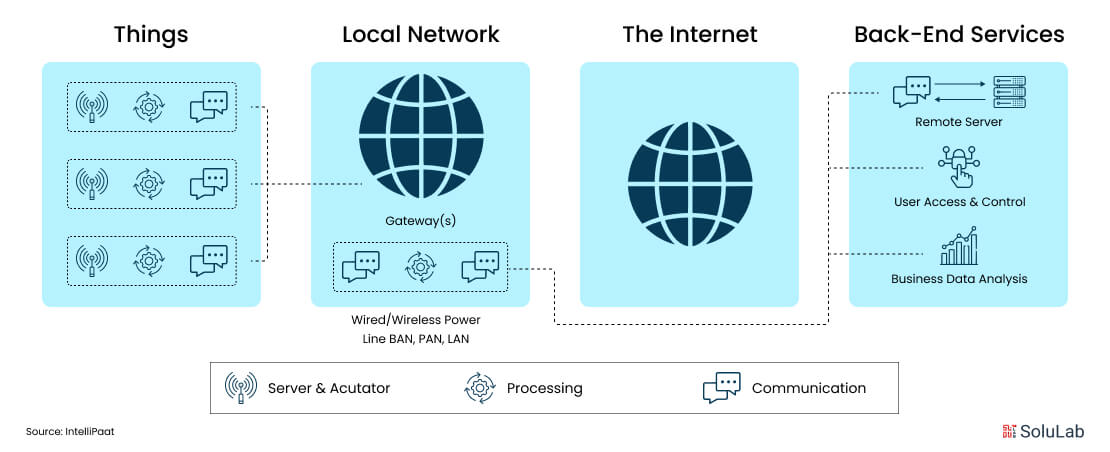
How Internet of Things Work

The Internet of Things is an amalgam of user applications, cloud servers, wireless networks, smart gadgets, and the Internet. An IoT device joins a local network. After that, it sends data to the cloud servers over the Internet. Moreover, the cloud servers provide the Internet of Things device access to the data or information from the end-user application. The two-way connection involved in this information transfer is what keeps the Internet of Things running.

As seen in the picture below, an Internet of Things system is made up of four main parts:

  • Internet of Things (IoT) Devices: These are intelligent electrical devices with wireless sensors that facilitate data flow across the network.
  • Local Network: It facilitates data access from Internet-connected devices.
  • The Internet: It facilitates communication between devices, servers and user applications.
  • Back-end Services: These comprise mobile applications, a distant server, and user access and control. These services continuously facilitate the exchange of streaming data from different end-user apps and IoT devices.

Benefits of IoT
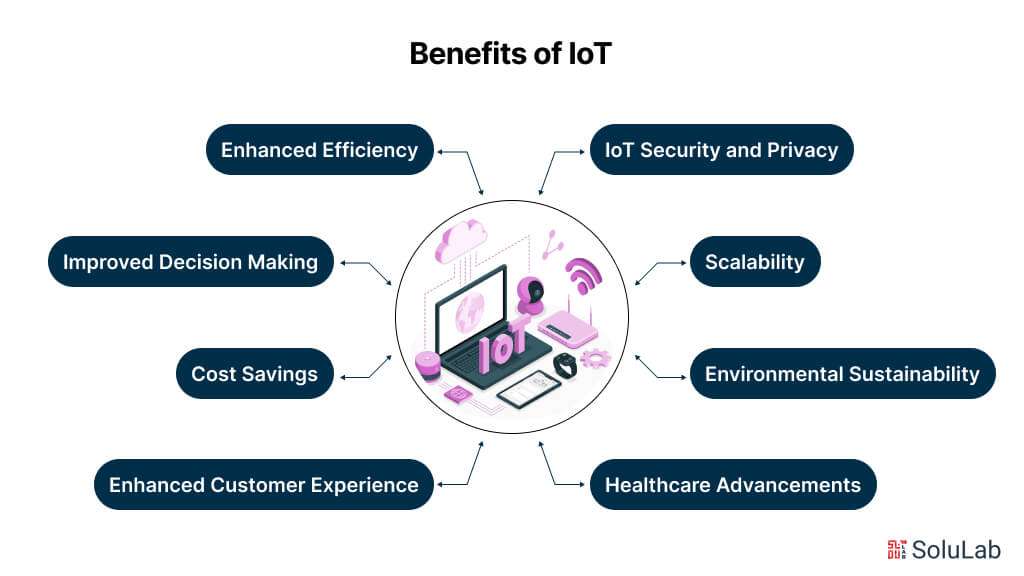
Benefits of IoT

IoT with machine learning brings forth a multitude of benefits, particularly in enhancing efficiency, productivity, and decision-making processes. Here’s a breakdown:

  • Enhanced Efficiency: By integrating machine learning in IoT algorithms, businesses can optimize operations and resource utilization. Machine learning can analyze data from IoT sensors to identify patterns and trends, enabling predictive maintenance, efficient inventory management, and streamlined workflows.
  • Improved Decision Making: IoT data combined with machine learning algorithms can provide valuable insights in real time. This allows businesses to make data-driven decisions promptly, based on predictive analytics and actionable intelligence derived from the analysis of vast amounts of sensor data.
  • Cost Savings: Predictive maintenance enabled by machine learning in IoT can significantly reduce downtime and maintenance costs by detecting potential equipment failures before they occur. This proactive approach prevents costly breakdowns and extends the lifespan of machinery and assets.
  • Enhanced Customer Experience: IoT devices can collect valuable data about customer behavior and preferences. By leveraging machine learning algorithms to analyze this data, businesses can personalize products and services, anticipate customer needs, and deliver tailored experiences, thereby increasing customer satisfaction and loyalty.
  • IoT Security and Privacy: While IoT introduces security and privacy concerns, machine learning can help mitigate these risks. Machine learning algorithms can detect anomalies in IoT device behavior, identify potential security threats, and proactively respond to cyber attacks. Additionally, encryption techniques and secure authentication methods can be implemented to safeguard IoT data and ensure user privacy.
  • Scalability: IoT systems generate vast amounts of data from numerous interconnected devices. Machine learning algorithms can efficiently process and analyze this data at scale, enabling businesses to adapt and scale their IoT infrastructure according to changing requirements and demands.
  • Environmental Sustainability: IoT combined with machine learning can contribute to environmental sustainability efforts by optimizing resource consumption, reducing energy wastage, and minimizing carbon footprint. Smart energy management systems, for instance, can analyze IoT data to optimize energy usage in buildings and industrial processes, leading to reduced environmental impact.
  • Healthcare Advancements: In healthcare, IoT devices integrated with machine learning algorithms can revolutionize patient care by enabling remote monitoring, early disease detection, and personalized treatment plans. Wearable devices and medical sensors can collect real-time health data, which can be analyzed by machine learning algorithms to provide actionable insights and improve patient outcomes.

Rad Blog: Artificial Intelligence in Healthcare: Future Outlook

Use Cases of IoT

When it comes to IoT, the applications are as diverse as they are transformative. Below, we delve into some of the top IoT applications and glimpse into the future possibilities of this groundbreaking technology.

Top IoT Applications

1. Smart Home Automation: IoT has revolutionized the way we interact with our homes. From thermostats that adjust based on occupancy to smart security systems that provide real-time monitoring, IoT enhances convenience, safety, and energy efficiency in residential spaces.

2. Industrial IoT (IIoT): In manufacturing and industrial settings, IoT plays a pivotal role in optimizing operations. Through sensor-equipped machinery, predictive maintenance analytics, and supply chain monitoring, IIoT enhances productivity, reduces downtime, and facilitates data-driven decision-making.

Read Our Blog: Iot Use Cases In Different Industries

3. Healthcare Monitoring: IoT-enabled medical devices, wearables, and remote patient monitoring systems are transforming healthcare delivery. These technologies facilitate continuous health monitoring, early detection of health issues, and personalized treatment plans, ultimately improving patient outcomes and reducing healthcare costs.

4. Smart Cities: IoT is instrumental in building smarter, more efficient urban environments. From intelligent traffic management systems and smart street lighting to waste management solutions and environmental monitoring, IoT enhances sustainability, reduces congestion, and improves the quality of life in cities.

Future Applications of IoT

Here are some of the IoT future applications to look for:

1. Precision Agriculture: In agriculture, IoT holds the potential to revolutionize farming practices through precision agriculture techniques. By integrating sensors, drones, and data analytics, farmers can monitor crop health, optimize irrigation, and enhance yield while minimizing resource consumption.

2. Autonomous Vehicles: The future of transportation lies in autonomous vehicles, powered by IoT technologies. These vehicles will be equipped with sensors, connectivity, and AI algorithms, enabling them to navigate roads safely, reduce accidents, and optimize traffic flow.

3. Smart Retail: IoT is reshaping the retail landscape, offering personalized shopping experiences and streamlining operations. From inventory management and smart shelves to personalized marketing and cashier-less checkout systems, IoT-driven solutions enhance efficiency and customer satisfaction in retail environments.

Check Out Our Case Studies: IoT in Retail

4. Energy Management: IoT plays a crucial role in optimizing energy usage and promoting sustainability. Smart grids, energy monitoring systems, and demand-response mechanisms enable efficient energy distribution, reduce wastage, and facilitate the integration of renewable energy sources.

Top 10 IoT Trends in 2025
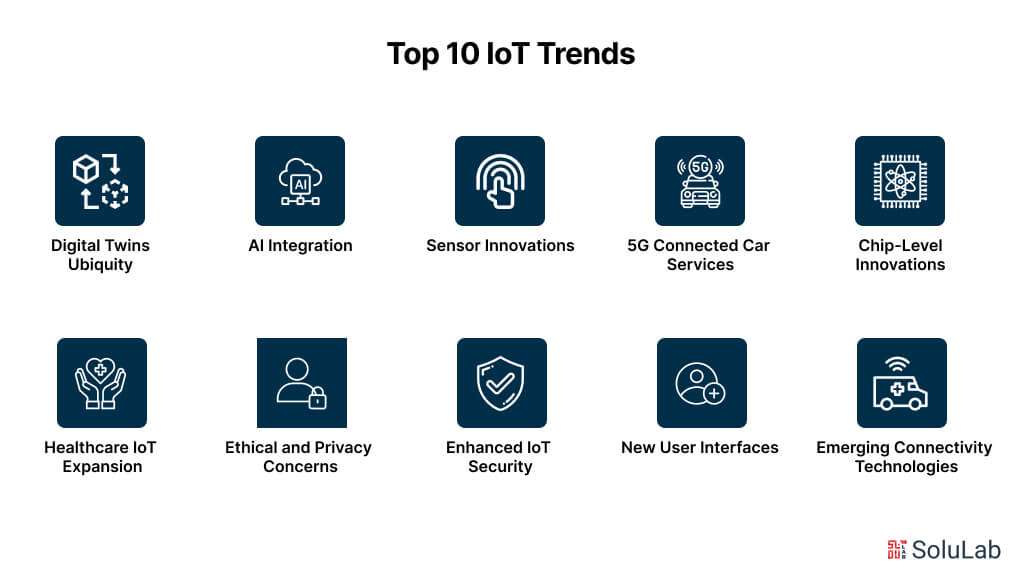
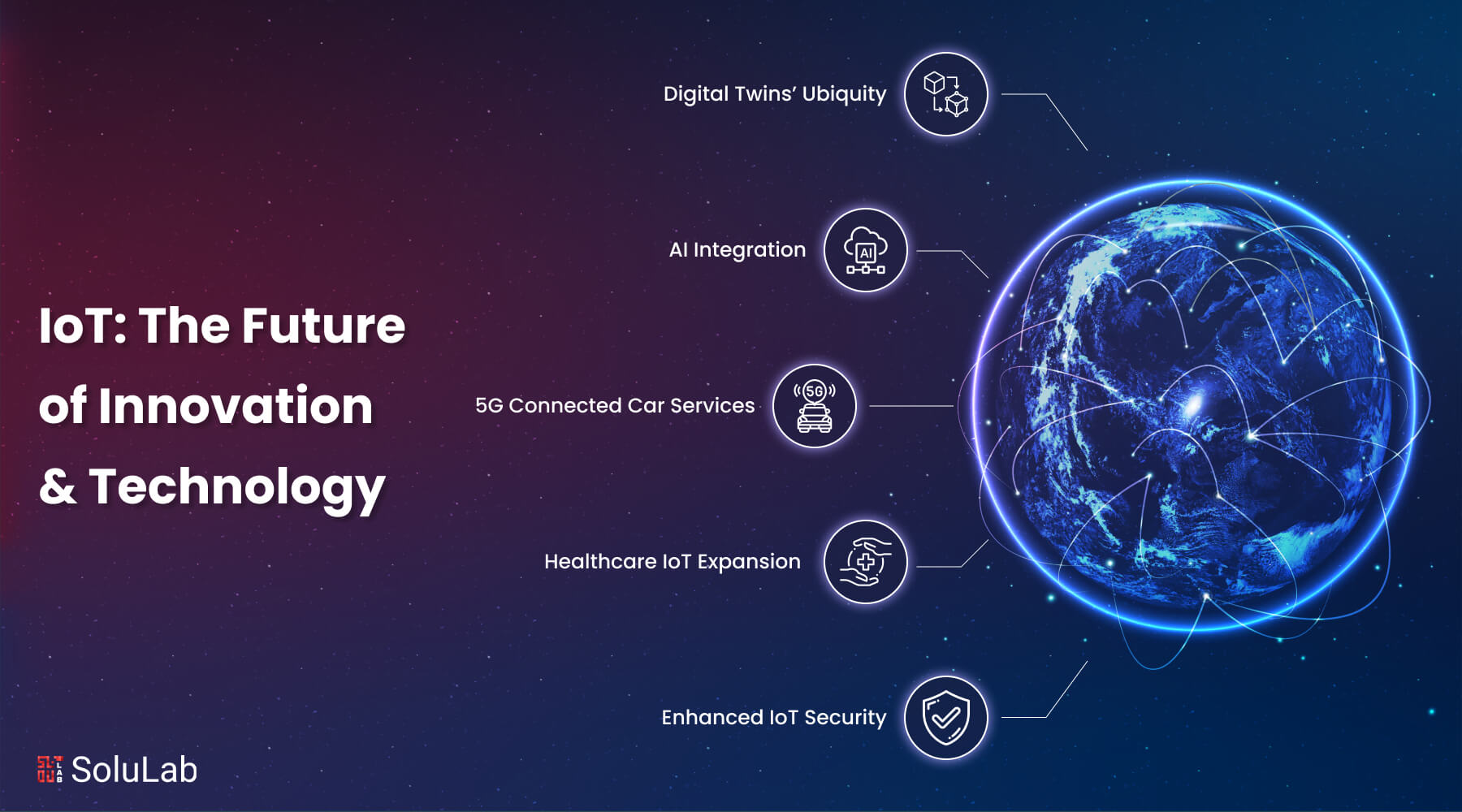
Top 10 IoT Trends

Here are some top trends and predictions for influencers in IoT technology.

1. Digital Twins’ Ubiquity: Digital twins, virtual representations of physical objects or systems, will see widespread adoption across industries in 2025. These digital replicas offer detailed insights into processes, enabling organizations to optimize operations, improve efficiency, and enhance decision-making. Post-COVID-19, businesses are prioritizing supply chain resilience, and digital twins play a crucial role in achieving this by providing visibility and enabling predictive analysis to mitigate disruptions.

2. AI Integration: As IoT devices proliferate, businesses are leveraging the wealth of data generated to power artificial intelligence (AI) models. This integration enables automation of processes, predictive analytics, and enhanced product or service quality. Edge processing capabilities are becoming more prevalent, allowing AI algorithms to run closer to the data source, resulting in faster decision-making and reduced reliance on central processing.

3. Sensor Innovations: Expect continued innovation in sensor technology in 2025, leading to more affordable IoT solutions and improved algorithms for extracting insights from sensor data. Advancements may include higher accuracy, lower power consumption, and increased sensitivity, enabling a wider range of applications across industries such as automotive, agriculture, and healthcare.

4. 5G Connected Car Services: With the global rollout of 5G networks, connected car services will become more prevalent. Enhanced connectivity will enable features such as real-time vehicle-to-vehicle communication, improved Advanced Driver Assistance Systems (ADAS), and seamless integration with other IoT devices. Collaborations between telecom providers and automotive manufacturers will drive the adoption of these services.

5. Chip-Level Innovations: The IoT industry will witness significant advancements at the chip level, driven by the demand for more processing power at the edge and addressing the global chip shortage. Specialized chips optimized for IoT applications will emerge, capable of handling tasks such as neural network processing and AI inference while consuming minimal power. These innovations will accelerate the development of AI-powered IoT solutions.

6. Healthcare IoT Expansion: IoT solutions will continue to transform healthcare, with the market expected to grow significantly by 2025. Smarter wearables and home monitoring devices will become more sophisticated, capable of monitoring various health parameters and facilitating remote patient monitoring. Virtual hospital wards, supported by IoT technology, will enable healthcare professionals to monitor and care for patients remotely, improving accessibility and patient outcomes.

Read Blog: Generative AI in Healthcare

7. Ethical and Privacy Concerns: Increasing awareness of privacy risks associated with IoT devices will drive regulatory actions and consumer demands for enhanced data protection measures. Concerns about data ownership, usage, and security will lead to stricter regulations governing IoT device manufacturers and service providers. Transparency and accountability in data handling practices will become paramount to build trust with consumers.

8. Enhanced IoT Security: The importance of IoT device security will be emphasized further, with governments and consumers demanding robust security features and labeling requirements. Legislation will mandate the removal of default passwords, and IoT devices will be required to undergo security assessments and display security labels indicating their level of protection. Manufacturers will invest in secure-by-design principles and encryption technologies to safeguard IoT ecosystems.

9. New User Interfaces: As IoT devices become more prevalent, manufacturers will explore innovative user interfaces beyond traditional touchscreens. Alternative interaction methods, such as voice commands, gesture recognition, and augmented reality interfaces, will enhance user experiences and improve accessibility. Automotive manufacturers, in particular, will prioritize intuitive interfaces for infotainment systems and vehicle controls.

10. Emerging Connectivity Technologies: The adoption of new connectivity technologies, such as Narrowband IoT (NBIoT) and advancements in 5G and satellite internet, will enable new AI applications and use cases. These technologies offer improved coverage, lower latency, and increased bandwidth, facilitating reliable communication between IoT devices and cloud platforms. OEMs will leverage these connectivity options to develop innovative IoT products tailored to specific industry needs.

CTA1

Future of IoT

The future of Internet of Things is exciting & dynamic. One of the main elements of the enormous change the world is undergoing is the Internet of Things (IoT). It seems certain that a variety of modern technologies, including edge computing, 5G, AI, and machine learning, will form the foundation of the future. Future projections for the Internet of Things include that it will completely transform sectors like industry, logistics, transportation, healthcare, and agriculture.

1. IoT Device Growth Projection

The forecast of over 21 billion IoT devices by 2025 represents a significant expansion from the 4.7 billion devices in 2016 and nearly 11.6 billion devices in 2021. This trajectory underscores the widespread integration of IoT technologies across diverse sectors, including smart homes, healthcare, manufacturing, and more.

2. Cyber Threats and IoT Vulnerabilities

The emergence of cyber threats targeting IoT devices is exemplified by the Mirai malware incident of 2016. Exploiting default credentials, this malware hijacked IoT devices to orchestrate Distributed Denial of Service (DDoS) attacks, disrupting critical services and websites. Such incidents highlight the inherent vulnerabilities within IoT ecosystems and the importance of robust security measures.

3. Adoption of Smart Technologies in Cities and Enterprises

Cities and enterprises are increasingly leveraging IoT technologies to enhance efficiency, sustainability, and resource management. Through the deployment of sensors and connected devices, cities can optimize services such as transportation, waste management, energy consumption, and public safety. Similarly, enterprises benefit from IoT solutions for process automation, supply chain optimization, and asset tracking, driving operational efficiency and cost savings.

4. Convergence of AI and IoT

The convergence of artificial intelligence (AI) and IoT enables transformative capabilities in user experiences and device functionality. By harnessing data collected from IoT sensors, AI algorithms can personalize interactions, anticipate user preferences, and optimize device performance. This integration facilitates intelligent automation, predictive analytics, and adaptive decision-making within IoT ecosystems.

5. Role of Routers in IoT Security

Routers play a crucial role in safeguarding IoT networks by serving as gateways between devices and the internet. Implementing robust security measures such as firewall protection, intrusion detection, and access control, routers mitigate cyber threats targeting vulnerable endpoints. As the number of IoT devices proliferates, routers become indispensable components in ensuring network security and resilience.

6. Impact of 5G Networks on IoT Adoption

The rollout of 5G networks accelerates the adoption of IoT solutions by enabling faster data transfer, lower latency, and increased device density. This advancement unlocks new opportunities for innovative applications across industries, including autonomous vehicles, remote healthcare monitoring, smart infrastructure management, and immersive multimedia experiences.

Conclusion

The world is moving toward a more automated, linked digital setting, which means there is never been a better opportunity for IoT development and innovation in the future. IoT devices are already providing countless opportunities for data collection and the emergence of new applications in daily life.

As usual, these developments will bring with them difficulties, such as threats to privacy and security. By now, businesses ought to have a solid plan in place to optimize their influence across the various IoT value chain domains. Government programs that encourage technical development and investments in networked infrastructure make it inevitable that the Internet of Things will take over our lives in the future.

SoluLab, a leading IoT development company enables organizations to fully realize the promise of IoT technology for driving innovation and digital transformation. SoluLab, with its team of experienced IoT developers and engineers, specializes in designing bespoke IoT solutions that are suited to each client’s specific requirements.  SoluLab helped Gearnetics develop an advanced IoT fleet management solution, enabling real-time monitoring for 10,000+ vehicles. Built on AWS IoT, it eliminated outdated onboard scales, offering route tracking, driver monitoring, fuel analysis, and weight management. With secure data transmission and real-time updates, the company saw a 47% ROI increase, optimizing 2,000+ trucks with smart sensors. SoluLab to get started with your IoT journey today. Contact SoluLab to get started with your IoT journey today.

FAQs

1. What is IoT, and how does it work?

IoT, or the Internet of Things, refers to the network of interconnected devices embedded with sensors, software, and other technologies that enable them to collect and exchange data over the Internet. These devices can range from smartphones and wearable gadgets to industrial machines and smart home appliances. IoT works by gathering data from these devices, analyzing it in real time, and using insights to automate processes, improve efficiency, and enhance user experiences.

2. What are the benefits of IoT adoption for businesses?

IoT adoption offers numerous benefits for businesses, including increased operational efficiency, cost savings through predictive maintenance, enhanced customer experiences through personalized services, and improved decision-making with real-time data insights. Additionally, IoT enables businesses to unlock new revenue streams, drive innovation, and gain a competitive edge in today’s digital economy.

3. What are some examples of IoT applications across industries?

IoT technology finds applications across various industries, such as healthcare, agriculture, manufacturing, smart cities, and transportation. For instance, in healthcare, IoT devices like wearable fitness trackers and remote patient monitoring systems help track vital signs and manage chronic conditions. In agriculture, IoT sensors monitor soil moisture levels and automate irrigation systems to optimize crop yields. Similarly, in manufacturing, IoT-enabled predictive maintenance reduces downtime and extends equipment lifespan.

4. What are the security and privacy concerns associated with IoT?

While IoT offers numerous benefits, it also raises concerns about security and privacy. IoT devices are vulnerable to cyber attacks, data breaches, and unauthorized access if not adequately secured. Additionally, the collection and storage of sensitive data by IoT devices raise privacy concerns regarding data ownership, consent, and usage. To address these challenges, businesses must implement robust security measures, encryption protocols, and privacy policies to safeguard IoT ecosystems and user data.

5. How can businesses get started with IoT adoption?

Getting started with IoT adoption involves several steps, including defining clear business objectives, identifying use cases aligned with organizational goals, selecting suitable IoT platforms and technologies, and partnering with experienced IoT development companies for implementation. It’s essential to conduct thorough research, assess technology requirements, and develop a roadmap for successful IoT deployment. By taking a strategic approach and leveraging the expertise of IoT professionals, businesses can embark on their IoT journey with confidence and maximize the benefits of this transformative technology.

6. How can SoluLab assist businesses in IoT development?

SoluLab is a trusted IoT development company known for its expertise in crafting tailored IoT solutions to meet the unique needs of businesses across various industries. With a dedicated team of skilled AI developers and engineers, SoluLab offers end-to-end IoT development services, from initial consultation and ideation to prototyping, implementation, and ongoing support. By leveraging modern technologies and best practices in IoT architecture, SoluLab helps businesses harness the full potential of IoT to drive innovation, streamline operations, and enhance customer experiences. With a proven track record of delivering successful IoT projects, SoluLab is committed to empowering businesses to thrive in the connected world of tomorrow.

Is Blockchain The Solution, Beauty And Wellness Industry Looking For?

Blockchain technology is dominating every field whether it be industrial, health, banks the impact of technology has even touched the beauty and wellness industry. According to the report by Inkwood research, the figures depict that the Global Beauty and Personal care products market is expected to grow from $432.7 billion in the year 2016 to $750 billion by the year 2024.
The highest contribution in this market is expected by Europe with around $225 billion in the next 5 years.

However, it has been observed that the beauty industry is one of those industries which has yet to use the potential of digital technologies.
Even today most of the spas, salons and wellness centers are dependent upon the telephone and pen paper method for the bookings of the customer.
                             

The New Trend In The Beauty And Wellness Industry

There has been the introduction of JOLLY for online booking in the beauty industry. This has resulted in improving efficiency and faster payments in the beauty industry. It has been quite successful since it was launched in the year 2016, for revolutionizing the business of beauty industry in Europe resolved the problem of appointments, save the time of the users moreover a new form of payment method was introduced which is more convenient.

Now blockchain is being used to upgrade this platform so that more salient features can be added to the platform. JOLLY was introduced with the aim to change the traditional method in the beauty industry and provide much effective beauty booking system. With the introduction of blockchain, it will be led to effective interaction between the buyers and the sellers.

Also, with the help of this, the users can book their appointment anytime 24/7 and they can also find the best prices and check the availability of the sellers, also they can receive awards and the buyers can make the payment in form of native token of JOLLY which is JOY.

The blockchain will provide complete transparency and with the help of this, the seller will also be able to compare themselves with their competitors in terms of the services and the prices and will also be able to receive the feedback of the customers. JOLLY is one of those platforms which is working to popularise the use of cryptocurrencies. According to JOLLY women, makeup around the 70 % purchase of the household and are responsible for $20 trillion in yearly consumer spending. It has been depicted that this figure is going to rise up by 40% in the next 5 years. Therefore to make the use of cryptocurrencies widely applicable it is quite necessary to indulge more and more women into it and platform such as JOLLY are expecting to bring this change as they are introducing the women to the crypto world through their respective platforms.                                      

Several Blockchain Projects Solving The Hurdles of The Beauty And Wellness Industry

Companies from Korea and Japan, are introducing several projects and are making huge investments in this industry,  for the development of a business which involves cryptocurrency.

Beautybloc – This blockchain company was introduced so as to look after the problems related to the cosmetic surgery industry. Some non-specialist is tacked by problems such as the wrong advertisement, wrong treatment. It also looks after to restore the faith lost by the industry.

BeautyBloc is a South Korean based large-scale project. It comprises of various information such as the data of the customer, the content related to the treatment of the customer, also it consists the information about the specialist who is going to look after the treatment and other stakeholders. Thus, it plays a very important as with the help of this unauthorized treatment can be prevented and there are fewer chances of fraud in this case.                             

Blockchain Connects The Manufacturers And Consumers

There are several platforms such as Cosmochain with the help of which the users can get connected to the suppliers , manufacturers, distributors etc.  The platform uses blockchain technology for its functions and it receives a huge amount of investments too. The platform has its own virtual currency which is called CosmoCoin / COSM the payments are made in this form in the platform.

COSMEE is the application which is developed by the company and with the help of which rewards in the form of virtual currency and in the form of services can be granted.

RVH co. Ltd.

It is one of the major beauty companies in Japan.  The company has its subsidiary under the name “Minor Garage”.
The role of this is the mining of the virtual currency and blockchain related business. The company promoted the development and also run several projects such as the training of the blockchain engineers.

What the future holds

Thus, blockchain has knocked the doors of the beauty industry as well and has made beneficiary changes to it and soon it is expected that the worldwide beauty industry will soon be under the influence of this blockchain technology.


How To Generate More Users/Revenue for E-commerce Business Using Sweepstakes

Sweepstakes are an efficient marketing channel that helps develop your business, generate more leads, promote your brand, and increase sales.

Sweepstakes have several benefits compared to other marketing methods. In addition, it’s easy and inexpensive to run. Just one single promotion can result in getting new customers, increasing sales, increasing followers on social media like Twitter, Facebook, Pinterest, etc, and better brand exposure and awareness.

According to Hubspot, “approximately 33% of contest entrants agree to receive information from brands allowing you to remarket to those customers to land the sale”.

Below is the list of objectives that the implications of sweepstakes can achieve

Boost visitors on the website:

Sweepstakes can go viral easily. Therefore, you can design it to attract new potential customers to your store.

Generate referrals:

You can provide unique referral links to each participant to track who referred whom and reward them accordingly. And,  these friends will refer to other friends and in this way, the website will attract more visitors and will help increase awareness of the website.

Grow your email list:

Now you might be wondering, “How exactly does that help my business?” Often, e-commerce websites that run sweepstakes will ask entrants to share their details with the website.

For example: “Enter with your email address” or “Follow us on Instagram to win.” 

Increase awareness of your store:

If you have a new website, you can use sweepstakes to help make more potential customers aware of your website.

Providing Incentives:

Sweepstakes are viral. Customers talk about them all the time and share them with their friends and colleagues. However, you can encourage them to share it even more by providing incentives. Just by providing small incentives, you can increase a lot of potential customers  

Further, offer them additional entries by liking, tweeting, or inviting friends to sweepstakes. You could even offer them a guaranteed gift (a discount for instance) for inviting several friends,  to join in or post about the sweepstakes on social media.

Overview of case study

Case study 1: Unique Hotels Facebook campaign   

Unique Hotels is a small group lifestyle hotel located mainly in Tallinn, Estonia and Manor House just outside the city. Each is located in historical buildings and surroundings that have been updated to include modern conveniences. And, each has a different character and level of service.

Objectives:

  • By using social media campaign, create brand awareness and encouraging content to share between users.
  • Generate leads and bookings by attracting visitors to the Unique Hotels’ websites with special offers.
  • Increase the Unique Hotel’s probable customers with offers, campaigns, and engaging content.
  • Develop a new community channel for customer interaction, give updates, and generate news.

Solution:

  • Run month-long sweepstakes campaigns on Facebook.
  • The viral aspect of the campaign is more sharing,  the extra points, and greater the chances of winning in both the weekly and main prize (luxury all-inclusive weekend in Vihula Manor) draws.
  • To encourage sharing even further they incorporated three ways to collect additional points and increase one’s chances of winning – the initial ‘Like’, sharing badges with friends and subscribing to the Unique Hotels newsletter.

Results:

  • After the successful completion of  the campaign, the Unique Hotel fan base went from 414 to 12,349
  • User engagement (any clicks on any stories) went from 2,108 to 30,944
  • Traffic to all of the Unique Hotels websites for November and December was 115% of the previous two month’s figures (September and October).
  • The Unique Hotels mailing list skyrocketed from 600 subscribers, predominantly Estonian-speaking, at the beginning of the campaign, to approximately 3,000 Estonian, English, and Russian subscribers

Case Study 2: Noritz

Noritz manufactures tankless water heaters for both home and commercial use. They’re sold through various distribution channels that primarily include installers and dealers. They expressed a desire to establish a way to increase brand exposure and gain the ability to directly communicate with end users to help increase the probability of a dealer/installer sale.

To satisfy that need a 12-month (with monthly prizes) sweepstakes campaign was initiated to attract new prospects, increase brand awareness, grow the subscriber list, and drive traffic to the dealer locator tool. To drive traffic to the sweepstakes mini-site Google AdWords was used with geo-targeted pay-per-click ads.

Results:

  • 45% registration rate
  • 28% referral rate
  • Substantial increase in the subscriber list
  • High use of dealer locator tool

The result was pretty impressive considering only Google Adwords was used.


Why Facilitate Your Business With Conversational Chatbot Development

Don’t be desperate like other businesses and start the haste to launch your own conversational chatbot. Rather think does your business need a conversational chatbot development or not? We understand to move along with this fast-paced world one needs to be adaptive to innovative technology. From the last two years, Converstional Chatbot Development is the emerging trend. If a website has conversational chatbot,  people consider it as a sign of modernity and showcase up to date nature of the website. Besides, it keeps the customer more engaged and gets the extensive information handy.

The reason behind the imperative role of bots for the business is the anytime support and better customer service management. It takes the branding of any business to the extreme level by making it easy for the customer to get the required info in the blink of the eye.

Conversational chatbot development are in vogue and can facilitate your business, how?

If you are not sure about getting chatbot for your venture or to know why conversational chatbots are essential for business, refer to the reasons given further:

conversational chatbot development

Effective replacement of human resources

Chatbots can easily replace humans and make them concentrate on qualitative tasks. Humans can get tired after serving customers for longer hours. On the contrary,  these technologies can work endlessly without getting bored or feeling tiresome. To save the cost of customer support, this is a vital step to be taken by every business. So, one can make their human resources available for more productive tasks. The website visitors can interact with these artificial humans 24/7 and get information about the products of the site.

Chatbot development is cost-effective

The biggest advantage that chatbot technology gives is the pocket-friendly price of the development. To offer a good user experience, if a business invests a significant amount of money then why not spend a little on this technology. This way your customers will be more satisfied as your website will be more interactive. So, you can avail the Benefits of chatbots by getting it developed for your business.

Read More: How Much it Cost to Develop a Messaging App like WhatsApp

Boost up the operations

Unlike human workers, the chatbot has no time bounds and can work endlessly. Chatbot business will function greatly as it can operate way more than the workforce.

chatbots in industries

With the involvement of this technology, any business or any industry can avail the boosted operations and more efficient work at the same time. Due to this automation of the work, a business owner can plan to enter new markets and that too within the budget.

Not at all difficult

Today, most of the organisations are in favor of conversational chatbot development. The easier and simpler the interface will be, the more familiar  it will be among the users. Customer satisfaction is the main motive of any company, so if modern technology can do this, it will be definitely given importance to. This way one understands why to use a chatbot and how it will increase business sales. Thus, this will enable the engagement of more customers and leading towards better customer base.

Quick development

Just because this technology is efficient that doesn’t mean it consumes a lot of development time. As compared to application development this task of chatbot development is not so time-consuming. If you want something out of the box that is not like the basic development that could take time. One cannot compromise with the time while being into a business, so the less consumption of time is in the favor of the company. The quicker your development will be the more early you can avail the executive strategies and analyze the market of conversational chatbots.

Adopt early for maximum success

We all know that whosoever offers something for the first time it can be attractive for the one who is watching. So, same is the case with the chatbots, the early you will adopt this technology the more easily you can allure your customer base. By doing this you can make them believe just like your business tactics your products are also modish. Moreover, you will get more loyal customers who will rely on you for your services and products. Therefore, before all businesses start using chatbots in their websites, you should instantly get your chatbot development done.

Better business branding

Not just the cost is low but conversational chatbot development can also minimize the efforts of customer service. You can also improve business branding with almost no efforts with this mode of technology. These days’ people prefer the solutions which are hassle-free and offer unlimited facilitation. This is the best way to target the potential customers as when they visit your site. With instant replies, businesses can delight their customers. And eventually, conversational chatbot development will lead to better branding.

Over to you: Delight your customers with conversational chatbot development

These cost-effective solutions are great for any business as they provide hassle-free solutions to consumers. One needs to get chatbots developed and need no customer service executive to handle the website queries. Thus, these easy to use customer friendly conversational tools build better customer satisfaction and better branding.

Enterprise Blockchain Development: Hurting or Helping Non-financial Industries?

What is enterprise blockchain for non-financial industries and how do it impact? In simple words, blockchain technology that focuses on providing decentralized services on a enterprise level is known as enterprise blockchain.  An enterprise blockchain helps to enhance the business performance highly and also increase the resilience. Thus, the downtime of due system failure is avoided which in turn, increases the enterprise performance. Enterprise blockchain development include ethereum development services, smart contract development services, development of Distributed Ledger Technology (DLT).

enterprise blockchain for non-financial industries

Though enterprise blockchain technology is considered to be helpful by many industries, still it is debated if it is helpful or hurting non-financial industries.

Enterprise Blockchain For Non-financial Industries

Non-financial industries include enterprises for which financial transactions are different from transactions handled by the enterprise owners themselves.  A non-financial industry includes enterprises of three types such as public, private and foreign controlled non-financial corporations.

A public non-financial corporation is handled by government institutions directly or indirectly. A private non-financial corporation is involved in trading one or more than one stock that is owned by other different private corporations or shareholder individuals or groups. A foreign controlled non-financial corporation deals with operations in a country that is not the parent country of the owner or the shareholder.

Enterprise Blockchain Develop Helps Non-financial Industries: This is how:

blockchain-helps non-financial

Reduction in Transaction Cost

Usage of smart contracts increases the accuracy of operations to avoid manual human mistakes in non-financial transactions. Automating operations save time and cost in large. It also eliminates multiple middlemen and thus allow non-financial industries to use valuable resources efficiently. Human force required to monitor and manage operations is reduced in large too with enterprise blockchain.

Increases Transparency in All Operations

Traditionally the number of eyes monitoring operations was huge, especially in the case of public non-financial transactions. This is because of centralized systematic usage of resources and operability. With enterprise blockchain, all operations are decentralized and everyone involved can access data and aggregate necessary information. With increased transparency, the compliance between parties and enterprises also increases between multiple non-financial corporations.

Enhances Traceability of Data And Information

Enterprise blockchain allows non-financial corporations to manage data seamlessly and access them anywhere anytime with necessary authorization. Such kind of protected administration maintains a strong record of all transactions and allows users and consumers to track any transaction from its point of origin till the transaction end. This is possible with the integration of Decentralized Ledger Technology (DLT) and smart contracts.

Prevents Fraudulent Hacks

With the help of public, private or consortium network with respective encryption keys, counterfeiting of products and services provided by non-financial industries is eliminated. This is accomplished by providing access to the blockchain platform based on permission. Proof of authenticity provides necessary validation of products and services with real-time stamp. Thus, data is protected even when transferred through untrusted or unknown channels and networks.

Enterprise Blockchain Development Hurt Non-financial Industries: This is how

blockchain hurting non-financial

Exploiting Enterprise Blockchain

Enterprise blockchain technologies may have loopholes since the technology is new without completely understanding it and does not yet have standardized regulatory compliance. Thus, some non-financial corporations may become vulnerable to security threats and thefts. However, the concept of blockchain by itself it to prevent such digital theft. But, yet still requires a huge some of money to be invested in building and maintaining the security firewall.  

Loss of Private Decryption Keys

Users and consumers are still getting used to the system of cloud storage and decentralized technology. Hence, consumers of non-financial industries are prone to store their private keys in a publicly accessible cloud storage without understanding its importance. Such kinds of public cloud storage systems are vulnerable to hacking. Thus, one wrong move and users might lose their accessibility or identity. This results in non-financial industries to lose their long-built brand image in seconds.

Enterprise Blockchain is Highly Volatile

The price of cryptocurrencies has the tendency to rise up to its peak point overnight and also fall below threshold point overnight. It is hard to predict the future trends and the outcome that come along with it. This makes the job of non-financial industries even harder in acquiring new customers with increased trust and confidence in terms transactions via digital platform.

Chances of Mismanagement is High

Without an expert organized team which has expertise knowledge in enterprise blockchain development, all transactions may tend to be stored imperfectly and dis-organized. This in turn also reduces quality of the data and non-financial industry will face challenges in accomplishing an efficient analysis of records and transactions.

Conclusion: Enterprise Blockchain Development Creates Value For Non-financial Industries

Storing, sharing and facilitating transfer of data across departments within a non-financial corporation and across multiple non-financial corporations in different countries is easier with enterprise blockchain. For example, in the case of franchised food business, maintaining the same quality of products and service is achievable with enterprise blockchain.

Though many governments and third-party enterprises may not accept enterprise blockchain, non-financial industries realize the importance of handling data digitally. It is high-time to protect content and profits earned by non-financial corporations with safety. In our opinion, despite the painful points, enterprise blockchain development will help non-financial industries in large.

Feel free to disagree or agree with us. Let us know what you think and why.


Why AngularJS Should Be Your Cup Of Tea For Enterprise App Development

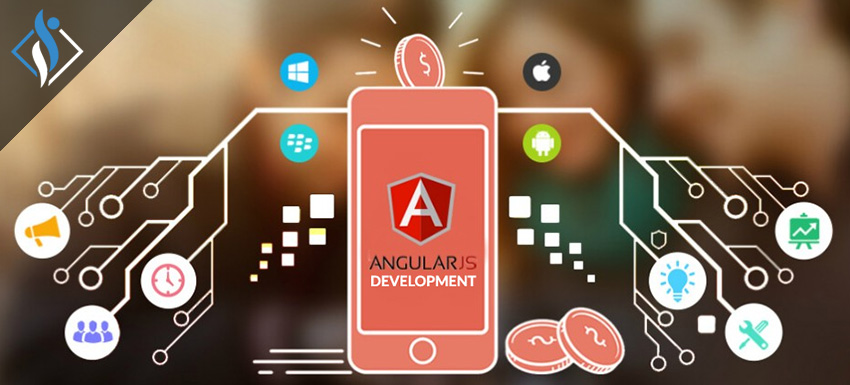
AngularJS is a JavaScript framework-based platform that programmers use to develop applications for enterprise professional purpose or customer focused commercial purpose. In today’s world, the need for web development has increased due to the increase in digital marketing. With a hike in the demand for web development, the need to hire AngularJS developer has increased too. With boost in a digital market, the e-commerce is expanding trying to capture a wider customer base too. Thus, all AngularJS development companies are on demand around the world. Is AngularJS for enterprise app development a good option for companies?

angular js

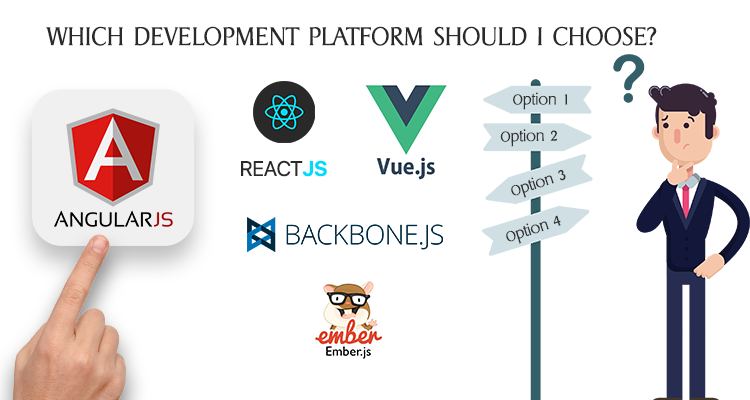
There are various programming platforms that a developer can use to develop enterprise applications and web applications such as HTML, CSS, etc. But, most of the developers prefer to use AngularJS to develop enterprise applications for the ease and comfortability developers have in using AngularJS.

This article, further, discusses about the reasons why AngularJS is a good choice for enterprise app development.

Reasons Why You Should Choose AngularJS for Enterprise App Development

AngularJS was developed by Google and launched in 2009.

It helps data accumulated and provides the developers with libraries. This makes the job of developers easy while expanding the code for future upgrades or updates. Unlike other programs, AngularJS does not require any extra source code.

Enhances The Ease Of Writing A Code

Though information technology industry is huge, not every developer may have the interest in writing huge extensive codes for the enterprise applications might be trying to develop. AngularJS reduces the complexity in writing a code. Hence, AngularJS developers do not have to break their heads in finding solutions to fixing a bug or writing a huge code.

AngularJS uses something called as Modal View Controller (MVC) architecture. It helps developers write codes easily without having to write unlimited lines of code for the implementation of any data model. This modal view controller is known for separating the logic of a program from the user interface and supporting the separated logical concerns with easy interaction via the controller.

Huge Availability of Tools

Angular JS Tools

(Image Source: DZone)

AngularJS provides command lines that make the job of a developer easier in terms of identifying:

  • which folder should the installations be made in,
  • which module should be imported for the enterprise application development, etc.

It also provides testing modules to verify and check if the program will render properly.

AngularJS provides developers with two important features. They are libraries and schematics.

  • The library features of Angular make the usage of open-source modules easier. Thus, components can be re-used, unlike the closed-source projects.
  • The schematics features of Angular allow developers to write and create their own modules or components by reducing the boilerplate code.

Boilerplate code indicates the codes implemented in different sections of a code without any alteration.

Enhanced Customization

Since AngularJS uses HTML it allows the developers to use new components and new syntax to add code or add information to the behavior of a program without any struggle. This helps the developer to be more focused on creating and developing the logic of a program which in turn enhances the efficiency and productivity of the program. HTML, also, provides many tags that the developers can use to customize the program to make it understandable and readable.

Simplicity in Building A Program  

Unlike most other platforms, AngularJS provides guidelines for every attribute that can be used which supports the developer for any verification or query resolution needed. This guideline also allows the developer to extend the attributes of HTML by providing sources of different tools to customize as mentioned in the above reasons.

AngularJS for enterprise app development is beneficial. Because it also provides directives to the developers which can be used to gather data and incorporate it into HTML. This enhances the routing and binding processes while writing code to develop an enterprise application.

Filter Flexibility Help in Refining The Code

When a program is being written to code and develop an enterprise application, it would be better to have tools to extra refine the code to ensure that the bug of a program is minimal. More refining means more efficiency if done right, wouldn’t you agree?

Yes, AngularJS provides filtering tools that are focused on transforming data. Developers have the opportunity to create their own filters. They can go beyond just using the pre-existing filter to enhance or test the program of the enterprise application being developed. This filtering flexibility enhances the value of an enterprise application program before even its outcome has been displayed.

angularjs for enterprise app development

Conclusion: AngularJS is robust; the possibilities to develop a perfect enterprise application are huge

AngularJS has a built-in data streaming feature too. This provides the opportunity for more expansion of the program for enterprise applications and web applications. However, AngularJS may not be an ideal choice for developing applications that are small in size in terms of framework. It may not be ideal for developing applications that comprise complex functionality like gaming. But, to develop enterprise applications and web applications, AngularJS is the best out there. It allows the developers to self-explore, refine, and choose the framework that best suits the enterprise application functionality.

Let us know, what other reasons you think why AngularJS for enterprise app development makes the most sense.

Should You Prefer Cryptocurrency App Development?

Crypto app development and crypo wallet solutions  have led to increased demand in its development

With the world demanding more security, privacy in all operations and transactions, cryptocurrency wallet development companies and cryptocurrency app development companies are grabbing the opportunities. The current world awareness on concept of decentralization and enterprises operating using it such as blockchain has added further more demand and awareness on cryptocurrencies too. One could say, cryptocurrencies are the next big or current big financial revolution that is changing business operations on different level even by the minute.


Cryptocurrency exchange development and cryptocurrency app development helps in accomplishing instant transactions as well as maintaining identities in secrecy. Hence, it is no surprise that integrating blockchain and cryptocurrencies in financial operations of a business provides faster, reliable and transparent ecosystem. Financial markets are a place that are constantly changing based various Political, Environmental, Societal, Technological, Economical and Legal (PESTEL) factors. But, with cryptocurrency, coping up with financial fluctuations is minimized and also increase the value of funds and transactions.

Should You Prefer Cryptocurrency App Development?

Cryptocurrencies serve best as an investment opportunity. It allows investors to find assets conveniently and manage them more securely. Also, the processing time taken to liquidate assets is faster with cryptocurrencies as cryptos are digital and decentralized with potential benefits. Cryptocurrencies have disadvantages too. Curious to know regarding cryptocurrency app development? Keep Reading. This article will help you decide if you should prefer to develop a cryptocurrency app based on its pros and cons.

Cryptocurrency, should you choose to develop it or not?

crypto pros and cons

Benefits of Cryptocurrency App Development

Strong and secured infrastructure

Cryptocurrencies are developed with privacy and security in mind right from its initial development stage till its deployment. Even after deployment, cryptocurrencies are constantly maintained and monitored for potential security threat, hack or breach. There is no possibility for a brute force or double spend attack. They allow transactions to be handled either through a public or private network as per requirement.

Appropriate legal taxing

Cryptocurrencies may be new but they are not hard to understand as you might think. It is known for obtaining taxes from users and peers for each transaction in right amounts at the right time for the right purpose. Thus, there is no leeway for fraud or mal-practices. No one can avoid paying taxes and this opens up for more trustworthy transactions with increased potential opportunities.

Transaction cost is lower

There is not third-party of middlemen interference in transaction accomplished with cryptocurrencies. Users and peers can directly connect with each other and thus eliminates the need for any third-party service. This reduces extra charges levied on transactions due to third party services provided.  Comparatively cryptocurrency transaction charges are lower than other digital payment methods.

Mining of crypto coins is easier

There are no restrictions on limitation as to who wants to become a part of the crypto infrastructure. In the case of public systems, anyone can start a node and conduct minding of crypto coins as per their preferences. In the case of private system, users with necessary authority can start a node and access internet or computers to speed up the process of mining crypto coins. On the whole, anyone and everyone can get accessibility to computers without restriction to use cryptocurrency.  

Cryptocurrencies are volatile

This particular benefit falls user cons too. But first, let us see why being volatile is benefit with cryptocurrencies. Since the chances of cryptocurrency coins to rise up in value like a rocket in shorter period of time is high, the possibilities to convert fixed assets into current assets or liquidate them quickly is also easier and faster. They are highly reward as the value of cryptos can go to maximum heights overnight.

Drawbacks of Developing A Cryptocurrency App

Value of cryptocurrency

Yes, it is true that the world has moved and is moving towards a digital trend but what is the scope of virtual currency acceptance across the world? Only the developed countries mostly use virtual currency as means of transactions mostly. Developing countries are still debating its potential benefits and threats. Today, the value of virtual crypto currency is only as high as the trust we place in its current and future potential.

Contemporary markets are reluctant

It is still a million-dollar question, whether cryptocurrency app development is beneficial enough to have a practical purpose in our everyday lives? or is it just potential enough for limited purposes such as operations that require privacy and secrecy? It is honestly arguable but the solution lies in focusing on endless possibilities that decentralization networks bring.

Currently slower in transaction speed

Cryptocurrency miners can handle almost 3 to 7 transactions per second where traditional digital payment methods using credit or debit cards such as American express, Visa or PayPal can handle more than 24000 transactions per second.

Volatility of cryptocurrency is also highly risky

As mentioned in the benefits section, cryptocurrency is highly volatile. It serves both as a benefit as well as a risk. As much as it can increase in its value overnight, its value can also decrease as low as possible overnight. You may never know why and what caused it but the in short amount of time either you can either reap 100% profit revenue or lose all at once.

Makes you think, does it not? So, what should you do? All you can do now is make sure the cryptos you mine adhere to your purpose perfectly, accepted by all in consensus and also maintains coherent privacy in the process. Research what kind of cryptocurrency suits your purpose better and make smart decisions.

It’s security structure functions too well

Well, do we need to debate is this a pro or a con? Arguably, I’d stick to saying it is a pro but we can’t avoid what is practical, right? Cryptocurrency infrastructure is highly secured with encryption with a unique public or private key. If some transaction has ended up losing coins or something has gone wrong during transaction, what is lost is lost. There is no point of recovery of the crypto coins. It is more than perfect for the jobl. So, stay sharp and keep both eyes wide open during crypto transactions.

Conclusion: Think before you leap in cryptocurrency app development

As the benefits suggest, they are highly potential bearing advanced technology used widely today and the days to come especially in financial operations. The cons of cryptocurrency app development may seem risky. But all of it can be avoided by maintaining and controlling cryptocurrency with an immutable protection in security and privacy against centralized financial inflation.

mining cryptos

After all, in the history if finances, when was the last time demand and supply had a chance to be balanced equally and simultaneously? This is possible today with cryptocurrency. Let us know what is your views on this? and finally did you decide to develop a cryptocurrency app or go fall into the black hole of Netflix and YouTube?


Blockchain in Beauty Industry: Fit or Mismatch?

Blockchain in Beauty Industry

Gone are the days when we used to mistrust a new technology and fear  its unforeseen potential threats. Today, people as well as enterprises are willing to take risks because all of us understand that, it is the only way to proceed further with innovation and creativity. Blockchain is one such innovative technology that has been a game changer for all industries and who would have thought that it would change the beauty industry too? You disagree with us? It is okay, you can always question how blockchain is changing the beauty industry? Is it a fit or mismatch to use blockchain for personal care? The answer to all these questions is here in this article. Keep Reading.

Blockchain Takes Care of Beauty Care Industry

Before we get into the debate of whether blockchain is a fit or mismatch for beauty industry, first you need to know and understand why blockchain?

blockchain in beauty industry

Blockchain development provides users with decentralized applications (dApps) that allow them to connect with beauty care professionals and dermatologists. Users can avail personal and customized services instantly. Traditionally, even when you visited a dermatologist at their salon, the only way to know they are legitimate is via their certification or trust your gut feeling. But, now with blockchain you have substantial evidence for all identities.

Blockchain uses proof of authentication, proof of evidence and proof of work to give everyone with the accessibility to verify credentials of beauty care professionals. Thus, all details are transparent creating a mutual trust and confidence between the beauty care service provider and the customer.

Blockchain in Beauty Industry: it is a fit!!!

Cryptocurrencies Make Transactions Faster

Blockchain provides mobile developers to develop cryptocurrencies and use tokens as a medium to make payments for beauty care services for online orders or professional advice instantly. The digital platform of making transactions is known for its encrypted security, privacy and originality. Users do not have to worry about their health data getting breached anymore. Online orders can also be traced back to their original source that makes real-time tracking more effective.

Scheduling Appointments Have Never Been Easier

Traditional system of making scheduled appointments with dermatologists of beauty care professional were typically through a phone call or online reservation. Now, using dApps specialized for beauty care products such as OPU AI, you can avail beauty care services at your doorstep and instantly too. The service provider comes to your home.

Cosmetic Surgeons Provide Better Care

cosmetic surgeon

With blockchain technology, cosmetic surgeons can easily connect with customers in real-time via decentralized platform, share information and  allow customers to get personalized attention and treatment. There is no country or societal restriction or limitation.

Spas and Salon’s Provide Enhanced Experience

By allowing customers to pay through cryptocurrencies and tokens, beauty care service providers are able to increase their consumerism by enhancing the service with instant bookings.

salon app header

They are also able to provide rewards benefits to the customers like instant offers and discounts that can be availed in the form of tokens too which users can use elsewhere. The most important benefit is the direct connection between service provider and the customer.

Beauty Wellness Centers And Its Benefits

Beauty care advisors can legally connect with customers and connect them with local beauty care professionals no matter the time or day. Their clients will have 24/7 access to beauty care suggestions and health care benefits with the help of blockchain. This is possible as blockchain is decentralized and there is no extra charge on any service or transaction. Thus, users and beauty care advisors can focus on what is important.

Miscellaneous Advantages of Blockchain In Beauty Care

Blockchain in beauty industry completely eliminates middlemen interference. Hence, neither it is difficult to find the appropriate beautician nor you need to pay commission for the same . This is a chance to make female population of the world aware about blockchain and bring them to light towards the benefits of blockchain and cryptocurrencies. The ability to accept, review and deploy online orders is agile and delivery of products is seamlessly efficient with blockchain. Increased transparency and adherence to NDA standards of all beauty care professional allow users to trust their service provider without any hesitation.

Blockchain in Beauty Industry: It Is Mismatch??

Though you might think that blockchain is a mismatch and may not be required in the beauty care industry. We would like to think otherwise and hopefully change your perception. Yes, the technology is new and still in its baby stages. Probably out of the cradle but yet still learning to walk the world towards a digital platform.

Following are some of the reasons why you may feel blockchain is a bane to the beauty industry.

Blockchain Comes With A Cost

Integrating blockchain in daily operations is not as easy as it may seem. This is because you might have an IT infrastructure already in place. Also, changing an IT infrastructure always comes with a heavy cost. Not just that, since blockchain is new, some professionals might find it harder to understand and prefer to stick to what they know. This leads to challenges such as training, cost of training and cost of convincing.

Blockchain is Still Building Is Legal Environment

Regulations for blockchain system is still being shaped, re-formed and transformed on a daily basis. This is because it is new and it explores the unexplored environments daily encountering new challenges and problems. Thus, the environment of blockchain is very much volatile and people might tend to misuse it. However, with public and private encryption, security is still intact. Thanks to the technology.

Complexity of Blockchain Functionality

Since, the operational functionality and its back-end functions are complex to understand, users are not able to fully appreciate the benefit it may bring to the beauty care industry. The only way to overcome this particular challenge is to be patient and with time and more awareness, everyone will understand its tech functionalities. But, until then fingers crossed.

Conclusion: Blockchain brings more value to beauty industry

Blockchain integrated with Artificial Intelligence (AI) and Augmented Reality (AR) bring more experience and benefits to the beauty industry. Wondering how? Blockchain will bring quick and instant facial recognition system to visually scan the customer face and use it to analyze through skin tone and generate a report based on that. Still believe that blockchain is a mismatch? Let us know why do you think so? If not, let us know which benefit do you like the most and why.


Take it or not: Blockchain Can Solve Major Problems for Gig Economy Freelancers

The main aspect of any business is finance. When it comes to digital disruption, finance is a favourite target too. That is why blockchain has been a key component of finance-technology use cases. Today, the number of independent workers and freelancers are increasing at an exponential rate. However, one key issue that is often coming up is the difficulty in getting paid on time. Most of the issues are due to transactional side problems, changing cross-border fees, and client-worker miscommunication. But, the blockchain technology provides the best solution by decentralizing all processes. This reduces bottlenecks across all transactions. Similarly, there are a lot of advantages of blockchain for the blockchain gig economy freelancers. Let’s take a look at these.

A better method of payment for both parties

The blockchain was actually designed to develop a secure method for financial transactions. It allows entry of payments and fund transfers in the form of blocks into a digital chain. The negligible fees involved in blockchain payments is another advantage.

freelancers payment

Besides, cryptocurrencies also allow payments without worrying about exchanging fiat currencies. Traditional transactions have remittance fees ranging up to 20% and cryptocurrency fees range from 0.05 – 0.25%. Also, blockchain helps in codifying the agreements between the contractors and clients. Further, cryptocurrency transactions with their lower fees benefit both freelancers and clients.

Lower middleman fees

Today, blockchain applications are becoming more and more popular. In fact, they are threatening the middlemen all over the economy. This is because blockchain aids users to interact directly with each other via a protocol. With a decentralized service, the role of middleman becomes useless. From international money transfers to online advertising, blockchain applications are ousting middlemen out of the market.

A perfect example is the Openbazaar that has 0% fees on all transactions of its Bitcoin online marketplace.  Moreover, several new blockchain freelance platforms are promising 0–1% fees on their platforms too.

Proof of work and protection of intellectual assets

Most of the freelancers face a lot of issues while working from different countries. One of these issues is the unnecessary control over their work product. Besides, clients also control their proof of work that they have actually completed their tasks. However, blockchain helps in getting rid of all these problems.

Blockchain helps to enter data into blocks, with the freelancer’s profile and real work examples. The best benefit of blockchain is that it permanently stores all the data in the chain. If any freelancer wants to change or add to the existing things, they can do it easily. They can actually add extra data into new blocks.

Copyright and intellectual property rights area which will not be problems with blockchain. Freelancers may want sole rights to their work products or wish to prove that they were the creators. Blockchain helps to codify the product’s creation with the time of creation too. Thus, freelancers will have well-established ownership rights that can’t be tampered with.

Tokens and smart contracts for new incentives

With blockchain applications, you can tokenise anything and everything. However, trust is the biggest issue that employers and freelancers face on the current platforms today. Also, many employers and freelancers don’t treat others fairly. This affects the whole system negatively. Besides, crypto-tokens and smart contracts can help to incentivize everyone. It can aid by working a clever way to act fairly and professionally at all times.

One such example is the Ethearnal that is tokenizing reputation. This company gives a real market value on its freelance platform. In fact, it can give a blow to your reputation as well as your wallet. Thus, it is a win-win situation for both freelancers and employers.

Further, the benefit of decentralization is that it helps in achieving fairer and distributed dispute resolution. This leads to better contract outcomes, accurate ratings, and less centralized authoritarian control.

Benefits for freelancers and employers

Both freelancers and employers benefit from the blockchain technology in many ways. Blockchain gig economy can solve the major issues for freelancers. Let’s take a look at how freelancers get the full benefit of the blockchain.

  • They get cash in their wallets faster than ever before.
  • They can either increase profits and reduce their rates too for being more competitive.
  • Tokenized reputation means that the better reputation you have, the more money you earn. Also, clients always have something on the line.
  • Decentralized control leads to a safer business. Thus, income can’t be unfairly held, hostage.

freelancer

While most of the benefits are for freelancers, they also affect employers directly. Blockchain can make their work easier in many ways. Also, payments won’t be a headache anymore. Apart from this, employers can also get quality freelancers. Let us see how.

  • Employers can have less at stake especially when the centralized authority decides to change anything or intervene.
  • There are some indirect benefits too. This is the 15–20% reduction in fees that will urge freelancers to reduce their rates to stay competitive. This will lead to the availability of cheaper freelancers. Moreover, if the blockchain platforms are better for freelancers, employers can attract the best freelancers.
  • Blockchain platforms run in a more efficient manner by leveraging smart contracts and tokenized incentives. This is an added advantage for employers because it would lead to less risk when hiring freelancers. Also, freelancers will produce only higher quality work.

Blockchain Solutions for freelancers

blockchain for freelancers

Openbazaar

Openbazaar.org is a general online marketplace. Here, anyone can sell anything peer-to-peer, using cryptocurrencies. They also found that a decentralized network actually works without central control. Besides, privacy and anonymity were the main motivations for Openbazaar. Moreover, the sole reasons for their success were in the support of the community and staff.

CanYa.io

CanYa is a blockchain-based freelance platform that follows decentralisation for everything.  From payments and governance to storage, almost everything is decentralised by CanYa. In fact, both digital and in-home freelancer services are available on this platform.  However, the main selling points of CanYa include simplicity and low fees. Moreover, you can find, book and even rate service providers. Also, if you want to buy real-world services, you can use the CanYaCoin too. The low fees at only 1% that gets converted into rewards is also another benefit. It actually encourages growth and helps in understanding the desired user behaviour.

Signing off…

More and more people are opting for freelancer jobs today. Also, the global freelance marketplace is huge. But, it also has many inefficiencies. Users struggle with high fees and slow payments. They also suffer from low work quality and dishonest employers.  Blockchain can ruin the careers of middlemen in mere seconds. But, this powerful decentralized structure can be beneficial for both employers and freelancers. In fact, the decentralized solutions of blockchain make the marketplace better for everyone. Freelancers and employers can even change their way of doing things. But, will they be able to pull off this new technology well?


A Beginner’s Guide To Hyperledger Blockchain

A hyperledger by its functionalities simplifies multiple process and operations on an enterprise level that helps you to transform your business with enhanced competitive advantage. Every hyperledger blockchain development company is focusing on how to use the decentralized distributed ledger system to automate processes and enhance business operations. With the need to control and monitor transactions in real-time, blockchain development companies have grabbed the opportunity to use blockchain in developing hyperledgers.

What is Hyperledger Blockchain?

Hyperledger is a blockchain technology-based tools that uses smart contract to create a globally distributed system. Such a kind of system allows transaction of data in real-time instantly without any lag, delay and also accomplish tasks with complete transparency. Hyperledger blockchain, when implemented successfully,  deploys an immutable business model that advances every business with profitable opportunities and bigger ROI generation.

Hyperledger provides multiple services such as open sourced security in applications and networks, higher accuracy rate in outcomeof operations, reliability in data transferred. This in turn increases the scalability of the business with confidence too. Hyperledgers build value to the existing system by integrating existing processes without the need for complete replacement of creation of a new infrastructure. Hyperledger blockchain also allows users to identify, track and trace back transactions to its source.

Hyperledger Blockchain, why do we need it?

Every industry especially after the birth of blockchain understood and realized the importance and need for running multiple operations and transactions simultaneously. But, this was not a major challenge either due to lack of hardware or inefficiency of hardware compatibility with software. Thus, the birth of hyperledger happened.

Hyperledger, how does it work?

Hyperledger directly connect peers and it is a perfect example of a P2P connected network. Any third-party of middlemen involved in the transaction will only be able to view and access very limited amount of information. However, hyperledger focuses on eliminating third-party services completely which will also be accomplished in the near future. It ensures that peers only with necessary permission and regulations can access data and information.

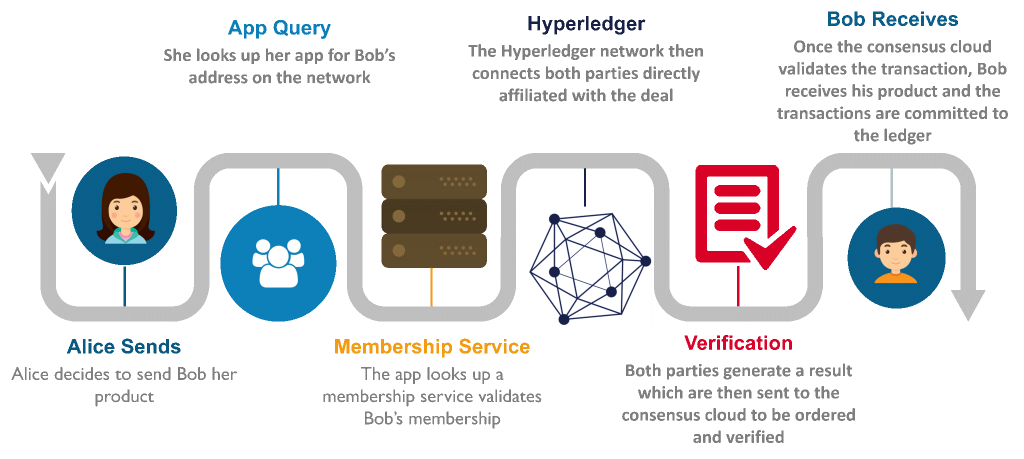
Hyperledger blockchain

(Image source: www.edureka.com)

Important Initial Hyperledger Framework Projects

Hyperledger Fabric

Hyperledger Fabric is a blockchain based hyperledger network that operates on a permission basis. These permissions can be customized and according to the preference of the enterprise consortium. It focuses on breaking down complex functions to provide simple enterprise solutions. The modular infrastructure of hyperledger fabric allow developer members to achieve consensus easily. Also, its smart contract known as chain code is beneficial as it connects multiple operations simultaneously. Yes, finally mission accomplished.

Hyperledger Burrow

It solely focuses on the usage of smart contracts and its integration with Ethereum Virtual Machine (EVM) to execute functions and internal operations automatically. In this system, all peers and nodes distribute information instantly without the requirement of a complete full disclosed signatory. It is known for avoiding gossip.

Hyperledger Iroha

It provides algorithms known as Byzantine Fault Tolerant (BLT) which is developed using C++ and is allows remote access to data and information. Enterprises can execute important functions and operations remotely and handle digital transition of assets conveniently. However, it is a little similar to hyperledger burrow because I also allow peers to transact data with the need for a signed transaction and just a half-signed proof of evidence is sufficient.

Hyperledger Sawtooth

It is simple hyperledger that provides typical decentralized functions to develop a simple distributed ledger. Hyperledger Sawtooth helps organizations to prevent data manipulation and face data storage challenges by building private or public large networks for data storage. It also ensures that all data stored is permanent and cannot be erased, deleted or manipulated.

Hyperledger Indy

It provides a library of decentralized features that allow building Distributed Ledger Technology (DLT) with a purpose. It allows components to be re-used and thus saves a lot of time and cost. Hence, this hyperledger increases the independency of operations by providing proof of authentication for all identities too. In short, this hyperledger is known for enhancing the communication between peers.

Tools Used To Develop Hyperledger Blockchain

Hyperledger Composer

It provides a quicker, faster and enhanced instrumental components that improves the smart contract operability. In addition, it creates a circulated environmental record and storage.

Hyperledger Cello

It a framework builder that helps to build advanced technology systems or automated infrastructures to oversee decentralized operations.

Hyperledger Explorer

It focuses on arranging data, conveying information, exchanging necessary data in chain codes for better interoperability between data transfers. Further, it omits all unnecessary data automatically based on the parameters set.

Hyperledger Quilt

It executes functions after interconnecting all data together to ensure that the data is of utmost quality and reliability. Also, it is an appropriate tool to use when the need for developing a record or storage system  does not require a typical circulatory environment.

Conclusion: Hyperledger is An Advanced Undertaking of Blockchain Taken To The Next Big Step

Hyperledger is easy to handle though it may be complex to understand in the initial stages. But, with practice and continuous usage, it becomes a piece of cake and you can gladly wave goodbye to traditional based data storage and transfer systems. It is currently attracting more and more industries to take part in its network and join the community to race towards a better future ahead in the digital ecosystem.  Let us know, what more would you like to know about hyperledger?


WhatsApp Telegram