Key Takeaways
- Logistics software is a set of connected modules: fleet management, route optimization, transport management (TMS), last-mile delivery, and real-time tracking.
- Integrations decide whether a build succeeds. GPS and telematics, maps APIs, your ERP, and carrier EDI are validated before features are scaled.
- AI adds value where it moves a number you already track, such as cost per mile, on-time rate, or vehicle utilization.
- A focused build typically costs $70,000 to $180,000 and takes 4 to 9 months. Large multi-module platforms cost $200,000 or more.
- A pilot on one region or fleet proves the data and the workflow before a full rollout.
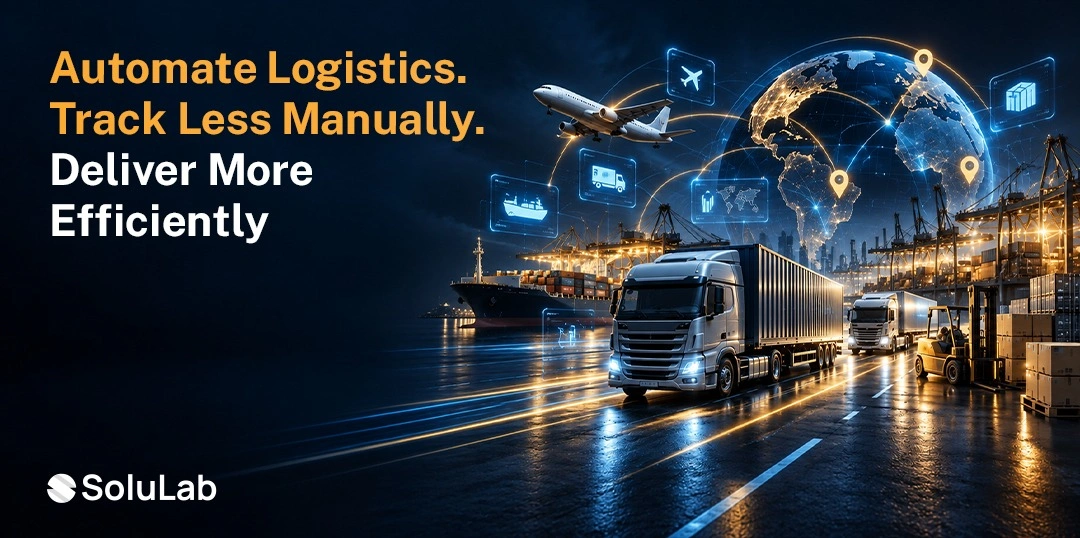
A logistics software development company builds the systems that move goods efficiently: fleet and driver apps, route optimization, transport management (TMS), last-mile delivery, and real-time tracking, integrated with GPS, telematics, maps, and carrier systems. SoluLab builds these as a consulting-led partner, with AI for route and demand prediction, ERP and EDI integration, and a pilot-first rollout.
What are the core modules of logistics software?
Logistics software is a set of connected modules, not a single tool. The core set covers most operations:
- Fleet management: vehicle health, driver assignment, maintenance, and fuel tracking.
- Route optimization: the fastest, cheapest routes given traffic, time windows, and load.
- Freight and transport management (TMS): planning, tendering, and settling shipments across carriers.
- Last-mile delivery: driver apps, delivery windows, and proof-of-delivery capture.
- Real-time tracking: live location and status for operations teams and customers.
Most projects start with one or two of these, then expand once the data and integrations are proven. If your first need is a driver or dispatch app, see our logistics and transportation app development work.
How does AI improve logistics software?
AI is where logistics software moves from record-keeping to decision-making. The proven patterns are practical, not speculative:
- Route and ETA prediction: models that use traffic and historical data to set realistic arrival times.
- Demand forecasting: predicting volume so capacity and staffing match reality.
- Load optimization: packing vehicles to cut trips and cost.
Each of these ties directly to a number the business already tracks, such as cost per mile, on-time rate, or vehicle utilization, which is what makes them worth building. McKinsey reported in April 2021 that early adopters of AI-enabled supply chain management improved logistics costs by 15 percent, inventory levels by 35 percent, and service levels by 65 percent compared with slower-moving competitors (McKinsey, Succeeding in the AI supply-chain revolution). Your own gains depend on your data, so we measure them against your baseline during the pilot.
For a closer look at agent-based automation, read our guide to AI agents in supply chain and logistics.
What tech stack and integrations power logistics software?
The value of logistics software is in what it connects to:
- GPS and telematics: live vehicle and device data, connected through our IoT development team.
- Maps and routing APIs: services such as Google Maps Platform, Mapbox, or HERE for distance, traffic, and geocoding.
- ERP integration: platforms such as SAP, Oracle, and Microsoft Dynamics 365, so orders, inventory, and finance stay in sync.
- Carrier EDI: electronic data interchange with carriers, including load tenders (EDI 204), shipment status (EDI 214), and freight invoices (EDI 210).
What does the logistics software development process look like?
A realistic build moves through four stages: discovery, integrations, a pilot, and scale. The order matters.
- Discovery. We map your operation, the modules you need first, and every system the software has to connect to.
- Integrations. Connections to GPS, ERP, and carrier systems are validated early, because they are where projects stall.
- Pilot. A pilot on one region or fleet proves the data and the workflow before a full rollout, which de-risks the operational switch.
- Scale. Real-time tracking and route optimization only pay off when the underlying integrations are reliable, so they are rolled out widely after the data flow is solid.
We run each stage in short iterations, following our agile software development process.
What are the industry use cases for logistics software?
- Third-party logistics (3PL): multi-client operations that need clear separation and billing.
- Freight and trucking: load planning, carrier tendering, and settlement.
- E-commerce fulfilment: warehouse-to-doorstep visibility and last-mile delivery.
Logistics platforms often sit inside a wider software estate. SoluLab also provides custom software development, AI software development, and manufacturing software development for the systems around them.
How do you choose a logistics software development company?
Evaluate partners on the things that make logistics builds succeed or fail.
| Criterion | What good looks like | Why it matters |
|---|---|---|
| Integration experience | Proven GPS, ERP, and carrier EDI work | Logistics software fails on integration |
| Domain knowledge | Understands TMS, last-mile, and routing | Generic teams miss operational reality |
| AI capability | Real route, ETA, and demand models | AI is the differentiator, not a buzzword |
| Rollout approach | Pilot-first, region-by-region | Reduces the risk of a big-bang failure |
| Scalability | Handles fleet and volume growth | Systems must grow with the operation |
| Proof | Named case studies with outcomes | Verifiable experience beats claims |
How much does logistics software development cost?
A focused logistics software build typically costs $70,000 to $180,000 and takes 4 to 9 months. Cost depends on the number of modules, the integrations required, and the scale of the operation.
| Build type | Typical scope | Indicative cost | Indicative timeline |
|---|---|---|---|
| Focused build | One or two modules with core GPS and ERP integrations | $70,000 to $180,000 | 4 to 9 months |
| Multi-module platform | TMS, fleet, tracking, AI, and several carrier integrations | $200,000+ | 9 months or more |
These are estimates. SoluLab confirms a fixed scope and price after discovery.
Why work with SoluLab for logistics software development?
SoluLab is a consulting-led engineering partner. We start with the operation, map the integration surface with GPS, ERP, and carriers, and prove the workflow with a pilot before scaling. AI for routing and forecasting is designed in where it moves a real number, not added as a label. The company has 11 years in business, a team of 250+, and 1,500+ projects delivered.
Case study: Morpheus.Network, a blockchain supply chain platform
Morpheus.Network is a SaaS platform that automates logistics documentation, customs compliance, and international payments. SoluLab built its smart contracts and zero-knowledge rollup infrastructure, and connected the platform to ERP and warehouse management systems, RFID, IoT and GPS tracking, and FedEx tracking. Payments run over the SWIFT network across 200+ countries and 1,600+ banks. The stack is React, Node.js, MongoDB, and AWS. Read the Morpheus.Network case study.
Our own product: SupplyBrain AI
SoluLab also builds and runs SupplyBrain AI, a supply chain risk intelligence product. It monitors 50,000+ real-time global signals and gives procurement and operations teams a 30 to 90 day forecast of disruptions. It integrates with SAP, Oracle, and other ERP platforms. See SupplyBrain AI.

Meet Your Architect
Chintan Thakkar, Co-founder and CEO, SoluLab. Chintan leads SoluLab’s product engineering across AI, blockchain, IoT, and enterprise software. Before co-founding SoluLab, he was a Vice President at Goldman Sachs, where he spent about a decade building software in regulated financial environments. View Chintan’s profile.
Ready to modernize your logistics operation? Talk to SoluLab for an honest scope and estimate.
FAQs
Chintan leads SoluLab's highest-level AI consulting conversations, assessing whether a client's business problem actually justifies an AI investment before any solutioning begins.