Key Takeaways
- MLOps manages predictive AI systems, focusing on structured data, model training, and measurable performance metrics.
- LLMOps manages generative AI systems, where prompts, context, and response quality drive outcomes.
- The core difference: MLOps optimizes models, LLMOps optimizes behavior and interaction.
- Architecture shifts from linear pipelines to layered systems with prompts, retrieval (RAG), and orchestration.
- Monitoring evolves from accuracy metrics to quality evaluation, including hallucination detection and human feedback.
- Most enterprises need a hybrid approach, combining ML models for decisions and LLMs for interaction.
- The real advantage comes from designing AI systems with scalability, observability, and governance in mind from day one.
From Models to Systems: Why AI Operations Strategy Is Now a Boardroom Decision
For years, enterprise AI success was measured in model accuracy.
That’s no longer enough.
Today, the real challenge isn’t building models – it’s making them reliable, scalable, and governable in production. This is where enterprise AI development enters the conversation.
What changed?
- AI moved from experiments → core business workflows
- Systems now interact with real users, real data, real risk
- Failures are no longer technical — they’re operational and reputational
This shift has created two parallel paradigms:
| Earlier Focus | Current Reality |
| Model performance | System reliability |
| Training pipelines | End-to-end AI lifecycle |
| Data pipelines | Prompt + data + orchestration layers |
| Offline evaluation | Continuous production monitoring |
And this is exactly where the distinction between MLOps vs LLMOps becomes critical.
- MLOps evolved to operationalize traditional machine learning systems
- LLMOps emerged to handle the unpredictability of generative AI systems
For enterprises, the question is no longer:
‘Which model should we build?’
It’s: ‘What operating system do we need to run AI safely at scale?’
This is exactly what this guide on LLMOps vs MLOps: Differences, Monitoring, and Best Practices aims to unpack for enterprise teams.
What is MLOps And Where It Still Dominates?
MLOps (Machine Learning Operations) is the discipline of managing the lifecycle of machine learning models in production, often referred to as AI model lifecycle management.
It brings software engineering rigor to AI systems.
Core Idea
MLOps ensures that models move smoothly from:
- experimentation
- to deployment
- to continuous monitoring and improvement
Typical MLOps Pipeline
Data → Training → Validation → Deployment → Monitoring → Retraining
Key Components of MLOps
- Data pipelines
Ingest, clean, and version structured data - Model training workflows
Repeatable and reproducible training processes - CI/CD for ML
Automated deployment and testing - Model monitoring
Track drift, performance, and latency - Retraining loops
Trigger updates when performance degrades
Where MLOps Works Best?
MLOps excels in environments where:
- Outputs are deterministic or predictable
- Data is structured and stable
- Evaluation metrics are clearly defined
Typical use cases:
- Fraud detection
- Credit scoring
- Demand forecasting
- Recommendation systems
Why MLOps Still Matters
Even with the rise of generative AI, MLOps remains critical because:
- Most enterprise AI workloads are still predictive
- It provides strong governance and reproducibility
- It is well-understood and mature
But…
MLOps starts to show limitations when systems become language-driven, probabilistic, and non-deterministic.
That’s where LLMOps comes in.

What is LLMOps And Why It Changes Everything?
LLMOps (Large Language Model Operations) is the practice of managing, deploying, and optimizing large language model–based systems in production. For many teams, this also acts as a practical guide to LLMOps when transitioning from traditional ML systems to generative AI.
At first glance, it looks similar to MLOps.
In reality, it’s fundamentally different.
Core Shift: From Models to Systems of Interaction
Traditional ML systems:
- Learn patterns from data
- Produce structured outputs
LLM systems:
- Generate language
- Interact dynamically with users and context
This changes everything.
What Makes LLMOps Different
Instead of a training-heavy pipeline, LLMOps focuses on:
Prompt → Context Retrieval → Generation → Evaluation → Iteration
Key Components of LLMOps Architecture
- Prompt engineering layer
Defines how the model behaves - Retrieval systems (RAG)
Injects real-time, external knowledge - Vector databases
Store and retrieve embeddings - Orchestration frameworks
Manage multi-step AI workflows - Evaluation pipelines
Measure response quality, not just accuracy
LLMOps for Generative AI Systems
LLMOps is essential when you’re building:
- AI copilots
- Customer support assistants
- Document intelligence systems
- Internal knowledge assistants
These systems don’t just predict — they respond, reason, and generate.
Why LLMOps Is Harder Than It Looks
Unlike MLOps:
- Outputs are non-deterministic
- Evaluation is subjective
- Behavior changes with small prompt variations
- Failures are often invisible until user-facing
The Real Implication for Enterprises
You’re no longer managing a model.
You’re managing a living system of prompts, data, context, and interactions.
And that requires a completely different operational mindset.
LLMOps vs MLOps: The Real Differences That Matter in Production
At a surface level, both aim to operationalize AI.
But in production, they behave very differently.
The gap shows up in how systems are built, evaluated, and controlled.
| Dimension | MLOps | LLMOps |
| Core focus | Model lifecycle | Interaction lifecycle |
| Input | Structured data | Prompts + unstructured context |
| Output | Predictable, numeric | Generative, language-based |
| Behavior | Deterministic | Probabilistic |
| Improvement method | Retraining | Prompt + retrieval tuning |
| Evaluation | Metrics (accuracy, F1) | Human + heuristic evaluation |
| Failure type | Drift, bias | Hallucination, inconsistency |
What This Means in Practice
- In MLOps, you fix problems by improving the model
- In LLMOps, you fix problems by adjusting:
- prompts
- context
- Orchestration
Why Enterprises Get This Wrong
Many teams try to apply MLOps thinking to LLM systems:
- Expecting stable outputs
- Relying only on offline evaluation
- Ignoring prompt sensitivity
This leads to:
- unpredictable user experience
- hidden failures in production
- poor trust in AI systems
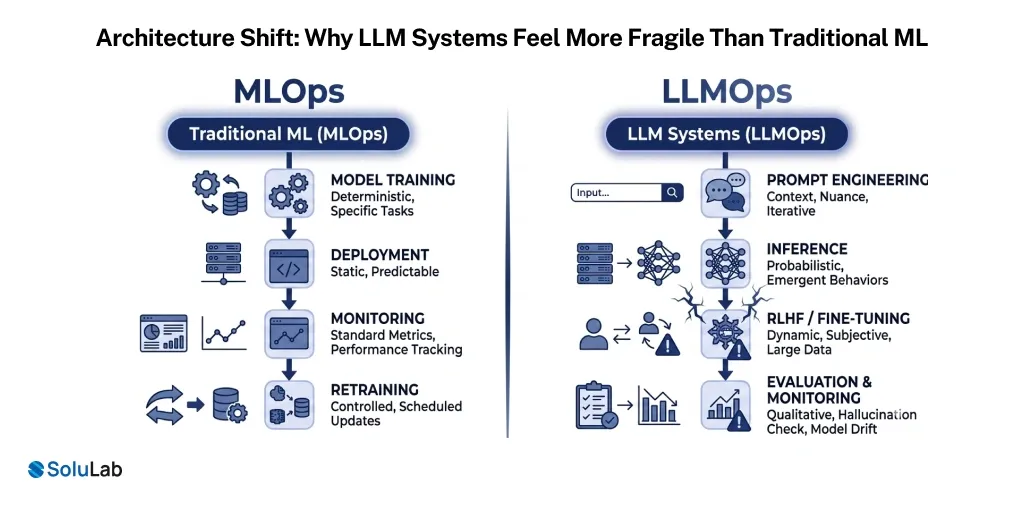
Architecture Shift: Why LLM Systems Feel More Fragile Than Traditional ML
Most enterprise teams don’t notice the difference between MLOps and LLMOps… until something breaks.
And when it does, the root cause is almost always architectural.
How MLOps Systems Are Built (And Why They Feel Stable)?
A typical ML system follows a predictable path:
- data is prepared
- models are trained
- outputs are deployed
- performance is monitored
Once deployed, the system behaves… mostly as expected.
That’s because:
- Inputs are structured
- outputs are constrained
- Behavior doesn’t change unless the model changes
In short, the system is designed for stability.
Why LLM Systems Don’t Behave the Same Way?
Now compare that with an LLM-powered system. The shift toward layered, interaction-driven systems is what defines modern LLMOps architecture.
There’s no single pipeline anymore. Instead, you’re dealing with layers:
- a prompt that defines behavior
- a retrieval system that injects context
- a model that generates responses
- an orchestration layer that connects everything
Even small changes in any of these layers can shift the output.
That’s where things start to feel fragile.
The Real Difference Isn’t Complexity – It’s Control
| In MLOps | In LLMOps |
| You control the model | You influence the model |
| Logic lives in code | Logic lives in prompts + flows |
| Behavior is testable | Behavior is situational |
What This Means in Practice?
- A small data issue in MLOps → performance drops gradually
- A small prompt change in LLMOps → output changes instantly
That’s a very different failure pattern.
Why Architecture Becomes a Business Decision?
In LLM systems, architecture isn’t just about scalability. It directly affects:
- response quality
- reliability
- trust
Which is why enterprises are moving toward:
- retrieval-first designs (RAG)
- controlled prompt frameworks
- layered validation systems
Monitoring and Evaluation: Why Traditional Metrics Stop Working
Monitoring is where most enterprise AI strategies quietly fail, especially when it comes to monitoring and evaluation in AI systems.
Not because teams ignore it, but because they measure the wrong things.
Why Monitoring Works Well in MLOps?
In traditional ML systems, performance is measurable.
You can track:
- accuracy
- error rates
- drift
And when something goes wrong, it shows up clearly in the metrics.
There’s a direct link between:
model → metric → outcome
Why That Model Breaks in LLM Systems?
Domain-specific LLMs don’t fail in obvious ways.
They fail in ways that look correct.
- A response can be fluent but wrong
- An answer can be relevant but incomplete
- Two identical queries can produce different outputs
This makes evaluation harder and riskier.
The Core Challenge: You’re Measuring “Quality,” Not Just Performance.
| MLOps | LLMOps |
| Did the model predict correctly? | Did the response make sense? |
| Is accuracy improving? | Is the answer trustworthy? |
| Can we automate evaluation? | Do we need human judgment? |
What Enterprises Start Realizing?
You can’t rely only on dashboards anymore. LLMOps requires:
- context-aware evaluation
- response-level tracking
- human feedback loops
Because failure isn’t always technical – it’s experiential.
How Failure Feels Different?
- In MLOps → you see a performance drop
- In LLMOps → users lose trust
And by the time trust is lost, metrics often haven’t caught up.
Practical Shift in Thinking
Instead of asking:
“Is the model accurate?”
You start asking:
“Is the system reliable in real-world usage?”
What Strong LLMOps Monitoring Looks Like?
- Grounding responses with retrieval
- Tracking prompt-response pairs
- Scoring outputs for quality, not just correctness
- Introducing human review where needed
How to Analyse When to Use LLMOps vs MLOps?
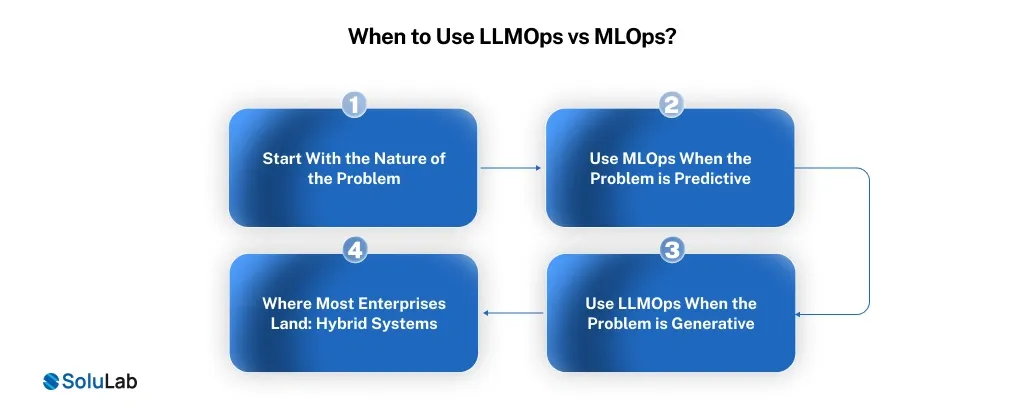
Most enterprises don’t choose between MLOps and LLMOps.
They end up needing both – just not everywhere.
The real challenge is knowing where each fits.
- Start With the Nature of the Problem
Before tools or architecture, the question is simple:
Are you predicting something or generating something?
- Use MLOps When the Problem is Predictive
MLOps is the right choice when:
- outputs need to be consistent and repeatable
- Decisions depend on structured data
- accuracy can be clearly measured
Typical scenarios:
- risk scoring
- fraud detection
- forecasting models
- recommendation engines
These systems need stability, not creativity.
LLMOps fits when:
- The system needs to interpret or generate language
- context changes dynamically
- User interaction is part of the workflow
- Use LLMOps When the Problem is Generative
Typical scenarios:
- AI copilots
- customer support automation
- document analysis
- internal knowledge assistants
These systems need flexibility, not strict predictability.
- Where Most Enterprises Land: Hybrid Systems
This is where things get interesting.
Modern AI systems often combine both:
- ML models → decision-making backbone
- LLMs → interaction layer
Example:
- ML model flags a risky transaction
- LLM explains the reasoning to a human analyst
Read more – AIOps, MLOps, and LLMOps
Enterprise Reality: What Breaks When You Scale LLMOps
LLM demos are easy. Production systems are not.
Most issues don’t show up during prototyping; they surface when usage increases.
1. Cost Becomes Unpredictable
Unlike traditional ML:
- You’re paying per token / API call
- Usage scales with user interaction
Which means:
- costs fluctuate
- Budgeting becomes harder
2. Data Governance Gets Complicated
LLMs often rely on:
- external APIs
- dynamic retrieval systems
This creates concerns around:
- data exposure
- compliance
- auditability
Especially in regulated industries.
3. Latency Impacts User Experience
LLM systems introduce delays:
- retrieval time
- generation time
- orchestration overhead
Even a few seconds of delay can:
- break user trust
- reduce adoption
4. Reliability Is Harder to Guarantee
Unlike ML systems:
- outputs are not always consistent
- edge cases are difficult to predict
This creates challenges in:
- SLA commitments
- production readiness
5. Vendor Lock-In Risks Increase
Many LLM systems depend on:
- proprietary APIs
- closed models
Switching later can mean:
- reworking prompts
- revalidating outputs
- rebuilding integrations
What This Means for Enterprises?
LLMOps isn’t just a technical layer.
It introduces:
- financial risk
- compliance exposure
- operational uncertainty
Which is why scaling requires intentional design, not experimentation.
Operating Model + Build vs Partner Decisions
Technology is only half the problem.
The bigger challenge is how teams operate around it.
Why Traditional ML Teams Struggle with LLM Systems?
MLOps teams are built around:
- data scientists
- ML engineers
- pipeline automation
But LLM systems require additional roles:
- prompt engineers
- AI product thinkers
- evaluation specialists
The Operating Model Shift
| MLOps Teams | LLMOps Teams |
| Model-centric | Experience-centric |
| Data-driven workflows | Prompt + interaction workflows |
| Offline evaluation | Continuous feedback loops |
Tooling Becomes Fragmented
In LLMOps, you’re often stitching together:
- LLM providers
- vector databases
- orchestration frameworks
- monitoring tools
Without a clear architecture, this leads to:
- duplication
- inefficiencies
- scaling issues
Build vs Partner: The Real Question
Most enterprises ask:
Should we build this in-house?
A better question is:
Do we have the capability to manage this long-term?
When Building Makes Sense?
- Strong in-house AI teams
- Need for full control (data, compliance)
- Long-term strategic investment
When Partnering Makes More Sense?
- Faster time to production
- Need for architecture clarity
- Avoiding early-stage mistakes
This is where working with an experienced large language model development company becomes relevant, not for execution alone, but for getting the system design right from day one. Many enterprises also explore enterprise LLM development services to accelerate this transition without compromising on architecture or governance.
What Enterprises Often Underestimate?
- LLM systems evolve rapidly
- Early architectural mistakes compound over time
- Retrofitting governance later is expensive
Designing a Future-Proof AI Operations Strategy
Most enterprises don’t fail because they chose the wrong tools.
They fail because they were designed for the present, not for evolution.
The Shift That’s Already Happening
The line between MLOps and LLMOps is starting to blur.
Enterprises are moving toward:
- multi-model systems
- shared infrastructure layers
- unified evaluation frameworks
In practice, this means:
- ML models handling decision logic
- LLMs handling interaction and reasoning
- orchestration layers connecting both
What a Future-Ready AI Stack Looks Like?
Instead of separate pipelines, leading AI expert teams are building:
- modular architectures
- model-agnostic layers
- evaluation-first systems
Core Principles That Actually Hold Up
1. Don’t over-index on tools
Tools will change. Architecture decisions won’t.
2. Design for observability early
If you can’t see what the system is doing, you can’t trust it.
3. Keep humans in the loop where it matters
Especially for high-risk or customer-facing workflows.
4. Separate logic from models
Avoid hardwiring behavior into any single model or provider.
A Practical Way to Think About It
Instead of asking:
“Should we adopt LLMOps or MLOps?”
Ask:
“How do we design a system where both can evolve without breaking each other?”
Where Teams See the Biggest Gains?
- Faster iteration cycles
- Better reliability in production
- Reduced vendor dependency
- Stronger compliance readiness
Strategic Note
This is where implementation experience matters.
Teams that approach AI as infrastructure, not just experimentation, tend to avoid early architectural traps. That’s also where top AI companies like SoluLab typically come in: helping design systems that are production-ready, compliant, and scalable from day one, rather than patched together later.

Conclusion
Choosing between LLMOps and MLOps isn’t really about picking one over the other. It’s about understanding what your system actually needs. If your use case demands precision and consistency, MLOps will carry you far. If it’s driven by language, context, and interaction, LLMOps becomes essential. In reality, most enterprise systems sit somewhere in between.
The real advantage comes from designing with that in mind early so you’re not rebuilding later. Focus less on tools, more on architecture. That’s what separates experiments from systems that actually work in production.
SoluLab, #1 AI development company, holds years of expertise and experience in delivering AI-led development for modern businesses. Knowing all the major ins and outs of businesses, our team offers strategic consulting to understand the specific needs and devise a personalized roadmap for flawless execution.
Want to discuss your unique idea? Get in touch now!
FAQs
Shipra Garg is a tech-focused content strategist and copywriter specializing in Web3, blockchain, and artificial intelligence. She has worked with startups and enterprise teams to craft high-conversion content that bridges deep tech with business impact. Her work translates complex innovations into clear, credible, and engaging narratives that drive growth and build trust in emerging tech markets.