Key Takeaways
- LLM interpretability in enterprise AI systems turns black-box outputs into traceable business decisions.
- Enterprises need interpretability before they scale AI into finance, healthcare, legal, insurance, HR, and customer operations.
- Strong interpretability improves governance, compliance, debugging, security, and model confidence.
- A reliable enterprise AI deployment with LLM interpretability needs observability, audit logs, prompt tracking, human review, and explainable workflows.
- SoluLab helps enterprises build secure, scalable, and business-ready LLM development solutions with better transparency, control, and integration.
A finance team does not reject an AI answer because it is wrong once. It rejects the system when nobody can explain why it was wrong. That is the real problem with enterprise AI. Accuracy may win a pilot, but interpretability wins production.
LLM interpretability for enterprise AI deployments helps businesses understand how a large language model reaches an answer, uses context, follows instructions, handles sensitive data, and behaves under pressure.
Without it, enterprises operate a powerful system that they cannot properly audit, defend, or improve. NIST’s Generative AI Profile recommends explainable AI methods to improve transparency and help stakeholders understand how and why AI content is generated. OWASP also lists prompt injection, sensitive information disclosure, supply chain risk, and improper output handling among major LLM application risks.
This guide explores why LLM interpretability is critical for businesses.
What Is LLM Interpretability in Enterprise AI Systems?
LLM interpretability in enterprise AI development means understanding why an AI model produced a specific answer, recommendation, summary, or action. It does not mean every neuron inside the model becomes simple. That is unrealistic for most large models. Instead, enterprises need practical visibility. They need to know:
- What data did the LLM use?
- Which prompt or instruction shaped the answer?
- Whether retrieval sources supported the output?
- Does the model follow the policy?
- Why does the answer change from one version to another?
- Whether the output created legal, compliance, or operational risk?
Interpretability gives AI a paper trail. It helps teams move from “the model said so” to “the system used this source, followed this rule, and produced this answer under these conditions.” That difference matters when AI touches customers, money, contracts, medical data, claims, or internal decisions.

Why Enterprises Cannot Scale AI Without Interpretability?
Many companies launch AI pilots with excitement. A simple chatbot answers questions. A summarizer speeds up reports. A coding assistant saves hours. Then the real questions begin.
- Who approved this answer?
- Which document did it use?
- Can compliance review it?
- Can the company explain it to a regulator?
- Can the model be trusted after a policy change?
- Can the system detect prompt injection or bad retrieval data?
This is where enterprise AI deployment with LLM interpretability becomes critical. Enterprise AI does not run in a demo room. It runs inside workflows with policies, customers, vendors, employees, and regulators.
Without interpretability, the company cannot separate a good answer from a lucky answer. It cannot prove that the AI followed business rules. It cannot quickly debug failures. It cannot build long-term trust.
How Interpretability Reduces Enterprise AI Risk?
A weak AI system gives answers. A strong AI system explains its operating context. Interpretability helps enterprises reduce risk in five major ways:
| Risk area | How interpretability helps |
| Compliance risk | Shows how outputs were generated and reviewed |
| Security risk | Detects suspicious prompts, unsafe retrieval, and policy bypasses |
| Business risk | Helps teams find why the model gave a wrong or costly answer |
| Reputation risk | Gives leaders confidence before public or customer-facing use |
| Operational risk | Makes failures easier to trace, fix, and prevent |
An AI consulting company must design interpretability from the start. It cannot bolt it on after launch. If logs, prompts, data sources, model versions, and decision paths are not captured early, the company loses the evidence it needs later.
Why Interpretability Matters for Compliance and Governance?
Regulated industries do not accept unexplained automation. Banks, insurers, healthcare providers, legal teams, and public-sector organizations need proof. They must show that AI systems are controlled, tested, monitored, and aligned with policies.
AI-powered solutions need to include governance features. A serious deployment should include model cards, prompt logs, human review points, risk scoring, source citations, output validation, access control, and escalation flows.
NIST’s AI Risk Management Framework focuses on governing, mapping, measuring, and managing AI risks across the AI lifecycle. This aligns closely with what enterprises need from interpretable LLM systems: visibility, accountability, and repeatable controls.

Why Generic AI Language Models Are Not Enough?
Public AI language models can answer broad questions, but enterprise workflows need more discipline. A general model may not understand internal policy, industry terms, restricted data, approval chains, or regulatory boundaries.
That is why many companies now choose custom LLM development. A custom LLM system can include private data retrieval, guardrails, domain prompts, user permissions, workflow integration, monitoring, and output controls.
For example, a healthcare AI assistant should not behave like a retail chatbot. A legal contract analyzer should not behave like a marketing copy tool. An insurance claims assistant should not invent policy terms. Interpretability helps each system stay within its lane. It gives teams visibility into whether the model used the right context and followed the right rules.
The Role of Interpretability in an Enterprise AI Deployment Strategy
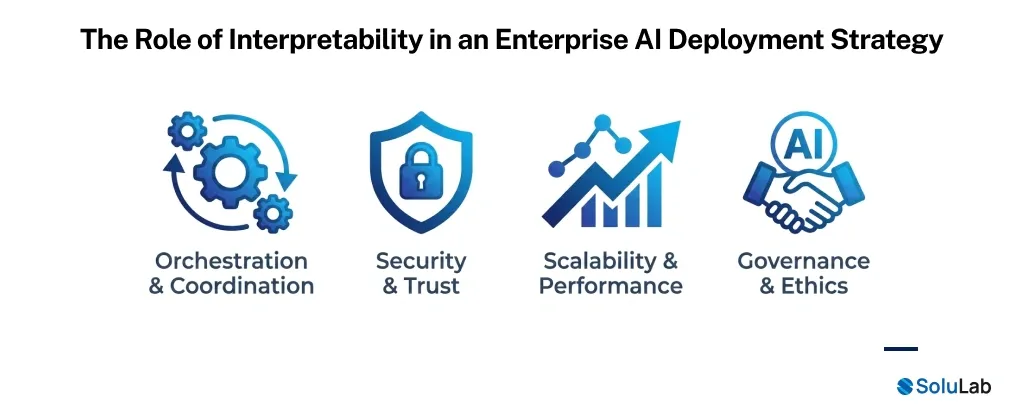
A strong AI-native strategy should not start with model selection. It should start with business risk.
The enterprise should ask:
- What decisions will the LLM support?
- What data can it access?
- What answers need human review?
- What logs must be stored?
- What regulations apply?
- What errors would cause financial or reputational damage?
- How will teams measure trust, not only accuracy?
Once those questions are clear, the company can design the AI architecture. It can choose the model, retrieval system, vector database, guardrails, APIs, dashboards, and monitoring stack.
This is where a large language model development company like SoluLab can help enterprises avoid shallow AI adoption. The goal is not to “add AI.” The goal is to deploy AI that business teams can trust, manage, and improve.
LLM Interpretability and Interoperability Must Work Together
Modern enterprise AI rarely uses one model or one system. It connects LLMs with CRMs, ERPs, data warehouses, vector databases, APIs, workflow tools, and business applications. This is where large language model interoperability becomes important.
Interoperability allows AI systems to work across tools. Interpretability helps teams understand what happens across those tools. Together, they answer important questions:
- Which system provided the data?
- Which model generated the answer?
- Which API triggered the action?
- Which user approved the workflow?
- Which rule blocked the output?
Without LLM interoperability in enterprise AI, companies end up with isolated AI tools. Without interpretability, they end up with connected tools that they cannot fully understand. Both are needed for enterprise-grade AI integration.
Why Businesses Need an LLM Interoperability Solutions Provider?
Top LLM solutions providers help enterprises connect models, tools, data sources, and business systems without creating chaos. This matters because enterprise AI often fails at the integration layer.
The LLM may be strong, but the workflow is weak. The data may be useful, but the retrieval system is messy. The API may work, but access control is missing. The output may sound right, but nobody knows which source supported it.
SoluLab’s value as an AI development company comes from building the practical layer around the model. That includes architecture, integrations, dashboards, compliance workflows, automation, and secure deployment.
How Smart Enterprises Measure LLM Interpretability?
Enterprise teams should not treat interpretability as a vague idea. They should measure it. Useful metrics include:
| Interpretability metric | What it shows |
| Source traceability | Whether answers link to approved business data |
| Prompt auditability | Whether prompts and system instructions are logged |
| Output consistency | Whether the model behaves reliably across similar tasks |
| Policy adherence | Whether outputs follow business and compliance rules |
| Human override rate | How often do people need to correct the AI |
| Hallucination rate | How often does the model give unsupported information |
| Escalation rate | How often does the system move risky cases to humans |
These metrics help leaders decide whether an LLM is ready for production. They also help AI engineers improve the system over time.
Where LLM Interpretability Creates the Most Business Value?
Interpretability has the highest value where mistakes are expensive. In these industries, domain-specific LLM solutions must focus on trust as much as performance. A fast answer that cannot be explained may create more risk than value.
| Industry | Why interpretability matters |
| Banking | Explains financial advice, fraud checks, and customer responses |
| Healthcare | Supports safe summaries, triage workflows, and clinical documentation |
| Insurance | Tracks claims decisions, policy references, and payout logic |
| Legal | Shows contract sources, clause reasoning, and review history |
| Retail | Improves product recommendations and customer support accuracy |
| Manufacturing | Explains maintenance alerts and operational suggestions |
| HR | Reduces bias and supports fair employee-facing workflows |
What an Interpretable Enterprise LLM Architecture Should Include
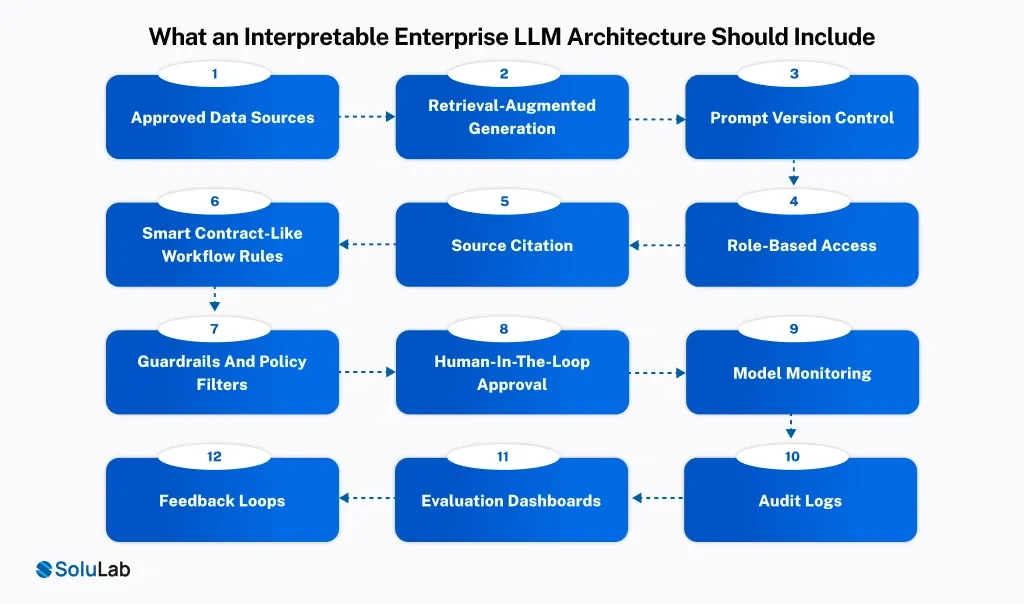
The following architecture makes LLM interpretability easy for AI development companies. It gives engineers, compliance teams, and business users a shared view of how the AI behaves. A company should not wait for a model failure to add these controls. It should design them before the first production release. A strong enterprise architecture should include:
1. Approved Data Sources
Approved data sources help LLM interpretability in enterprise AI systems by ensuring the model uses verified documents, trusted databases, internal policies, and accurate business knowledge instead of unreliable information.
2. Retrieval-Augmented Generation
Retrieval-augmented generation improves LLM interpretability for enterprise AI deployments by connecting model responses to enterprise data sources, helping teams trace answers back to relevant documents.
3. Prompt Version Control
Prompt version control supports enterprise AI deployment with LLM interpretability by tracking prompt changes, system instructions, testing history, and output differences across business use cases.
4. Role-Based Access
Role-based access strengthens enterprise AI development services by giving users permission-based access to models, datasets, workflows, and sensitive information based on their business roles.
5. Source Citation
Source citation improves LLM development solutions by showing which documents, policies, reports, or knowledge bases supported each AI-generated answer inside enterprise workflows.
6. Smart Contract-Like Workflow Rules
Smart contract-like workflow rules support large language model interoperability by automating approvals, escalation paths, data checks, and compliance actions across connected enterprise systems.
7. Guardrails and Policy Filters
Guardrails and policy filters help an AI solutions provider for LLMs prevent unsafe outputs, restricted data exposure, biased responses, and policy violations during real-time AI interactions.
8. Human-in-the-Loop Approval
Human-in-the-loop approval improves custom LLM development services by allowing experts to review high-risk responses, sensitive recommendations, and critical decisions before final action.
9. Model Monitoring
Model monitoring supports an enterprise AI deployment strategy by tracking accuracy, hallucinations, drift, latency, safety issues, usage patterns, and performance across live enterprise environments.
10. Audit Logs
Audit logs strengthen LLM interoperability in enterprise AI by recording prompts, outputs, users, data sources, model versions, API calls, and workflow actions for compliance review.
11. Evaluation Dashboards
Evaluation dashboards help a large language model development company measure response quality, source accuracy, user feedback, policy adherence, risk scores, and model reliability over time.
12. Feedback Loops
Feedback loops help an AI-led development company improve enterprise LLM systems by collecting user corrections, expert reviews, failed outputs, and performance insights for continuous optimization.
Common Mistakes Enterprises Make With LLM Interpretability
These mistakes create silent risk. The AI may look useful in meetings, but fail under real pressure. Many enterprises make the same mistakes:
Launching Chatbots Without Audit Logs
Many companies launch AI-powered chatbots without audit logs. To fix it, add prompt, output, user, source, and model-version tracking for stronger LLM interpretability in enterprise AI systems.
Connecting Private Data Without Retrieval Controls
Enterprises often connect private data directly to LLMs. To fix it, use retrieval permissions, approved knowledge bases, and access rules for safer private LLM solution interpretability.
Measuring Accuracy but Ignoring Explainability
Accuracy alone is not enough. To fix it, track source traceability, reasoning paths, citations, and confidence scores during LLM interpretability for enterprise AI deployments.
Using Different AI Tools Across Departments
Separate AI tools create data silos and governance gaps. To fix it, build a unified AI framework with an enterprise AI solutions provider for LLMs.
Skipping Prompt Versioning
Teams often change prompts without records. To fix it, use prompt version control, testing logs, and approval workflows within custom LLM development services.
Ignoring Adversarial Prompt Testing
Enterprises may skip prompt-injection and jailbreak testing. To fix it, run red-team testing, abuse simulations, and security reviews through an expert AI integration company.
Ignoring Downstream System Impact
LLM outputs can trigger actions in CRMs, ERPs, or workflows. To fix it, add validation gates and LLM interoperability in enterprise AI controls.
Deploying Without Clear Ownership
Some businesses launch LLMs without assigning owners. To fix it, define model owners, risk reviewers, and escalation teams in the Enterprise AI Deployment Strategy.
Using Generic Models for Sensitive Workflows
Generic AI language models may misunderstand industry rules. To fix it, use domain tuning, RAG, guardrails, and expert-reviewed LLM development solutions.
Treating Interpretability as a Post-Launch Feature
Adding transparency later creates blind spots. To fix it, design logs, citations, monitoring, and governance from day one with a large language model development company.

Final Thoughts
LLM interpretability for enterprise AI deployments is critical because enterprises cannot scale what they cannot understand. A model may write, summarize, classify, and recommend. But in production, business leaders need more than impressive outputs. They need traceability, accountability, security, and control. The future of enterprise AI will not belong to companies that use the biggest model. It will belong to companies that build the most trusted AI systems.
Builds Enterprise-Ready LLM Systems With Better Control With SoluLab!
SoluLab is a leading AI development company in the USA that builds enterprise-grade models, AI assistants, and business-focused LLM applications. Its LLM development services focus on models that understand context, nuance, and industry language. SoluLab also offers enterprise AI development services for companies that want to integrate AI into operations, decision-making, automation, and productivity workflows.
For enterprises, this matters because LLM success does not come from adding a generic chatbot. It comes from building a controlled AI system around real business data, workflows, security rules, and governance needs.
FAQs
LLM interpretability for enterprise AI deployments means understanding how an LLM produces outputs, uses data, follows instructions, and behaves inside business workflows. It helps enterprises audit, debug, govern, and trust AI systems.
LLM interpretability in enterprise AI systems is important because enterprises need transparency, compliance, security, and accountability. It helps teams understand AI decisions instead of blindly trusting model outputs.
SoluLab supports enterprise AI deployment with LLM interpretability through custom LLM development, workflow integration, smart dashboards, secure architecture, governance features, and enterprise-ready AI deployment planning.
SoluLab is a strong LLM development company for businesses that want custom AI assistants, enterprise LLM systems, workflow automation, chatbot solutions, and secure AI applications built around real business needs.
LLM development solutions include custom model development, fine-tuning, RAG systems, AI chatbot development, prompt engineering, API integration, model monitoring, compliance controls, and enterprise deployment support.
Large language model interoperability means connecting LLMs with enterprise tools, databases, APIs, workflows, and other AI models so they can work together safely and efficiently.
An LLM interoperability solutions provider helps enterprises connect AI models with business systems while maintaining security, data control, governance, and workflow visibility.
An AI development company can improve interpretability by adding audit logs, source citations, prompt tracking, model monitoring, role-based controls, human review, and explainable workflow design.
Shipra Garg is a tech-focused content strategist and copywriter specializing in Web3, blockchain, and artificial intelligence. She has worked with startups and enterprise teams to craft high-conversion content that bridges deep tech with business impact. Her work translates complex innovations into clear, credible, and engaging narratives that drive growth and build trust in emerging tech markets.