Key Takeaways
- Domain-specific SLMs are trained on specialized legal and medical datasets, enabling higher accuracy than general-purpose AI models.
- Legal and healthcare organizations are adopting SLMs to improve compliance, reduce hallucinations, and enhance decision-making.
- Generic LLMs often struggle with industry-specific terminology, regulations, and high-stakes workflows.
- Organizations investing in specialized AI models gain better control, reliability, and long-term business value from their AI initiatives.
You’re exploring AI to automate research, documentation, compliance, and decision-support workflows.
Now comes the challenge:
How do you ensure AI understands complex industry terminology, follows regulations, and delivers accurate responses without costly hallucinations?
The answer lies in domain-specific Small Language Models (SLMs).
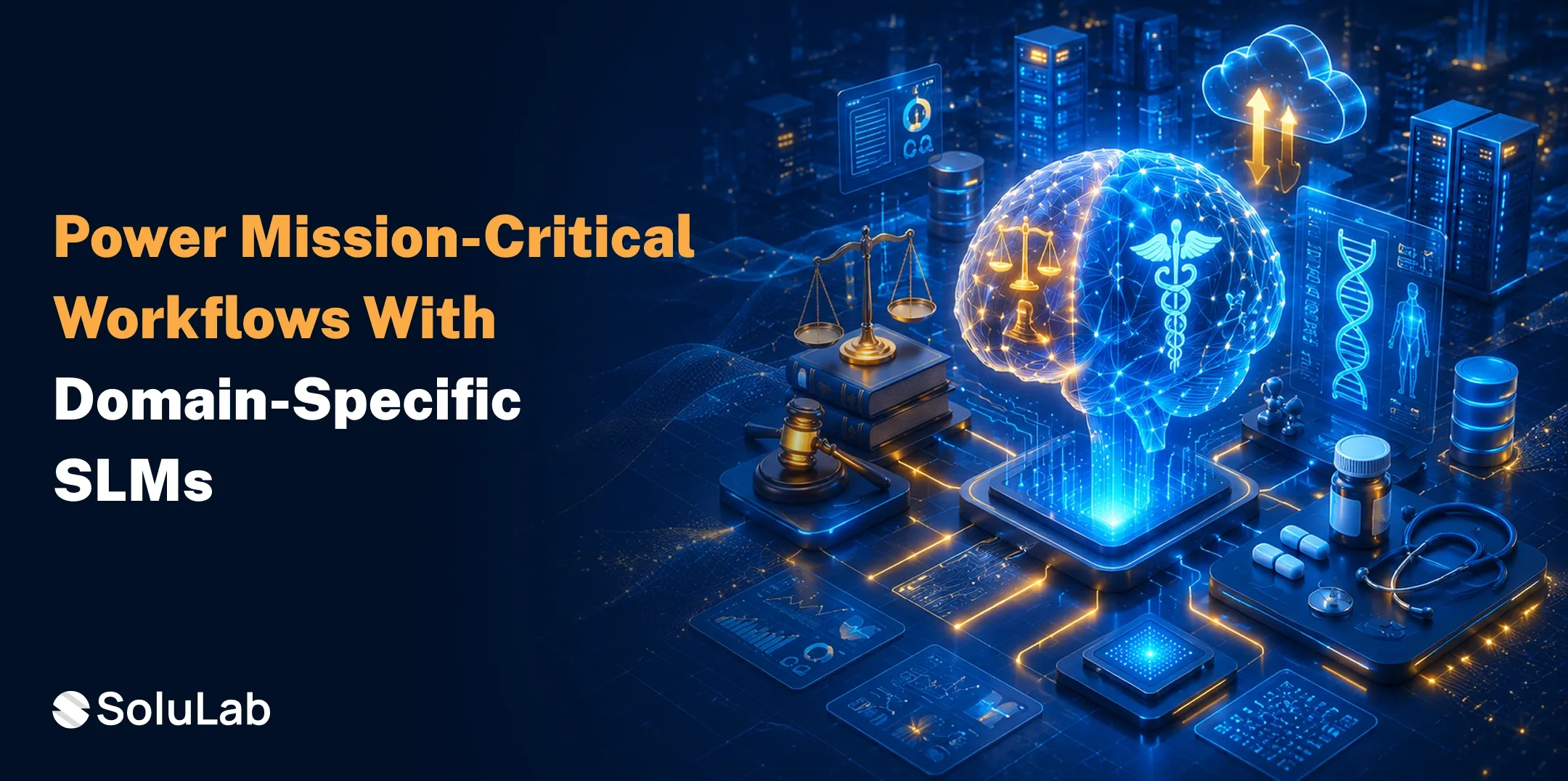
Unlike general-purpose AI models trained on broad internet data, domain-specific SLMs are trained on specialized legal and medical datasets. They can understand industry context, support compliance requirements, improve accuracy, and operate more efficiently than larger models.
As a result, organizations are investing in custom SLM and LLM development to build secure, reliable, and cost-effective AI solutions. This guide explores how domain-specific SLMs are trained for LegalTech and MedTech applications and why they are becoming a strategic advantage.
What Are Small Language Models (SLMs)?
Small Language Models (SLMs) are compact AI models designed to perform specific language tasks with fewer parameters than large language models (LLMs). While LLMs are built to handle a wide range of topics and use cases, SLMs are optimized for efficiency, lower infrastructure costs, faster inference, and deployment in resource-constrained environments.
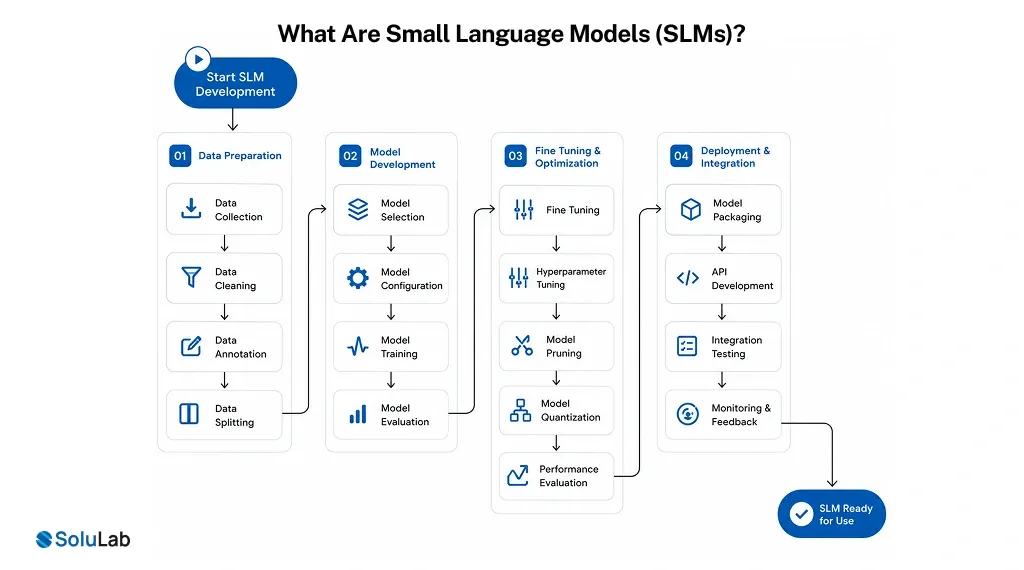
Organizations increasingly use Domain-specific AI models when they need higher accuracy in specialized fields such as law, healthcare, finance, or manufacturing.
By training or fine-tuning domain-specialized SLMs on industry-specific datasets, businesses can create AI systems that better understand technical terminology, regulatory requirements, and workflow-specific contexts.
This makes SLMs particularly valuable for LegalTech and MedTech applications, where precision, privacy, and compliance are critical requirements.
Why Are Legal and MedTech Companies Moving Toward Domain-Specific SLMs?
Legal and healthcare organizations operate in highly regulated environments where accuracy, privacy, and compliance are non-negotiable. As a result, many are adopting specialized AI models built for industry-specific workflows and data.
Recent healthcare AI research identifies privacy concerns, limited resources, and deployment efficiency as key reasons healthcare organizations are exploring Small Language Models over larger AI systems.
- Higher accuracy in specialized tasks: Unlike general-purpose AI, Domain-Specific Language Models are trained on industry-relevant data, enabling more accurate legal analysis, medical documentation, and domain-specific decision support.
- Reduced hallucination risks: Generic models may generate incorrect or unsupported information. SLMs for Specific Domains are better equipped to understand industry terminology and deliver more reliable outputs.
- Stronger data privacy and security: Legal firms and healthcare providers often handle sensitive information. Smaller models can be deployed in controlled environments, reducing exposure to third-party platforms.
- Lower infrastructure and operating costs: Smaller models require fewer computational resources, allowing organizations to deploy AI capabilities without the high costs associated with large-scale models.
- Easier customization and maintenance: Organizations can fine-tune SLMs for Specific Domains using proprietary datasets, creating highly tailored AI systems that align with unique business requirements.
- Better integration with enterprise workflows: These Domain-Specific Solutions can be embedded into legal research platforms, electronic health record systems, and compliance tools to streamline everyday operations.

Key Differences: Small Language Models (SLMs) vs. Large Language Models (LLMs)
Selecting between SLMs and LLMs depends on your accuracy, cost, and deployment requirements. Enterprise Domain-Specific SLMs are increasingly preferred for specialized business applications that require efficiency and control.
| Factor | Small Language Models (SLMs) | Large Language Models (LLMs) |
|---|---|---|
| Domain Expertise | Optimized for specific industries and tasks. | Designed for broad, general-purpose use. |
| Cost | Lower training and deployment costs. | Higher infrastructure and operating costs. |
| Speed | Faster inference and response times. | Generally slower due to model size. |
| Privacy | Easier to deploy on-premise. | Often cloud-dependent. |
| Customization | Easier and faster to fine-tune. | More complex to customize. |
| Compliance | Better suited for regulated industries. | Requires additional compliance controls. |
| Best Use Cases | Legal, healthcare, finance, and enterprise workflows. | Content creation, research, and general AI tasks. |
| Deployment | Works well with limited resources. | Requires significant computing power. |
| ROI | Cost-effective for specialized applications. | Valuable for broad AI capabilities. |
Read More: RAG vs LLM Fine Tuning
How to Implement Domain-Specific SLM for Legal and MedTech Applications?
Building an AI model for legal and healthcare environments requires a structured approach that combines quality data, model optimization, compliance controls, and continuous performance evaluation.
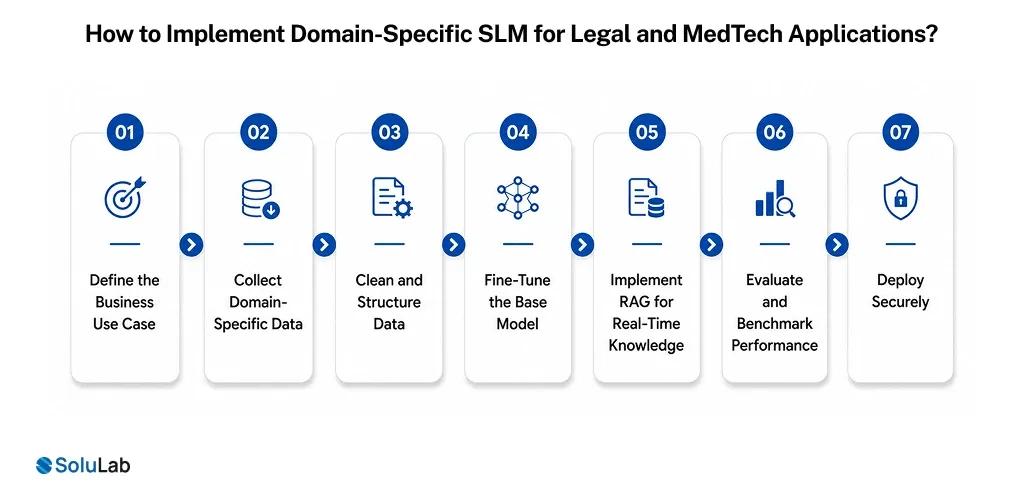
1. Define the Business Use Case
Clearly identify the problem the model will solve, such as contract analysis, clinical documentation, legal research, or patient record summarization, to guide development priorities and success metrics.
2. Collect Domain-Specific Data
Gather relevant datasets from trusted legal or medical sources, including contracts, court rulings, clinical notes, treatment guidelines, and regulatory documents, to build specialized knowledge.
3. Clean and Structure Data
Remove duplicates, correct inconsistencies, anonymize sensitive information, and organize data into structured formats that improve model training quality and reduce errors.
4. Fine-Tune the Base Model
Use custom small language model development techniques to adapt a foundation model with industry-specific datasets, improving accuracy, contextual understanding, and task performance.
5. Implement RAG for Real-Time Knowledge
Integrate Retrieval-Augmented Generation (RAG) to enable the model to access current documents, regulations, and research without requiring frequent retraining cycles.
6. Evaluate and Benchmark Performance
Test the model against domain-specific benchmarks, measuring accuracy, hallucination rates, compliance adherence, response quality, and overall business impact before deployment.
7. Deploy Securely
Implement security controls, access management, monitoring systems, and regulatory safeguards to ensure small language models for business operate safely in production environments while supporting long-term domain-specific AI model development goals.
Why Don’t LLMs Perform Well in Legal and Medical Workflows?
Domain specific LLMs are trained on broad internet-scale datasets, making them useful for general tasks. However, legal and medical environments demand accuracy, compliance, and specialized expertise that generic models often struggle to deliver.
1. Hallucination Risks
Generic LLMs can generate convincing but inaccurate information, which can lead to serious consequences when handling legal advice or medical recommendations. In fact, the Legal AI market is projected to grow from $1.45B (2024) to $3.90B (2030).
- Fabricated facts and references
- Inaccurate legal or medical outputs
- Reduced trust in AI systems
2. Limited Domain Knowledge
Without specialized training, LLMs often fail to understand industry-specific terminology, regulations, and workflows required in legal and healthcare settings.
- Poor understanding of terminology
- Misses industry-specific context
- Inconsistent task performance
3. Compliance and Auditability Challenges
Legal and healthcare organizations must explain how decisions are made. Generic models often lack the transparency and traceability required for regulatory compliance.
- Limited decision traceability
- Difficult regulatory compliance validation
- Weak audit-ready documentation
4. Data Residency Concerns
Many organizations cannot allow sensitive data to leave specific regions or environments. Public LLM deployments may create privacy and governance challenges.
- Sensitive data exposure risks
- Cross-border data restrictions
- Enterprise governance concerns
What Data Sources Should You Use to Train Legal and Medical SLMs?
To build accurate and reliable Small Language Models for Domain-Specific Applications, organizations need high-quality datasets that reflect industry terminology, workflows, regulations, and real-world decision-making scenarios.
Legal Data Sources
- Court rulings: Judicial opinions and case law help train domain-specialized SLMs to understand legal reasoning, precedents, argument structures, and jurisdiction-specific interpretations used in legal research and analysis.
- Statutes: Laws, codes, and legislative documents provide foundational legal knowledge, enabling models to interpret regulations, identify compliance requirements, and answer legal queries accurately.
- Contracts: Employment agreements, NDAs, vendor contracts, and service agreements help models learn legal clauses, obligations, risk factors, and contract review workflows.
- Regulatory documents: Government regulations, compliance frameworks, and policy documents improve a model’s ability to support audits, regulatory reporting, and industry-specific compliance tasks.
Medical Data Sources
- Clinical notes: Physician observations, patient histories, and treatment records help models understand medical terminology, diagnoses, symptoms, and clinical decision-making processes.
- Medical journals: Peer-reviewed research papers provide evidence-based knowledge that enables AI systems to generate accurate insights and stay aligned with current medical findings.
- Treatment guidelines: Clinical protocols and healthcare recommendations help models learn standardized care pathways, treatment plans, and best practices across medical specialties.
- Drug databases: Medication information, dosage guidelines, contraindications, and drug interaction records help models support pharmaceutical research and medication-related decision-making.
Read More: Custom LLM Development for Enterprises
How Much Does It Cost to Build a Small Language Model?
Building a Legal or MedTech SLM can range from tens of thousands to hundreds of thousands of dollars, depending on data complexity, customization requirements, infrastructure choices, and compliance needs.
| Cost Component | Estimated Cost (USD) | Description |
|---|---|---|
| Dataset Costs | $5,000 – $20,000+ | Acquiring, licensing, annotating, and preparing legal documents, medical records, research papers, or proprietary datasets. |
| Fine-Tuning Costs | $10,000 – $25,000+ | Adapting a base model using domain-specific datasets to improve performance on specialized legal or healthcare tasks. |
| Infrastructure Costs | $2,000 – $25,000/month | GPU resources, cloud services, storage, vector databases, and deployment environments are required for training and inference. |
| Ongoing Maintenance Costs | $1,000 – $20,000/month | Monitoring performance, updating datasets, retraining models, maintaining compliance, and implementing security improvements. |
| Estimated Total Initial Investment | $50,000+ | Typical cost range for developing and deploying a production-ready Legal or MedTech SLM solution. |
Why Choose SoluLab for Domain-Specific SLM Development?
Building a successful domain-specific SLM requires the right expertise, infrastructure, and industry knowledge. SoluLab helps organizations design, train, deploy, and scale specialized AI models tailored to business needs.
- Domain-Specific SLM Development
- Custom SLM Fine-Tuning
- Retrieval-Augmented Generation (RAG) Implementation
- Vector Database Integration
- AI Infrastructure Setup
- MLOps and Model Monitoring
- Data Engineering and Preparation
- AI Security and Compliance Solutions
As a trusted SLM development company, SoluLab combines deep technical expertise with an AI native approach to build scalable and high-performing AI solutions. Our team also offers AI consulting services to help businesses identify the right use cases, technology stack, and deployment strategy for long-term success.
Conclusion
Domain-specific SLMs are changing how organisations approach AI in regulated industries. Instead of relying on large, general-purpose models, businesses can build specialised systems.
The result is higher accuracy, better compliance, lower infrastructure costs, and more reliable outputs for mission-critical workflows.
If you’re looking to develop a secure, high-performing AI solution tailored to your industry, SoluLab, an AI development company, can help your business build and deploy domain-specific models with confidence.
FAQs
Neha is a curious content writer with a knack for breaking down complex technologies into meaningful, reader-friendly insights. With experience in blockchain, digital assets, and enterprise tech, she focuses on creating content that informs, connects, and supports strategic decision-making.