Key Takeaways
- Each LLM model comes with benefits and limitations. GPT for multimodal AI, Claude for writing & coding, and Llama for private deployment and customization. Choosing the best LLM for enterprise purely relies upon data sensitivity and integration requirements. Choosing a hybrid model strategy could be the best choice for having LLM functionality across every business function.
Choosing an enterprise LLM solution depends on the requirements of any business. Each LLM has its own perks and limitations. While GPT-4o is ideal for multimodal AI and general enterprise productivity, Claude 3.5 works excellently for content and coding.
Llama 3, especially Llama 3.1, provides better control with open-weight deployment. This guide highlights the enterprise LLM comparison covering GPT-4o vs Claude 3.5 vs Llama 3 by understanding what works best for enterprises.
How GPT-4o, Claude 3.5 & Llama 3 Are Different? A Quick Comparison Table
| Factor | GPT-4o | Claude 3.5 | Llama 3 / Llama 3.1 |
| Best for | Multimodal workflows, assistants, customer support, automation | Research, coding, writing, document-heavy tasks | Private deployment, customization, cost control |
| Model type | Closed-source API model | Closed-source API model | Open-weight model family |
| Enterprise control | Medium | Medium | High |
| Multimodal strength | Very strong | Strong, depending on version and use case | Improving, but setup depends on implementation |
| Custom deployment | Limited | Limited | Strong |
| Cost control | API-based pricing | API-based pricing | Infrastructure-dependent |
| Data-sensitive use cases | Good with enterprise controls | Good with enterprise controls | Strong when self-hosted |
| Best buyer profile | Companies needing fast AI integration | Teams needing reasoning and content quality | Enterprises with AI engineering resources |
GPT-4o for Enterprise AI
GPT-4o is often the safest starting point for companies that want a capable model without building heavy AI infrastructure. It works well for customer support copilots, sales assistants, document processing, voice-enabled applications, internal knowledge bots, and multimodal AI tools.
The “o” in GPT-4o stands for omni, and that matters for enterprise use. OpenAI’s GPT-4o s model accepts combinations of text, audio, image, and video as input and can generate the same. This helps enterprises to avoid stitching together separate models for voice, image understanding, and text generation.
Where GPT-4o works best?
| Use case | Fit |
| AI chatbots and copilots | Excellent |
| Voice-based customer support | Excellent |
| Image and document understanding | Strong |
| Sales and marketing automation | Strong |
| App-based AI features | Strong |
| Deep private model customization | Limited |
For companies comparing Llama vs. gpt 4 or Llama 3.1 vs GPT-4o, GPT-4o usually wins on ease of adoption. You do not need to manage GPUs, model serving, inference optimization, or safety tuning from scratch. That is valuable when speed to market matters.
For businesses investing in ChatGPT development solutions, GPT-4o also offers faster deployment cycles, stronger multimodal capabilities, reliable API infrastructure, and a smoother developer experience for building AI copilots, enterprise assistants, customer support automation, and intelligent workflow systems.
Claude 3.5 for Enterprise AI
Claude 3.5 Sonnet became popular among business and engineering teams because of its strong balance between reasoning, writing quality, coding, and speed. Anthropic stated that Claude 3.5 Sonnet outperformed Claude 3 Opus on a wide range of evaluations while operating at the speed and cost profile of its mid-tier model.
Claude 3.5 is useful when the task needs more than a quick answer. It is strong for policy review, contract analysis, long-form writing, technical documentation, product requirement documents, code explanation, and internal knowledge workflows.
Where Claude 3.5 works best?
| Use case | Fit |
| Long document analysis | Excellent |
| Business writing | Excellent |
| Code review and debugging | Strong |
| Research workflows | Strong |
| Internal knowledge assistants | Strong |
| Full private deployment | Limited |
In a GPT-4o vs Claude 3.5 comparison, GPT-4o has the advantage in multimodal and real-time interaction. Claude 3.5 often feels more structured for long-form reasoning, editorial tasks, and careful business analysis.
In a Claude 3.5 vs Llama 3 comparison, Claude is easier to deploy through API-based workflows. Llama gives more infrastructure control, but it requires more engineering ownership.
Llama 3 and Llama 3.1 for Enterprise AI
Llama 3 is different from GPT-4o and Claude 3.5 because it gives enterprises more control over deployment and customization. Meta released Llama 3 with 8B and 70B parameter models and later released Llama 3.1 with a 405B model. Meta described Llama 3.1 405B as one of its most capable openly available foundation models.
For enterprises, that open approach is the main attraction. An AI development company can fine-tune, host, optimize, and deploy Llama-based systems in private or controlled environments. This is especially useful for banking, healthcare, insurance, legal, manufacturing, government, and other sectors where data control matters.
Where Llama 3 works best
| Use case | Fit |
| Private AI deployment | Excellent |
| Fine-tuned domain models | Excellent |
| Cost-controlled high-volume inference | Strong |
| On-premise or VPC deployment | Strong |
| Open-source AI products | Strong |
| Fast no-code adoption | Limited |
For businesses comparing Llama vs claude or Llama vs. GPT-4, the main trade-off is clear. Llama gives control. GPT-4o and Claude 3.5 give convenience.
Click here – Create Open Source AI Model Like Llama
Enterprise AI Model Comparison by Business Need
| Business need | Best choice | Why |
| Fast AI product launch | GPT-4o | Strong API access, multimodal capability, broad use cases |
| Long-form analysis and writing | Claude 3.5 | Strong reasoning, writing, and document handling |
| Private deployment | Llama 3 / 3.1 | More control over infrastructure and data |
| Customer support automation | GPT-4o | Strong conversational and multimodal experience |
| Legal or policy review | Claude 3.5 | Better fit for careful reading and structured responses |
| Industry-specific AI assistant | Llama 3 / 3.1 | Can be fine-tuned for domain-specific needs |
| AI app with voice and image input | GPT-4o | Native multimodal strength |
| Cost-sensitive large-scale inference | Llama 3 / 3.1 | Self-hosting can reduce long-term API dependency |
How to Select the Best LLM for Enterprise Use?
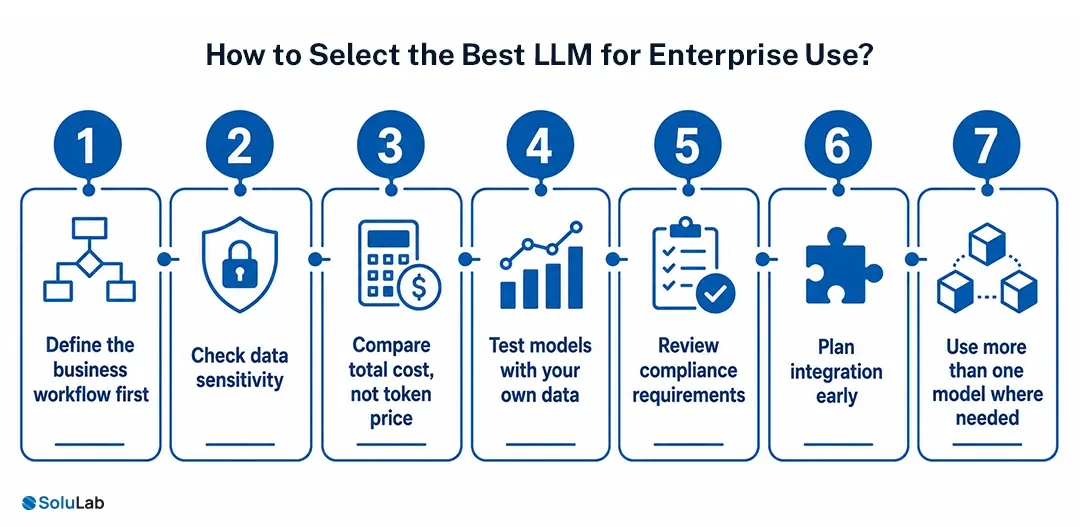
Here is a practical numbered checklist for enterprise teams.
- Define the business workflow first
Do not start with the AI model. Start with the task. A support chatbot, legal reviewer, coding assistant, voice agent, and private knowledge bot need different model strengths.
- Check data sensitivity
If sensitive data cannot leave your environment, Llama 3 may be a better fit. If API use is acceptable, GPT-4o and Claude 3.5 are easier to integrate.
- Compare total cost, not token price
API models reduce infrastructure overhead. Open models reduce vendor lock-in, but you must manage hosting, monitoring, scaling, and security.
- Test models with your own data
Benchmarks help, but internal evaluation matters more. Test the models on real support tickets, contracts, product documents, code repositories, and customer queries.
- Review compliance requirements
Enterprises must review all the compliance requirements before production AI deployment.
- Plan integration early
An LLM does not create value alone. It needs workflow integration, retrieval-augmented generation, vector databases, APIs, dashboards, human review, and monitoring.
- Use more than one model where needed
Many enterprises do not need one winner. They use GPT-4o for multimodal customer experience, Claude 3.5 for document-heavy reasoning, and Llama 3 for private domain-specific workflows.
GPT-4o vs Claude 3.5 vs Llama 3: Which One Should You Choose?
If your business wants the quickest route to a capable AI product, GPT-4o is usually the practical choice. It is strong across text, image, audio, and real-time assistant experiences.
If your business depends on writing quality, document review, coding, and careful reasoning, Claude 3.5 is a strong enterprise option.
If your business needs private deployment, deeper customization, and more control over model behavior, Llama 3 or Llama 3.1 is worth serious evaluation.
For most enterprise teams, the smartest answer is not “one model for everything.” The better approach is a model strategy. Use each LLM where it performs best, then connect it through secure integration, retrieval, evaluation, and governance.

How SoluLab Helps Enterprises Choose and Integrate LLMs?
SoluLab helps businesses evaluate, integrate, and customize enterprise-grade AI models based on real use cases. As an LLM development company, SoluLab supports AI consulting, model selection, LLM integration, RAG development, chatbot development, AI agent development, private AI deployment, and workflow automation.
Whether you are comparing GPT-4o vs Claude vs Llama comparison options or planning production-ready AI integration services, we help you move from model selection to secure enterprise deployment.
FAQs
Shipra Garg is a tech-focused content strategist and copywriter specializing in Web3, blockchain, and artificial intelligence. She has worked with startups and enterprise teams to craft high-conversion content that bridges deep tech with business impact. Her work translates complex innovations into clear, credible, and engaging narratives that drive growth and build trust in emerging tech markets.