Key Takeaways
- LLM development cost in 2026 spans a wide range, from around $5,000 for a small chatbot up to $50,000+ for a fully custom, proprietary model.
- Data quality, infrastructure choices, security needs, and integration depth are what actually move the price, not the “AI” label itself.
- A basic API-based chatbot sits at the cheap end. Multi-agent platforms and custom-trained models sit at the expensive end.
- Gartner expects spending on specialized, domain-specific language models to jump 210% in 2026 alone.
- The company you build with matters almost as much as the model itself. Scope and planning quietly decide most of the final bill.
How much is this going to cost me?” That’s usually the first thing a business asks before anyone even talks about features. With LLM Development Cost, the honest answer is: it depends. Some teams get away with $5,000 for a simple chatbot. Others end up spending half a dollar on a model built entirely around their own data.
There’s no single price for a large language model project, and anyone who gives you one number without asking a single question is probably guessing. Cost shifts with what you’re building, how messy or clean your data is, and how deep the AI needs to sit inside your existing systems.
This guide walks through all of that in plain language, so you’re not caught off guard the first time you talk numbers with an LLM development company

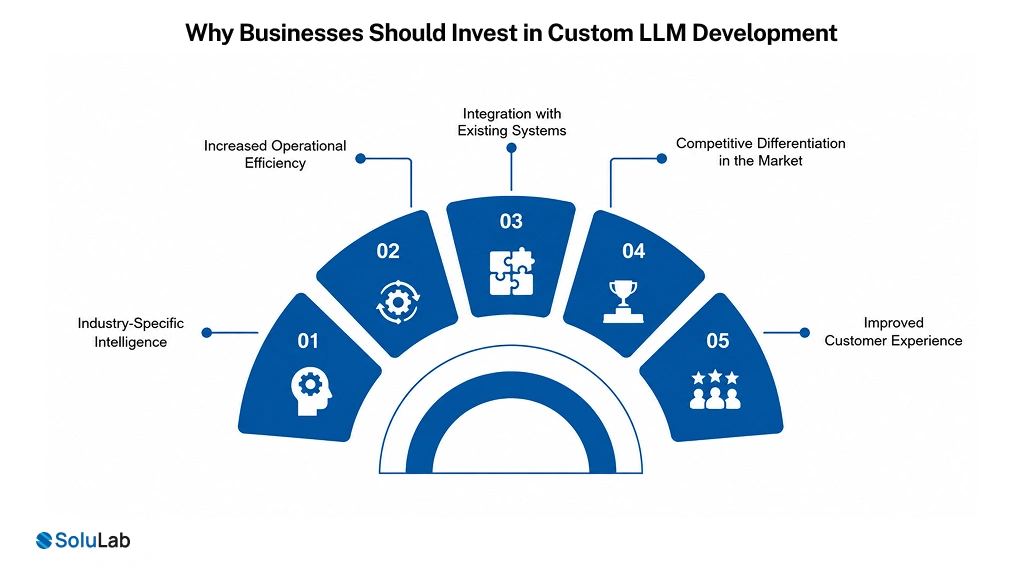
Why Businesses Should Invest in Custom LLM Development?
A generic chatbot can handle FAQs just fine. Ask it something that actually matters to your business, though, and it usually stumbles. According to Gartner, LLMs could become up to 100× more cost-efficient by 2030 compared to similar models developed in 2022.
That’s the gap custom LLM development is built to close by training the model on your own data instead of publicly available knowledge. Below are five reasons more companies are choosing to build rather than rent.
1. Industry-Specific Intelligence
Feed a model your industry’s terms, edge cases, and internal shorthand, and it stops guessing. It starts sounding like it actually works there. Most teams get here through focused LLM fine-tuning services, which teach a base model the specifics a generic one never learned.
- Understands industry jargon correctly
- Fewer made-up or wrong answers
- Sounds like your team, not a script
2. Increased Operational Efficiency
Somewhere in every company, a task exists that eats hours every single week for no good reason. A well-trained LLM can quietly take that task over, freeing people for work that actually needs a human brain.
- Cuts document review time way down
- Handles routine questions without help
- Less manual copy-paste, more real work
3. Integration with Existing Systems
A custom LLM can sit inside your CRM, your help desk, or your internal tools, so nobody has to jump between five different tabs just to get an answer.
- Plugs into tools you already use
- Pulls live data without extra steps
- Fits into how your team already works
4. Competitive Differentiation in the Market
Two competitors using the same public chatbot are basically offering the same experience with different logos. A model trained on your own data is something a rival can’t just copy by signing up for the same subscription.
- Creates an edge rivals can’t copy
- Reflects how your brand actually talks
- Builds something that’s genuinely yours
5. Improved Customer Experience
Generic bots forget everything the second a chat ends. A custom model can carry context, remember past interactions, and answer faster because it’s not searching the whole internet for a guess. Pair that with an AI agent development company, and you get a real assistant instead of a scripted FAQ page.
- Faster replies with fewer mistakes
- Remembers a customer’s history
- Feels less robotic, more useful
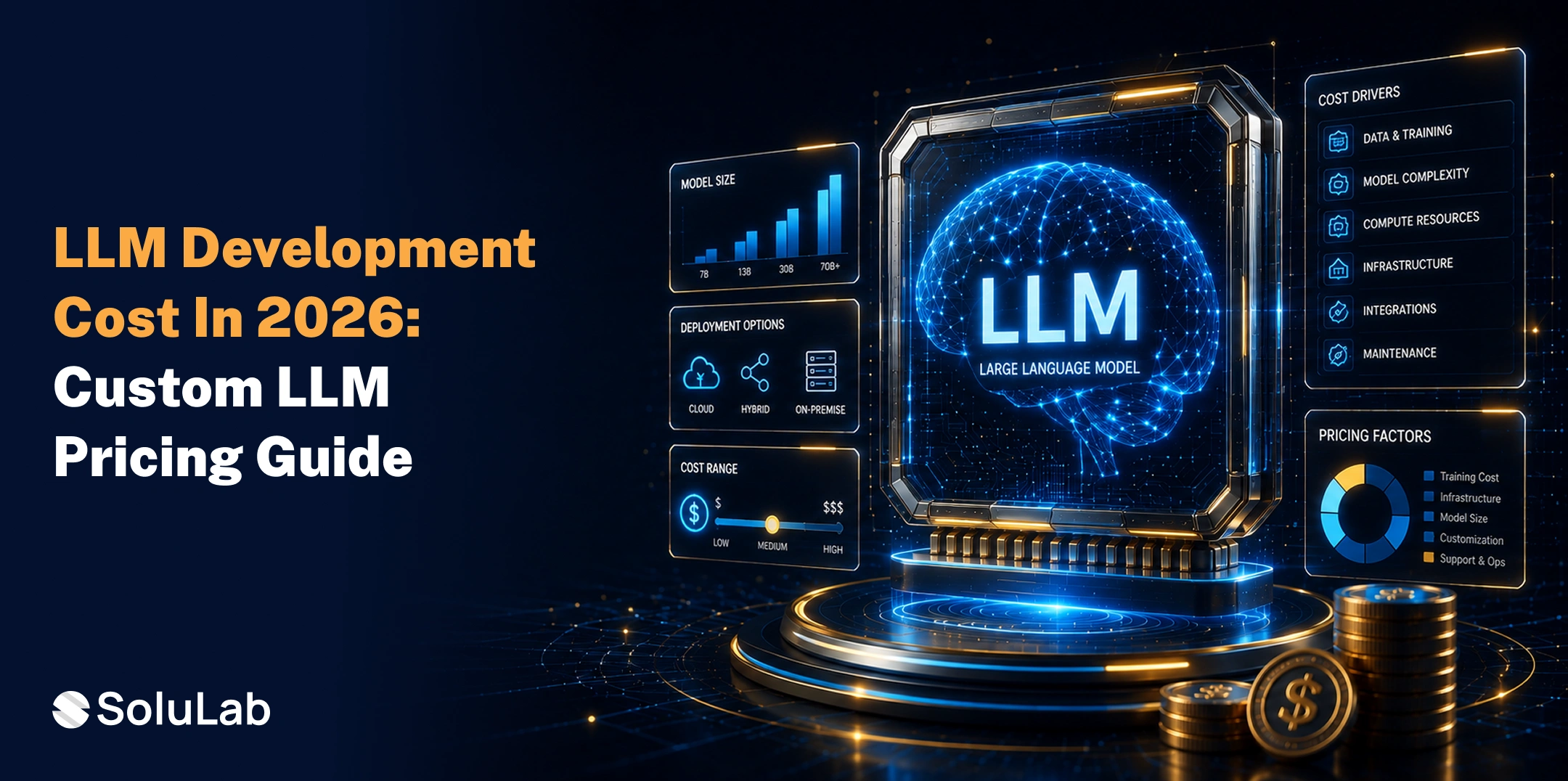
Key Factors That Influence Custom LLM Development Costs
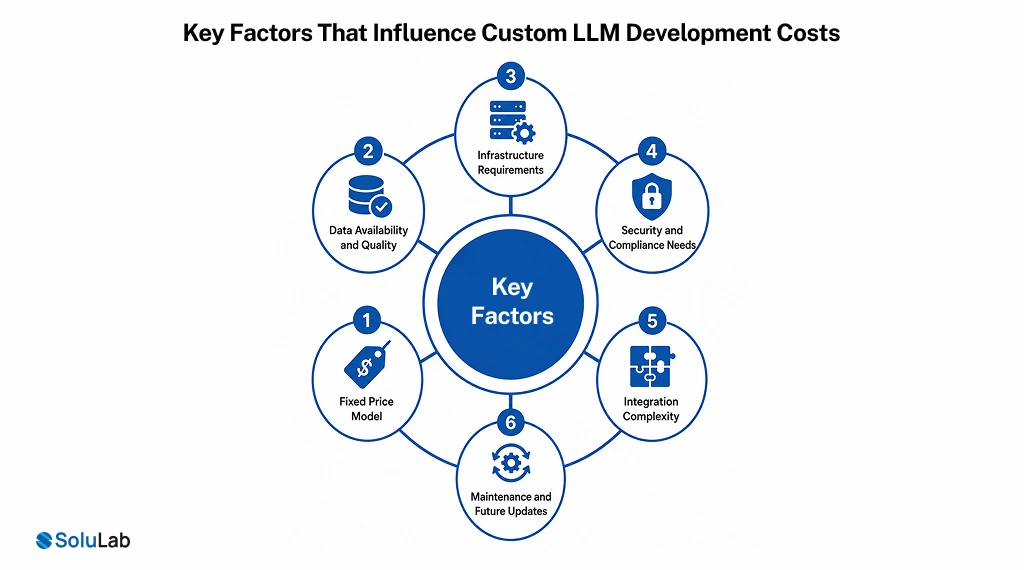
Ask two companies for “an AI chatbot,” and you’ll get two wildly different quotes. That’s not a pricing scam. It’s because a dozen hidden factors quietly stack up behind the scenes. Knowing them up front means fewer surprises later.
1. Fixed Price Model
Some projects run on a flat fee. Others bill hourly, or in monthly sprints as scope shifts. Which model you pick changes not just the total cost, but who carries the risk if requirements change mid-project.
- Fixed pricing works for small, defined builds
- Hourly billing suits shifting requirements
- Sprint pricing fits longer, evolving projects
2. Data Availability and Quality
If your data is already clean and organized, great, you’re ahead of most companies. If it’s scattered across five systems and half-labeled, expect weeks of cleanup before training even starts.
- Clean data shortens the whole timeline
- Messy data adds real cleanup cost
- More sources usually means more complexity
3. Infrastructure Requirements
Where the model actually runs changes the bill a lot. Cloud GPUs, private servers, and hybrid setups all come with different price tags attached, and this is exactly where solid enterprise AI development planning saves money later instead of costing more.
- Cloud hosting scales with actual usage
- On-premise servers cost more upfront
- Hybrid setups balance cost against control
4. Security and Compliance Needs
Healthcare, finance, and legal work all carry extra rules, and those rules cost money to satisfy. Skip them to save a few dollars now, and it almost always costs more later. Regulated teams usually bring in AI consulting services early just to map out the rules before writing a line of code.
- Encryption adds setup time upfront
- Audits mean extra documentation work
- Compliance reviews stretch early timelines
5. Integration Complexity
Wiring a model into one modern API is a quiet afternoon’s work. Wiring it into five old, disconnected systems is a different project entirely, and the price reflects that.
- Legacy systems need custom connectors built
- More integrations mean more testing
- Modern, API-first tools cost less to link
6. Maintenance and Future Updates
Launch day feels like the finish line, but it isn’t. Models drift, answers go stale, and bugs show up months later. That ongoing work needs its own line in the budget from day one, not an afterthought.
- Monitoring catches drift before users notice
- Retraining keeps answers current over time
- A support plan handles bugs as they come
How Much Does LLM Development Cost in 2026?
Pricing swings hard depending on what’s actually being built, so seeing real ranges side by side helps more than any single average number would.
Here’s a rough breakdown across common project types, based on typical scope and effort. If retrieval work is a big part of your project, teams looking into RAG development services should plan for somewhere in the middle of this table, not the low end.
| Solution Type | Estimated Cost Range |
| Basic API-Based LLM Chatbot | $5,000 – $15,000 |
| LLM-Powered MVP | $15,000 – $40,000 |
| RAG-Based Knowledge Assistant | $25,000 – $350,000 |
| LLM App with Workflow Automation | $40,000 – $50,000 |
| Fine-Tuned Domain-Specific LLM App | $30,000 – $50,000 |
| Multi-Agent LLM Platform | $50,000+ |
| Custom-Trained Proprietary LLM | $50,000+ |
LLM Development Cost by Business Size
Company size shapes what solution actually makes sense, more than most people expect going in. A ten-person startup and a global bank are not shopping for the same thing, even if they both say “we need an AI chatbot” in the first sales call.
| Business | Recommended Solution | Estimated Cost |
| Startup | Basic chatbot or LLM-powered MVP | $5,000 – $40,000 |
| SMB | RAG-based knowledge assistant | $25,000 – $60,000 |
| Mid-size | Workflow automation app or fine-tuned model | $60,000 – $150,000 |
| Enterprise | Multi-agent platform or custom-trained LLM | $50,000 – $60,000+ |
SoluLab Is Your Budget-Friendly LLM Development Partner!
Budget matters, sure, but who you build with matters just as much. SoluLab, an AI-led company, doesn’t hand off half a project and wish you luck with the rest. Here’s what’s actually covered:
- End-to-end LLM development: From the first strategy call to the day it goes live, our team can build a private LLM shaped around your exact data and rules, not a generic template.
- Enterprise AI consulting: Our consultants help lock down the right scope before a single line of code gets written, so you’re not paying later for features nobody asked for.
- Private LLM deployment: Hosting stays secure and sensitive company data never has to leave your control.
- RAG implementation: Your model gets connected to your actual documents and knowledge base, so answers stay grounded instead of invented.
- Fine-tuning: Further training on your own examples so the model reasons and talks like your business, not a demo bot.
Past those five, SoluLab also handles AI integration services for teams that need the model wired into tools they already use, plus broader AI automation solutions for companies that want to automate more than one workflow at a time.

Conclusion
There’s no single number behind LLM development cost, and if someone quotes you a flat price before asking a single question about your data or your systems, treat that as a red flag, not a bargain.
Real cost comes down to your data, your infrastructure choices, your compliance load, and how deeply the model needs to sit inside your business.
Get a free quote from SoluLab, a leading AI development company, and find out what your specific project would actually cost before committing a dollar.
FAQs
Neha is a curious content writer with a knack for breaking down complex technologies into meaningful, reader-friendly insights. With experience in blockchain, digital assets, and enterprise tech, she focuses on creating content that informs, connects, and supports strategic decision-making.