
Key Takeaways
- Every vendor says agile; almost none can prove it. The buyer’s job is checking whether cadence, contract and team structure actually allow scope to change, not whether the word appears in the pitch.
- A fixed-price contract cancels out agile. Scope freezes at signature, every learning becomes a change request, and the vendor is paid to resist the adaptation you hired them for. Capped time and materials is the practical fit.
- Keep the product owner on your side of the table. If the vendor supplies both the product owner and the team, nobody in the room represents your business when scope decisions get made.
- Working software every sprint is the only reliable proof. Slide-deck demos, an unreorderable backlog and estimates that never change are the clearest signs of agile theatre.
- Ask for cycle time and deployment frequency, not velocity. Velocity is a planning aid for one team. Used as a performance target it inflates within two sprints and stops telling you anything.
- Scrum or Kanban fits most engagements; SAFe usually does not. Below roughly thirty engineers, SAFe is process weight. A vendor proposing it for a team of six is selling method, not delivery.
Hiring agile developers means hiring engineers who deliver working software on a short, fixed cadence and adjust scope as the product is understood, rather than building to a specification signed off a year earlier. The difficulty is that almost every development firm now describes itself as agile, and most of what is sold under that label is a waterfall project with a daily standup bolted on. The buyer’s real job is not finding a vendor who says agile. It is checking whether the delivery cadence, the contract and the team structure actually allow agile to happen.
On this page: what an agile team is made of, Scrum versus Kanban versus SAFe, the engagement and contract models agile requires, how to spot agile theatre before you sign, the interview questions that work, the metrics to ask for, and what it costs.

What Does an Agile Development Team Look Like?
When you hire agile developers, five to nine people is the working range. Larger than that and the coordination cost eats the speed agile is supposed to buy.
| Role | What they own | Who usually fills it |
| Product owner | Backlog priority, scope decisions, the “why” | You, the client — this rarely outsources well |
| Scrum master or delivery lead | Cadence, blockers, process health | The vendor |
| Developers | Building and reviewing the work | The vendor |
| QA engineer | Testing inside the sprint, not after it | The vendor |
| Designer | Working one sprint ahead of development | Either |
| DevOps | Pipeline, environments, release automation | The vendor, often part-time |
Notably, the role most often mishandled is product owner. If the vendor supplies both the product owner and the team, nobody in the room represents your business, and every scope decision gets made by the people paid to build. Keep the product owner on your side, even if it is a part-time responsibility for someone senior.
The service side of this sits on SoluLab’s agile software development page.
Scrum, Kanban or SAFe: Which Should You Ask For?
| Scrum | Kanban | SAFe | |
| Cadence | Fixed sprints, usually two weeks | Continuous flow, no sprints | Sprints coordinated across multiple teams |
| Best for | New product build with an evolving roadmap | Support, maintenance, unpredictable inbound work | Large organisations running many teams on one product |
| Planning overhead | Moderate | Low | High |
| What you commit to | Sprint scope, reviewed every two weeks | Priority order, changeable any time | Quarterly planning increments |
| Common failure | Sprints that always overrun | No cadence, so progress becomes invisible | Process weight crushing the teams underneath |
In practice, for most engagements below about thirty engineers, Scrum or Kanban is the honest answer and SAFe is overhead. A vendor who proposes SAFe for a single team of six is selling process, not delivery.
Which Contract Model Does Agile Actually Need?
However, this is the section most hiring guides skip, and it is where agile engagements quietly die.
| Model | Fits agile | Why |
| Time and materials | Yes | Scope can change sprint to sprint without a change request |
| Capped time and materials | Yes | Gives you a budget ceiling while keeping scope flexible — usually the right answer |
| Dedicated team, monthly | Yes | Fixed capacity, flexible scope, simplest to administer |
| Fixed-bid, fixed scope | No | The scope is frozen at signature, which is the opposite of agile |
Consequently, a fixed-bid contract with an agile process on top gives you the worst of both: every genuine learning becomes a change request, and the vendor is financially motivated to resist the adaptation you hired them for. If a vendor offers you a fixed price for an evolving product and calls it agile, that is the first red flag.
In practice, capped time and materials is the sensible compromise. You get a ceiling for your finance team and flexibility for your product team, with a review point when the cap is approached. The engagement models across SoluLab’s hiring routes are covered in the guide to hiring dedicated developers and the dedicated team versus freelance developer comparison.
How Do You Spot Agile Theatre?
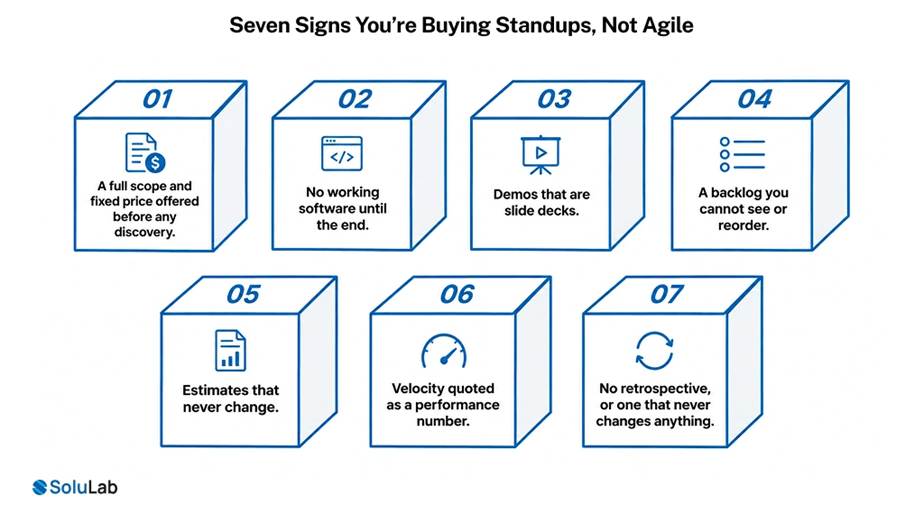
Before you hire agile developers, watch for these seven signals, in rough order of how reliably they predict trouble.
- First, a full scope and fixed price offered before any discovery. Agile cannot begin from a frozen specification.
- Second, no working software until the end. If the first demo is in month four, the sprints are decorative.
- Third, demos that are slide decks. A sprint review shows software running, not progress reported.
- Then a backlog you cannot see or reorder. If priority is the vendor’s decision, you are not the product owner.
- Also, estimates that never change. Real teams re-estimate as they learn; a plan that survives contact with the code unchanged was never a plan.
- Moreover, velocity quoted as a performance number. Velocity is a planning aid for one team. Used as a KPI, it gets inflated within two sprints.
- Finally, no retrospective, or one that never changes anything. A team that improves nothing is running a ceremony, not a process.
Therefore ask to sit in on one sprint review from an existing client engagement, with the client’s permission. Vendors doing this properly will find a way to arrange it. Vendors who cannot will explain why it is impossible.
What Should You Ask in the Interview?
So here are eight questions, with what a good answer sounds like.
- “How long are your sprints and what happens when work does not finish?” Good answer: it returns to the backlog and gets re-prioritised. Bad answer: the team works the weekend.
- “Who is the product owner in this engagement?” Good answer: they expect it to be you and will say so.
- “Show me a sprint review recording or invite me to one.” Willingness matters more than the artefact.
- “What did your last retrospective change?” A specific answer means retrospectives are real.
- “How do you handle a mid-sprint change request from us?” Good answer: it waits for the next sprint unless something is swapped out. A vendor who says yes to everything is not protecting your delivery.
- “What is your definition of done?” Should include tested, reviewed and deployable, not “code complete”.
- “How often do you deploy to a real environment?” Weekly or better on healthy engagements.
- “Tell me about a time you told a client their idea would not work.” The best delivery teams push back. A vendor with no example is describing an order-taking relationship.
Which Delivery Metrics Should You Ask For?
Therefore ask for these:
- Cycle time — how long a piece of work takes from start to deployed. The single most useful number.
- Deployment frequency — how often working software actually reaches an environment.
- Escaped defects — bugs found after release rather than in the sprint.
- Sprint goal achievement — how often the team meets the goal it set itself.
Meanwhile, ignore or discount these:
- Velocity as a cross-team comparison. Story points are not a shared unit between teams, and treating them as one guarantees inflation.
- Similarly, lines of code or commit count. Measures typing, not delivery.
- Also hours logged. Measures presence, not progress.
So agree which metrics you will see, and how often, before the engagement starts. Pipeline and environment work sits with DevOps consulting, and deployment frequency is usually limited by it rather than by the developers.
What Drives the Cost of Hiring Agile Developers?
There is no honest flat figure when you hire agile developers. Instead, these factors move it:
- First, team size and shape. A five-person cross-functional team costs more than three developers, and delivers more predictably because testing happens inside the sprint.
- Then seniority mix. Agile relies on engineers who can make decisions without escalating. Junior-heavy teams need more of your time, which is a real cost.
- Also location. Rates vary widely by region, and this is the main commercial reason distributed teams exist.
- Next, whether the vendor supplies a delivery lead. Someone has to run the cadence; if the vendor does not provide it, you will.
- Similarly, time zone overlap. Agile depends on conversation. Thin overlap either raises the rate or slows the cadence.
- Finally, contract model. Capped time and materials usually prices slightly above pure T&M because the vendor carries the ceiling risk.
Finally, compare total cost of ownership, including your own product owner time, which is a real commitment of one to two days a week on an active build.

How Do You Choose an Agile Development Partner?
Finally, six checks, in rough order of how much they predict the outcome.
- First, a contract model that fits agile. Capped time and materials or a dedicated team, not fixed-bid with agile language on top.
- A named delivery lead, not a rotating account manager.
- Your right to interview and reject team members, written into the contract.
- Then evidence of cadence — a sprint review you can attend, or recordings from a consenting client.
- A willingness to disagree with you during the sales conversation. It is the cheapest signal available.
- Verifiable references from engagements of comparable length. The SoluLab case studies library is the kind of evidence to ask any vendor for.
Otherwise walk away from a vendor who offers a fixed price for an undefined scope, cannot name your delivery lead, or answers every question with yes.
Meanwhile, SoluLab runs agile delivery teams for clients across the US, UK, Europe and Asia-Pacific, in the client’s time zone, with the client holding product ownership. Engagements run through agile software development, custom software development and enterprise software development, on a cloud and DevOps foundation that makes short release cycles possible.
Frequently Asked Questions
Shipra Garg is a tech-focused content strategist and copywriter specializing in Web3, blockchain, and artificial intelligence. She has worked with startups and enterprise teams to craft high-conversion content that bridges deep tech with business impact. Her work translates complex innovations into clear, credible, and engaging narratives that drive growth and build trust in emerging tech markets.