Quantum computing is starting to create the kind of quiet panic leaders feel when they realize a shift is happening, whether they’re ready or not. Because the global quantum computing market is expected to hit $1.88 billion in 2026, growing at nearly 30% a year and heading toward $19.44 billion by 2035, the question isn’t if this matters anymore—it’s what happens if you wait too long to adopt AI-driven quantum computing solutions.
Even The World Economic Forum is already pointing out that more than $35.5 billion has gone into quantum technology, with the potential to unlock $1 trillion in economic value by 2035 across finance, logistics, and pharma. This isn’t hype money, it’s capital chasing real constraints that classical systems are starting to hit as data and complexity explode.
What’s changed is that quantum no longer feels like science fiction. When combined with AI development services, machine learning frameworks, and predictive analytics, it’s emerging as a practical competitive edge. The road is still messy – hardware limits, immature software, and looming cryptography risks, but that’s exactly why the next few years matter, and why waiting comes with a real cost.
Key Takeaways
- Problem: Look, every founder knows the pain of optimization bottlenecks, whether it’s juggling volatile markets in finance or rerouting trucks during a logistics snarl. That’s the problem – classical computers hit walls on complex, multi‑variable challenges, costing companies millions in inefficiencies and missed opportunities.
- The solution: Quantum computing steps in with parallel processing that can crush these problems, potentially slashing computation times from days to minutes and unlocking 10–20x ROI in targeted use cases like risk modeling or supply chain tweaks.
- Here’s where SoluLab comes in: We’ve helped enterprises build hybrid quantum‑classical apps that integrate seamlessly with existing stacks, starting with proofs-of-concept that deliver quick wins. No hype, just results, and our clients have seen 25% efficiency gains in early pilots. So are you Ready to explore with us?
Global Quantum Computing Market Outlook & Revenue Projections for 2026
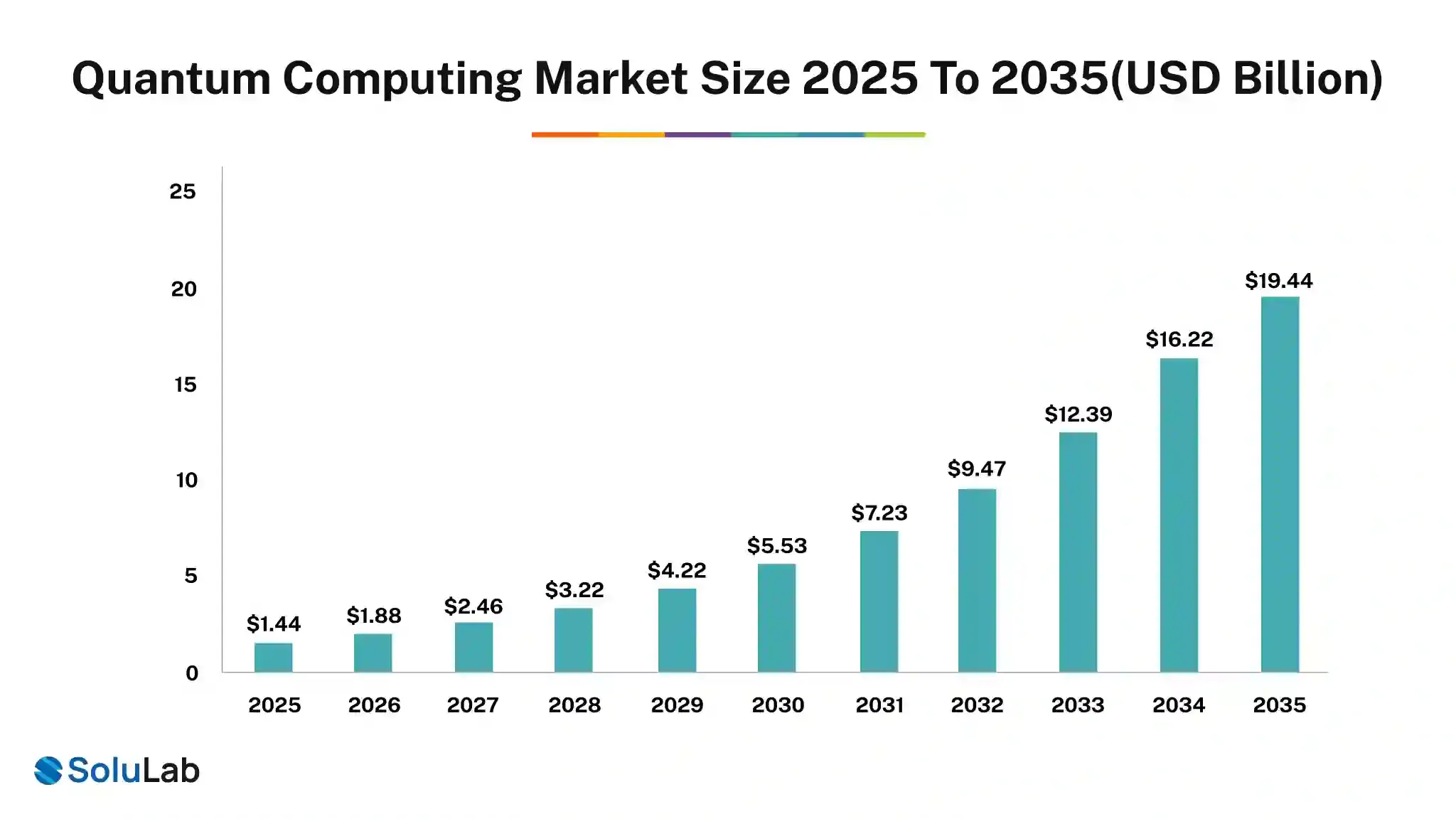
The quantum landscape is heating up, and it’s not just buzz, as real dollars are flowing in. From Statista’s view, quantum tech as a whole could top $106 billion by 2040, but zooming in on computing, Precedence pegs 2026 at $1.88 billion, up from $1.44 billion last year.
Even Forbes echoes this, noting a surge in investments hitting $35.5 billion globally via the World Economic Forum’s tally, with North America grabbing 61% share thanks to heavy R&D.
So, you might ask why the boom? Quantum computing ROI for companies in optimization and simulation is pulling in sectors desperate for an edge – finance, logistics, pharma, and energy are all testing workflows that classical machines can’t solve efficiently.
McKinsey estimates that quantum computing could unlock $400–600 billion in value for the financial sector alone by 2035, mostly via portfolio optimization, risk modeling, and settlement liquidity.
Expect Asia‑Pacific to catch up fast, with China’s $7.4 billion push driving a 35% regional CAGR, and Europe’s €1 billion Quantum Flagship fueling growth in quantum computing platforms at 32%.
| Region | 2026 Projected Revenue | CAGR (2026–2035) | Key Drivers |
| North America | $1.15B | 30% | Tech giants like IBM and Google are leading hardware innovation |
| Europe | $0.38B | 32% | Government initiatives focus on quantum computing cloud services |
| Asia‑Pacific | $0.25B | 35% | China and Japan’s investments in quantum computing companies in 2026 |
| Rest of World | $0.1B | 28% | Emerging adoption in finance and logistics |
This isn’t pie‑in‑the‑sky, it’s grounded in WEF and McKinsey analyses showing quantum could add $1 trillion to the global economy by 2035 through optimized industries.
Leading Quantum Computing Platforms and Their Real-World Enterprise Use Cases
The field’s crowded, but a few are pulling ahead.
- IBM’s Heron R3 chip hit 156 qubits with 16x better performance, eyeing fault‑tolerance by 2029 – perfect for quantum computing impact on finance and logistics.
- Google’s Willow smashed error correction barriers, running 13,000x faster on select tasks, while IonQ’s trapped‑ion tech promises scalability for enterprise quantum computing solutions.
- Don’t sleep on startups like Rigetti (Ankaa series) or D‑Wave, whose annealing focus nails optimization for examples of companies using quantum computing, like JPMorgan’s portfolio tweaks. Quantinuum’s Apollo aims for millions‑gate circuits by 2030.
- Quantum computing software providers like Xanadu (photonic) and Qilimanjaro (annealing) round out the pack, blending hardware with cloud access and APIs that plug into existing workflows.
By 2026, the quantum computing race will no longer be just about qubit count. Leaders are competing on fidelity, usability, and AI integration solutions, with Asia’s Origin Quantum and Europe’s Quandela pushing innovation in enterprise-grade quantum platforms.
Hardware Progress and Roadmaps Shaping Quantum Computing Trends in 2026
Hardware’s where the action is. As of 2025, breakthroughs like:
- Google’s 105‑qubit Willow with 99.97% fidelity set the stage for 2026 scaling,
- IBM’s Nighthawk prototype links chips into 360‑qubit systems, targeting 1,000+ qubits by 2027 via quantum computing platforms.
- IonQ’s microwave traps hit 256 qubits, and PsiQuantum is eyeing 1 million by 2028.
Their roadmaps scream hybrid, but the Future of quantum computing 2026 means room‑temperature qubits from Xanadu’s photonic chips, which could slash power and cooling costs, plus modular designs that let you plug into classical infrastructure instead of buying a full‑stack machine.
But challenges linger, as decoherence limits runs to microseconds, though error correction is improving 10x yearly, according to Quora threads and industry reports. Expect 500–5,000 physical qubits mainstream by year‑end, per LinkedIn and research‑front forecasts.
Read More: Advanced Security Technologies in Post‑Quantum Cryptography
How Quantum Software and Middleware Are Driving Enterprise Adoption and ROI?
Software’s catching up
Qiskit (IBM) and Cirq (Google) dominate, with quantum computing software providers like Quantistry and Classiq adding domain‑specific tools for finance and chemistry.
Middleware is key
PennyLane and similar frameworks bridge quantum‑AI and hybrid workflows, which is why Globant’s 2026 report expects 75% of users to access quantum via quantum computing cloud services by 2030.
Adoption’s surging
Examples of companies using quantum computing include ExxonMobil, which simulated battery materials to cut R&D time by 50%, and JPMorgan, which ran portfolio‑optimization pilots on IBM’s hardware. Enterprises dip their toes via AWS Braket and Azure Quantum, with 53% planning pilots per IBM’s 2025 Readiness Index.
Talent’s Scarce
Quantum computing consulting services like SoluLab’s fill the gap by translating complex algorithms into business‑ready workflows instead of pure‑science experiments. They turn complex quantum algorithms into enterprise-ready AI workflows, actionable predictive models, and scalable business solutions, rather than just theoretical experiments.
Why Companies Are Investing in Quantum Computing to Power Next-Generation AI?
The distinction between quantum computing and classical computing becomes critical when classical AI models reach their limits in optimization, combinatorial search, and probabilistic inference. The Quantum‑classical hybrid models can run optimization kernels, sampling, and feature‑extraction tasks on quantum processors, while classical CPUs and GPUs handle general‑purpose training and inference.
Here is how it takes effect:
- Quantum‑AI accelerates model training by exploring high‑dimensional parameter spaces in parallel, cutting time‑to‑insight from hours or days to minutes.
- Quantum‑inspired algorithms already run on classical HPC and GPU clusters, acting as a bridge to true quantum advantage before large‑scale fault‑tolerant hardware arrives.
Key advantages for enterprises
- Faster, smarter decision-making – Quantum-AI enables real-time risk modeling, anomaly detection, and predictive analytics by compressing complex simulations that classical AI struggles to process efficiently.
- Improved financial modeling and planning – It enhances portfolio optimization, stress testing, and liquidity planning, delivering better risk-adjusted outcomes in finance-heavy environments.
- Hyper-personalization at scale – By combining quantum computing with AI integration services, enterprises can analyze thousands of micro-patterns simultaneously, enabling ultra-precise recommendations, dynamic pricing, and predictive insights.
- Advanced pattern discovery – Quantum-assisted feature extraction and dimensionality reduction accelerate the move from raw data to actionable insights.
- Energy-efficient AI infrastructure – By reducing reliance on large GPU clusters, quantum-AI lowers compute time and energy consumption.
- Scalable and sustainable AI systems – Quantum-AI parallelism enables greener data centers and drives long-term, eco-efficient AI strategies for enterprise-scale applications.
Read More: Quantum AI for Enterprises
Real-World Enterprise Use Cases of Quantum Computing in 2026
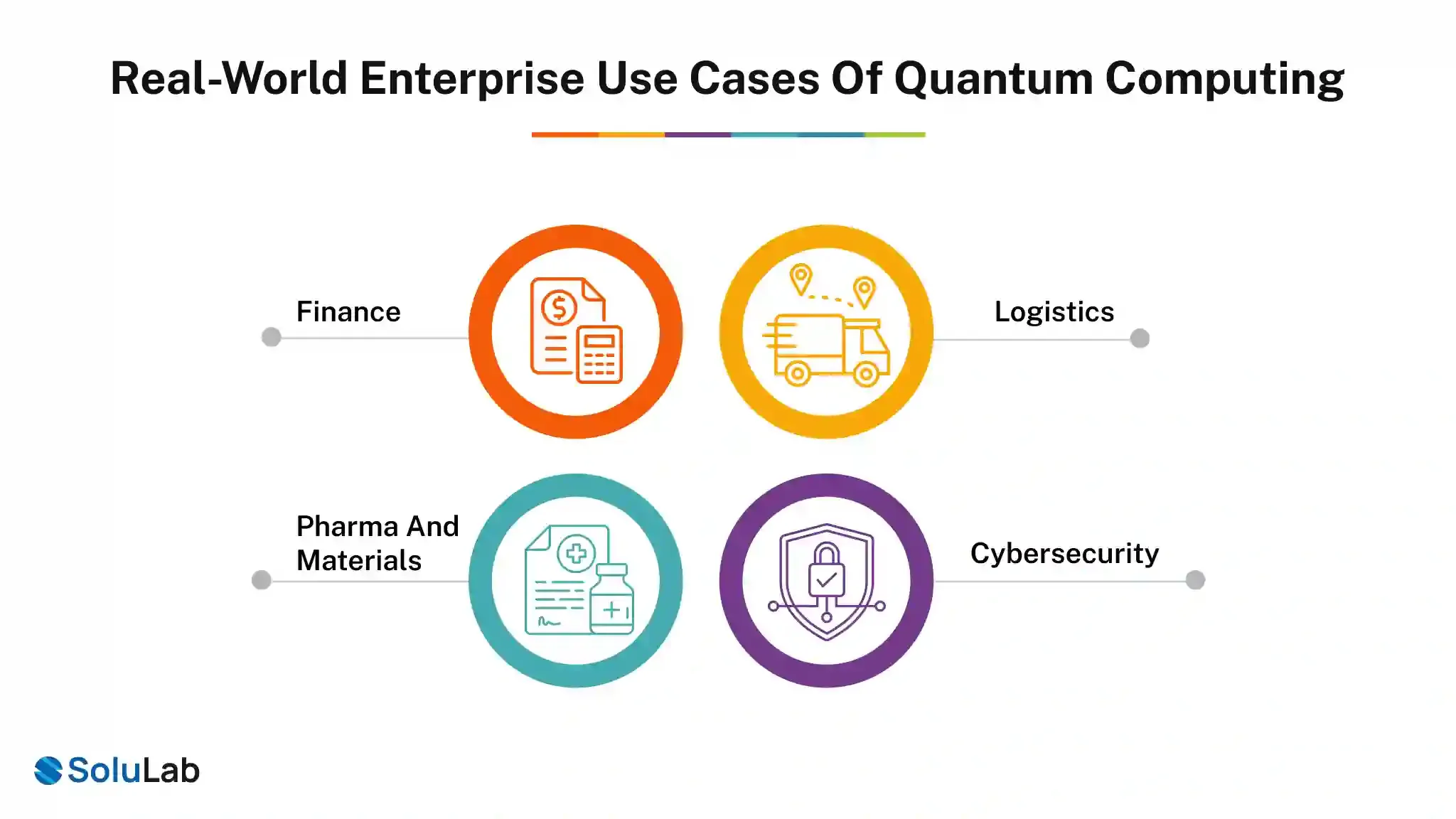
Here are a few sectors that are implementing Quantum Computing in their legacy systems
Finance
HSBC and Vanguard have used quantum‑classical hybrids to improve bond‑trading predictions and portfolio‑risk analysis, showcasing quantum computing’s impact on finance and logistics at scale.
JPMorgan reported 10x speedups in option‑pricing and risk‑scenario runs via quantum computing ROI for companies in optimization layers.
Pharma And Materials
Roche and similar companies have reduced drug-candidate screening timelines from years to months by leveraging quantum computing and AI-powered molecular simulations, enabled by quantum software providers offering life-science toolkits and predictive analytics.
Logistics
DHL and others have optimized routes across 1,200 sites, saving 15–20% in fuel and delivery time – a concrete example of real-world applications of quantum computing and quantum computing use cases in the real world that prove the benefits of quantum computing for businesses in ESG‑driven efficiency.
Cybersecurity
Quantum key distribution and quantum-safe protocols are being implemented in NIST-backed pilots and government initiatives, enabling AI-driven secure communications and next-generation enterprise security.

What Experts Say About Real-World Quantum Computing?
2026 is the year of hybrids as quantum‑classical workflows will deliver first‑mover advantages,” says Bernard Marr on LinkedIn, echoing a broader trend that quantum computing trends 2026 are shifting from lab experiments to industrial implementation in finance, logistics, and pharma.
Even Reddit threads buzz with optimism: Error correction breakthroughs make utility‑grade quantum real by 2027, per r/QuantumComputing.
From Quora, experts say quantum‑AI hybrids will reshape finance, logistics, and cybersecurity, while WEF warns that the same tools enabling $1 trillion in gains could also break legacy encryption unless post‑quantum cryptography rolls out on schedule.
Governments lean in, expect $40 billion+ investments in quantum by 2030, notes commentator Charlie Brock, aligning with EU and U.S. national‑security budgets already flowing into the sector.
Why Governments and Regions Are Investing in Quantum Computing?
The U.S. reauthorized the National Quantum Initiative with $2.7 billion, focusing on fault‑tolerant systems and critical‑infrastructure security, while China’s $7.4 billion push is building quantum‑secure communication and computing infrastructure at scale.
The EU’s Quantum Flagship is now €1 billion+, with a roadmap to transition critical infrastructure to post‑quantum cryptography by 2030, formalized in the EU PQC Action Plan.
Regional hubs are popping up everywhere – Illinois’ quantum park ($500M), California’s AB940 ($121M), and Germany’s $3 billion plan by 2026, all aligning with quantum computing trends 2026 and the future of quantum computing 2026.
Even India’s National Quantum Mission ($750M) is specifically targeting quantum computing platforms and quantum‑safe cryptography, which directly relates to how governments are investing in quantum technology.
The Real Risks and Technical Headwinds Facing Quantum Computing Platforms in 2026
Quantum’s not perfect, as decoherence kills qubits fast, there are high system costs ($10M+), limited access, and talent shortages slow adoption, as Reddit and industry reports highlight.
There’s also the crypto threat: Harvest now, decrypt later attacks mean attackers stockpile encrypted data today, hoping to decrypt it once fault‑tolerant quantum machines are available.
Scalability issues persist; today’s NISQ‑era chips are noisy, so hybrid quantum‑classical loops are the realistic path forward.
And the Ethical risk persists, as quantum‑AI hybrids enter finance and logistics, IEEE and QuRISK warn that algorithmic bias and transparency need to be baked in from day one.
| Risk | Impact | Mitigation |
| Decoherence | Unreliable computations | Error‑correction advances and hybrid workflows |
| High Costs | Slow enterprise entry | Quantum computing cloud services and Hybrid‑QCaaS |
| Crypto Break | Data exposure | PQC migration and post‑quantum crypto roadmaps |
Conclusion
2026 could indeed be quantum’s pivot, from labs to ledgers, logistics, and risk engines, with quantum computing trends 2026 like hybrid workflows and quantum‑computing‑as‑a‑service (QCaaS) making it accessible.
For founders, it’s about spotting why companies invest in quantum computing: massive ROI in optimization, simulation, and security that can’t be ignored. But act fast, as the future of quantum computing in 2026 favors the prepared.
Whether you’re in finance eyeing quantum computing ROI for companies or logistics chasing 20–30% efficiency gains, quantum is your next move. At SoluLab, a top AI consulting company, we help enterprises turn quantum potential into measurable outcomes with quantum computing consulting, AI integration, and enterprise-grade QCaaS solutions.
Let’s connect and build your next-generation AI-quantum enterprise platform!
FAQs
With over 3 years of experience, I specialize in breaking down complex Web3 and crypto concepts into clear, actionable content. From deep-dive technical explainers to project documentation, I help brands educate and engage their audience through well-researched, developer-friendly writing.