The quantum clock is ticking, and if your enterprise isn’t preparing, you’re already behind. The global post‑quantum cryptography (PQC) market is projected to grow at a CAGR of over 25–44% between 2026 and 2033, with several reports estimating the PQC‑migration market alone will hit around USD 12–23 billion by 2033–2035.
That’s not someday or after‑next‑quarter talk. It’s a clear signal that enterprises are starting to treat quantum‑safe security as a board‑level risk, not a lab‑only project.
And every quarter you wait is a missed opportunity to secure your systems, protect sensitive data, and stay competitive while rivals who move fast are locking in boardroom‑level advantages. Quantum‑safe security isn’t optional anymore; it’s a business survival play.\
Key Takeaways
- The problem: Traditional public‑key cryptography (RSA, ECC) is highly vulnerable to future quantum computers, and the “Harvest Now, Decrypt Later” threat means adversarial actors are already vacuuming up encrypted data they plan to decrypt once quantum machines mature.
- The solution: Migrating to post‑quantum cryptography via crypto‑agile designs, hybrid key‑exchange schemes, and quantum‑safe infrastructure across networks, storage, and identity systems.
- How SoluLab can help: You need a partner who can design, implement, and continuously evolve both blockchain‑native and enterprise‑grade quantum‑safe architectures, from post‑quantum TLS to quantum‑resistant blockchains and quantum‑safe custody wallets.
What Is Post‑Quantum Cryptography?
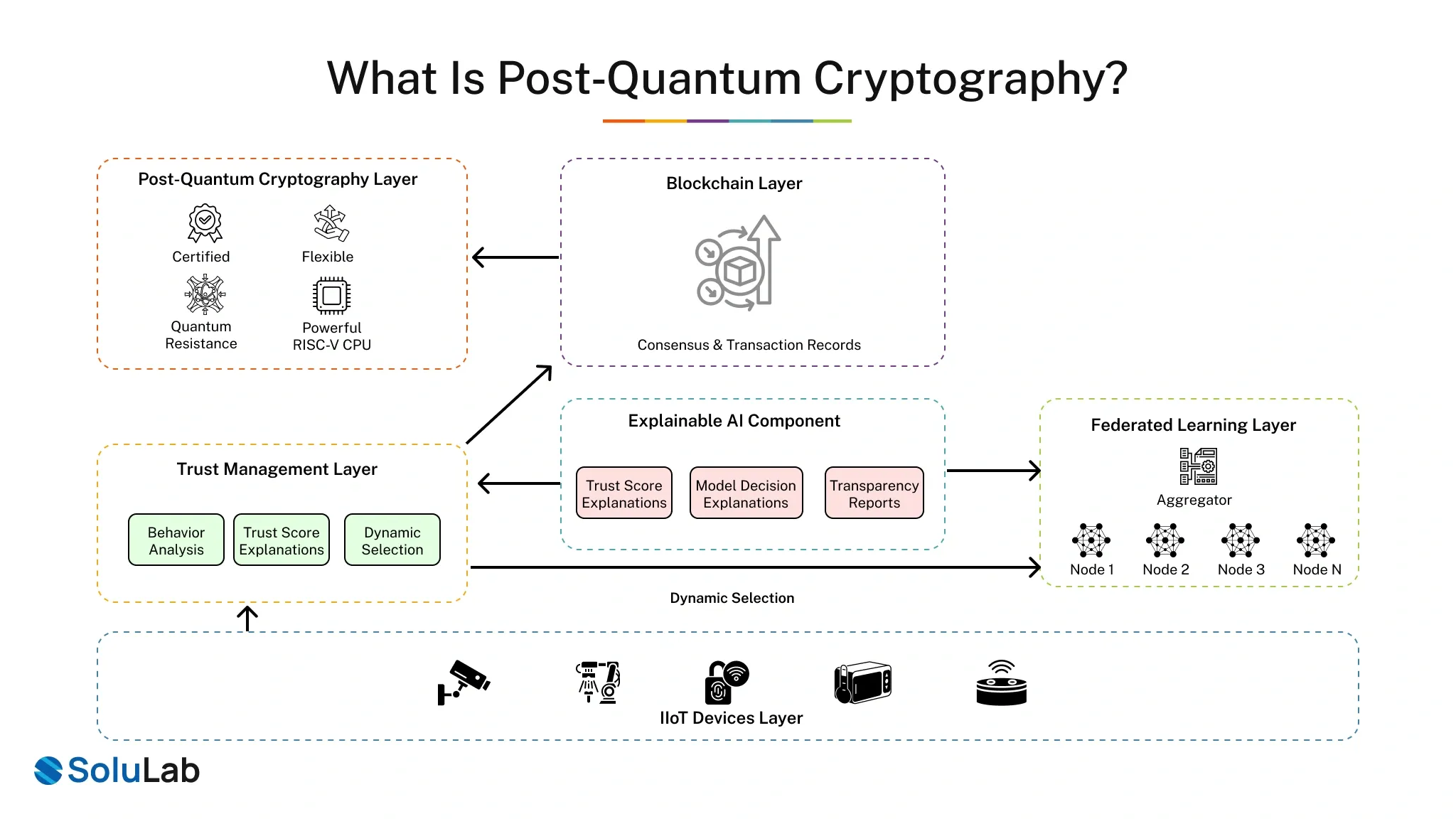
Post‑quantum cryptography is not about quantum hardware; it’s about math that stays hard even when quantum computers are running. Specifically, post‑quantum crypto and blockchain solutions are built on problems like lattice‑based cryptography, hash‑based signatures, and code‑based schemes that today’s quantum algorithms struggle to break.
NIST has already standardized the first wave of post‑quantum cryptography algorithms, including CRYSTALS‑Kyber (FIPS 203) for key‑exchange, Dilithium‑based signatures (FIPS 204), and SPHINCS+ (FIPS 205) as a hash‑based backup signature scheme.
In practice, this means enterprise quantum‑safe encryption tools that are no longer academic but part of real‑world cryptographic baselines.
For you, why post‑quantum crypto is important comes down to three words: data longevity. Your health records, contracts, financial data, and IP may need to remain confidential for 10–20 years. If they’re protected by classical RSA or ECC, a future quantum computer can crack them. That’s why post‑quantum security is a current‑risk‑mitigation priority.
PQC Algorithm Types & Their Role in Enterprise Quantum-Safe Encryption Tools
You don’t need to implement every NIST‑approved algorithm everywhere; you need a smart, layered strategy.
Here’s how decision‑makers should think about this in practice:
- Lattice‑based algorithms (e.g., Kyber, Dilithium) are excellent for enterprise quantum‑safe encryption tools, post‑quantum TLS implementation services, and hybrid post‑quantum TLS because they strike a good balance between performance and security.
- Hash‑based signatures like SPHINCS+ are ideal for long‑lived software updates, hardware‑rooted signatures, and post‑quantum secure communication solutions where you want stateless security and are less concerned about key‑size overhead.
- Code‑based schemes (e.g., HQC, BIKE) are emerging as enterprise‑ready options when you want alternative math foundations and possibly post‑quantum PKI‑like properties.
For a blockchain development company, the right blend of post‑quantum crypto and blockchain depends on whether you’re building open‑permissionless blockchains, enterprise‑consortia networks, or custody‑heavy DeFi rails.
Top 12 Advanced Security Technologies in Post‑Quantum Cryptography in 2026
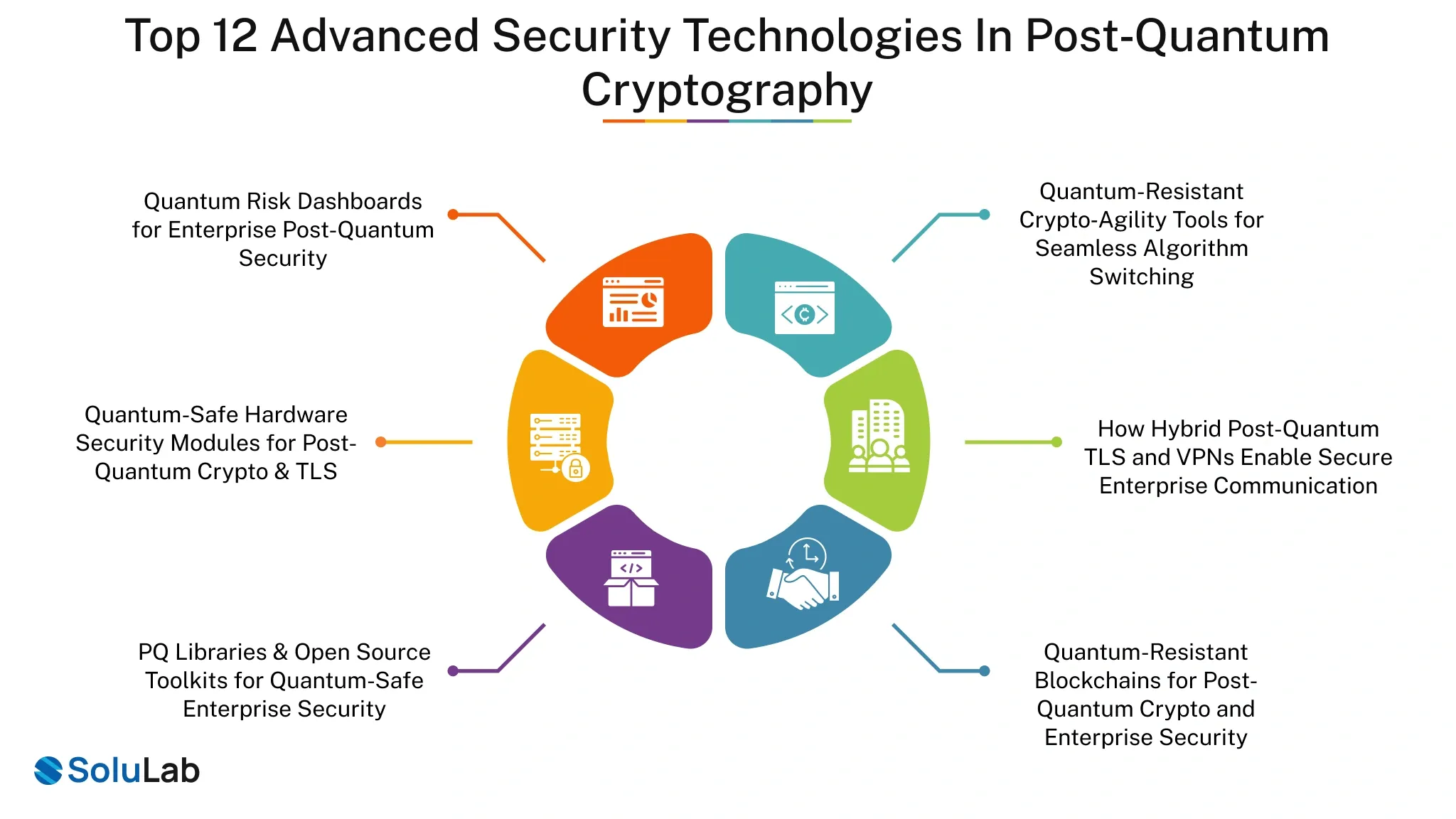
The rise of quantum computing is reshaping the security landscape, and traditional encryption methods are becoming increasingly vulnerable. Enterprises that adopt post‑quantum cryptography today are not just protecting data, they’re future‑proofing their operations against the next generation of cyber threats.
Here are top 12 advanced security technologies that will define post‑quantum resilience in 2026 and beyond.
1. Quantum Risk Dashboards for Enterprise Post-Quantum Security
Think of this as your first trip to the doctor for a full‑body scan. Instead of guessing which parts of your infrastructure are quantum‑exposed, you actually see them in a live view.
- Quantum risk dashboards are tools that scan your entire tech stack, like APIs, TLS endpoints, PKI, HSMs, cloud KMS, and embedded crypto, and map every place that still relies on RSA‑2048, ECC‑256, or other quantum‑vulnerable algorithms.
- These dashboards then overlay data‑classification, so you can see which systems protect 10–20‑year‑lived data versus short‑lived sessions.
For a blockchain company, this is also how you map chain‑level exposure: where legacy keys are still used for signing, governance, or custody.
Once you see the heat map, you can focus your post‑quantum TLS implementation services and crypto‑agility efforts on the highest‑risk paths first.
Key value:
- Avoid boiling the ocean and instead prioritize migration by exposure and business impact.
- Show auditors you’re not guessing, you’ve got a quantum‑safe security posture assessment you can talk about in concrete terms.
2. Quantum-Resistant Crypto‑Agility Tools for Seamless Algorithm Switching
Crypto‑agility is the backbone of any post‑quantum security strategy. In practice, it means you can swap out RSA for Kyber, ECDSA for Dilithium, or drop in a new lattice‑based scheme, without rewriting your entire stack.
Crypto‑agility suites usually include:
- A central cryptographic policy engine that defines which algorithms are allowed and when they must be retired.
- A key‑management layer that orchestrates HSMs, cloud KMS, and software keystores under one API.
- A stable crypto‑service gateway so applications consume crypto through a consistent interface, not via hardcoded ciphers.
For enterprise‑grade blockchain systems, this is how you turn post‑quantum crypto and blockchain into a managed, repeatable process instead of a one‑off project.
For example, a crypto‑agility platform can let you:
- Rotate from ECDSA‑based signatures to hybrid ECDSA‑Dilithium across thousands of microservices without touching every line of code.
- Enforce quantum‑safe custody wallets and post‑quantum secure communication solutions at the API layer.
This is what makes post‑quantum security affordable and scalable, it’s governance with automation, not just math.
3. Quantum-Safe Hardware Security Modules for Post-Quantum Crypto & TLS
If cryptography is the lock on your crown‑jewel data, PQ‑ready HSMs are the high‑security vault. These are FIPS‑compliant modules that now support NIST‑standardized post‑quantum algorithms like Kyber (ML‑KEM) and Dilithium alongside traditional RSA/ECC.
Modern post‑quantum hardware security vendors ship HSMs that can:
- Offload Kyber‑based key‑exchange and Dilithium‑style signatures at line rate, so you don’t kill latency.
- Inject quantum‑safe entropy via integrated QRNGs, giving you strong randomness for keys and nonces.
For enterprise‑level guardians of data (think banks, healthcare, critical infrastructure), PQ‑ready HSMs anchor:
- Master keys for entire quantum‑safe custody wallets and crypto‑exchanges.
- Post‑quantum secure communication solutions such as hybrid TLS and VPN gateways.
So, if you want enterprise quantum‑safe encryption tools that meet regulatory scrutiny, you run them on PQ‑ready HSMs.

4. How Hybrid Post-Quantum TLS and VPNs Enable Secure Enterprise Communication
Going full‑PQ‑only today is a bit like replacing every car in your fleet with a prototype EV. Possible, but risky and expensive. Hybrid post‑quantum TLS is the pragmatic approach – combine classical ECDH with a post‑quantum KEM so an attacker must break both to decrypt a session.
In practice, hybrid PQ TLS looks like:
- Client and server negotiate ECDH‑style key‑exchange with a lattice‑based KEM (e.g., ML‑KEM).
- The shared secret is derived from both components, so the handshake is safe as long as at least one holds up.
Cloud providers and payment networks are already rolling out hybrid post‑quantum TLS at the edge, so you can protect APIs, customer ingress, and internal mTLS without breaking legacy clients.
That’s why post‑quantum TLS implementation services are such a hot capability for any serious blockchain development company building secure rails for DeFi platforms, custody, and cross‑chain messaging.
For you, the takeaway is: hybrid post‑quantum TLS is the bridge from the RSA‑based world to the PQ‑native world.
5. PQ Libraries & Open Source Toolkits for Quantum-Safe Enterprise Security
At the code level, post‑quantum cryptography is nothing without PQ libraries and open source toolkits. These are the building blocks that let you drop Kyber, Dilithium, SPHINCS+ into existing stacks without reinventing the wheel.
Popular options in 2026 include:
- Open Quantum Safe (liboqs), which wraps NIST‑standardized schemes into a C library you can plug into OpenSSL‑style stacks.
- Vendor SDKs for lattice‑based KEMs/signatures that integrate with existing PKI and TLS stacks.
For hire post‑quantum cryptography developers, these libraries are the starting point for:
- Adding post‑quantum key‑exchange to existing DeFi protocols.
- Integrating post‑quantum signatures into identity systems, smart contracts, and blockchain nodes.
From our perspective, owning deep experience with PQ libraries and open source toolkits is what lets you build quantum‑resistant blockchains quickly and safely, without reinventing signatures from scratch.
6. Quantum-Resistant Blockchains for Post-Quantum Crypto and Enterprise Security
Quantum‑resistant blockchains are not a future‑research concept in 2026; they’re emerging in production. Projects like QuantumShield‑BC and academic‑grade frameworks show how you can build chains with post‑quantum signatures at the protocol layer, QKD‑secured communication, and QRNG‑powered consensus.
What makes a chain quantum‑resistant, in practice:
- Transaction signatures that use lattice‑based schemes or hash‑based SPHINCS+ instead of ECDSA.
- Consensus mechanisms that use quantum‑safe randomness (e.g., QRNG) for leader selection and validator choosing, so adversaries can’t predict the next block producer.
For enterprises, quantum‑resistant blockchains matter because:
- They protect on‑chain value (tokens, NFTs, records) for decades, not just years.
- They give you a native layer for quantum‑safe custody wallets and post‑quantum secure communication solutions without relying on bolt‑on external tools.
As a blockchain consulting company, designing and launching a quantum‑resistant blockchain is a positioning move: it shows you’re ahead of the curve, not following the herd.
7. PQ‑Optimized Wallets & Quantum-Safe Custody Solutions for Enterprises
Every NFT, every token, every yield position lives on a wallet key. If that key is ECDSA‑based, it’s sitting on a quantum‑crackable target list. That’s why PQ‑optimized wallets and custody solutions are now a core part of any quantum‑safe security solutions for enterprises.
Today’s serious quantum‑safe custody wallets implement:
- Post‑quantum signatures for transactions (e.g., SLH‑DSA / SPHINCS+).
- Post‑quantum backup encryption for recovery phrases (e.g., ML‑KEM).
For institutional treasuries and exchanges, PQ‑optimized custody means:
- Hybrid schemes where some signatures are classical, and others are post‑quantum, so you don’t break compatibility overnight.
- Hardware‑rooted security (e.g., secure elements or HSMs) that enforce automated key rotation and tamper‑proof signing.
For you, this is a revenue‑rich vertical – designing and auditing (custody‑first product lines that appeal to hedge funds, VCs, and enterprise treasuries.
8. Automated Post-Quantum Key Rotation for Enterprise Security
Manual key‑management is error‑prone. In a post‑quantum security world, automated PQ key rotation and lifecycle management is non‑negotiable.
Modern platforms do this by:
- Scheduling key‑rotation based on time, event, or regulatory trigger.
- Tracking key‑use, algorithm‑age, and crypto‑policy across the enterprise via a centralized key‑management engine.
For you, the business value is simple:
- You reduce the window of exposure for every key, which directly lowers the risk of Harvest Now, Decrypt Later attacks.
- You can prove compliance with crypto‑transition timelines because you have audit trails for every rotation and decommission.
From a Quantum-resistant blockchains company, integrating automated PQ key rotation into your quantum‑resistant blockchains and custody stacks is how you build operational resilience that doesn’t rely on heroic human operators.
9. How QRNG Powers Quantum-Resistant Blockchains and Post-Quantum Crypto
A quantum‑random number generator (QRNG) is exactly what it sounds like – a source of randomness that’s rooted in quantum physics, not algorithms.
In 2026, enterprise quantum‑safe encryption tools are starting to rely on QRNGs for:
- Generating long‑lived master keys for HSMs.
- Creating ephemeral session keys for TLS and VPNs.
Why this matters for post‑quantum security:
- Even if your PQ‑based algorithms are mathematically sound, weak randomness can break the whole system.
- QRNGs give you a measurable advantage in entropy quality, which is critical for post‑quantum hardware security and blockchain consensus.
For you, this is especially relevant when designing quantum‑enhanced consensus protocols that rely on unpredictable leader selection and validator randomness.
10. Hybrid Multi‑Sig Security Schemes for Quantum-Safe Enterprise Security
In blockchain and enterprise environments, multi‑signature schemes are already common. The hybrid multi‑sig evolution is where you mix classical signatures with post‑quantum signatures, so an attacker must break both.
Examples in practice:
- A 2‑of‑3 multi‑sig that requires 2 ECDSA signatures with 1 Dilithium signature.
- A governance key for a DAO that needs 3 classical votes plus 1 PQ‑based vote to execute a high‑risk change.
For enterprise treasuries and protocol teams, this is a way to:
- Keep existing tooling and ecosystem compatibility while gradually upgrading to post‑quantum security.
- Reduce the risk of a single PQ‑implementation bug or standard‑change from breaking the whole system.
As a crypto wallet development company, offering hybrid multi‑sig security schemes is a strong differentiator when you’re negotiating with regulated institutions that want to move slowly but still reduce quantum‑risk.
11. Hybrid Post-Quantum TLS and Enterprise PKI Implementation
Post‑quantum PKI is the logical extension of all this work: it replaces or augments your RSA‑ and ECC‑based certificate chains with PQ‑ready or hybrid ones.
In practice, 2026 is the year when:
- Dual‑stack certificate infrastructures issue test intermediates for Kyber‑based and Dilithium‑based certificates.
- Enterprises start phasing out ECC‑only certs for long‑lived workloads and customer‑facing surfaces.
So, post‑quantum PKI is what makes your hybrid post‑quantum TLS real:
- Without PQ‑ready PKI, your TLS handshakes are still anchored in quantum‑vulnerable certificates.
- With it, you can build end‑to‑end post‑quantum‑ready communication across APIs, internal services, and external partners.
This is how you connect enterprise‑level blockchain identity systems to quantum‑resistant solutions without trust gaps.
12. Quantum-Safe Auditing Services to Strengthen Enterprise Crypto & Blockchain
Finally, post‑quantum security is meaningless without governance and auditability. That’s where specialized PQ auditing and compliance services come in.
These services typically include:
- PQ‑risk assessments that map your crypto‑exposure and key‑lifetimes.
- Gap‑analysis against NIST, ENISA, and national‑level timelines (e.g., India’s 2026–2035 quantum‑safe migration plan).
From a CISO or compliance standpoint, this is how you:
- Turn quantum‑safe security from a technical initiative into a board‑reportable risk‑mitigation program.
- Prepare for regulatory expectations around post‑quantum cryptography and crypto‑agility.
This is where you turn quantum‑safe security solutions for enterprises from a technical initiative into a board‑reportable, risk‑managed program.
How Enterprises Are Embracing Quantum-Safe Security Solutions?
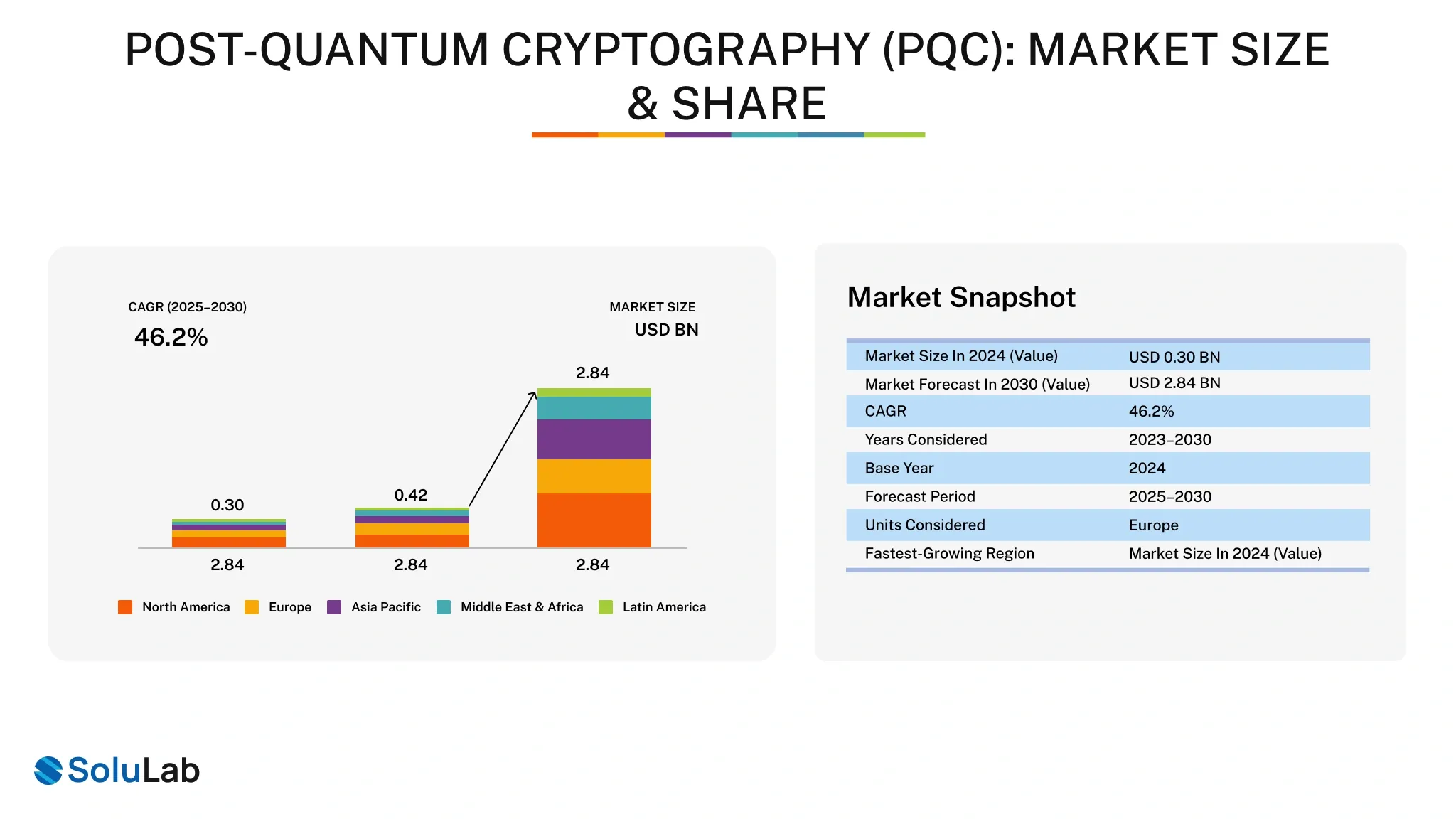
Across financial services, defense, telecom, and critical infrastructure, the trend is clear: early movers are already launching PQC‑migration pilots, while latecomers risk being left behind.
Examples:
- India’s national quantum‑safe plan proposes a structured migration for critical systems by 2028–2035, with a strong emphasis on crypto‑agility and early vendor‑selection.
- EU’s DORA and similar regulations are pushing quantum‑safe infrastructure into the compliance stack for financial institutions.
So, the signal is straightforward – post‑quantum security is not a fire‑drill‑on‑the‑day‑it‑happens game. It’s a multi‑year investment that starts today.
Conclusion
If you’re running an enterprise or a growth‑stage startup, you’re going to need quantum‑safe security solutions, post‑quantum TLS implementation services, and quantum‑safe custody wallets as part of your core architecture.
That’s where a mature crypto development company like SoluLab comes in. Whether you want to hire post‑quantum cryptography developers or integrate hybrid post‑quantum TLS, the key is to start with a pragmatic, risk‑based roadmap, not a giant unmanageable rewrite.
The choice is yours.
FAQs
With over 3 years of experience, I specialize in breaking down complex Web3 and crypto concepts into clear, actionable content. From deep-dive technical explainers to project documentation, I help brands educate and engage their audience through well-researched, developer-friendly writing.