Enterprises are racing to adopt AI, yet many complex problems still overwhelm classical computing systems. Optimization, drug discovery, financial modeling, and large-scale simulations demand computational power far beyond today’s infrastructure.
Analysts estimate quantum technology could generate up to $2 trillion in value for businesses by 2035, particularly in finance, chemicals, and life sciences.
However, the road to enterprise adoption is not straightforward. High infrastructure costs, limited quantum hardware, and skills shortages remain major barriers.
As 2026 approaches, enterprises must evaluate both the opportunities and constraints of Quantum AI to determine where real value lies and how to prepare for this next computing revolution.
Key Takeaways
- The Problem: Classical computing is not the best at solving complex optimization, simulation, and data analysis problems, so enterprises face constraints in the adoption of emerging quantum AI technologies due to inadequate quantum expertise and infrastructure.
- The Solution: Quantum AI is an intervention of quantum computing and advanced machine learning that is aimed at solving high-complexity enterprise problems, which can accelerate models, make more accurate predictions, and open up new opportunities in finance, logistics, healthcare, and cybersecurity.
- How SoluLab Helps: SoluLab assists organizations in the exploration, prototype, and production of quantum AI use cases through the development of hybrid AI-quantum architectures, finding business-ready applications, and supporting organizations on the path of scaled enterprise adoption.
What Is Quantum AI?
Quantum AI refers to the integration of quantum computing technologies with artificial intelligence. Quantum computers operate on the principle of quantum mechanics, leveraging phenomena like superposition and entanglement to perform calculations at speeds unattainable by traditional computers.
For enterprises, Quantum AI has potential applications in areas such as financial modeling, drug discovery, logistics optimization, climate modeling, cybersecurity, and advanced simulations.
Why Are Businesses Moving Toward Quantum-AI?
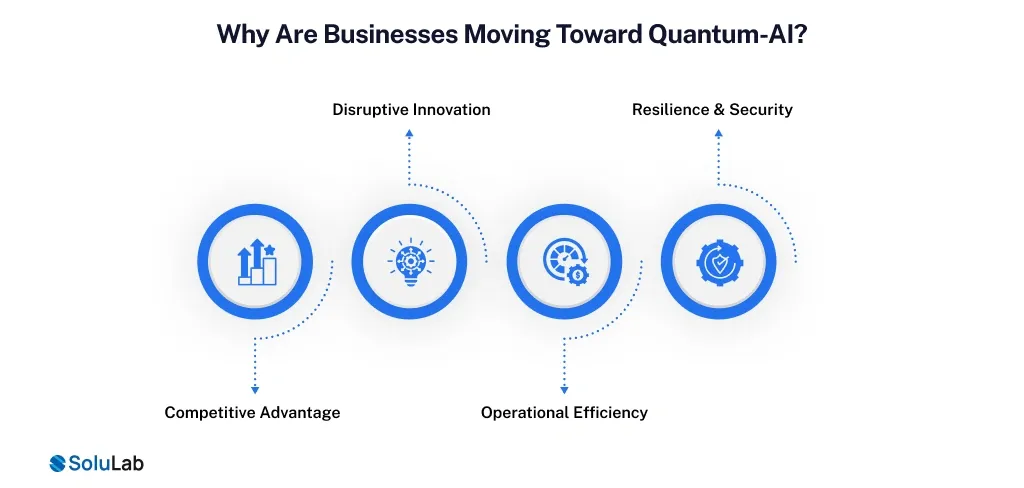
To address complex problems more quickly, operate less frictionally, and to develop new innovation opportunities, businesses are considering investing in Quantum computing across industries using emerging Enterprise quantum AI solutions.
- Competitive Advantage: In the early adoption of quantum-AI, companies have improved optimization rate, predictive knowledge, and strategic decision-making capabilities that lead to their competitive advantage in finance, logistics, pharmaceutical, and other industries that rely on complex data.
- Disruptive Innovation: Quantum-AI makes possible breakthroughs that traditional computing has problems with, such as molecular simulation, portfolio optimization, and complex modeling, which enables businesses to create new products, services, and business models entirely.
- Operational Efficiency: Quantum-AI is capable of working with large datasets and solving optimization problems within a few seconds to assist businesses with supply chain optimization, decreasing energy use, optimizing routing, and automating complex decision-making.
- Resilience & Security: As cyber risks and data complexity increase, quantum-AI can assist businesses to make their cryptographic frameworks more robust, find anomalies quicker, and create more resilient frameworks that can manage security issues in the next generation.
Key Opportunities of Quantum AI for Enterprises
Quantum computing and AI use cases are revealing new opportunities to businesses. Ranging from accelerated optimization to greater data understanding, Quantum AI is slowly defining how organizations are going to address complicated business issues.
1. Advanced Data Optimization
Quantum AI is capable of analyzing very complex data and variables at the same time, making enterprises resolve logistics, scheduling, and supply chain optimization challenges far more quickly in comparison with traditional AI systems.
2. Drug Discovery and Research
Quantum computing has the ability to model molecular interactions faster than ever before. In addition to this, AI development solutions for healthcare and biotech enterprises can save much time on drug discovery and material research.
3. Portfolio Optimization and Financial Risk Modeling
Quantum AI enterprise opportunities can allow financial institutions to work with large financial data volumes, enhance risk simulation, anomalies, and investment portfolio optimization with greater precision.
4. Quicker Training of Machine Learning
The Enterprise can use Quantum machine learning to train models and recognize patterns faster, providing faster insights to fight fraud, customer analytics, predictive maintenance, and enterprise decision-making.
5. Complex Supply Chain and Logistics Planning
Quantum AI will allow organizations to consider millions of combinations of supply chain options at the same time, allowing organizations to decrease operational expenses, enhance supply chain efficiency, and streamline international logistics systems.
Quantum AI vs Classical AI
Quantum AI harnesses quantum bits (qubits) for parallel processing and superposition, revolutionizing computation beyond classical AI’s binary limits. This fusion promises exponential speedups in optimization, machine learning, and simulation tasks unsolvable by traditional systems.
| Aspect | Classical AI | Quantum AI |
| Processing | Sequential or parallel on CPUs/GPUs | Massive parallelism via quantum entanglement |
| Speed for Complex Problems | Polynomial time; scales linearly | Exponential speedup (e.g., Grover’s algorithm) |
| Key Strength | Mature tools, vast datasets, reliable | Optimization, factoring, quantum simulations |
| Limitations | Struggles with NP-hard problems | Noisy hardware, error-prone, early-stage tech |
| Real-World Use | Chatbots, image recognition, NLP | Drug discovery, finance modeling (e.g., IBM Q) |
| Current Status | Widespread, production-ready | Experimental (e.g., Google Sycamore supremacy) |
Business Applications of Quantum AI
Along with the convergence of quantum algorithms and AI, businesses are considering Quantum computing in business to enable faster business decisions, enhanced analytics, and capabilities in the formation of Enterprise AI innovation 2026 across key industries.
- Healthcare: Quantum artificial intelligence can speed up the process of drug development, model molecules, and enhance more accurate diagnostics. Advanced predictive modeling can also be used to help hospitals optimize treatment planning and clinical trial analysis.
- Cybersecurity: Quantum AI assists companies in faster threat identification after the complex patterns are analyzed on large-scale datasets. It also allows more powerful encryption models and post-quantum security models that are resistant to cyber attacks of the next generation.
- Finance: Quantum AI can help financial institutions to optimize their portfolio, detect fraud, and perceive risk in a short period of time. Such systems consider an enormous number of market situations at a time to enhance investment plans and trading choices.
- Energy: The quantum AI has the potential to improve the optimization of power grids, predict energy demand, and speed up battery research. These models are applied in the energy systems of energy companies to model complex energy systems and minimize operational inefficiencies.
- Manufacturing: Manufacturers are using Quantum AI to streamline the supply chain, develop new materials, and forecast equipment breakdown. The result is smarter production planning, fewer downtimes, and a speedy process of innovation.
- Logistics: Quantum AI applies to logistics companies to address the difficult problems of route optimization and fleet management. It does the analysis of millions of variables in order to minimize delivery time, fuel consumption, and operational costs.
How to Prepare Your Business for the Quantum Era?
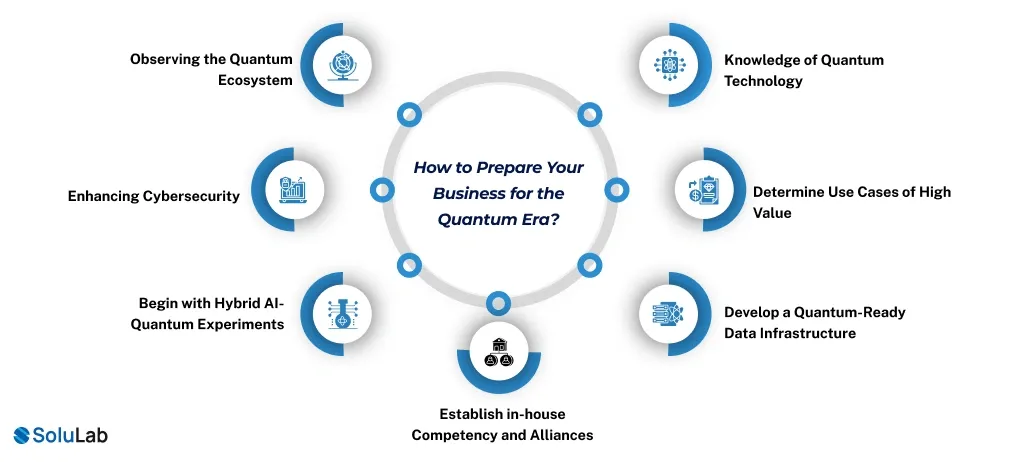
The field of quantum computing is no longer a laboratory project but a technology in actual business. Those organizations planning ahead will obtain rapid knowledge, enhanced safety, and competitive advantage since the quantum age redefines the technology of the enterprise.
1. Knowledge of Quantum Technology: Begin with training leadership and technical teams on concepts of quantum computing, its projects, and constraints in the industry. The knowledge of possible applications can enable businesses to determine in which areas quantum capabilities can generate practical operational benefits.
2. Determine Use Cases of High Value: Examine complicated problems in which classical systems fail, like optimization, logistics, drug discovery, and financial modeling or risk analysis. Such spheres are the ones that will be the most advantageous in terms of deploying AI solutions to enterprises.
3. Develop a Quantum-Ready Data Infrastructure: Quantum systems are dependent on well-organized, quality datasets. Businesses were expected to upgrade their data structure, move on to a scalable cloud system, and be ready to create datasets that could assist in hybrid classical-quantum procedures.
4. Establish in-house Competency and Alliances: The expertise in quantum is still uncommon. To hasten the learning process and practical experimentation, organizations need to train the existing engineers, cooperate with the universities, and collaborate with specialized technology companies.
5. Begin with Hybrid AI-Quantum Experiments: The initial deployments of classical AI with quantum computing will be in most real-world scenarios. Pilot projects enable businesses to experiment with Enterprise-level quantum AI implementation and reduce risk, and demonstrate quantifiable business results.
6. Enhancing Cybersecurity: Many of the conventional encryption standards will be broken by quantum computers. Companies are advised to start adopting post-quantum cryptography in order to protect sensitive enterprise and customer information in the long run.
7. Observing the Quantum Ecosystem: The quantum hardware, quantum algorithms, and AI software models are changing rapidly. The companies ought to regularly assess the progress made by research institutions, technology suppliers, and other companies in the global technological arena so that they can modify their strategy.
Future of Quantum AI for Enterprises
Quantum AI is steadily moving from theoretical labs to enterprise experimentation, promising faster optimization, smarter decision models, and breakthroughs in data processing that classical AI systems struggle to achieve efficiently.
1. Quantum-Enhanced Optimization: Quantum AI would significantly benefit difficult optimization problems, such as logistics routes, portfolio allocation, and supply chain design. Quantum algorithms can help enterprises solve problems on a large scale, in seconds, rather than in hours.
2. Accelerated Drug Discovery and Scientific Research: In quantum computing with AI, pharmaceutical and biotech companies will be able to perform molecular interactions much more accurately. This may shorten drug discovery, decrease research expenses, and speed up breakthrough treatments.
3. Next-Generation Cybersecurity: The next generation of cybersecurity is quantum AI that can transform the way cybersecurity is approached by providing advanced cryptography, anomaly detection, and predictive threat analysis. Businesses are able to detect advanced cyber attacks at earlier points and enhance security infrastructures to counter any new quantum attacks.
4. financial risk modeling: Quantum AI can be useful in financial risk modeling and market simulation to simulate thousands of market scenarios at the same time by using Quantum AI. This assists in enhancing the risk modeling of portfolios, pricing derivatives, and detecting fraud with enhanced predictive accuracy.
5. Climate and Energy Modeling Breakthroughs: The application of Quantum AI in climate modeling, energy grids, material science, and many more can assist energy companies and governments in addressing these issues. Such lessons can speed up the innovation of clean energy and the sustainable planning of infrastructure.
Conclusion
Quantum AI is slowly removing the experimental research and moving to practical enterprise exploration. Although the technology has the potential to transform the areas of optimization, financial modeling, cybersecurity, and science discovery, organizations have to deal with hardware constraints, high prices, and changing infrastructure.
Companies that begin learning, experimenting, and developing quantum-ready strategies now will be in a better position as the ecosystem evolves.
If you are exploring this space, SoluLab, an Enterprise AI Development Company, can help your business evaluate opportunities and build practical quantum-ready solutions.
FAQs
Neha is a curious content writer with a knack for breaking down complex technologies into meaningful, reader-friendly insights. With experience in blockchain, digital assets, and enterprise tech, she focuses on creating content that informs, connects, and supports strategic decision-making.