Key Takeaways
- The issue: Billions of on-chain value are processed through Web3 applications daily, but the majority of them do not have dynamic audits and rule-based notifications. The exploits of flash loans, bridge attacks, and manipulation of smart contracts go unnoticed by manual detection systems before they expand exponentially.
- The fix: The fix is to use AI-based threat monitoring that consists of real-time blockchain data feeding, anomaly detection models, wallet behavior analytics, and automated response triggers. This will enhance the security of Web3 since the suspicious pattern of transactions is realized in advance, which prevents significant financial harm.
- How SoluLab Helps: SoluLab designs AI-powered Web3 security architectures that integrate on-chain analytics, anomaly detection models, compliance automation, and real-time alert systems.
According to industry reports, 760+ on-chain security incidents in 2024 led to roughly $2.36 billion in stolen funds, marking a 31% increase year-over-year.
The use of Web3 applications is expanding rapidly, along with exploits. Flash loan attacks on smart contract vulnerabilities result in the loss of millions of funds in a few minutes.
Conventional security solutions find it difficult to trace decentralized and real-time blockchain networks where transactions are immutable, and attackers develop rapidly.
Cybersecurity through AI and blockchain analytics is the way out. With the implementation of an advanced AI fraud detection system as part of AI Web3 security solutions, projects are able to identify anomalies early on, automatically respond, and mitigate financial and reputational risk to a large degree.
Why Web3 Applications Need AI-Based Threat Monitoring?
Web3 apps handle billions of permissionless digital assets, which are perfect targets of automated exploits that can operate more quickly than humans. Threat monitoring AI delivers real-time intelligence, whereby general audits are not sufficient.
- Expansion of On-Chain Financial Value: Billions are transferred in the DeFi protocols and bridges daily. During peak cycles, the platform value locked has surpassed tens of billions of dollars, which raises incentives to attack and exposures to systemic risk.
- Smart Contract Vulnerabilities: Attacks learned contracts may have logic errors or upgrade risks even when they are audited. Smart contract audits are not sufficient to thwart runtime abuse, and the Poly Network exploit could be used to expose more than 600 million dollars worth of contracts due to failures in contract validation.
- Flash Loan Attacks: Flash loans enable the possibility to lend out millions of dollars without collateral in a single transaction. The Euler Finance exploit cost almost the whole of its funds in a few minutes, which demonstrates the need to implement AI to identify irregular transaction sequencing immediately.
- MEV Exploitation: MEV bots scan through mempools to front-run or sandwich orders. On blockchains such as Ethereum, MEV has been extracted, making hundreds of millions of dollars, at the expense of ordinary users, by manipulating prices.
- Rug Pulls and Governance Attacks: The malicious teams use their concentration of tokens to drain the liquidity or alter the voting in the DAO. The Ronin Network bridge breach has exposed the key governance vulnerabilities, showing why there is a need to monitor behavioral AI outside rule-based systems.
Core Components of an AI-Based Threat Monitoring Architecture
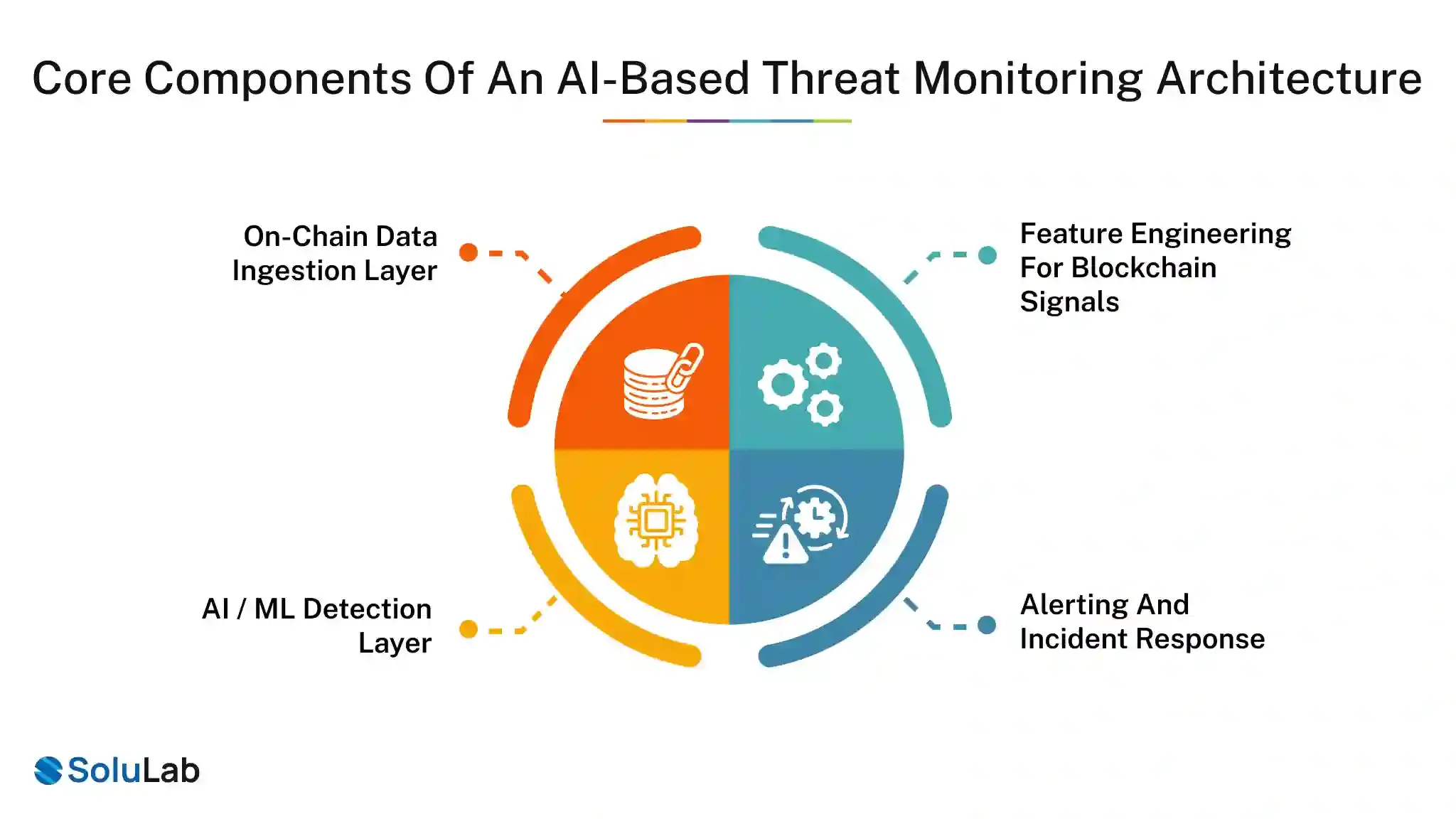
Modern Web3 security demands real-time intelligence that moves as fast as on-chain transactions, combining AI, behavioral analytics, and automated controls to detect, assess, and neutralize threats before funds are drained.
1. On-Chain Data Ingestion Layer
- Full node and RPC integration
Connect directly to blockchain nodes or managed RPC providers to stream live transaction data. Ethereum alone processes over 1 million daily transactions, making real-time ingestion critical for threat visibility. - Mempool monitoring
Scanning pending transactions helps detect flash loan attacks before confirmation. Many exploits, including the Euler Finance attack, were executed within minutes, proving pre-block monitoring is essential. - Cross-chain data aggregation
Bridges and multi-chain apps expand attack surfaces. The Ronin Network breach exposed over $600M, highlighting why ingestion must include cross-chain transaction feeds. - Event indexing and smart contract logs
Tools like The Graph structure contract events into queryable datasets, enabling faster anomaly detection across token transfers, governance proposals, and liquidity pool changes.
2. Feature Engineering for Blockchain Signals
- Wallet behavior profiling
Cluster wallets by transaction frequency, token diversity, and counterparties. Suspicious wallets often show burst activity patterns before exploits, especially in rug pulls and governance attacks. - Transaction graph modeling
Graph analytics maps fund flows across addresses. Platforms like Chainalysis use graph clustering to uncover laundering networks moving millions through layered transfers. - Liquidity movement indicators
Sudden liquidity withdrawals exceeding historical averages can signal exploit attempts. DeFi hacks frequently involve abnormal liquidity shifts within 5–10 block windows. - Smart contract interaction sequencing
Track function call order patterns. Flash loan exploits often repeat specific call chains across smart contracts, allowing AI systems to flag deviations from normal execution behavior.
3. AI / ML Detection Layer
- Supervised fraud classification models
Train models using labeled exploit data from incidents like Poly Network. Classification algorithms can identify known exploit signatures with high precision. - Unsupervised anomaly detection
Autoencoders and isolation forests detect unknown threats by flagging deviations from baseline transaction behavior. This is vital since over 60 percent of new exploits use novel attack vectors. - Graph neural networks (GNNs)
GNNs analyze wallet interaction structures rather than individual transactions, improving detection accuracy for coordinated Sybil attacks in DAO governance. - Adaptive model retraining
Threat actors evolve quickly. Continuous retraining using fresh on-chain data reduces model drift and improves detection reliability over time.
4. Alerting and Incident Response
- Real-time risk scoring
Assign dynamic threat scores to transactions or wallets. High-risk scores can trigger automatic safeguards before fund transfers finalize. - Automated smart contract controls
Protocols can integrate pause functions or circuit breakers. Rapid response mechanisms help limit damage during high-volume exploits. - Security dashboard and SOC integration
Alerts should integrate into SIEM systems and dashboards, enabling human review. AI reduces noise, prioritizing high-confidence threats. - Audit logging and compliance trails
Maintain structured logs for investigations and regulatory reporting. Transparent audit trails strengthen trust, especially for institutional-grade DeFi platforms.
Step-by-Step Implementation Framework
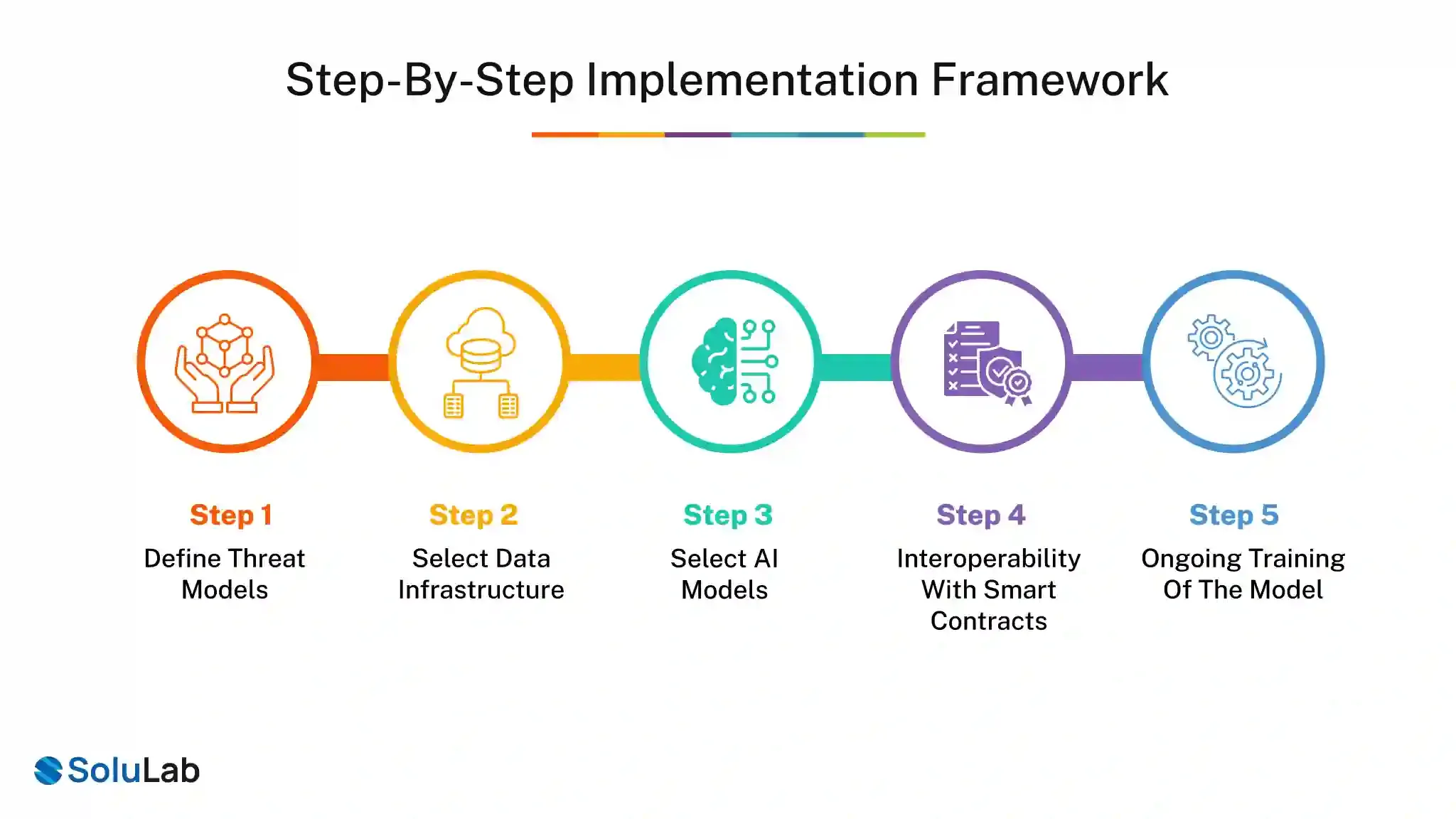
Web3 applications transfer billions of dollars every day, which are ideal targets of automated exploits. The application of an AI-powered threat monitoring must be structured in a layered manner, integrating security engineering, blockchain intelligence, and dynamic machine learning.
Step 1: Define Threat Models
Begin by mapping protocol-specific threats, including flash loan exploits, governance manipulation, bridge vulnerabilities, and smart contract reentrants. During 2023, more than 1.8 billion dollars were lost in several DeFi exploits. Identify attack surfaces, transaction patterns, and adversary patterns and construct detection systems.
Step 2: Select Data Infrastructure
Configure real-time blockchain data ingestion by full nodes, archive nodes, or controlled RPC providers. Check mempool activity and index transactions with tools such as The Graph. Scalable streaming pipelines and warehousing to perform behavioral analysis are demanded by high-frequency protocols that have thousands of transactions per minute.
Step 3: Select AI Models
Supervised models are to be used on known exploit signatures, whereas the unknown threats are to be detected through unsupervised anomaly detection. Graph neural networks can be used to identify coordinated wallet behavior, and classification models can identify suspicious call of the contract. Chainalysis and other blockchain analytics companies have been utilizing AI-based clustering to track illegal money flows.
Step 4: Interoperability with Smart Contracts
Connect monitoring outputs to on-chain protective measures, e.g., pause mechanisms, multisig authorizations, or automated risk scoring. An example is that, following the Ronin Network bridge hack, most protocols added real-time withdrawal limits and emergency response signals to minimize the exposure of systems to active attacks.
Step 5: Ongoing Training of the Model
Patterns of threats change rapidly. Different retraining models on new datasets of exploits, adversarial models, and red-team testing. Large exploits such as the Poly Network exploit demonstrated that attackers evolve quickly, and continuous learning will be needed to mitigate false negatives and increase detection accuracy with time.
Regulatory and Compliance Considerations
High-quality Web3 security does not simply involve identifying threats, but also aligning the use of AI-driven monitoring systems with the changing regulatory and compliance structures across the world that control digital assets and blockchain-based banking and financial services.
- Compliance and Regulatory: Chainalysis reported in 2023 that there were over $ 24 billion of illegal crypto transactions in the world. An AI-powered surveillance is useful in identifying suspicious wallet clusters, layering, mixers, and suspicious liquidity flows to enforce AML compliance in DeFi protocols and exchanges.
- Implications of the FATF: The Financial Action Task Force mandates the Virtual Asset Service Providers to disclose the sender and the beneficiary information of the transfer exceeding regulatory limits. The Web3 applications use AI algorithms to screen transactions, identify non-compliant transactions, and trace cross-border flows, minimizing regulatory exposure.
- Jurisdiction-Based Compliance: There are numerous Crypto regulations in the EU, the US, the UAE, and Singapore. Dynamic application of region-based compliance rules, sanction lists, and reporting standards by AI engines can ensure that smart contracts and wallets work with local regulatory restrictions and expand to a worldwide level.
- Audit Logs to Regulators: Regulators are now demanding live audit trails of high-value transactions. AI-controlled applications produce tamper-proof records of flagged transactions, risk scores, and wallet interactions. These systematic logs will make it easier to report to the regulators as well as enhance transparency in investigations or financial audits.
Conclusion
Make sure that in your next blockchain projects can no longer avoid the implementation of AI-based threat monitoring in Web3 Applications. With the growth of DeFi protocols, tokenization platforms, and the digital asset ecosystems, so do the attackers.
Monitoring based on AI allows detecting anomalies in real time, behavioral analysis, and automated response systems, which exceed stationary auditing.
Through the integration of data pipelines, smart models, and reporting that meets compliance, the organizations can minimize risks of exploits and create user trust.
It also takes the right approach with the help of professionals in AI Development Services to create scalable and adaptive security systems that are adjusted to new threats and regulatory requirements in the global Web3 markets.
SoluLab, a Web3 development company, can help you integrate AI-based threat detection, real-time blockchain analytics, and smart contract risk monitoring to protect user funds and protocol integrity from day one.
FAQs
Neha is a curious content writer with a knack for breaking down complex technologies into meaningful, reader-friendly insights. With experience in blockchain, digital assets, and enterprise tech, she focuses on creating content that informs, connects, and supports strategic decision-making.