Businesses today face structural limits that slow growth and capital access:
• Ownership structures are difficult to fractionalize
• Revenue sharing across stakeholders is complex
• Global participation in investment is restricted
Therefore, Business model tokenization solves these gaps.
Large financial institutions are already piloting asset tokenization for funds and on-chain settlements. Technology firms are integrating blockchain into supply chains and digital identity systems.
Hence, the conversation has now shifted from “Why tokenize?” to “What should we tokenize, and how to ensure you are 100% building a valid tokenized business model?”
Key Takeaways
- Global markets now demand real-time liquidity and fractional ownership via regulated, high-performance blockchain-based digital assets.
- Enterprises must transition from experimental pilots to hybrid architectures that balance public transparency with institutional privacy.
- Success requires modular platforms with programmable compliance and AI-driven risk management to ensure long-term ecosystem scalability.
What Does It Mean to Tokenize a Business Model in 2026?
Tokenization is best understood as the digitization of rights, not just assets.
A token can represent:
- Ownership rights
- Access rights
- Revenue participation rights
- Governance rights
- Usage permissions
Instead of relying on contracts stored in internal systems, these rights are encoded into smart contracts on blockchain infrastructure. The result is programmable, transferable, and verifiable value.
1. From Asset Representation to Rights Engineering
Earlier, tokenization focused mainly on real-world assets like real estate or commodities. In 2026, the focus has expanded to:
- Revenue share tokenization
- Membership and loyalty tokenization
- Access control tokenization
- Decentralized governance models
- Tokenized intellectual property
A token does nothing by itself. Its value comes from the rules written into it. Those rules define who can transfer it, how it generates income, whether it grants voting power, and how it interacts with other systems.
2. Semi-Decentralized vs Fully Decentralized Models
There are two practical models:
a. Semi-decentralized model:
A traditional company tokenizes part of its operations. For example:
- Issuing a security token to fractionalize ownership.
- Issuing a utility token to access platform services.
Tokenizing booking rights in a rental business.
The company still manages core operations but distributes certain rights on-chain.
b. Fully decentralized model:
The infrastructure is decentralized, and governance gradually shifts to token holders. The founding entity may hold tokens, but does not control everything. Over time, governance resembles a public market structure.
For enterprises, semi-decentralization is currently the more realistic and lower-risk entry point.
Which Parts of a Business Model Can Be Tokenized, and When Should You Consider It?
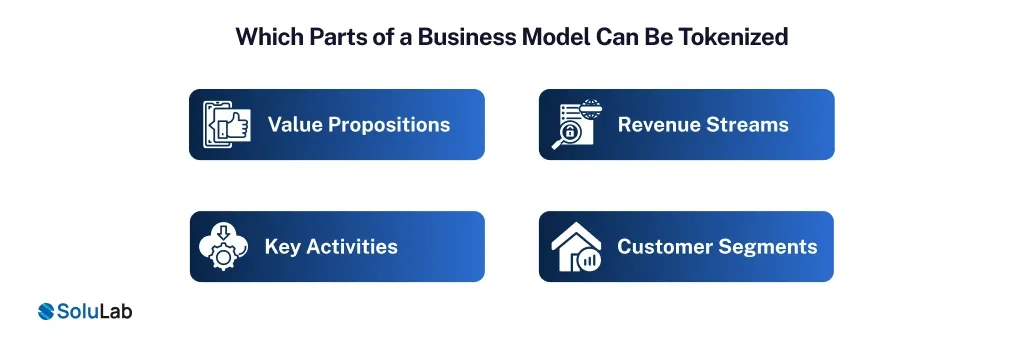
Not every business needs tokenization. The key is identifying which parts of your Business Model Canvas can benefit from decentralization and programmability.
1. Value Propositions
Ask yourself:
- Can your core offering be digitized?
- Can rights linked to your service be represented as programmable tokens?
- Would customers benefit from tradable access?
Examples:
- Event tickets that unlock partner discounts.
- Tokenized booking rights in hospitality.
- Digital access passes for B2B SaaS platforms.
If your value can be digitized or asset-backed, tokenization becomes viable.
2. Revenue Streams
Revenue streams are one of the most powerful areas for RWA tokenization.
You can tokenize:
- Revenue-sharing rights.
- Subscription credits.
- Usage-based consumption units.
- Network participation rewards.
This allows:
- Flexible pricing models.
- Secondary market liquidity.
- Automated profit distribution.
However, if token holders expect profits to be generated mainly from the company’s efforts, the token may be classified as a security. That changes regulatory requirements.
3. Key Activities
If your key activities can be:
- Digitized
- Verified digitally
- Executed across multiple nodes
Then decentralization adds value.
For example:
- Storage provisioning
- Data validation
- Transaction processing
- Content curation
If your core business is heavily physical and centralized with no digital auditability, tokenization may add complexity without benefits.
4. Customer Segments
Tokenization works best when:
- Customers are digitally native.
- They understand wallets and digital assets.
- They value liquidity and flexibility.
Enterprise clients may benefit from tokenized supply chain rights, settlement automation, or programmable compliance tokens.
When Should You Consider Tokenization?
Consider it when you:
- Need global liquidity.
- Want 24/7 market accessibility.
- Want to reduce intermediaries.
- Require shared state across multiple participants.
- Make automated, transparent auditing.
- Need incentive alignment among ecosystem participants.
If these conditions are absent, tokenization may not justify the cost.
What Are the Main Advantages of Tokenization for Businesses and Investors?
Tokenization provides measurable enterprise benefits when implemented correctly.
1. Liquidity and Market Access
Tokenization enables:
- Fractional ownership.
- Borderless investor pools.
- 24/7 secondary trading.
- Faster settlement cycles.
For businesses, this means:
- Lower capital barriers.
- Increased valuation potential.
- Better exit flexibility.
For investors, it means:
- Easier entry.
- Reduced lock-in periods.
- Transparent asset tracking.
2. Operational Efficiency
Smart contracts automate processes such as:
- Dividend distribution.
- Revenue sharing.
- Access validation.
- Reward distribution.
This reduces:
- Brokerage costs.
- Manual compliance overhead.
- Settlement delays.
In enterprise environments, even a 10–20% reduction in operational friction can significantly impact margins.
3. Transparency and Auditability
Blockchain-based token systems provide:
- Immutable transaction logs.
- Public or permissioned audit trails.
- Reduced reconciliation errors.
This is valuable in regulated sectors like finance, healthcare, and supply chain management.
4. Incentive Alignment
Token models allow:
- Incentives for early adopters.
- Rewards for service providers.
- Governance participation.
This is particularly useful in platform-based businesses where network effects matter.
5. Integration and Interoperability
A token acts like an open API. It can integrate with:
- Wallets
- Exchanges
- Partner platforms
- Payment systems
This enables cross-system compatibility at lower integration costs. For enterprises, this creates ecosystem expansion without rebuilding infrastructure from scratch.
How Do Security Tokens (STOs) and Utility Tokens (ICOs) Differ in Business Use?
Understanding this difference is critical.
1. Security Tokens (STOs)
A security token represents:
- Equity ownership
- Debt rights
- Revenue participation
- Governance rights
If investors expect profits primarily from company efforts, the token likely qualifies as a security under frameworks such as the Howey Test.
Business use cases:
- Fractional equity issuance.
- Tokenized real estate.
- Revenue-sharing instruments.
- Structured financial products.
Advantages:
- Regulated structure.
- Institutional credibility.
- Legal clarity in compliant jurisdictions.
Challenges:
- Licensing requirements.
- Higher compliance costs.
- Secondary market restrictions in some regions.
2. Utility Tokens (ICOs and Variants)
A utility token provides:
- Access to services.
- Platform usage rights.
- Network participation.
It is not meant to represent ownership or profit entitlement.
Business use cases:
- SaaS consumption credits.
- Storage or compute tokens.
- Loyalty ecosystems.
- Access passes.
Advantages:
- Flexible design.
- Lower regulatory complexity (if structured properly).
- Strong alignment with product adoption.
Risks:
- Misclassification can trigger regulatory scrutiny.
- Token velocity issues can reduce value stability.
Enterprises must conduct a legal review before issuance. Token classification is not a branding decision; it is a compliance reality.
Tokenization should follow a structured method. Random token launches create legal and economic problems.
What Is the Process for Tokenizing a Conventional Business Model?
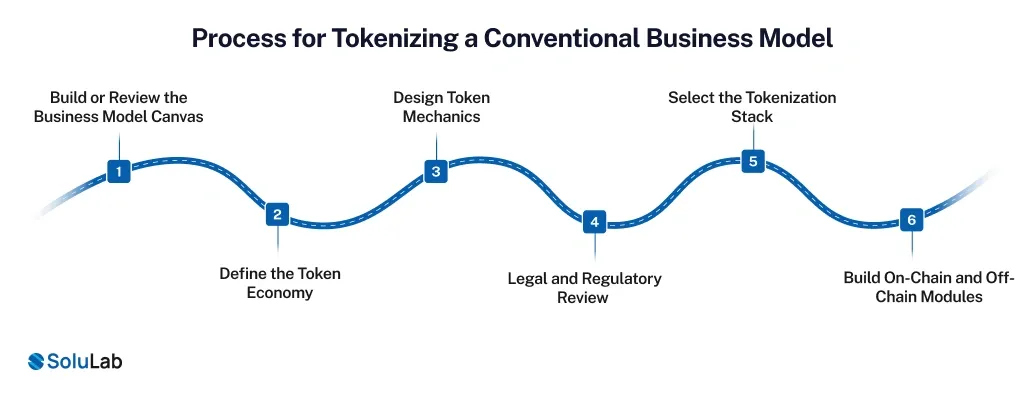
Step 1: Build or Review the Business Model Canvas
Map:
- Value Propositions
- Customer Segments
- Revenue Streams
- Key Activities
- Key Resources
- Cost Structure
Identify where decentralization adds measurable value.
Step 2: Define the Token Economy
Clarify:
- What problem does the token solve?
- Who are the participants?
- What are their incentives?
- How does the token circulate?
Define:
- Purchase incentives.
- Holding incentives.
- Usage incentives.
A healthy token economy balances these three.
Step 3: Design Token Mechanics
Define:
- Supply (fixed or inflationary).
- Distribution model.
- Primary sale strategy.
- Secondary market strategy.
- Burn or reward mechanisms.
Be mindful of token velocity. High velocity can reduce network value. Mechanisms such as staking or reward locks can stabilize the ecosystem.
Step 4: Legal and Regulatory Review
Classify the token:
- Currency
- Utility
- Security
- Hybrid
Conduct:
- Jurisdictional analysis.
- AML/KYC design.
- Data protection compliance review.
Ignoring compliance early leads to costly corrections later.
Step 5: Select the Tokenization Stack
Choose infrastructure based on:
- Security.
- Scalability.
- Transaction costs.
- Smart contract expressiveness.
- Integration capability.
Consider:
- Compliance platforms.
- Exchange protocols.
- Custody solutions.
- Wallet compatibility.
Step 6: Build On-Chain and Off-Chain Modules
On-chain:
- Smart contracts.
- Governance logic.
Off-chain:
- User dashboards.
- Admin panels.
- Payment gateways.
- Analytics systems.
A successful enterprise token model combines both.

What Services Can SoluLab Offer You in Building a Tokenized Business Model?
As discussed above, tokenization is not just about issuing a digital token. It is about redesigning ownership, access, governance, and revenue flows into a structured, compliant digital framework. That is where SoluLab steps in as a tokenized platform development company focused on enterprise execution.
We support:
- Enterprise tokenized platform development
- Compliant tokenized business model development
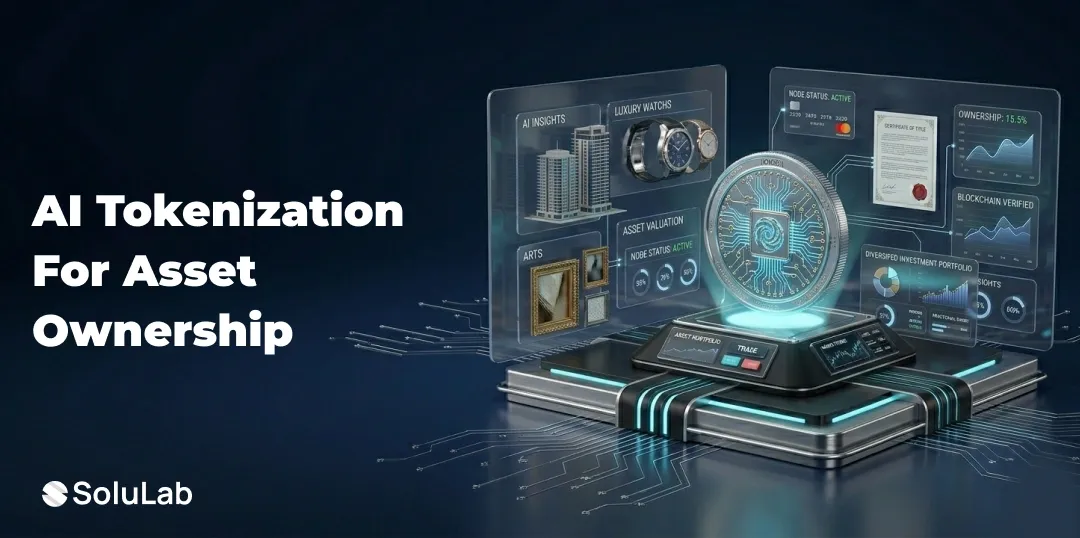
- AI tokenization for asset ownership
- AI-powered asset tokenization solutions
With our 250+ experts’ support, you can avail customization and multiple integrations to your system. Contact us today and discuss your business model tokenization framework.
FAQs
Deepika is a content writer who blends storytelling with strategic thinking. She explores topics across digital innovation, emerging tech, and the evolving blockchain industry. She enjoys breaking down complex ideas into simple, engaging narratives in the growing global markets.