
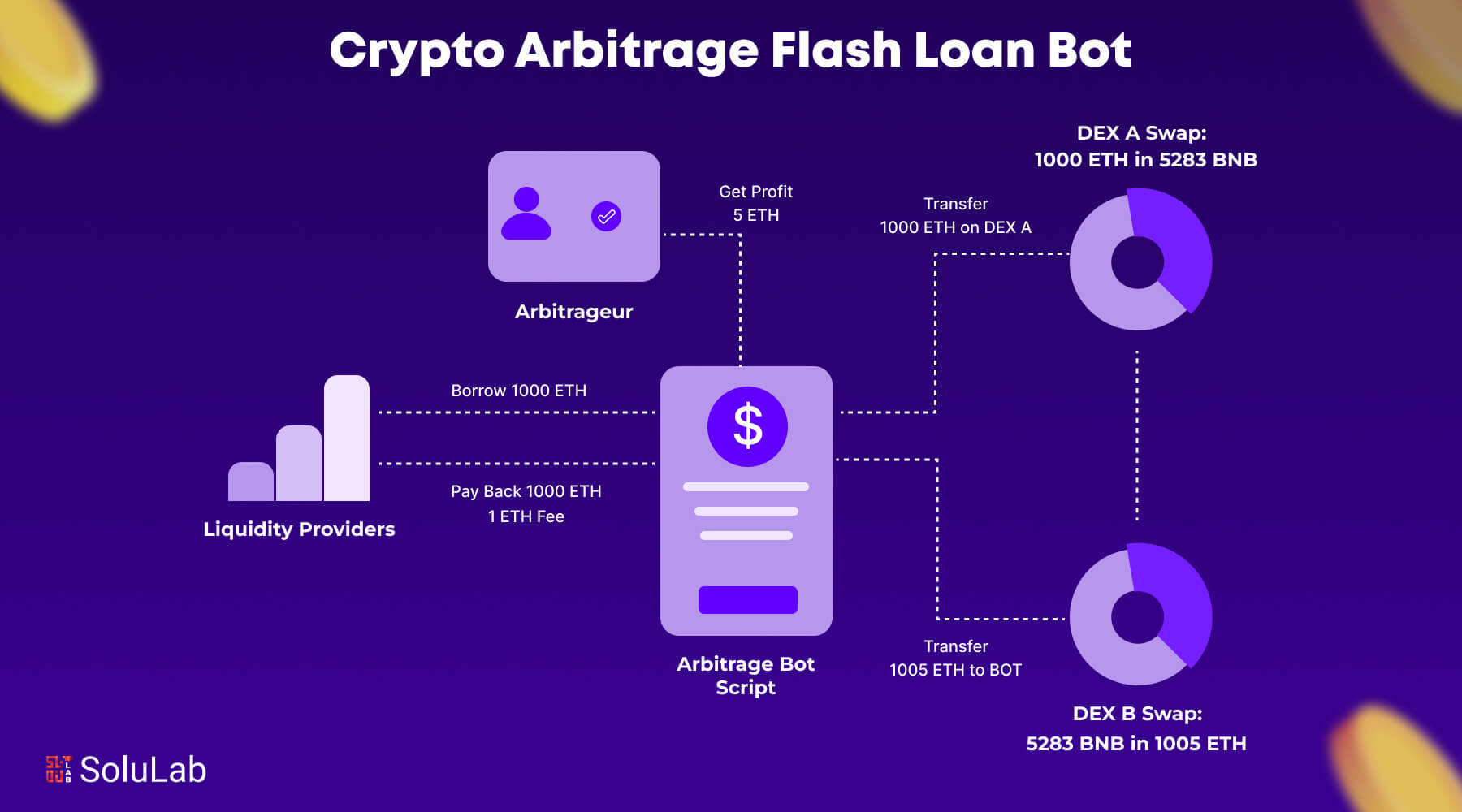
Crypto moves fast. And if you can move faster than the gap between two exchanges, that gap is money. This is the whole idea behind flash loan arbitrage bots, which more and more traders now use to catch price differences the second they appear. The mechanic is odd if you have never seen it before: the bot borrows crypto and pays it back inside one single transaction, no collateral held for more than a blink. Borrow a large sum, buy an asset cheap on one platform, sell it dearer on another, repay the loan, and pocket what is left. All of it in seconds. Aave, one of the bigger DeFi protocols, has processed heavy flash loan volume for years. Back in July 2020, for one stretch, the daily value of flash loans it issued climbed from $11 million to over $130 million within a month.
So here is what this guide covers. We will walk through how to build a flash loan arbitrage bot from the ground up, starting with what a flash loan even is, then moving into the actual coding and deployment. You will also see which tools and platforms you need, how to keep your transactions safe, and a few honest ways to squeeze more profit out of a market that never sits still.
What Are Flash Loans?
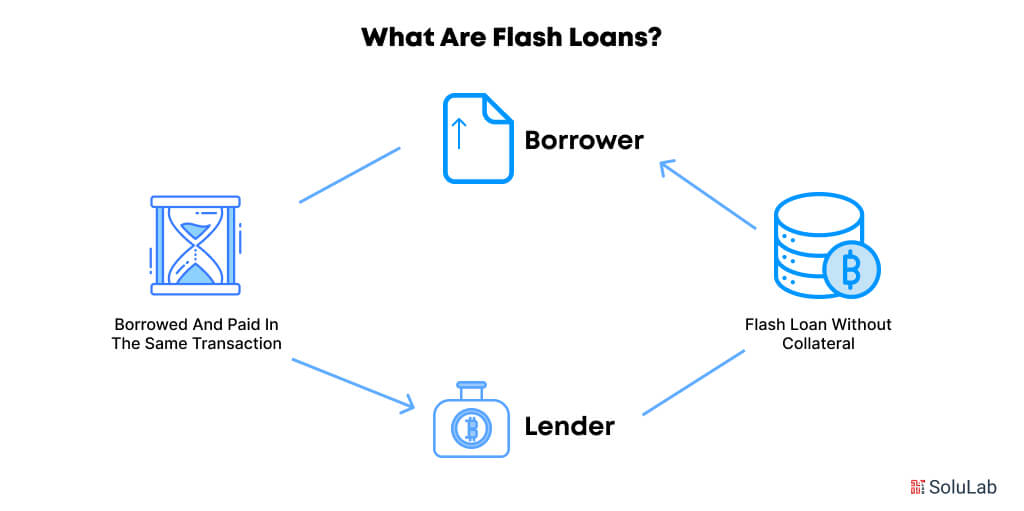
A flash loan is a strange, clever piece of the decentralized finance (DeFi) ecosystem. Regular loans want collateral. Flash loans do not. You can borrow a large amount of cryptocurrency and put up nothing, because the whole loan lives and dies inside one blockchain transaction. The borrowed money has to come back before that transaction closes. If it does not come back, the chain simply pretends none of it happened, and the lender loses nothing.
The classic use case is the flash loan arbitrage smart contract. A trader spots the same asset priced differently across decentralized exchanges, then acts on it. Picture one transaction: take the flash loan, buy the asset where it is cheap, sell it where it is expensive, pay the loan back. Done.
None of this works without flash loan arbitrage Smart contracts, which are just agreements written straight into code that run themselves. These flash loan arbitrage smart contracts check every condition, repayment included, and enforce it automatically. That is what keeps the whole thing tight and safe.
Key Features of Flash Loans
A few things set flash loans apart:
- No Collateral Required: You pledge nothing. Repayment is baked into the same transaction, so the lender is never exposed.
- Instant Execution: Borrow, use, repay. All of it in seconds, because the blockchain settles that fast.
- Flexibility: People use them for arbitrage, for refinancing other loans, and sometimes for gaming protocol incentives.
Traders like flash loans because the profit can be real, whether through arbitrage or other tactics. But there is a darker side. Bad actors have used them to attack protocols, and that keeps DeFi platforms busy tightening their systems, trying to keep the door open for honest use while shutting it on exploits.
What is Crypto Arbitrage?
Crypto arbitrage comes down to one thing: the same coin sells for two different prices in two different places, and you take the spread. Buy low on one exchange, sell high on another, keep the difference. It works because crypto markets are messy. Prices drift apart from one venue to the next thanks to gaps in trading volume, liquidity, or plain regional demand.
The sharpest version of this in the decentralized finance (DeFi) world is flash loan arbitrage. Here you borrow a big sum through a flash loan, no collateral, repaid inside one blockchain transaction. That single trick removes the need for your own capital, which is why arbitrage stopped being a rich-trader-only game and opened up to anyone who can code.
Naturally, people want to automate it. A lot of traders and developers now weigh the flash loan arbitrage bot development costs before committing to build one. The bot’s job is simple to describe and hard to do well: spot the opportunity, fire the trade, repay the loan, all within seconds.
Types of Crypto Arbitrage
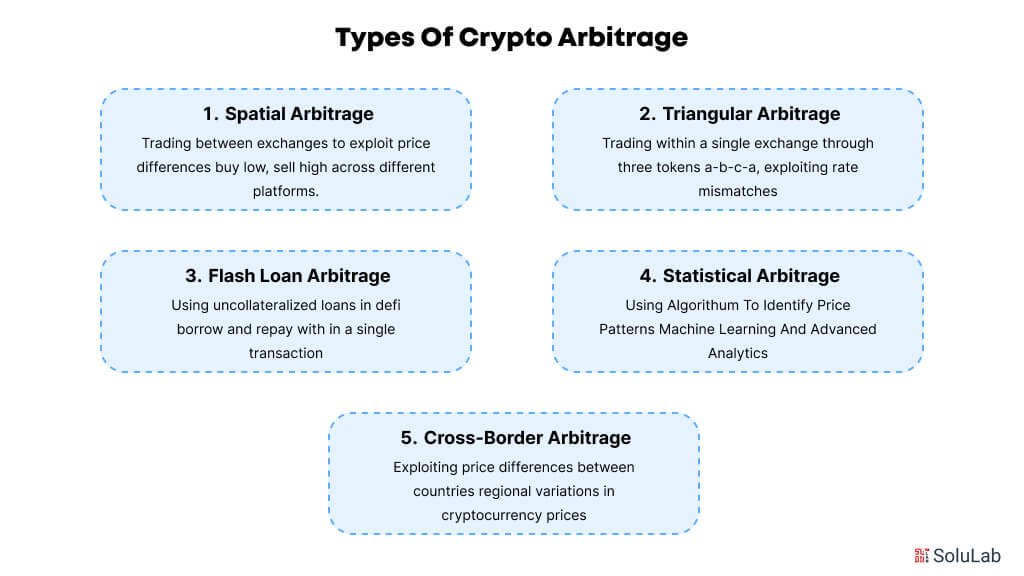
Arbitrage is not one thing. Here are the main flavors:
1. Spatial Arbitrage
This is the plain version. You trade the same coin between two exchanges, buying where it is cheaper and selling where it is dearer, and the gap is your profit. It shows up constantly, since prices between exchanges rarely stay perfectly aligned, which is why so many traders lean on it.
The catch is speed. Prices shift in a hurry, and a slow hand loses. That is why most people hand this off to bots, which fire the trades fast enough to beat both the clock and the transaction fees.
2. Triangular Arbitrage
Triangular arbitrage stays inside a single exchange. The profit hides in three cryptocurrency pairs whose rates do not quite agree. You loop through the conversions, Token A into Token B into Token C and back to Token A, and pocket whatever the mismatch leaves behind.
It demands exact math and quick execution, or slippage eats the edge. Most traders let pre-programmed algorithms or bots run these loops, since doing it by hand is both slow and error-prone.
3. Flash Loan Arbitrage
Here is where flash loans come in. You borrow uncollateralized funds and repay them inside one blockchain transaction, using that window to exploit price mismatches across decentralized exchanges or liquidity pools. No upfront capital needed.
It took off in DeFi precisely because it is efficient and open to anyone. If you plan to automate it, knowing the flash loan arbitrage bot development cost upfront matters, because that number shapes whether the whole thing is worth building.
4. Statistical Arbitrage
This one is quantitative. Algorithms and models hunt for price patterns or correlations between coins, and traders act on what the numbers predict, spreading trades across several assets or exchanges.
It usually pulls in machine learning or heavier crypto arbitrage trading bots. Expect the flash loan arbitrage bot development cost to run higher here, because the analytics and infrastructure behind it are not cheap.
5. Cross-Border Arbitrage
Cross-border arbitrage chases price gaps between exchanges in different countries, gaps that usually trace back to local rules, demand, or liquidity. You buy where a coin is cheap and sell where the same coin costs more, one market to the next.
The upside is real, but so are the headaches: regulatory compliance and transaction delays can both bite. Automated systems help by finding the openings and executing before they close.
Pre-Requisites to Building a Flash Loan Bot
Building one of these bots takes three things at once: technical skill, some financial sense, and a working grasp of how blockchains actually run. This is not plug-and-play. It is planning, careful coding, and fast execution. Here is what you need before you start:
1. Understanding Smart Contracts: Everything the bot does runs through smart contracts that talk to blockchain protocols. You need real fluency in Solidity if you are on Ethereum, or Rust if you are on Solana, enough to write and deploy contracts that are both efficient and hard to break. These contracts handle the borrowing, the trading, and the repayment on their own, inside one transaction.
2. Familiarity with Blockchain Protocols: You have to know the plumbing. How flash loans work, which platforms offer them (Aave and dYdX among them), and how decentralized exchanges behave. Gas fees, transaction speeds, and the quirks of whichever chain you pick all matter more than people expect.
3. Technical Infrastructure: The setup around the bot counts too. You want access to a blockchain node, your own or through a solid provider, so transactions go through fast. And a high-performance server for hosting keeps latency low, which in arbitrage is the difference between a win and a miss.
4. Proficiency in Arbitrage Logic: You need to know how to find an opportunity and then teach the bot to find it too. That means scanning several DEXs in real time, doing the profit math, and firing the trade cleanly. In practice, this is where teams get stuck, because the windows are tiny and the competition is not asleep.
5. Risk Management Skills: The stakes are high and mistakes cost money. Build in guardrails: simulate on testnets first, cap your transaction costs, and let the bot fire only when the profit clears a threshold you set. Skip this and one bad transaction can undo a week of good ones.
6. Knowledge of Compliance and Security: There is a legal and security layer you cannot ignore. Guard the bot against exploits like front-running, and make sure it stays inside the rules of the platforms and jurisdictions it touches. Ignoring either one is how good projects turn into bad headlines.
Get these right and you have the foundation for a bot that can actually run complex financial strategies in the DeFi technology.
How Flash Loan Arbitrage Bots Work?
At heart, these bots sit between two parties: lenders and borrowers. The borrower’s smart contract reaches out to a provider like Uniswap, Aave, or dYdX, pulls a flash loan, runs whatever operation it planned, then pays the loan back. The key word is atomic. Every step lands, or nothing does. There is no halfway state where half the trade goes through and leaves you holding the bag.
Key Components of a Flash Loan Arbitrage Bot
Three moving parts do most of the work:
1. Loan Acquisition: It starts with the ask. The borrower requests funds from a flash loan provider. No collateral, but the loan has to clear inside the same transaction, so no debt ever lingers.
2. Smart Contract Interaction: With funds in hand, the borrower calls on other smart contracts to do the real work, arbitrage, liquidation, or yield farming, wringing profit out of whatever inefficiency the market left open.
3. Loan Repayment: When the work is done, the borrowed amount plus any fees goes back to the lender, all inside the same transaction cycle.
Five Stages of the Flash Loan Process
Zoom in and the process breaks into five stages:
1. Loan Transfer: The provider hands the requested assets to the borrower’s smart contract. This is the kickoff, the moment the planned operations can begin.
2. Invocation: The borrower calls the smart contract, firing off the pre-defined functions and setting the whole sequence in motion.
3. Operation Execution: Now the borrowed assets go to work. The contract talks to various DEXs and other contracts, running arbitrage (buy cheap here, sell dear there) or liquidation (clear bad debt to claim the collateral). The point is profit, or hitting whatever financial goal the strategy set.
4. Loan Repayment: Operations finished, the borrowed assets plus any interest or fees head back to the provider. The contract handles this automatically, so the loan terms are always met.
5. Balance Verification: Last, the provider checks the repayment. If the money falls short or the operations failed to earn enough, the whole transaction reverts. Every action unwinds, and no loss or debt survives.

Step-by-Step Guide to Building a Crypto Arbitrage Flash Loan Bot
Put simply, building a crypto arbitrage flash loan bot means building a machine that runs arbitrage trades on borrowed flash loan money. The guide below walks through the pieces of building a flash loan arbitrage bot, from picking a protocol to shipping the finished product. Let us get into it:
1. Choosing the Right DeFi Protocol
First move in how to build a flash loan arbitrage bot is picking the right decentralized finance (DeFi) protocol. Aave, dYdX, and Uniswap are the usual names for running flash loans and arbitrage trades. Weigh each one on:
- Supported assets.
- Transaction fees (gas costs).
- Liquidity pools and arbitrage opportunities.
- Ease of integration with your bot.
Aave, for one, has strong flash loan support, which is why so many developers working on flash loan arbitrage bot development start there.
2. Writing the Flash Loan Smart Contract
The smart contract for flash loan arbitrage is the spine of the whole bot. It borrows, trades, and repays, all inside one blockchain transaction. What goes into it:
- Flash Loan Functionality: Hook into the DeFi protocol to borrow the asset you want.
- Arbitrage Execution: Write the logic that runs the arbitrage trades on the DEXs.
- Repayment and Error Handling: Pay back the loan plus fees. If that fails, the transaction has to revert.
Reach for Solidity on Ethereum, Rust on Solana. Whatever you pick, tune the contract for gas efficiency. High fees quietly eat your profit if you let them.
3. Integrating Arbitrage Logic
With the smart contract for flash loan arbitrage in place, wire in the logic that spots and executes the opportunities. That breaks into:
- Scanning DEXs: Pull live price data from several DEXs through their APIs.
- Profit Calculation: Run the numbers on each spread, factoring in transaction fees and gas costs before you commit.
- Automated Execution: Let the bot fire instantly, putting the borrowed funds to work with no wasted motion.
Good arbitrage logic is what separates a profitable bot from a slow one. In building a flash loan arbitrage bot, this is the part that decides whether you win the race in a crowded market.
4. Testing and Deploying the Bot
Do not skip testing. It is the phase in flash loan arbitrage bot development where real money is not yet on the line. Put your bot on a testnet first, say Ethereum’s Goerli or Rinkeby, and simulate trades without risking a cent. The things to check:
- Verifying smart contract functionality.
- Testing arbitrage trades under different market conditions.
- Making sure flash loans repay cleanly every time.
Once the tests pass, push the bot to the mainnet. Lean on a dependable blockchain node provider to keep latency down and performance steady. Then watch it run in the real world and tune as you learn.
Follow those steps and you will have learned how to build a flash loan arbitrage bot that is efficient, profitable, and secure. Shipping a bot that actually works is a blend of technical skill, market feel, and careful execution. Get the approach right and your bot can ride flash loans into crypto arbitrage bot opportunities.
Key Challenges in Building a Flash Loan Arbitrage Bot and How to Overcome Them
Building a flash loan arbitrage bot is a real shot at profiting from DeFi markets, but it is far from free of trouble. How well you handle the trouble decides whether the bot pays off or just breaks. Here are the big obstacles, and what to do about each:
1. High Gas Fees
Gas fees are the first wall you hit in flash loan arbitrage bot development, and on Ethereum they hit hard. A high fee can swallow the entire arbitrage margin and turn a decent trade into a losing one.
How to Overcome It: Trim your smart contract for flash loan arbitrage so it does less computational work and burns less gas. Run the bot on cheaper networks, Binance Smart Chain, Polygon, or Layer 2 options like Arbitrum and Optimism. And watch the gas trends, then trade when the network is quiet.
2. Latency and Competition
Opportunities blink in and out, sometimes gone in a few seconds. A bot that lags even a little misses the trade or hands it to a faster competitor.
How to Overcome It:Run a high-performance dedicated server or virtual private server to cut latency. Pair it with a reliable blockchain node provider so your bot gets updates in real time. Then build fast execution into your how to build a flash loan arbitrage botplan so it reacts the instant it needs to.
3. Price Slippage
Slippage is when the price moves mid-transaction, so your profit shrinks or flips into a loss.
How to Overcome It: Set a slippage tolerance so the bot backs off when prices swing too far. Make smaller trades to move the market less. And stick to decentralized exchanges with deep liquidity, where slippage bites least.
4. Smart Contract Vulnerabilities
A sloppy smart contract for flash loan arbitrage is an open door. Attackers walk through it, or the contract just breaks mid-run, and either way you lose money.
How to Overcome It: Audit the contract properly, using tools like MythX or ConsenSys Diligence. Hammer it on testnets before it ever touches the mainnet. And keep up with current security practices, guarding against known tricks like reentrancy attacks.
5. Complexity in Arbitrage Logic
Hunting profitable trades across many exchanges and assets is heavy work, and it is easy to get wrong.
How to Overcome It: Let advanced algorithms do the spotting for you. Bring in machine learning models to sharpen your read on which trades will pay. And start simple, then scale the strategy up as the bot proves itself.
6. Regulatory and Compliance Issues
Some places regulate arbitrage bots or flash loans, which can drop legal hurdles in front of developers and users alike.
How to Overcome It: Learn the legal ground in your target markets before you deploy. Keep the bot inside the terms of the DeFi protocols and exchanges it touches. And steer clear of anything that could be read as manipulative or fraudulent.
Work through these one by one and you can build a bot that is both sturdy and quick, capable of turning real profit. Good flash loan arbitrage bot development comes down to technical skill, a clear plan, and constant tuning. Handle the obstacles with care and your bot can hold its own in the DeFi world.
Tips for Maximizing Arbitrage Profits
Wringing more out of arbitrage takes a plan and the right tools. A few tips that actually move the needle:
Choose the Right Arbitrage Opportunities
Go where the volatility and the price gaps are biggest. Trading across platforms, say between decentralized exchanges (DEXs) and centralized exchanges, tends to open up the most profitable windows.
Utilize Flash Loan Arbitrage
Flash loans changed the math on arbitrage. Borrowed funds for a single transaction let you play the price gaps with no capital of your own. Just make sure you have a solid flash loan arbitrage bot ready to run those trades cleanly.
Read Blog: How to Create A Crypto Trading Bot?
Optimize Bot Speed and Performance
Speed is the whole game here. A fast bot wins; a slow one watches. Put money into quality flash loan arbitrage bot development to cut latency and handle high-frequency trades. When a bot works in milliseconds, it catches the openings a slower one never sees.
Understand Development Costs and ROI
Before you build or buy, weigh the flash loan arbitrage bot development cost against what it can realistically earn. A good bot may look pricey on day one, but a strong performer pays that back and then some over a long run of trades.
Monitor Gas Fees and Slippage
On-chain profits leak fast through gas fees and slippage. Pick platforms with low transaction costs, and tune how you execute so as little as possible drains away.
Keep a Close Eye on Market Trends
Most openings come from market inefficiencies, a spike in volume or a sudden price jump. Stay close to the trends and lean on real-time monitoring tools to catch the trades worth taking.
Stack these habits on top of good tools and a clear strategy, and your profits climb while the risk stays in check. Always run the numbers on cost versus gain first, so the trading you do can actually last.

Conclusion
A crypto arbitrage flash loan bot asks a lot of you: a real grip on smart contracts, on blockchain mechanics, and on how markets actually behave. Get those right and flash loans plus automated trading open doors that are hard to reach any other way. The road there runs through gas fees, market swings, and the sheer fiddliness of building the thing. With the right approach and a development partner who knows the terrain, you can ship a bot that both chases profit and runs smoothly in a market that gives nothing away for free.
At SoluLab, we build tailored solutions for blockchain and cryptocurrency projects. As one example, we worked with Crypto Mining, a pioneering e-commerce company, to build a decentralized marketplace running on blockchain technology and smart contracts. That platform makes buying mining hardware simpler, and it offers hosting for the times a miner’s market is out of reach. Pairing deep technical work with user-first design, we help businesses put blockchain to real use.
Ready to take the next step? Contact us today to explore how SoluLab can bring your crypto and blockchain projects to life with expert development solutions. Let’s build the future together!
FAQs
Shipra Garg is a tech-focused content strategist and copywriter specializing in Web3, blockchain, and artificial intelligence. She has worked with startups and enterprise teams to craft high-conversion content that bridges deep tech with business impact. Her work translates complex innovations into clear, credible, and engaging narratives that drive growth and build trust in emerging tech markets.