
Key Takeaways
- Personalization is not a recommendation engine. Recommendations are one surface out of six, and teams that build only that one wonder why the numbers never move much.
- Measurement is why these programmes die. Gartner expected most to be abandoned for lack of provable ROI, and architecture guides never mention it.
- A permanent holdout group is the only honest proof. Without one you are attributing sales you would have made anyway.
- Your data layer caps everything. Identity resolution across sessions and devices decides whether personalization works at all.
- Start with one surface and a holdout. Platforms that personalize everything at once cannot attribute anything to anything.
Most teams building an AI personalization platform for ecommerce get the engineering right and the evidence wrong. Gartner predicted that by 2025, 80% of personalization efforts would be abandoned, and the stated reason was not technical failure or weak models. It was a lack of measurable return.
That prediction aged well, and it should shape how you build rather than what you build. Personalization touches search ranking, category and merchandising order, content, offers and lifecycle messaging, not simply the recommendation carousel that most teams start with and then stop at. Getting it working across those surfaces is a solved engineering problem with good documentation.
Proving it earned anything is where programmes quietly end. This guide covers both sides: the architecture of AI ecommerce personalization, surface by surface, and the measurement design that decides whether yours survives its second budget cycle.
What Is an AI Personalization Platform?
An AI personalization platform is the system that decides what each visitor sees, across every surface of your store, based on who they are and what they have done. It combines an identity layer, a behavioural data pipeline, models that score relevance, and a serving layer fast enough to run inside page load. A recommendation engine is one consumer of that platform, not the platform itself.
1. Why the Distinction Matters Commercially
Teams that scope ecommerce personalization software as “build a recommendation engine” ship a carousel, see a modest lift, and conclude personalization is overrated. They tested one surface out of six.
2. What Sits Underneath Every Surface
One identity graph, one behavioural event stream, one feature store, one set of models. Build these once and each new surface is weeks of work. Build them per surface and you have four systems that disagree about who the customer is.
3. Where Recommendations Fit
AI-powered product recommendations are the most visible output and the easiest to demo, which is why they dominate the conversation. They are also the surface where incremental lift is hardest to prove, for reasons covered below.
4. What Makes It “AI” Rather Than Rules
Rules personalize by segment: show this banner to returning customers. Models personalize by individual, and more usefully they learn which signals predict behaviour rather than requiring you to guess.
Which Surfaces Should You Personalize?
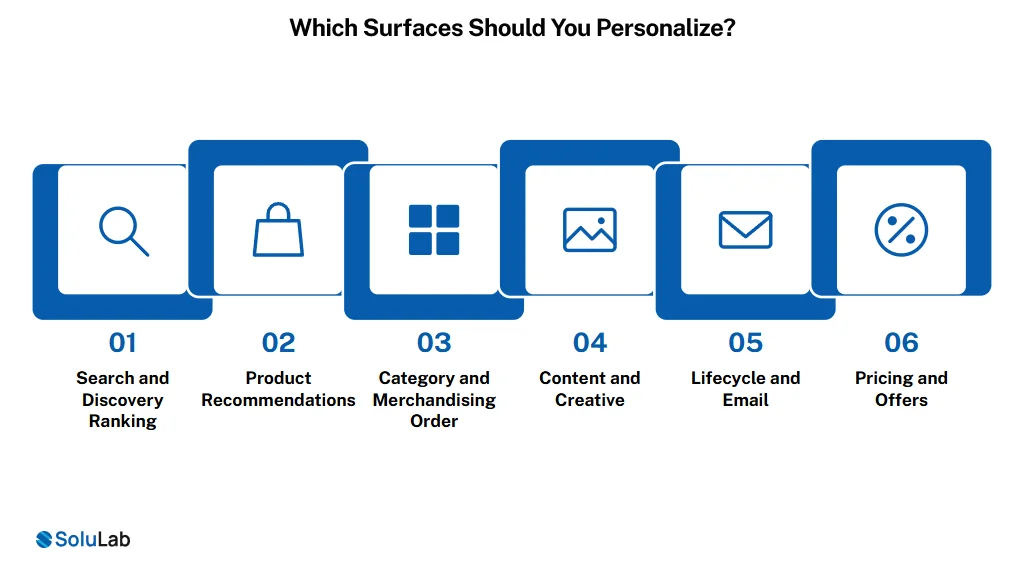
Search ranking usually returns most, because a shopper using search has already told you what they want. Recommendations are the most visible. Lifecycle messaging is the cheapest to test. Pricing and offers carry the most risk.
1. Search and Discovery Ranking
Re-ranking search results by predicted relevance to this shopper. Highest return in most catalogues, because intent is already declared and the baseline is usually keyword matching.
2. Product Recommendations
Home page, product page, cart. The ecommerce recommendation engine surface. Visible, well understood, and covered in depth in our guide to AI-based recommendation systems.
3. Category and Merchandising Order
The sequence appear in a category listing. Quietly one of the highest-traffic surfaces on most stores and frequently left entirely manual.
4. Content and Creative
Which banner, which hero, which editorial module. Easy to test, and the place a personalized shopping experience becomes visible to the shopper rather than invisible.
5. Lifecycle and Email
Send time, product selection, subject line. Cheapest surface to experiment on because the measurement is clean and the audience is already segmented.
6. Pricing and Offers
Discount depth and targeting. Highest risk, both commercially and reputationally, and the one most likely to attract regulatory attention. Treat it last.
What Data Does the Platform Need?
Four layers: an identity graph that resolves the same person across sessions and devices, a behavioural event stream, enriched catalogue data, and consent state. Identity resolution is the one that caps everything. If you cannot tell that yesterday’s anonymous browser is today’s logg+ed-in customer, your models are learning from fragments.
1. Identity Resolution
Anonymous to known, device to device, session to session. Most personalization underperforms here rather than in the models, and it is rarely the part teams audit first.
2. Behavioural Events
Views, searches, clicks, add-to-cart, purchases, returns. Timestamped and tied to the identity graph. Returns are the strongest negative signal you have and the one most often left out of the pipeline.
3. Catalogue Enrichment
Attributes, embeddings, images, descriptions. Thin product data limits every downstream surface, and vision and language models can fill most of the gaps automatically.
4. Consent State as a First-Class Input
Which visitors have consented to what, available at serving time. Bolting this on later means rebuilding the serving path, which is covered properly in the privacy section below.
5. How to Audit It Quickly
Three numbers tell you most of what a readiness assessment would: the share of sessions you can resolve to a known identity, the share of products with complete attributes, and how many days of event history you hold.
What Does the Architecture Look Like?
Five components: an event pipeline, a feature store, a two-stage retrieval and ranking model layer, a low-latency serving service, and an experimentation framework. The first four are well documented everywhere. The fifth is the one that decides whether the platform survives, and almost nobody treats it as architecture.
1. Event Pipeline
Streaming ingestion of behavioural events into both a real-time store for serving and a warehouse for training. Standard infrastructure, and the place latency problems originate.
2. Feature Store
Computed features available consistently to both training and serving. Training and serving skew, where the two see different values, is one of the hardest bugs in production ML to diagnose.
3. Retrieval and Ranking
Retrieval narrows the catalogue to a candidate set using embedding similarity. Ranking re-scores those candidates against user context and business objectives. Two stages because scoring 80,000 items per request is not viable inside a page load.
4. Serving Layer
Sub-100ms responses, graceful degradation to a sensible default when models are unavailable, and caching that does not serve a stale experience. A personalization platform that adds 400ms to page load has cost you more than it earned.
5. Experimentation Framework
Assignment, holdout management, metric computation and guardrails. Build this first, not last. Everything below depends on it.
Teams assembling this stack typically work through our machine learning development team for the model and serving layers.
How Do You Actually Measure It?
This is the section no competing guide has, and it is the one that decides whether your platform is still running in two years.
1. Attribution Is Not Measurement
Attribution credits personalization for purchases that flowed through a personalized surface. Most of those customers would have bought anyway. A dashboard showing “personalization-influenced revenue” is measuring traffic, not impact.
2. Hold Out a Permanent Control Group
A percentage of traffic that never receives personalization, permanently. Compare it to everything else continuously. This is the only honest number, and it is the one thing that lets you answer “what did this earn us” in a budget review.
Teams resist this because it feels like leaving money on the table. The holdout costs you a fraction of a percent of revenue and buys you the ability to prove the rest.
3. Measure Incremental Revenue per Visitor
Not click-through on the widget. Not conversion on the personalized page. Revenue per visitor across the whole session, holdout versus treated. Surface-level metrics improve easily while the total does not move.
4. Set Guardrails That Can Stop a Rollout
Return rate, average order value, catalogue coverage, page latency. A personalization system that lifts conversion while raising returns has made you poorer, and only a guardrail catches that before the quarter closes.
5. Watch Catalogue Coverage Specifically
If high accuracy comes with low coverage, you have built an expensive bestseller list. Track what share of your range is ever surfaced.
6. Run Tests for Full Weekly Cycles
Shopping behaviour is weekly. A test running Tuesday to Friday measures a slice of your customers, not your customers. Calculate sample size from the smallest lift worth shipping, then honour the duration.
How Do You Implement It, Step by Step?
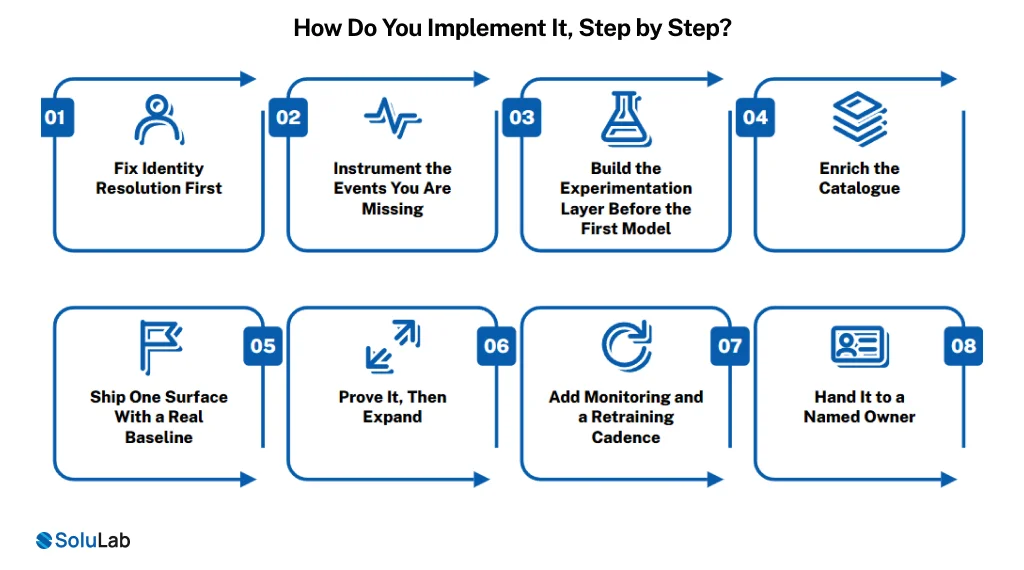
Fix identity, then instrument events, then build the experimentation layer, and only then ship a model. Teams that reverse this sequence end up with a working platform they cannot prove anything about, which is the position most abandoned programmes reach.
1. Fix Identity Resolution First
Before any modelling, resolve anonymous sessions to known customers across devices. Measure what share of sessions you can tie to an identity today. If it is under half, this step is the project, and nothing downstream will work properly until it is done.
2. Instrument the Events You Are Missing
Audit your event stream against the list in the data section. Most stores are missing search queries, scroll depth or return reasons. Add them and wait, because models need history and you cannot backfill behaviour you never captured.
3. Build the Experimentation Layer Before the First Model
Assignment logic, a permanent holdout, metric computation and guardrails. This feels like deferring the interesting work. It is the step that makes every later result defensible, and retrofitting it means re-running every test you already ran.
4. Enrich the Catalogue
Run vision and language models over product imagery and descriptions to fill attribute gaps. This usually lifts results more than changing algorithm does, and it is cheaper than most teams expect.
5. Ship One Surface With a Real Baseline
Pick the highest-return surface, usually search ranking, and compare against what you do today rather than against nothing. A rules-based or popularity baseline is the comparison that matters.
6. Prove It, Then Expand
Run the test for full weekly cycles, check the guardrails, and only move to a second surface once the first has cleared the threshold you agreed. Sequencing is what lets you attribute anything to anything.
7. Add Monitoring and a Retraining Cadence
Drift detection, coverage tracking, feature freshness and an alert when the model’s inputs change shape. Decide the retraining frequency up front rather than discovering it after performance decays.
8. Hand It to a Named Owner
Someone in merchandising or growth who holds the holdout numbers and reports them. A platform with no owner degrades silently, and the measurement is the first thing to stop being looked at.
Why Do Personalization Programmes Get Abandoned?
Gartner’s prediction that 80% of personalization efforts would be abandoned named the cause directly: an inability to demonstrate return. Not model quality, not infrastructure. The programmes that die are usually working. They simply cannot prove it when the budget conversation arrives.
1. No Baseline Was Captured
Nobody recorded what revenue per visitor looked like before. Without that, every result is an assertion.
2. The Holdout Was Skipped
The most common and most expensive omission. Twelve months in, someone asks what personalization contributed, and the honest answer is that nobody can separate it from everything else that changed.
3. Everything Was Personalized at Once
Six surfaces launched together means no surface can be attributed anything. Sequence them, and let each prove itself.
4. Success Was Defined After the Fact
Numbers arrive, then someone decides what counts as good. Agree the threshold in writing while you are still impartial.
5. The Platform Outlived Its Sponsor
Personalization sits across merchandising, marketing and engineering and is owned by none of them. Without a named owner holding the measurement, it degrades quietly. Ecommerce personalization solutions fail on organisational ownership at least as often as on technology.
Privacy, Consent and What You Can Legally Personalize
Behavioural personalization is processing personal data. Under GDPR that needs a lawful basis, and under several US state laws it needs an opt-out that actually works. Consent state has to be available at serving time, which is an architecture requirement, not a policy one.
1. Consent Must Reach the Serving Layer
If your platform cannot check consent before personalizing, you will personalize for people who declined. Pass consent state into the serving path from day one.
2. Deletion Has to Reach the Models
A deletion request covers the feature store and training data, not just the customer record. Design for it, because retrofitting is painful.
3. Sensitive Inferences Are a Real Risk
Inferring health, pregnancy, financial distress or similar from browsing is legally and reputationally dangerous even when technically possible. Exclude those categories explicitly rather than hoping the model does not find them.
Build, Buy or Compose?
Buy a packaged personalization suite, compose best-of-breed components, or build custom. Most mid-market retailers should buy. Most enterprises end up composing. Custom is right when personalization quality is your differentiator rather than a feature of your store.
1. Buy a Packaged Suite
Fastest, and the vendors are mature. You inherit their data model and their measurement, and their reporting will flatter them.
2. Compose Best-of-Breed
Vendor search ranking, custom recommendations, your own experimentation layer. More integration work, far more control over measurement, and the pattern most large retailers converge on.
3. Build Custom
Custom AI personalization platform development makes sense when you hold behavioural or returns data a generic vendor model cannot use, or when your business rules are too specific for a packaged product to express.
4. The Question That Decides It
Would a customer choose you because of your personalization? If no, buy it and spend the budget on catalogue and identity instead. If yes, you are building a product and a vendor will constrain you.
What Does It Cost and How Long Does It Take?
Grand View Research forecasts the recommendation engine market reaching USD 33.23 billion by 2030 at a 36.3% compound rate, with retail holding a 25.0% share in 2023. Recommendations are one surface, which gives a sense of the scale of the wider personalization category.
| Scope | Typical range | Timeline |
| Data and identity readiness assessment | $12,000 to $25,000 | 2 to 3 weeks |
| Single surface with full measurement | $60,000 to $130,000 | 10 to 16 weeks |
| Multi-surface platform, three or four surfaces | $150,000 to $350,000 | 20 to 32 weeks |
| Experimentation and measurement layer alone | $40,000 to $90,000 | 6 to 10 weeks |
| Ongoing | Monthly | Retraining, serving, monitoring |
How SoluLab Can Help
SoluLab has delivered 500+ projects since 2014, with machine learning and data engineering as core practices.
1. Data and Identity Readiness
We audit identity resolution, event coverage and catalogue completeness, and tell you what quality of personalization your data can support before anything is built.
2. Measurement Design First
Holdout structure, guardrail metrics and the lift threshold, agreed in writing before the first model ships. This is the part that keeps programmes funded.
3. Platform Engineering
Event pipelines, feature stores, retrieval and ranking, and a serving layer that stays inside your latency budget. Delivered through our AI-powered solutions practice.
4. Surface Rollout in Sequence
One surface, proven, then the next. We will tell you which to start with based on your traffic and margin rather than which demos best.
5. Catalogue Enrichment
Vision and language models over your product data to fill the attribute gaps that cap every surface downstream.
6. Integration Into Your Existing Stack
Commerce platform, CDP, ESP and analytics, handled through our AI integration services team so the platform fits what you already run.

Conclusion
The engineering for an ecommerce personalization platform is well understood and widely documented. Event pipelines, feature stores, two-stage retrieval and ranking, low-latency serving. You can find a dozen architecture guides covering all of it, and they are mostly correct.
What they leave out is the part that determines whether your platform exists in two years. The abandonment risk sits in measurement, not technology, and the teams that avoid it do four things: capture a baseline, hold out a permanent control group, sequence surfaces instead of launching them together, and agree the success threshold before seeing results.
Build the experimentation layer first. Everything else is easier to fix later.
If you want that done properly, SoluLab, an AI development company, can help your business design the measurement and build the platform around it.
FAQs
Neha is a curious content writer with a knack for breaking down complex technologies into meaningful, reader-friendly insights. With experience in blockchain, digital assets, and enterprise tech, she focuses on creating content that informs, connects, and supports strategic decision-making.