Key Takeaways
- An AI stylist is a ranking problem wearing a fashion interface. The hard part was never the styling, it was deciding which 20 of 80,000 items to show you.
- Cold start decides whether your app survives week one. A new user has no history, and a stylist with no history is just a catalogue.
- Body photos are biometric data in several jurisdictions. Treat that as an architecture decision, not a privacy policy footnote.
- Your catalogue metadata caps your ceiling. If your product data says “blue dress” and nothing else, no model will style it well.
- Click-through is a trap. The metric that matters is whether the recommendation survives the return window.
Fashion got a lot more crowded. A mid-sized retailer now carries more items than anyone can browse, and shoppers abandon carts because choosing is exhausting rather than because the price was wrong.
That is the gap an AI fashion stylist fills, and the money is following it. Grand View Research valued the virtual try-on market at USD 9.2 billion in 2023, put it at USD 18.1 billion in 2026, and forecasts USD 46.4 billion by 2030, a 26.4% compound rate, with apparel the largest segment. So the demand is real, and most retailers accept they need something here.
What almost nobody explains is how these things are actually built, which is the part that decides whether yours works. This guide covers both: what an AI stylist does, how it does it, and what it takes to ship one of your own.

What Is an AI Fashion Stylist?
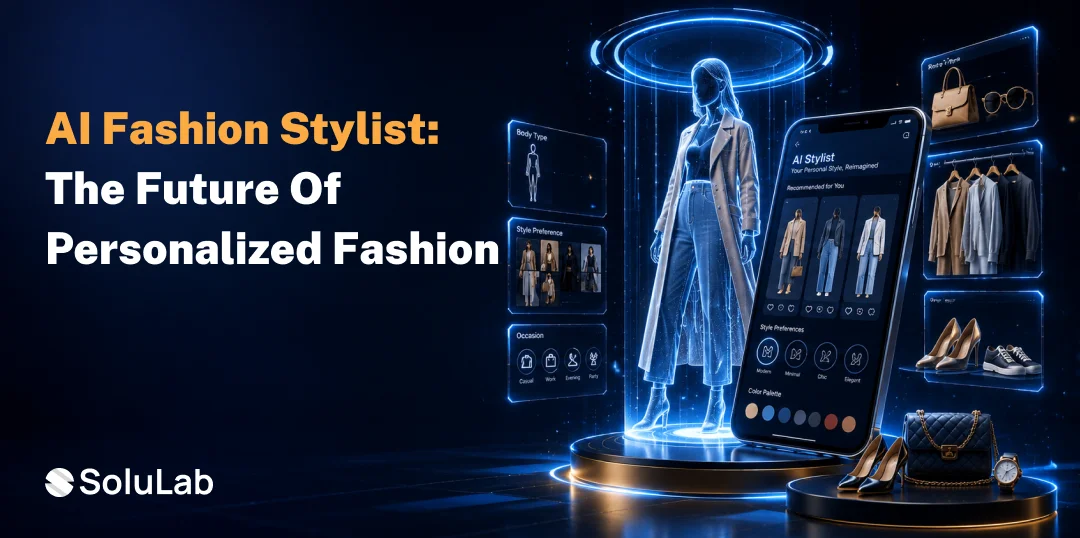
An AI fashion stylist is software that recommends clothing and outfits to a specific person, using their stated preferences, past behaviour, body data and context such as weather or occasion. It learns what suits you and narrows a catalogue of thousands down to a handful of options. Think of it as a ranking engine with taste, rather than a search bar with better filters.
Here is the thing most explanations miss. An AI stylist is not one model. It is three or four systems stacked together, and each one solves a different problem.
1. The Understanding Layer
This works out what each garment actually is. Not “blue dress”, but silhouette, neckline, fabric weight, formality, colour family, pattern scale. Computer vision extracts what your product data left out, which is usually most of it.
2. The Preference Layer
This works out what you like. Explicit signals come from quizzes and saves. Implicit signals come from what you lingered on and what you sent back. The second kind is more honest than the first.
3. The Ranking Layer
This decides what you see. Out of 80,000 items, which 20? That is the actual product, and it is where most of the engineering goes.
4. The Generation Layer
This is newer. Instead of only picking from stock, it can render an outfit on you, or compose a look that nobody merchandised. This is where a virtual fashion stylist starts feeling different from a filter.
5. The Explanation Layer
This tells you why. “Because you wore this with that” converts better than silent suggestions, and it is cheap to build. Skipping it is a common mistake.
How Does an AI Fashion Stylist Actually Work?
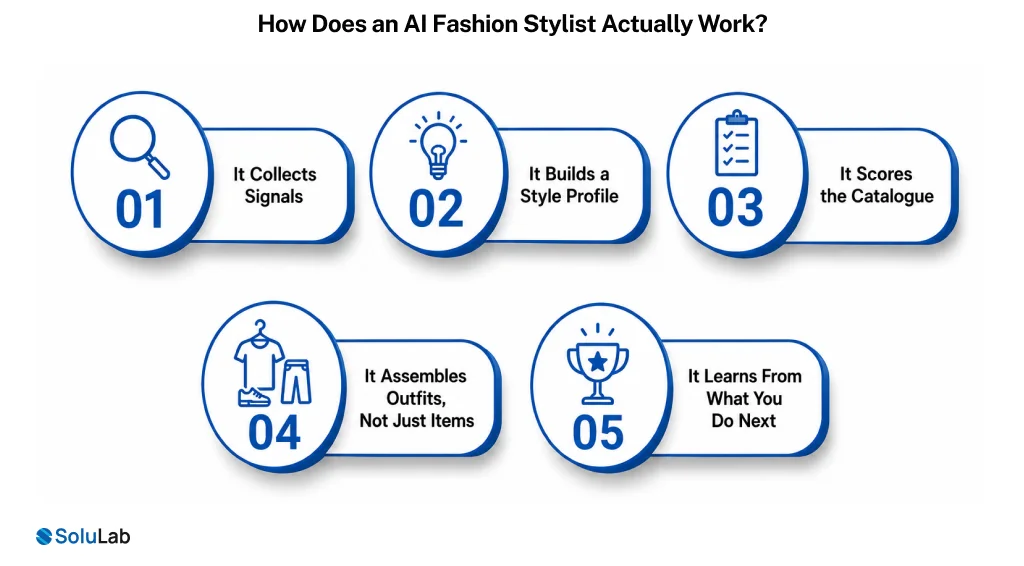
You give it signals, it builds a style profile, it scores every item in the catalogue against that profile and the occasion, then it shows you the top handful. The loop tightens every time you accept, reject or return something. Nothing magical happens. It is a recommender system with fashion-specific features and a much prettier front end.
1. It Collects Signals
A style quiz, a few photos, your purchase history, your returns. Returns are the most valuable signal in fashion and the most underused, because a return is an unambiguous no.
2. It Builds a Style Profile
Those signals become a vector. Think of it as coordinates in a space where similar styles sit near each other. Your profile is a point in that space, and the system looks for items nearby.
3. It Scores the Catalogue
Every item gets a score against your profile, the occasion, the season and what is in stock. AI outfit recommendations come out of this step, and the quality depends almost entirely on how well your catalogue is described.
4. It Assembles Outfits, Not Just Items
Recommending a good shirt is easy. Recommending a shirt that works with trousers you already own is a different problem, and it is what separates an AI outfit generator from a product carousel.
5. It Learns From What You Do Next
Accept, ignore, buy, return. Each action feeds back. A good system gets noticeably better in a fortnight. A bad one feels identical in month three, which is how you know the feedback loop is not wired up.
What Can an AI Stylist Actually Do?
1. Daily Outfit Suggestions
Weather, calendar, what is clean. An AI wardrobe planner that knows you have a client meeting and that it is raining is more useful than one that only knows your size.
2. Shop-the-Look Recommendations
You like one item, it builds the rest of the outfit around it. This is where personalized fashion recommendations turn into basket size.
3. Wardrobe Gap Analysis
It looks at what you own and tells you what is missing. Honest, useful, and slightly uncomfortable.
4. Virtual Try-On
See it on you before you buy. This is the feature driving the market figures above, and it is also the one with the biggest privacy footprint. More on that shortly.
5. Personal Shopping Assistance
An AI personal shopper that answers “what do I wear to an outdoor autumn wedding” in plain language. Conversational interfaces suit this well, which is why so many teams reach for our chatbot development patterns here.
6. Beauty and Skincare Extension
The same architecture works beyond clothes. An AI beauty assistant matches foundation shades from a selfie. An AI skincare recommendation app reads skin concerns and suggests a routine. The models differ, the structure does not.
What Every Guide Skips: The Three Hard Parts
This is the section the rest of the internet does not have. Every article about AI stylists explains what one is and lists the technologies. Almost none mention the three things that actually decide whether your app works.
1. Cold Start, or Why Week One Decides Everything
A new user has no history. A recommender with no history is a catalogue with extra steps.
This is the single biggest reason styling apps lose users in the first session, and it is solvable, but only deliberately:
- Onboarding that earns its length. Eight to twelve forced-choice image picks will do more than a thirty-question quiz, and people finish it.
- Borrow from similar users. Place the new user near a cluster of existing ones and start there.
- Lean on content, not collaboration, early. Item attributes work without behavioural history. Collaborative signals come later.
- Show range, not confidence. Early recommendations should sample widely. You are gathering information, not proving accuracy.
New items have the same problem from the other direction. A garment added this morning has no interaction data, and if your system only ranks what has sold, your new season never surfaces.
2. Body Photos Are Biometric Data
A user photo for try-on or body shape is not a normal upload. Under the EU’s GDPR, biometric data processed to uniquely identify someone is a special category needing an explicit lawful basis. In the United States, Illinois’ Biometric Information Privacy Act carries a private right of action, which is why so many retailers have faced claims over face and body scanning features. [VERIFY: have counsel confirm current BIPA and GDPR positions for your specific feature before launch.]
Three architecture decisions follow, and they are architecture decisions rather than policy ones:
- Process on device where you can. A measurement extracted on the phone and discarded beats a photo stored on your servers.
- Store derived features, not source images. You rarely need the photo. You need the measurements.
- Make deletion real and provable. Including from your training sets, which is the part teams forget until someone asks.
Bolt privacy on later and you will rebuild the pipeline. Design for it and the cost is close to zero.
3. Your Catalogue Data Is Your Ceiling
No model fixes bad product data. If your catalogue says “blue dress, size M” and nothing else, a AI fashion recommendation system has almost nothing to reason with.
What good looks like: silhouette, neckline, sleeve, length, fabric, weight, stretch, pattern scale, formality, season, colour in a usable colour space, and fit notes from returns. Most retailers have perhaps a third of this.
How to Build an AI-Powered Fashion App
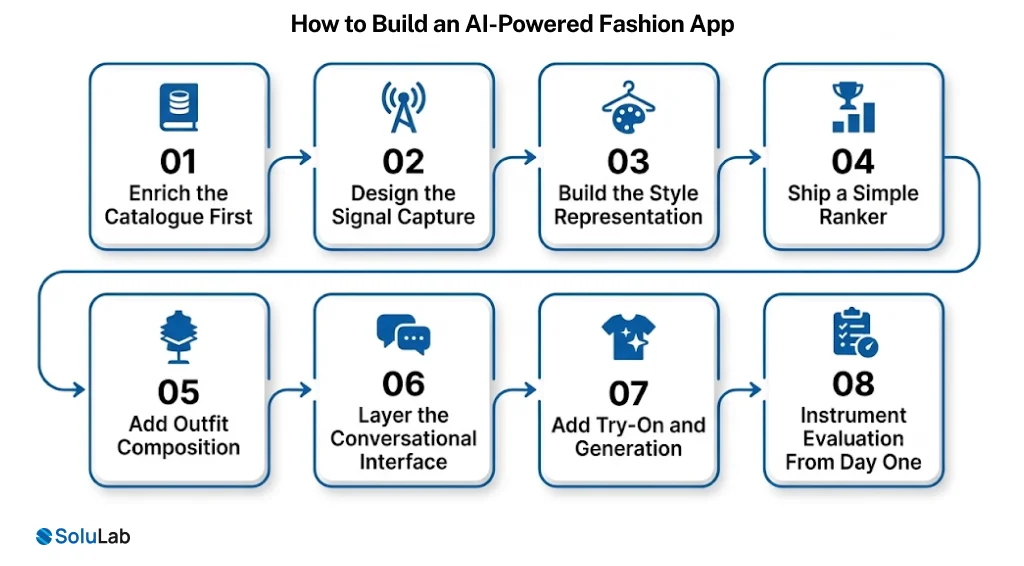
Start with catalogue enrichment, then signal capture, then a simple ranker, then outfit logic. Add try-on and generation once the basics hold. Most teams start at try-on because it demos well, and that is why most styling apps feel impressive once and useless afterwards.
1. Enrich the Catalogue First
Run computer vision over your product images to extract the attributes your data lacks. This is unglamorous; it takes weeks, and everything downstream depends on it.
2. Design the Signal Capture
Decide what you will learn from, and how. Onboarding picks, saves, time on item, add to cart, purchase, return reason. Instrument returns properly. Everyone forgets returns.
3. Build the Style Representation
Embeddings for items and users in a shared space. Keep it swappable. Model choice here changes more often than anything else in the stack.
4. Ship a Simple Ranker
Content-based scoring plus business rules for stock and margin. Resist the urge to start with something clever. A simple ranker you can debug beats a sophisticated one you cannot.
5. Add Outfit Composition
Compatibility between items, not just similarity to the user. This is a distinct model and a genuinely harder one, since two items you like individually can still look wrong together.
6. Layer the Conversational Interface
Natural language in, styled outfits out. An AI fashion assistant that handles “something for a beach wedding, I hate yellow” needgs intent parsing on top of the ranker, not instead of it.
7. Add Try-On and Generation
Now, not first. Virtual try-on and generated looks are high-impact and high-cost, in compute and in privacy exposure. They are a second-phase feature in almost every successful build.
8. Instrument Evaluation From Day One
Not click-through. Measure conversion, basket size, and crucially the return rate on recommended items. A stylist that drives purchases people send back has made things worse while looking like a success.
What Does It Cost to Build an AI-Powered Fashion App?
Building an AI-powered fashion app costs around $20,000 to $80,000+. Here’s a complete breakdown:
| Scope | Typical range | Timeline |
| Catalogue enrichment pipeline only | $20,000 to $45,000 | 4 to 7 weeks |
| MVP stylist: enrichment, profile, ranker, basic app | $60,000 to $120,000 | 10 to 16 weeks |
| Full app with outfit composition and conversation | $120,000 to $250,000 | 16 to 24 weeks |
| Virtual try-on added | $50,000 to $80,000 on top | 8 to 14 weeks |
| Ongoing | Monthly | Retraining, inference, catalogue sync |
Should You Build It or Buy It?
Buy if styling is a feature of your store. Build if styling is your product. The line is whether the recommendation quality is what customers are choosing you for, or just something that makes your existing catalogue easier to shop.
Scale is part of this decision. Grand View Research expects the global apparel market to reach USD 2.54 trillion by 2033, growing at 4.1% a year from 2026, and notes that offline still holds the largest revenue share. Online discovery is the contested ground, which is why styling tools are being bought and built at the same time.
1. Buy When Styling Supports the Catalogue
Off-the-shelf recommendation and try-on vendors integrate in weeks and cost a fraction of a build. If you are a retailer who wants better product discovery, start here.
2. Build When Styling Is the Differentiator
If customers would use your app without buying anything, you are building a product and a vendor will constrain you. Styling quality becomes your moat, and you cannot outsource a moat.
3. Build When Your Data Is the Advantage
If you hold fit and return data nobody else has, a generic vendor model cannot use it properly. That data is the reason to build.
4. Hybrid Is Common and Sensible
Vendor try-on, custom ranking. Most mature fashion apps end up here, and nobody advertises it because no vendor benefits from recommending it.
Where AI Styling Is Heading
Here the future of AI styling looks like:
1. Agentic Shopping Changes the Customer
When shoppers delegate purchases to agents, your product data gets read by software rather than people. Structured, machine-readable catalogue data stops being hygiene and becomes distribution. We cover this shift in AI agents in retail and e-commerce.
2. Generated Looks Before Manufactured Ones
Showing a garment that does not exist yet, then making it if enough people want it. This inverts the merchandising cycle and a few brands are already testing it.
3. The Wardrobe as the Account
The valuable asset moves from your purchase history to a structured model of everything you own. Whoever holds that holds the relationship.
4. Beauty and Fashion Converging
The same profile driving outfit choices also drives personalized beauty recommendations. An AI makeup assistant and a clothing stylist share more infrastructure than most teams realise.
5. Smaller Models, On Device
Privacy pressure and latency are pushing attribute extraction and basic ranking onto the phone. That changes the cost model considerably.
How SoluLab Can Help
We have delivered 500+ projects since 2014, with AI and mobile engineering as core practices.
1. Feasibility and Data Assessment
We audit your catalogue and behavioural data and tell you what quality of virtual personal styling it can actually support. Sometimes the answer is that enrichment comes first, and that is worth knowing before a build starts.
2. Catalogue Enrichment Pipelines
Computer vision over your product imagery to extract the attributes your PIM never captured.
3. Recommendation and Outfit Engines
Style representation, ranking, outfit compatibility and the cold start strategy that keeps week-one users.
4. Conversational and Try-On Layers
An AI personal stylist interface over the ranker, with try-on where the privacy architecture supports it.
5. Privacy-First Architecture
On-device processing, derived-feature storage and provable deletion, designed in rather than retrofitted.
6. The App Itself
Native or cross-platform, built on the same stack. The broader industry view sits in AI in the fashion industry.

Conclusion
An AI fashion stylist looks like a styling problem and is really a data problem. The teams that ship good ones spend their first month on catalogue attributes and signal capture, not on the model, and they decide how they will handle cold start and body data before they build anything that depends on either. The ones that start with virtual try-on because it demos well tend to launch something impressive that nobody opens twice.
If you are scoping one, start with a hard look at your product data. It will tell you more about what is possible than any model comparison will.
SoluLab, an AI development company, can help your business build it, from the enrichment pipeline underneath to the app on top. Book a discovery call, and we will tell you honestly what your data supports.
FAQs
Neha is a curious content writer with a knack for breaking down complex technologies into meaningful, reader-friendly insights. With experience in blockchain, digital assets, and enterprise tech, she focuses on creating content that informs, connects, and supports strategic decision-making.