
Key Takeaways
- A PoC that cannot fail is marketing. Agree the go or no-go number before you see a single result, or you will rationalise whatever you get.
- Random train and test splits invalidate most recommendation PoCs. The model sees the future, the metrics look excellent, production disappoints.
- If you do not beat a “most popular item” baseline, you have no result. Most PoCs never build one.
- Offline accuracy and online revenue are loosely coupled. A model that wins offline can lose money online, and only an online test tells you which.
- Your catalogue metadata caps the outcome. Thin product data produces thin recommendations regardless of algorithm.
Recommendation engines are no longer a differentiator; they are table stakes, and the spending reflects it. Grand View Research forecasts the recommendation engine market reaching USD 33.23 billion by 2030, growing at 36.3% a year from 2024, with retail holding a 25.0% share in 2023A PoC that cannot fail is marketing. Agree the go or no-go number before you see a single result, or you will rationalise whatever you get.
The problem is not whether to build one. The problem is that most teams commit budget before knowing whether their catalogue and behavioural data can support decent AI-powered product recommendations at all.
That is what an AI recommendation engine PoC is for. Done properly, it answers one question in weeks rather than quarters: will this work on our data, and by how much? Done badly, which vendors admit is more common than they’ll let on, it produces encouraging numbers that mean nothing and a build that disappoints months later. This guide covers the methodology that separates the two.
What Is an AI Recommendation Engine PoC?
An AI recommendation engine PoC is a short, bounded test that runs candidate recommendation algorithms against your actual product catalogue and interaction history, measures them against a defined baseline, and produces a go or no-go decision with a number attached. It is not a demo. A demo shows that recommendations can be generated. A PoC shows whether yours would be better than what you do today.
1. What Separates a PoC From a Prototype
A prototype proves something can be built. A PoC proves it is worth building. The distinction matters commercially, and we cover it in detail in PoC vs prototype vs MVP.
2. What It Must Produce
Three things: a measured comparison against a baseline, an honest account of what your data cannot support, and a cost estimate for the production build. A PoC that produces only the first is half finished.
3. How Long It Should Take
Four to eight weeks for most catalogues. Longer than that usually means the data work was underestimated, which is itself a finding worth having.
4. What It Should Cost Relative to the Build
Roughly 10% to 20% of the production build. Spend less and it proves nothing. Spend more and you have started building without deciding to.
Why Do Most Recommendation PoCs Fail to Produce a Decision?
Because they are designed to succeed. A PoC with no pre-agreed failure threshold will always be reported as promising, which means it decided nothing and cost a quarter. Gartner expected 30% of generative AI projects to be abandoned after proof of concept by the end of 2025, and separately found that only 48% of AI projects move from prototype to production, with an average cycle of eight months.
Those two numbers describe the same problem from opposite ends. Projects die after the PoC because the PoC never asked a question that could be answered no.
1. No Baseline Was Built
If you do not know what “recommend the most popular items” achieves on your catalogue, you cannot say whether your model is good. This baseline takes an afternoon and it is skipped constantly.
2. The Success Threshold Was Set Afterwards
Numbers arrive, then someone decides what counts as good. Agree the threshold in writing before testing. A machine learning recommendation engine that lifts click-through 2% may be worth building or may be noise, and which one depends on a decision you should make while you are still impartial.
3. Business Rules Were Ignored Until Too Late
Stock availability, margin floors, brand exclusions, regional rules. A model that recommends out-of-stock or unprofitable items scores beautifully and ships never.
4. The Data Problem Was Discovered Last
Gartner has forecast that 60% of AI projects will be abandoned through 2026 because of inadequate AI-ready data. In recommendation work this surfaces as thin catalogue attributes, and it should be the first thing you check, not the last.
What Data Do You Need, and How Much?
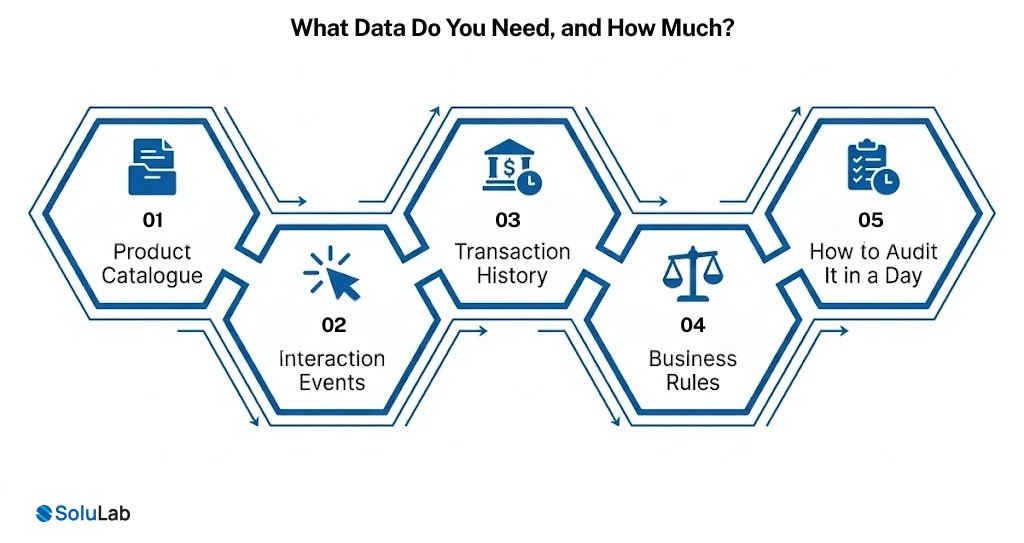
The product catalogue with real attributes, user interaction events, transaction history, and your business rules. The common thresholds are roughly 10,000 interactions and three to six months of history for collaborative methods to work at all, though content-based approaches need far less. Catalogue attribute depth matters more than interaction volume.
1. Product Catalogue
Not just titles and prices. Category hierarchy, attributes specific to your vertical, images, descriptions, and crucially a consistent identifier that survives across systems. Most catalogues fail on the last point.
2. Interaction Events
Views, clicks, searches, add-to-cart, wishlist. Timestamped, user-identified, and ideally including the context the interaction happened in.
3. Transaction History
Purchases, and returns. Returns are the strongest negative signal available and almost nobody feeds them into a personalized recommendation engine.
4. Business Rules
Stock, margin, exclusions, compliance constraints. Collect them before modelling. They narrow the candidate set and they change what “good” means.
5. How to Audit It in a Day
Count the percentage of products with complete attributes. Count the percentage of users with more than five interactions. Check whether identifiers match across catalogue and events. Those three numbers tell you most of what a readiness assessment would, and they are the first thing our AI-based recommendation system work starts with.
Which Algorithms Should the PoC Test?
Content-based for cold start and new items, collaborative filtering for behavioural signal, hybrid for the realistic production answer, and a semantic or embedding approach where product text and imagery carry meaning. Testing one algorithm is not a PoC; it is an implementation with extra steps.
1. Content-Based Filtering
Recommends items similar to what the user engaged with, using item attributes. Works on day one with no behavioural history, which makes it the cold start answer. Limited by how well your catalogue is described.
2. Collaborative Filtering
Recommends what similar users liked. Strong once you have interaction density, useless before it. This is the method most associated with an AI-powered recommendation system and the one most likely to disappoint in a thin-data PoC.
3. Hybrid Models
Combine both, usually weighting content-based early in a user’s life and collaborative later. This is what production systems actually look like, so a PoC that does not test a hybrid is not testing the real candidate.
4. Semantic and Embedding Approaches
Represent products and users in a shared vector space using text and image understanding. Particularly strong where attributes are inconsistent, because the model reads the description and the picture rather than trusting the metadata.
5. The Baseline You Must Also Run
Most-popular-item recommendations. No personalisation at all. If your sophisticated model cannot beat this, and that happens more often than vendors admit, you have learned something valuable and cheap.
How Do You Validate Recommendations on a Real Catalogue?
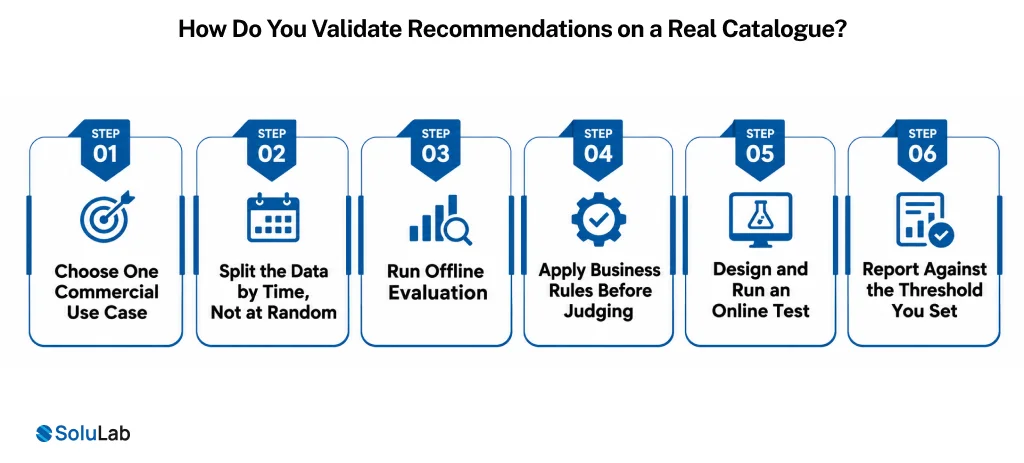
Offline first to rank the candidates, then online to find out whether the ranking was real. Offline tests ask whether the algorithm predicts items users engaged with. Online tests ask whether customers buy more. These frequently disagree, and when they do, the online result is the one that counts.
1. Choose One Commercial Use Case
Homepage recommendations, product page cross-sell, cart upsell, or email. Pick one. A PoC that tries to prove four placements proves none of them properly.
2. Split the Data by Time, Not at Random
This is the step that invalidates more PoCs than any other, and the next section explains why in detail. Train on an earlier period, test on a later one.
3. Run Offline Evaluation
Precision@K and recall@K for relevance, NDCG@K for ranking quality, catalogue coverage for how much of your range gets surfaced, and cold start performance measured separately for new users and new items.
4. Apply Business Rules Before Judging
Re-score the recommendations with stock, margin and exclusion rules applied. Offline metrics computed before this step describe a system you cannot ship.
5. Design and Run an Online Test
A/B test against your current experience with a pre-calculated sample size and duration. Detail below.
6. Report Against the Threshold You Set
Go, no-go, or a specific stated condition under which it becomes a go. A PoC report without one of those three outcomes has not finished.
The Four Measurement Mistakes That Invalidate a PoC
This is the part no competing guide covers, and each of these four will produce confident numbers that do not survive production.
1. Random Train and Test Splits Leak the Future
If you split interactions randomly, your training set contains events that happened after events in your test set. The model effectively sees the future, and every algorithm you test scores well.
This is not a subtle statistical nicety. It is the difference between a PoC that predicts production performance and one that does not. Always split chronologically: train on weeks one to eight, test on weeks nine and ten. The numbers will drop, sometimes sharply. Those lower numbers are the real ones.
2. Offline Accuracy Does Not Predict Online Revenue
Offline metrics measure whether the model reproduces past behaviour. Online tests measure whether it changes future behaviour. Those are different questions, and a model that is excellent at the first can be worthless at the second, because recommending items a user would have found anyway scores well and adds nothing.
Use offline testing to shortlist, never to decide.
3. Popularity Bias Makes Everything Look Good
Recommend bestsellers to everyone and your accuracy metrics improve, because bestsellers are what most people buy. You have built an expensive bestseller list.
Track catalogue coverage alongside accuracy: what share of your range ever gets recommended. If coverage is low and accuracy is high, you are measuring popularity, not personalisation.
4. The Feedback Loop Hides the Damage
Once live, the model shapes the data it later learns from. Items it recommends get seen, get bought, and look more popular. Items it ignores disappear. Within months your training data reflects the model’s choices rather than customer preference.
Build an exploration allowance from the start, where a small share of recommendations are deliberately chosen to gather information. Nobody includes this in a PoC, and it is cheaper to design in than to retrofit.
How Do You Design the Online Test?
Calculate the sample size before you start, run for full weekly cycles, define guardrail metrics that can stop the test, and decide the decision rule in advance. Most recommendation A/B tests are stopped when the numbers look good, which is how teams ship changes that do nothing.
1. Calculate Sample Size First
Work backwards from the smallest lift worth shipping. If a 1% conversion improvement would not justify the build, do not design a test that can only detect 3%.
2. Run Full Weekly Cycles
Shopping behaviour is weekly. A test running Tuesday to Friday measures a slice of your customers, not your customers.
3. Set Guardrail Metrics
Average order value, return rate, and catalogue coverage. A recommender that lifts conversion while raising returns has made you poorer, and only a guardrail catches it.
4. Do Not Stop Early Because It Looks Good
Peeking at results and stopping when significance appears inflates false positives substantially. Decide the duration, then honour it.
5. Measure Incrementality, Not Attribution
Attribution credits the recommendation for purchases that would have happened anyway. A holdout group that never sees recommendations is the only honest comparison.
What Should the PoC Deliver, and What Does It Cost?
Here’s what PoC deliver and cost:
| Deliverable | What it contains |
| Data readiness assessment | Attribute completeness, interaction density, identifier integrity, with the gaps named |
| Algorithm comparison | Three or more candidates plus baseline, scored offline on time-based splits |
| Business rule impact | How much performance changes once stock, margin and exclusions apply |
| Online test result | Incremental lift against a holdout, with guardrails reported |
| Production cost estimate | Build, integration and run cost for the recommended approach |
| Go or no-go recommendation | Against the threshold agreed at the start |
| Scope | Typical range | Timeline |
| Data readiness assessment only | $8,000 to $18,000 | 1 to 2 weeks |
| Offline PoC, three algorithms plus baseline | $25,000 to $55,000 | 4 to 6 weeks |
| Offline plus online A/B validation | $45,000 to $90,000 | 7 to 10 weeks |
| Production build after a successful PoC | $90,000+ | 12 to 24 weeks |
How SoluLab Can Help
SoluLab has delivered 500+ projects since 2014, with machine learning engineering as a core practice.
1. Data Readiness Assessment
We audit your catalogue and interaction data and tell you what quality of recommendation it can support before anyone builds. Sometimes the answer is enrichment first, which is cheaper to hear early.
2. PoC Design and Execution
Protocol first: baselines, chronological splits, metrics and a threshold agreed in writing. Then the comparison. Our AI recommendation engine development services cover both the design and the build.
3. Catalogue Enrichment
Computer vision and language models over your product data to extract the attributes your PIM never captured, which usually lifts results more than changing algorithm does.
4. Production Builds and Integration
Serving infrastructure, latency budgets, business rule engines and integration into your commerce platform. Related retail patterns sit in AI agents in retail and e-commerce and AI in demand forecasting.
5. Evaluation and Monitoring
Drift detection, coverage tracking and the exploration allowance that stops your feedback loop closing.
6. Vendor-Neutral Advice
We build, and we will also tell you when an off-the-shelf platform is the better answer for your volume. That conversation is usually shorter than vendors would like.
Conclusion
The honest summary is that most recommendation PoCs answer the wrong question. They ask whether recommendations can be generated, which was never in doubt, instead of whether yours would beat what you already do by enough to justify the build. The difference comes down to four things: a baseline you actually ran, a threshold you set before seeing results, a chronological split so the model cannot see the future, and an online test against a holdout.
Get those four right and a PoC costs six weeks and settles the question. Get them wrong and you will get encouraging numbers, a production build, and a quiet conversation nine months later about why the lift never appeared.
If you want that run properly, SoluLab, an AI development company, can help your business design and execute it. Book a discovery call and we will start with your data rather than our slides.
FAQs
Neha is a curious content writer with a knack for breaking down complex technologies into meaningful, reader-friendly insights. With experience in blockchain, digital assets, and enterprise tech, she focuses on creating content that informs, connects, and supports strategic decision-making.