Key Takeaways
- Real AI integration means a model wired into a live workflow with permission to act, not a pilot running beside the business.
- The strongest examples share three traits: abundant structured data, a fast verification loop, and a clearly defined handoff to a human.
- Named deployments beat vague claims. Waymo, Klarna, John Deere, Mastercard and Siemens all run AI in production with public, checkable results.
- Klarna’s reversal is the most useful case on this list, because it shows what happens when you measure volume instead of quality.
- Integration difficulty lives in the connectors and permissions, not the model. Every mature example spent more on plumbing than on AI.
- Most industries are further along in back-office automation than in the customer-facing applications that get the headlines.
- Start with one high-volume workflow, run it in shadow mode, and expand only after the numbers hold.
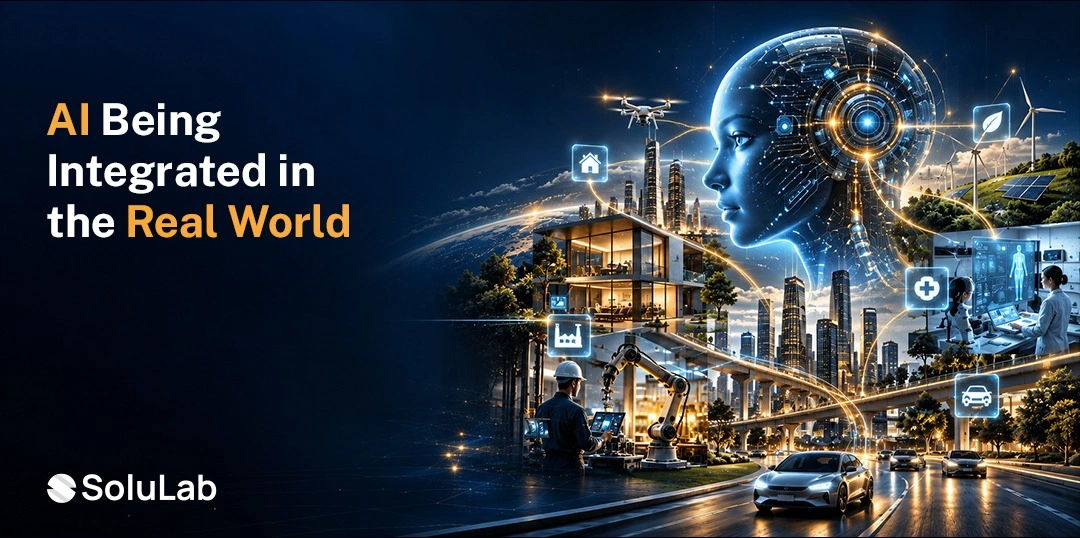
Examples of AI being integrated in the real world now span nearly every sector: radiology triage in hospitals, driverless taxis on public roads, fraud scoring on card transactions, weed-spotting cameras on tractors, and support assistants handling millions of chats.
What separates real AI integration from a pilot is simple. The model is wired into a live workflow, with permission to act, and someone is accountable for the outcome.
The money has followed. In the 2026 Gartner CIO and Technology Executive Survey, 84% of respondents expected their enterprise to increase generative AI funding this year (Gartner). Spending is not the constraint anymore. Integration is.

What does AI integration in the real world mean?
AI integration means connecting a model to your live systems, data, and workflows so it produces an outcome someone depends on. A chatbot answering questions in a demo environment is a prototype. The same model reading a ticket, checking an account, issuing a refund, and writing back to the CRM is an integration.
1. The three things that make it real
First, connection to systems of record. The model reads and writes where the business actually keeps its data. Second, permission to act, scoped and logged. Third, a defined fallback when confidence drops, because every deployed system eventually meets an input it should refuse.
2. Why integration is harder than the model
This surprises people. On almost every engagement we run, connector work, authentication, error handling, and permission design consume more hours than the AI layer. Legacy systems rarely have clean APIs. Rate limits differ. Sandbox environments are inconsistent or missing. The model is the easy part.
3. Integration versus automation
Automation executes fixed rules. Integration puts a model inside the loop so the system can handle inputs the rules did not anticipate. Most production deployments blend both, with deterministic automation handling the predictable path and the model handling the variance. Our broader breakdown of AI use cases and applications covers how that split typically falls by industry.
Top 10 examples of AI integration in the real world
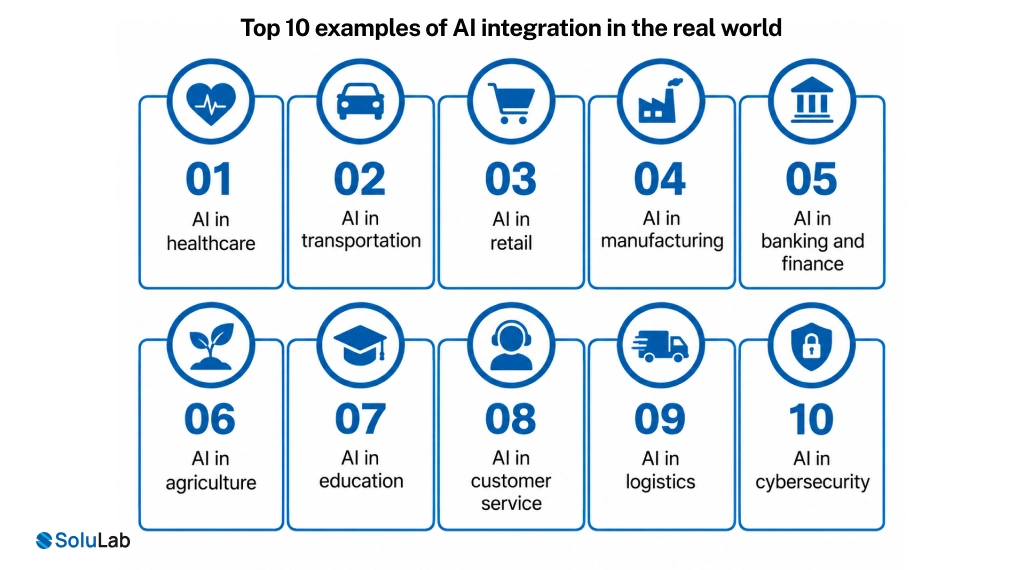
These are production deployments, not proofs of concept. Each one has named companies behind it and results you can go and check.
1. AI in healthcare: from diagnosis to patient care
Hospitals use AI to triage imaging studies, flag time-critical findings, and remove documentation burden from clinicians. The pattern is consistent: the model prioritizes and drafts; the clinician decides. Regulatory clearance, not model accuracy, is usually what gates deployment.
Aidoc runs FDA-cleared algorithms across hospital networks that scan CT studies as they arrive and push urgent findings to the top of the radiologist’s worklist. Viz.ai does something similar for stroke, detecting large vessel occlusions and alerting the intervention team directly, which compresses the window that determines patient outcomes.
On the documentation side, Microsoft’s Nuance DAX Copilot listens to the clinical encounter and drafts the note. That returns time clinicians previously spent typing after hours. None of these replace a clinician. They reorder the queue and remove typing. Hospitals extending this further into workflow automation typically start with AI agents in healthcare for scheduling and administrative tasks before touching anything clinical.
2. AI in transportation: smarter navigation and autonomous driving
Transportation is where AI moved from advisory to operational. Routing systems predict conditions rather than measuring them, and autonomous vehicles now carry paying passengers without a human in the driver’s seat.
Waymo operates fully driverless commercial robotaxi service in Phoenix, San Francisco, Los Angeles and Austin, with no safety driver on board. That is the clearest existence proof on this list. Google Maps rebuilt its arrival time predictions using graph neural networks developed with DeepMind, treating the road network as a graph and predicting traffic conditions rather than reporting them.
Tesla’s supervised full self-driving takes a different architectural bet, relying on vision and end-to-end learning rather than detailed prior maps. The three approaches disagree on almost everything technically. That tells you the problem is not settled. Broader applications across fleets and infrastructure sit under AI in transportation.
3. AI in retail: personalized shopping and demand forecasting
Retail was early and remains among the most mature. The money is less in recommendations than in forecasting, because a better demand forecast reduces both stockouts and markdowns at the same time.
Amazon’s recommendation and forecasting systems are the canonical example, driving a substantial share of discovery and feeding inventory decisions across a network of fulfillment centres. Walmart applies machine learning to demand forecasting and shares the resulting signals with suppliers.
That changes replenishment upstream, not just on its own shelves. Stitch Fix built its entire operating model around algorithmic styling paired with human stylists, a genuinely hybrid design rather than a bolt-on. Retailers moving toward conversational and agentic experiences are increasingly building on AI agents in retail and e-commerce.
4. AI in manufacturing: predictive maintenance and smart factories
Manufacturing has the best economics for AI on this list, because the cost of an unplanned line stoppage is enormous and precisely known. That makes the business case arithmetic rather than aspirational.
Siemens Senseye Predictive Maintenance ingests sensor and maintenance data across industrial assets to forecast failures before they happen. Siemens runs it inside its own plants, not just as a product it sells. BMW uses computer vision for automated quality inspection on production lines, catching paint and assembly defects that are genuinely hard for a human to catch consistently at line speed.
GE Aerospace monitors engine telemetry to schedule maintenance around actual component condition rather than fixed intervals. The common thread is sensors that already existed, finally being used. More on the sector sits in our breakdown of the role of AI in the manufacturing industry.
5. AI in banking and finance: fraud detection and risk management
Banking ran machine learning in production decades before the current wave. What changed is the speed of scoring and the addition of language models for document-heavy work.
Mastercard’s Decision Intelligence scores transactions in real time against behavioural patterns, deciding within milliseconds whether a purchase looks like you. PayPal runs comparable models across its payment volume. On the document side, JPMorgan’s COiN system parses commercial loan agreements to extract clauses that analysts previously read manually, which is a narrow task with a clear verification path.
HSBC has worked with Google Cloud on anti-money-laundering detection. The target there is the false positive rate, which historically buried compliance teams in pointless review work. Related applications across lending and compliance sit under AI in banking.
6. AI in agriculture: precision farming and crop monitoring
Agriculture is an underrated AI success story, largely because the results are measured in chemistry rather than clicks.
John Deere’s See and Spray mounts computer vision on the sprayer boom, distinguishes weeds from crops in real time, and sprays only the weeds. Deere reports substantial reductions in herbicide volume compared with broadcast spraying. That is a cost saving and an environmental one at the same time.
Bayer’s Climate FieldView aggregates field-level data to guide seeding density and input decisions per zone rather than per field. Blue River Technology, now part of Deere, pioneered much of the underlying vision work. This is a domain where the verification loop is a season long, which slows iteration considerably.
7. AI in education: personalized learning and AI tutors
Education deployments are real but earlier in maturity, and the honest evidence on learning outcomes is still thin compared with the enthusiasm.
Khan Academy’s Khanmigo, built on GPT-4, tutors students through problems using Socratic prompting rather than supplying answers, and it is deployed across school districts. Duolingo Max added explanation and roleplay features.
Learners practise conversation and get told why an answer was wrong, not just that it was. Coursera Coach does something similar for adult learners inside course content. The design constraint that matters here is refusing to just give the answer, which is harder to engineer than it sounds. Sector context sits under AI in education.
8. AI in customer service: intelligent support and AI agents
This is the most instructive example on the list, because it includes a public reversal that most vendor case studies quietly omit.
In February 2024, Klarna announced its AI assistant had handled 2.3 million conversations in its first month. The company equated that to roughly 700 full-time agents. Average resolution dropped from about 11 minutes to under 2. Fourteen months later, CEO Sebastian Siemiatkowski told Bloomberg that cost had been too dominant a factor and the result was lower quality, and Klarna began rehiring human agents.
By 2026 the company had settled on a hybrid model where AI handles routine volume and humans handle complex and premium cases. The assistant never went away, and it now does more work than ever alongside people. Read that arc carefully before planning your own rollout. The lesson is not that AI support fails. It is that Klarna measured volume and cost rigorously, and customer outcome quality much less so. Practical patterns for getting this right sit under AI in customer service.
9. AI in logistics: smarter supply chains and route optimization
Logistics runs on optimization problems with expensive wrong answers, which makes it a natural fit. The wins here are incremental per package and enormous in aggregate.
UPS built ORION to optimize delivery routes across its network, and the company has reported savings in the region of a hundred million miles driven per year. DHL applies machine learning to demand forecasting and warehouse operations.
Maersk uses AI for container flow and port call optimization, where a few hours of berth time carries real cost. FedEx Dataworks builds predictive visibility across shipment data. Multi-agent coordination across these workflows is covered in our work on AI agents in supply chain and logistics.
10. AI in cybersecurity
Security teams adopted AI early out of necessity, because alert volume long ago exceeded what humans could triage. The recent shift is from anomaly detection toward assisted investigation.
Darktrace models normal network behaviour per environment and flags deviations, rather than matching known signatures. Microsoft Security Copilot sits on top of an analyst’s tooling to summarize incidents, explain scripts, and draft response steps.
CrowdStrike’s Charlotte AI triages detections to cut the review burden on tier-one analysts. The uncomfortable symmetry is that attackers use the same capabilities for phishing and reconnaissance. This area never reaches a steady state. Deeper coverage sits under agentic AI in cybersecurity.
What do the strongest AI integration examples have in common?
Three conditions, and they predict success better than industry or budget does. Run a candidate workflow against them before you commit.
1. Abundant structured data that already exists
Every example above sits on data the organization was already collecting. Sensor telemetry on industrial assets. Transaction histories. Imaging studies. Route and delivery records. Nobody in this list created a new data pipeline first. They finally used one.
2. A fast, cheap verification loop
Was the fraud flag correct? Did the engine fail? Did the package arrive on time? These answers come back quickly and cheaply, which lets the model improve. Agriculture is the outlier here, with a growing season between action and outcome, and its iteration speed suffers accordingly.
3. A defined human handoff
Radiologists still read the scan. Stylists still curate the box. Klarna learned this one the hard way. The deployments that hold up define exactly which decisions the model finalizes and which it escalates, and they resource the escalation path properly.
4. What is conspicuously absent
Nothing on this list is a general-purpose assistant doing everything for everyone. Every single one is narrow, scoped, and connected to specific systems. That is not a coincidence, and it is the most transferable lesson here.
How is AI integration changing real-world business operations?
It is changing where work sits rather than eliminating it. Routine volume moves to models, humans move up the complexity ladder, and a new category of work appears around monitoring and governance that did not exist three years ago.
The adoption numbers show the gap clearly. The 2026 Stanford AI Index found organizational adoption of AI reached 88%, while actual production deployment of autonomous agents still sits in single digits across most businesses. Nearly everyone is using AI somewhere. Very few have wired it into a workflow with permission to act.
1. Cost structures shift from linear to fixed
Support, review, and processing costs traditionally scaled with headcount. Once a model absorbs the routine tier, cost becomes mostly fixed infrastructure plus a small inference charge per transaction. That changes how you plan capacity for a demand spike.
2. Cycle times compress, sometimes dramatically
Regulatory impact assessment, claims processing, route planning, incident triage. The pattern repeats. Work that queued for a person now happens on arrival, which moves the bottleneck somewhere else in the process. Finding the new bottleneck is a real exercise, and teams are often surprised by where it lands.
3. New roles appear around the systems
Someone owns model performance. Someone reviews sampled outputs. Someone updates the knowledge base when the product changes. Deloitte’s 2026 TMT Predictions size the global agentic AI market at roughly $8.5 billion in 2026, growing toward $35 billion by 2030, and note that better orchestration by enterprises could push that as high as $45 billion (Deloitte). Orchestration is a job, not a feature.
4. Measurement becomes the hard part
When a human handled the work, quality was implicitly managed through training and supervision. When a model handles it, quality has to be measured explicitly or it drifts unnoticed. This is the operational change most organizations underestimate.
Why do AI integration projects fail?
Mostly on scope, data readiness, and measuring the wrong thing. Gartner predicts that more than 40% of agentic AI projects will be canceled by the end of 2027, citing escalating costs, unclear business value, and inadequate risk controls (Gartner).
1. Optimizing for volume instead of outcome
The Klarna lesson, and it generalizes. Deflection rate, tickets closed, and documents processed are all easy to measure and easy to game. Resolution accuracy, reopen rate, and customer outcome quality are harder to measure and are the ones that matter. Pick the harder metrics first.
2. Starting with the wrong workflow
Teams often pick the most visible process rather than the most suitable one. High volume, stable rules, existing data, and low blast radius beat strategic importance every time for a first integration.
3. Underestimating the plumbing
Budget allocated to model work and nothing to connectors, authentication, error handling, or permission design. This is the most predictable overrun in the category. If your estimate does not have integration as the largest line item, re-estimate.
4. No operational owner after launch
The project team disbands, performance drifts as data and products change, and nobody notices for months. Name an owner before you go live, not after.
What does AI integration cost and how long does it take?
A scoped production AI integration typically costs between $40,000 and $50,000+ and takes 8 to 20 weeks, driven mainly by how many systems it touches and how clean the data is. A pilot on a single workflow lands well below that and is the right first commitment.
1. What drives the number
| Cost driver | Effect on budget | Why |
| Number of systems connected | Highest single driver | Each adds auth, error handling and sandbox setup |
| Data quality and availability | High | Cleanup is routinely underestimated by half |
| Regulatory scope | High in healthcare and finance | Validation, audit trails and documentation |
| Autonomy level | Moderate to high | Write actions need testing, logging and rollback |
| Custom model work | Variable | Often avoidable; an off-the-shelf model plus retrieval usually wins |
| Ongoing monitoring | Recurring | Drift detection and revalidation never stop |
2. Build, buy, or integrate
If your workflow is generic and your stack is mainstream SaaS, a vendor feature is probably cheaper and faster. Custom AI integration earns its cost when your workflows are unusual, your data cannot leave your environment, or you need the model to act inside systems no vendor supports. Be honest about which you are. For a small team on a standard stack, custom is often overkill, and we will say so. Most engagements start as scoped AI integration services work rather than a full custom build.
3. Where teams get the estimate wrong
Two places, consistently. Data cleanup and exception handling. The happy path is maybe 30% of the engineering effort. The rest is everything your source systems do when they are having a bad day.
How can businesses start integrating AI into their operations?
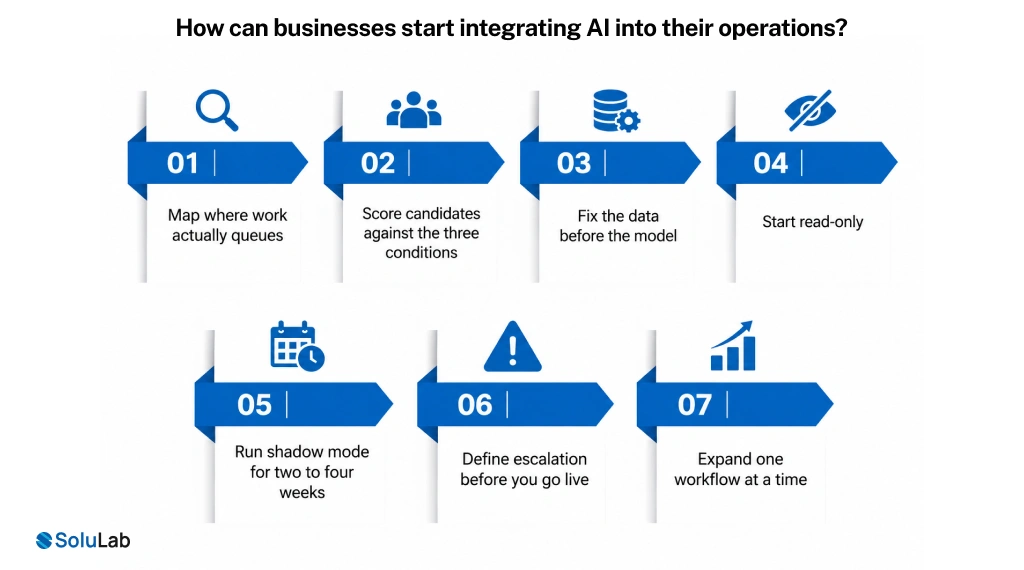
The order matters more than the speed, and teams that jump to step five usually rebuild.
1. Map where work actually queues
Find the processes where things wait. Waiting is where cost hides. Count volume, time each step, and calculate a rough cost per transaction so you have a baseline to beat.
2. Score candidates against the three conditions
Existing structured data, fast verification loop, definable human handoff. Anything failing two of the three goes to the bottom of the list regardless of how strategic it feels.
3. Fix the data before the model
Retrieval and prediction quality are capped by data quality. Stale documentation, duplicate records, and inconsistent schemas all degrade output. This is the least glamorous phase, and skipping it is why accuracy plateaus.
4. Start read-only
Let the system look things up and propose before you let it change anything. Promoting a capability from read to write should be a deliberate decision with a test plan, not a configuration flag.
5. Run shadow mode for two to four weeks
The model processes live work and produces proposals nobody acts on. Compare its output against what your team actually did. This gives you a real accuracy baseline before anything is at stake, and it is the single highest-value step in this list.
6. Define escalation before you go live
Set a confidence threshold. Name the decisions that always need a human regardless of confidence. Give staff a one-click override that logs the correction as a training signal.
7. Expand one workflow at a time
Launch on a single process, review outputs manually for a few weeks, then add the second. Teams that launch ten workflows at once cannot diagnose which one is failing. Where internal capacity is the constraint, it is usually faster to hire AI developers for defined build phases than to retrain a product team mid-flight. An AI consulting engagement can also run the scoring exercise in step two inside a couple of weeks.

Conclusion
The examples above look diverse and are not. A hospital triaging scans, a tractor spotting weeds, and a bank scoring a transaction are all doing the same thing: applying a model to data that already existed, inside a workflow where someone checks the result. That is the whole pattern.
If you are looking for where to start, ignore the industry framing and run your own processes against the three conditions. Existing structured data, quick verification, clear human handoff. The workflow that scores highest is almost never the one leadership assumed, and finding that out early is worth more than any vendor demo.
SoluLab, an AI development company, can help your business identify which workflows are genuinely ready, build the integration into the systems you already run, and put the monitoring in place before go-live rather than after. We have delivered integrations across healthcare, finance, retail, logistics and manufacturing, and we will tell you plainly when a vendor feature would serve you better than a custom build.
FAQs
Shipra Garg is a tech-focused content strategist and copywriter specializing in Web3, blockchain, and artificial intelligence. She has worked with startups and enterprise teams to craft high-conversion content that bridges deep tech with business impact. Her work translates complex innovations into clear, credible, and engaging narratives that drive growth and build trust in emerging tech markets.