Key Takeaways
- EMR integration enables seamless exchange of patient data between healthcare systems and applications.
- Standards such as HL7, FHIR, and DICOM support secure and interoperable data sharing.
- Common EMR integration methods include APIs, interfaces, middleware, and custom integrations.
- Integration costs depend on system complexity, features, data volume, security requirements, and implementation scope.
- Proper EMR integration improves workflow efficiency, data accuracy, patient care, and interoperability.
- Security, compliance, authentication, and data privacy should be considered throughout the integration process.
EMR integration is the process of connecting an electronic medical record system with other clinical, billing, or patient-facing software so data flows automatically. It uses standards like HL7 and FHIR, or vendor APIs, routed through an interface engine, so patient records stay consistent across every system that needs them.
SoluLab builds healthcare software and system integrations for providers, ISVs, and digital health vendors, from EMR data exchange to full interface-engine architecture. If you are scoping a build, our enterprise software development team can plan the standards, endpoints, and compliance work with you. That work sits inside our healthcare software development practice.
What is EMR integration?
EMR integration connects an electronic medical record system to the other software a practice runs, so data moves between them without manual re-entry. It ties the EMR to billing and revenue-cycle tools, lab and imaging systems, e-prescribing, scheduling, and patient apps.
The point is a single, current view of the patient. When a lab result posts, the EMR shows it. When a visit closes, the charge lands in billing. Without integration, staff copy data by hand between screens, which is slow and error-prone.
People often say EMR and EHR interchangeably. An EMR is the digital chart inside one practice; an EHR is designed to share that record across providers. The integration work is largely the same, which is why “emr integration” and “ehr integration” describe the same connective plumbing.
How does EMR integration work?
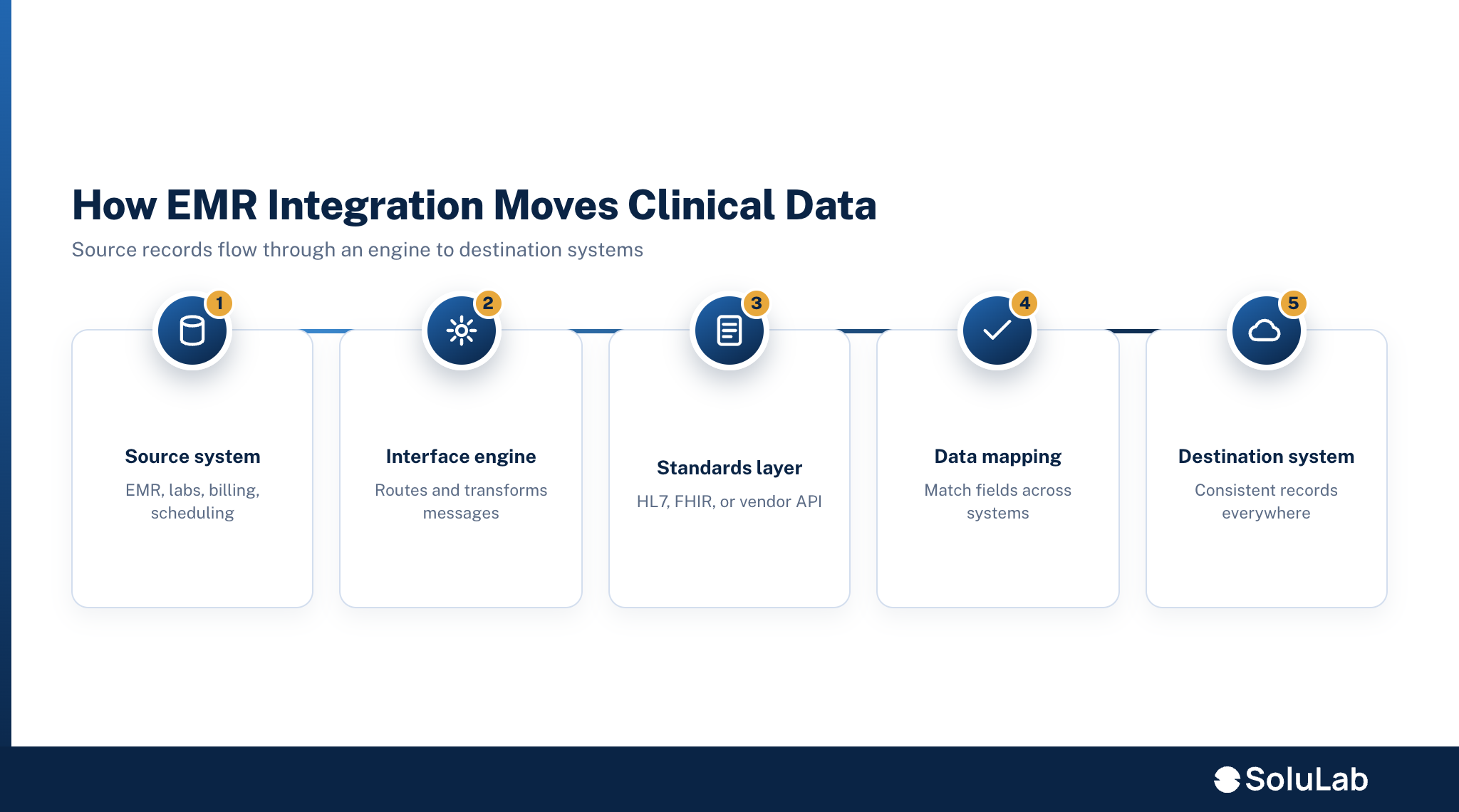
EMR integration works by moving a clinical message from a source system, translating it, and delivering it to a destination system in a format that system accepts. The flow usually looks like this:
- Source event. A system generates data: an admission, a lab order, a completed charge, a new patient demographic record.
- Interface engine. A middleware layer receives the message. It queues, routes, and transforms data so mismatched systems can talk. Engines like Mirth Connect, Rhapsody, and Redox handle this role.
- Data mapping. The engine maps fields from the source format to the destination format, for example turning an HL7 v2 segment into the fields a billing system expects.
- Transport. The message travels over a standard: an HL7 v2 feed, a FHIR REST API call, or a vendor API, secured in transit.
- Destination system. The target system ingests the data and acknowledges receipt, so both sides know the exchange succeeded.
Point-to-point setups skip the central engine and wire two systems directly. That is quick for one connection and painful once you have ten, because every new system multiplies the links you maintain.
Definition box, interface engine: An interface engine is middleware that sits between clinical systems, receives messages, transforms formats, routes them to the right destination, and logs every transaction for audit. It is the traffic controller of a healthcare integration.
What standards are used in EMR integration (HL7 vs FHIR)?
EMR integration relies on healthcare data standards so different vendors’ systems can exchange information they both understand. The main ones are HL7 v2, HL7 FHIR, and direct vendor APIs.
HL7 Version 2 is the long-serving messaging standard that moves admissions, orders, and results between systems, and it still runs a large share of live hospital interfaces. FHIR (Fast Healthcare Interoperability Resources) is HL7’s modern standard for exchanging healthcare information electronically, built on common web technology such as RESTful APIs, XML, JSON, and HTTP (HL7 FHIR overview). FHIR draws on the earlier HL7 v2 and v3 work and repackages it for web and mobile app development (IBM on HL7 and FHIR). FHIR has become a leading interoperability standard for exchanging healthcare data (peer-reviewed review, PMC).
The table below compares the three routes most EMR integrations use.
| Approach | Data format | Best use case | Real-time support | Integration effort |
| HL7 v2 | Pipe-delimited messages (ADT, ORM, ORU) | Legacy hospital feeds: admissions, orders, results | Near real-time via message feeds | Moderate; needs mapping and an engine |
| HL7 FHIR | RESTful API, JSON or XML resources | Modern app, mobile, and patient-facing exchange | Yes, on-demand API calls | Lower for API-native systems |
| Direct vendor API | Vendor-specific (often REST/JSON) | One named EMR, for example a cloud EMR’s own API | Yes, where the vendor supports it | Varies by vendor documentation |
Most real deployments mix these. A hospital may keep HL7 v2 feeds for lab results while adding FHIR APIs for a new patient app.
What are the main types of EMR integration?
EMR integration comes in four common patterns, and the right one depends on how many systems you connect and how much you can maintain.
- API-based integration. Systems talk through published APIs, increasingly FHIR REST APIs. Best when the EMR and the target both expose modern, documented endpoints.
- Interface-engine integration. A central engine routes and transforms messages between many systems. Best when you have several endpoints and want one place to manage them.
- Point-to-point integration. Two systems connect directly with no middleware. Fast for a single link, hard to scale as connections multiply.
- File-based integration. Systems exchange batch files, such as scheduled CSV or flat-file drops. Common for older systems and non-urgent data, but not real-time.
How long does an EMR integration take and what does it cost?
Timeline and cost depend on the standards involved, the number of endpoints, the state of each system’s API, and certification or compliance needs. A single FHIR API connection to a modern cloud EMR is far lighter than routing a dozen HL7 v2 feeds through a new interface engine.
The cost and timeline drivers are consistent across projects:
- Number of endpoints. Each system you connect adds mapping, testing, and maintenance.
- Standard and system age. Modern FHIR endpoints move faster than bespoke work against legacy HL7 v2 feeds.
- Data mapping complexity. Mismatched field structures and custom segments add effort.
- Compliance scope. HIPAA safeguards, audit logging, and any certification add time.
- Ongoing maintenance. Interfaces need monitoring, error handling, and updates as source systems change.
Specific price ranges and delivery timelines vary widely by scope, so we do not publish a single figure here. Scope yours against the drivers above, then get a quote on your named EMR and endpoint list.
Is EMR integration HIPAA compliant?
EMR integration can and must be built to comply with HIPAA, because it moves protected health information (PHI) between systems. Any integration handling PHI has to protect that data in transit and at rest, and log who accessed what.
Under HIPAA, the Privacy Rule protects individually identifiable health information held or transmitted by a covered entity or its business associate (HHS summary of the HIPAA Privacy Rule). The Security Rule covers the technical protection of that information in electronic form (CDC on HIPAA). For an integration, that translates into concrete controls:
- Encrypt PHI in transit (TLS) and at rest.
- Enforce access control and authentication, so only authorized systems and users read the data.
- Keep audit logs of every message and access event.
- Sign business associate agreements with vendors who touch PHI.
Ask any integration partner for their current security attestations and confirm they will sign a business associate agreement before PHI moves.
What are the benefits of EMR integration?
EMR integration pays off by cutting manual work and keeping records accurate across systems. The gains show up in daily operations rather than in one headline metric.
- Fewer manual entries. Staff stop re-keying data between the EMR, billing, and labs.
- Fewer errors. Automated exchange removes transcription mistakes that manual copying introduces.
- Faster access to information. Results, charges, and demographics appear where clinicians and billers need them, sooner.
- Better continuity of care. A consistent record follows the patient across labs, specialists, and patient apps.
Peer-reviewed work on EMR and FHIR-based exchange supports interoperability as the foundation for these outcomes (PMC review of FHIR tools). [VERIFY: any SoluLab-specific outcome numbers or client results before citing them as first-party.

How do you choose an EMR integration partner?
Choose an EMR integration partner on standards depth, security posture, and delivered track record, not on a feature list. Use this checklist when you evaluate vendors:
- Standards support. Real HL7 v2 and FHIR experience, plus vendor-specific APIs for your named EMR.
- Interface-engine skill. Hands-on work with engines like Mirth Connect, Rhapsody, or Redox.
- Security and compliance. Demonstrated HIPAA-aligned practices, encryption, access control, and audit logging, with current attestations you can inspect.
- Track record. Shipped healthcare integrations, with references you can check.
- Maintenance model. A plan for monitoring interfaces and handling failures after go-live.
SoluLab builds healthcare software and integrations across these requirements. Our software consulting team scopes the standards and endpoints, cloud computing consulting covers where the interfaces run, and AI development applies once integrated clinical data feeds AI features. For reliable release and monitoring of live interfaces, our DevOps consulting services cover the operational side.
Frequently Asked Questions
Chintan leads SoluLab's highest-level AI consulting conversations, assessing whether a client's business problem actually justifies an AI investment before any solutioning begins.