Key Takeaways
- The matching engine is the easy part. Licensing, custody and core banking integration consume most of the budget and all of the timeline.
- Your licence class is set by your highest-risk activity, not your product vision. Operating a trading venue sits in the top tier wherever you are.
- Custody structure is an architecture decision made on day one. Retrofitting segregation after launch means rebuilding.
- Banks fail these projects on reconciliation, not on blockchain. A ledger that cannot be reconciled to the core system daily will not pass audit.
- Buying the venue and building the integration is the pattern most regulated launches converge on, and almost nobody advertises it.
Banks stopped asking whether to offer digital assets and started asking how to do it without failing an audit. The market has moved accordingly.
Grand View Research forecasts the cryptocurrency exchange platform market reaching USD 264.3 billion by 2030, growing at 28.4% a year from 2024, with banks, fintechs and credit unions grouped as commercial end users.
The engineering, though, is not the hard part. A matching engine is a solved problem. Digital asset exchange development for banks is difficult because a regulated crypto exchange has to sit inside an existing supervisory perimeter, reconcile to a core banking ledger every single day, and satisfy an examiner who has very likely never approved one before.
This guide covers what that actually takes in practice: licence classes, capital thresholds, custody structure, core banking integration and the timelines you should actually plan against.

Why Is a Bank-Grade Exchange Different?
A retail exchange optimises for listings, liquidity and speed to market. A regulated venue optimises for auditability, segregation and supervisory comfort. The same matching engine sits inside both, but everything around it changes: who holds the assets, how they are reconciled, what gets reported, and who can be held personally accountable when something breaks.
1. The Perimeter Already Exists
A fintech startup builds its compliance programme around the product. Crypto exchange development for banks runs the other way: the product fits inside a programme that already exists, with an audit function, a risk committee and regulators who will ask why this did not go through them.
2. An Institutional Crypto Trading Platform Reconciles Daily
Every position on the venue must tie back to the core banking ledger. On-chain settlement that takes minutes and a core system that batches overnight do not reconcile themselves, and this is where most bank crypto projects actually stall.
3. Segregation of Client Assets Is a Legal Structure
Where client assets sit, who controls the keys and what happens in insolvency are legal questions with architectural answers. Decide them before you write code.
4. Supervisors Want Explainability
A supervisor will ask how an order was priced, who could have moved the assets, and what your surveillance caught. “The system handled it” is not an answer that closes a review.
What Licences Does a Digital Asset Exchange Actually Need?
In the EU, operating a trading platform requires a Class 3 CASP authorisation under MiCA, the highest tier, with minimum own funds of EUR 150,000. Custody and exchange services sit at Class 2 with EUR 125,000, and order execution or advice sits at Class 1 with EUR 50,000. Your class is set by the highest-risk service you offer, and a Class 3 authorisation covers the tiers below it.
This section exists because every competing page on this topic says “ensure regulatory compliance” and then stops. Crypto exchange licensing requirements are specific and public, so here are the actual numbers.
1. The Three MiCA CASP Classes
| Class | Minimum own funds | Services covered |
| Class 1 | EUR 50,000 | Order execution, reception and transmission, placing, advice, portfolio management, transfer |
| Class 2 | EUR 125,000 | Custody and administration, fiat exchange, crypto-to-crypto exchange, plus Class 1 |
| Class 3 | EUR 150,000 | Operating a crypto-asset trading platform, plus Class 1 and 2 |
Capital must be paid-up share capital, share premium or retained earnings. Crypto-assets on the balance sheet do not count toward it, and national competent authorities can require more than the minimum based on your risk profile.
2. How Long Authorisation Takes
Four to nine months is the typical range, and the variance by regulator is large. CySEC in Cyprus runs roughly four to six months. The Bank of Lithuania and Latvijas Banka run four to eight. BaFin in Germany runs nine to eighteen.
Choose your jurisdiction with that spread in mind. It is frequently the longest item on the whole programme plan.
3. The Transition Period Has Closed
MiCA’s EU-wide transitional period ended on 1 July 2026, with no extensions granted. Several member states closed earlier, including Germany and Austria at the end of 2025 and Lithuania on 1 January 2026. Firms operating on legacy national registrations no longer have a runway.
4. Outside the EU
The United States remains a patchwork of state money transmitter licences plus federal considerations. Singapore runs through the MAS Payment Services Act. The UAE splits between VARA in Dubai and ADGM in Abu Dhabi. The UK operates FCA registration for cryptoasset activities. None of these map cleanly onto MiCA, which is why multi-jurisdiction launches cost considerably more than a single-market one.
How Should Custody Be Structured?
Digital asset custody solutions come in three shapes: self-custody with your own key infrastructure, a qualified third-party custodian, or a hybrid where hot wallet operations are internal and cold storage is external. The decision drives your licence class, your insurance, your capital treatment and your architecture, so it is not a later-phase choice.
1. Self-Custody With HSM and MPC
You hold the keys using hardware security modules or multi-party computation. Maximum control, maximum operational burden, and it usually raises your licence class because custody becomes one of your regulated activities.
2. Qualified Third-Party Custodian
A regulated custodian holds client assets. Reduces your operational risk and often your capital requirement, at the cost of a dependency and a fee. Most bank launches start here.
3. Hybrid Hot and Cold Split
Internal hot wallets for settlement liquidity, external cold custody for the bulk. This is where most mature venues land, and it is the structure worth modelling first.
4. What Supervisors Ask About Keys
Who can initiate a transfer, how many approvals are required, how key ceremonies are recorded, and what happens if two signatories are unavailable. Answer these in the design document, not the incident report. Our digital wallet development services work covers the key management layer specifically.
What Does the Architecture Look Like?
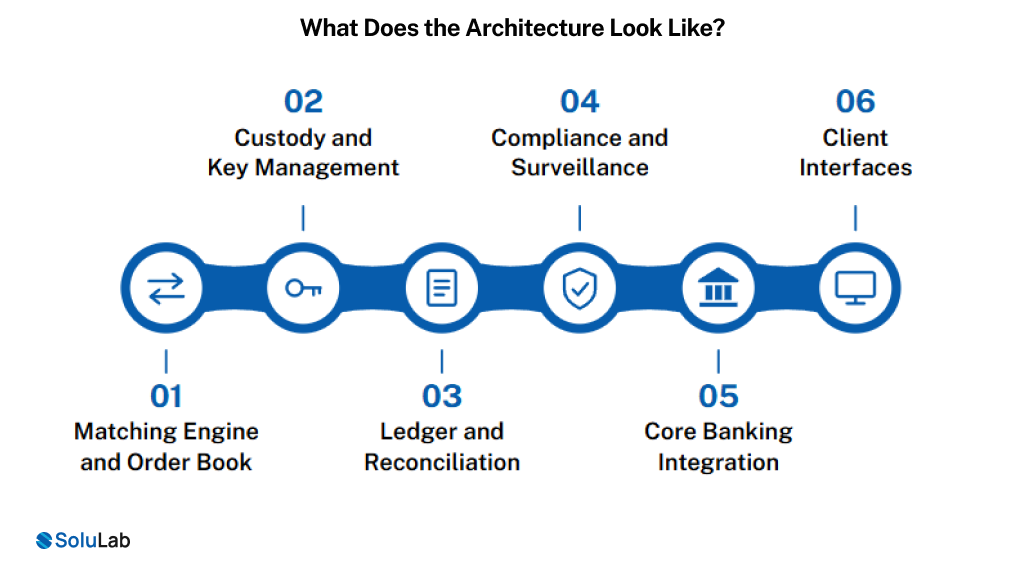
A crypto exchange architecture for a regulated institution has six layers: the matching engine and order book, the custody and key management layer, the ledger and reconciliation service, compliance and surveillance, the core banking integration, and client-facing interfaces. The matching engine is the smallest and best understood of the six.
1. Matching Engine and Order Book
Price-time priority, order types, risk checks pre-trade. Mature, well-documented, and available off the shelf. Spend your engineering elsewhere.
2. Custody and Key Management
HSM or MPC infrastructure, wallet hierarchies, approval workflows, and the air gap between hot and cold. The security perimeter of the whole system.
3. Ledger and Reconciliation
An internal double-entry ledger that is the source of truth, reconciled against both on-chain state and the core banking system. Build this properly and most audit findings disappear.
4. Compliance and Surveillance
Crypto exchange compliance lives here: KYC and KYB onboarding, transaction monitoring, sanctions screening, market abuse surveillance, and Travel Rule messaging for transfers above threshold. Related patterns sit in our blockchain KYC solutions work.
5. Core Banking Integration
Account linking, fiat rails, settlement instructions, and position feeds back into the bank’s reporting. Covered in the next section because it deserves one.
6. Client Interfaces
Web, mobile, and an API for institutional clients. In institutional digital asset infrastructure the API is the product and the UI is a convenience, which is the reverse of retail.
How Does It Integrate With Core Banking?
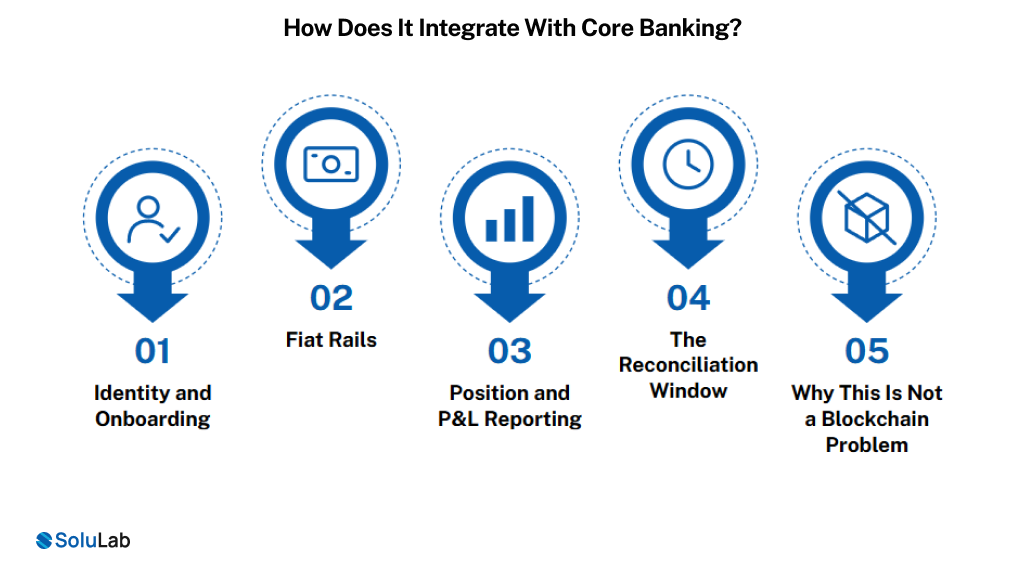
Through four connection points: customer identity, fiat movement, position reporting and daily reconciliation. The last one breaks the most projects, because blockchain settles continuously and core banking settles in batches, and nobody owns the gap between them until it appears in an audit.
1. Identity and Onboarding
Reuse the bank’s existing KYC rather than running a parallel process. Two customer records for one person is a regulatory problem waiting to surface.
2. Fiat Rails
Deposits and withdrawals through existing accounts, with the venue holding a settlement account rather than becoming a payment institution in its own right.
3. Position and P&L Reporting
Digital asset positions have to appear in the same reports as everything else. Treasury and finance will ask for this on day one of the pilot.
4. The Reconciliation Window
This is the hard one. On-chain state changes continuously. Core banking closes daily. You need a reconciliation service that reconciles three ledgers, your internal one, the chain, and the core system, and reports breaks before anyone asks.
5. Why This Is Not a Blockchain Problem
Teams staff these projects with blockchain engineers and discover the critical path runs through integration people who understand the core banking system. Budget accordingly. Our blockchain consulting services practice scopes exactly this gap.
Should You Build, Buy or White Label?
| Component | Typical range | Timeline |
| Regulatory scoping and licence application support | $25,000 to $80,000 | 4 to 9 months elapsed |
| White-label venue, configured and branded | $60,000 to $80,000 | 8 to 16 weeks |
| Custody integration, third-party custodian | $50,000 to $60,000 | 8 to 14 weeks |
| Compliance and surveillance layer | $80,000 | 12 to 20 weeks |
| Core banking integration and reconciliation | $80,000+ | 16 to 28 weeks |
Where Regulated Exchange Projects Fail
Here are some mistakes you should avoid:
1. Reconciliation Designed Last
The most common cause. Three ledgers, no owner, and a break report nobody can explain to an auditor.
2. Licence Scope Set by the Product Team
A feature gets added late, the activity changes class, and the authorisation no longer covers what you built.
3. Custody Decided After Architecture
Changing custody model post-design means rebuilding the key management, approval and reconciliation layers together.
4. Compliance Treated as a Feature
Surveillance and Travel Rule messaging bolted on at the end rather than designed into the transaction flow. They touch every path, so retrofitting is expensive.
5. Blockchain Expertise Without Banking Expertise
A team that understands chains but not core banking will build something elegant that finance cannot reconcile and audit will not sign.
How SoluLab Can Help
SoluLab has delivered 500+ projects since 2014, with blockchain engineering as a founding practice.
1. Regulatory and Architecture Scoping
Our digital asset exchange development services start here. We map your intended activities to licence classes and capital requirements, then design the architecture that supports them, before any build decision.
2. Platform Selection and Integration
Vendor-neutral assessment of matching and custody stacks, then the integration work that turns a licensed venue into your venue.
3. Compliance and Surveillance Engineering
Regulated crypto exchange development services differ from retail builds mainly here: KYC and KYB flows, transaction monitoring, sanctions screening and Travel Rule messaging designed into the transaction path rather than bolted alongside it.
4. Reconciliation and Core Banking Integration
The three-ledger reconciliation service, position reporting and fiat rail connections. The part that decides whether you pass audit.
5. Custom Build Where It Is Warranted
Full venue construction using our blockchain development services and smart contract development services teams, where off-the-shelf genuinely does not fit.
6. Tokenization Beyond Trading
Many bank programmes start with an exchange and move to issuance. Our work on digital asset tokenization covers that next step.

Conclusion
The hard parts of building a digital asset exchange for a regulated institution are not the parts that demo well. A matching engine can be licensed in weeks. A licence takes four to nine months and sets your launch date. Custody structure determines your capital treatment and cannot be changed cheaply later. And the reconciliation between three ledgers, yours, the chain and the core banking system, is where audits are passed or failed.
Teams that launch successfully tend to do the same four things: scope the licence before the product, decide custody before the architecture, staff the core banking integration as the critical path it is, and buy the matching engine rather than building it.
If you are scoping one of these, SoluLab, a blockchain development company, can help your business get the sequence right. Book a discovery call and we will start with your licence position rather than a platform demo.
FAQs
Neha is a curious content writer with a knack for breaking down complex technologies into meaningful, reader-friendly insights. With experience in blockchain, digital assets, and enterprise tech, she focuses on creating content that informs, connects, and supports strategic decision-making.