
Key Takeaways
- The problem: Most banks still run on slow, batch-heavy core systems with quarterly releases and manual testing. Every AI feature, pricing change, or regulation update has to pass through the same fragile pipeline, so teams delay changes or bundle them into risky big-bang deployments.
- The solution: Modern DevOps in banking, combined with platform engineering and AI-assisted tooling, lets teams deploy updates weekly or even daily while staying compliant. Automated testing, AI-driven monitoring, and secure pipelines reduce defects and give compliance teams real-time visibility.
- How SoluLab can help: With focused enterprise DevOps consulting and implementation, we help banks modernize legacy systems, integrate compliance from day one, and launch AI-driven banking products faster without increasing operational risk.
Your bank is not just competing with other banks anymore. It is competing with every fast-moving digital product your customers use daily. While regulators tighten oversight and margins shrink, another shift is happening quietly but aggressively: banks are pouring unprecedented capital into AI and automation.
Global spending on AI and generative AI in banking is projected to hit around $40 billion in 2025 and exceed $80 billion by 2028. The institutions that can turn AI ideas into secure, compliant production systems the fastest will control the next decade of financial services.
This is where the real tension appears. Many banks are still running slow release cycles, siloed teams, and legacy infrastructure while competitors deploy AI-powered fraud detection, automated lending decisions, and personalized banking experiences weekly or even daily.
This is why DevOps services are no longer optional. It is the operating model that determines whether your bank can launch innovations quickly or fall permanently behind competitors already deploying new features, compliance updates, and AI systems every week.
What DevOps in Banking Really Means for Financial Institutions Today?
If you strip away the buzzwords, DevOps in the banking sector is just this: shorten the distance between an idea in a business leader’s head and safe code in production, with risk, security, and compliance built into the path instead of bolted on at the end.
For a bank, that means payments, lending, onboarding, and risk teams can iterate live journeys without waiting for a quarterly release event and a war room. Modern Enterprise Banking DevOps looks less like IT optimizing itself and more like a single product‑centric organization where business, technology, and risk share one backlog and one set of metrics.
AI copilots and automation are already lifting developer productivity by 20–40 percent in many financial services teams, but those gains only show up when the underlying pipelines are automated, observable, and stable.
So when we talk about DevOps in Financial Services, we are really talking about an operating model that touches:
- Core and channel architecture (APIs, events, microservices).
- Tooling (CI/CD, observability, deployment automation, policy‑as‑code).
- Ways of working (cross‑functional product teams, SRE, platform teams).
The big differences in banking DevOps from general DevOps come from regulation, risk appetite, and legacy cores that you cannot just rebuild from scratch. You cannot move fast and break things with payments, credit decisions, or KYC; you have to move fast and not break anything that matters, which is a different engineering game.

Major Challenges in DevOps Implementation in the Banking Sector
When we walk into a traditional bank, the issues look very similar from country to country. The challenge is not convincing people that DevOps matters; it is navigating constraints that are nothing like a typical SaaS environment.
Some of the big ones:
1. Legacy cores and batch processing
Most core systems still assume end‑of‑day batches and narrow release windows, which makes continuous delivery tough by design. DevOps in banking software development has to respect that reality while progressively wrapping cores with APIs, moving reads to replicas, and decoupling channels from mainframe cycles.
2. Regulatory pressure and AI governance
Governance, data lineage, model risk, and AI transparency now sit at the top of the risk register for financial institutions. That means Compliance in banking DevOps cannot be an afterthought, as you need approvals, audit trails, testing evidence, and policy controls wired into the pipeline so risk teams see what is happening in real time.
3. Fragmented tooling and silos
Different business lines often run their own tools, environments, and change calendars. Integration of DevOps in banking means building common platforms and patterns that still allow each line of business enough autonomy to move at its own pace.
This is where the Role of Machine Learning in Banking for DevOps becomes very practical: AI‑based test generation, log anomaly detection, incident prediction, and auto‑remediation reduce the operational load and make frequent releases safer.
When you integrate DevOps and AI like this, you give teams leverage on the complexity they could never manage manually.
Enterprise Banking DevOps Architecture for Core Platforms and Digital Channels
Architecturally, the banks that win do not try to rip and replace the core in one go. They build a layered model where DevOps in the banking sector looks slightly different at the core, middle, and edge.
Typical patterns we see:
1. Core systems: stability first
You wrap core with APIs and events, run stricter change‑control, and use feature flags plus careful canary releases. For these layers, DevOps in banking emphasizes reliability, rollback, and exhaustive testing more than speed.
2. Middle layer: orchestration and services
Here, DevOps in Financial Services often means microservices, containers, and service meshes that orchestrate payments, onboarding, KYC, and risk checks. This is also where AI Integration services for credit scoring, fraud detection, and personalization can be safely rolled out with DevOps.
3. Edge: digital channels
Mobile, web, and partner APIs can move faster with blue‑green deployments, A/B tests, and aggressive monitoring. In this zone, the advantages of DevOps for banks are highly visible to customers: faster feature releases, fewer incidents, and better performance.
Under the hood, Enterprise DevOps Services usually focus on building:
- A golden path for CI/CD (pipelines as code).
- Standardized observability (metrics, traces, logs).
- Security and compliance guardrails (DevSecOps and policy‑as‑code).
Banks that get this right see tangible benefits of DevOps for banks: fewer failed releases, higher change success rate, and lower mean‑time‑to‑recovery, which directly improves both operational risk and customer experience.
Real-World Applications of DevOps in Banking Software Development
To make this less abstract, it helps to look at how three large players have approached DevOps in the banking industry powered by AI technology.
1. Capital One
Capital One leaned into cloud‑native architectures and DevOps early, rebuilding its delivery pipelines around continuous integration, automated testing, and microservices.
Their engineering teams use platform capabilities so product teams can spin up environments, run tests, and deploy with minimal friction, an example of DevOps in banking software development at scale.
This shift let Capital One release more frequently, adopt new data and AI capabilities, and sunset legacy tooling faster, effectively showing the real-world applications of DevOps in banking around card products and digital experiences.
2. JPMorgan
JPMorgan’s all‑in on cloud stance for certain workloads, coupled with aggressive CI/CD and infrastructure automation, shortened its release cycles and improved resilience. Their cloud migration work is a strong example of the integration of DevOps in banking, where infrastructure, security, and app teams all share the same platform.
This has paved the way for advanced analytics and AI workloads to run closer to real time, highlighting how AI DevOps Integration can unlock new risk, trading, and customer‑facing use cases when the plumbing is right.
3. HSBC
HSBC has invested in DevOps tooling like CloudBees and moved more than 100 petabytes of data to Google Cloud to support an agile, experiment‑driven delivery model. By adopting Kubernetes, multi‑cloud, and continuous delivery practices, they are using DevOps in Financial Services as a lever to reduce technical debt and accelerate new data‑driven products.
This is another concrete real world applications of DevOps in banking: core risk modelling tools and business banking services running on cloud‑native, DevOps‑enabled platforms, with faster time to decision for risk and product teams.

DevOps in Banking Maturity Model: Stages of DevOps Adoption for Financial Services
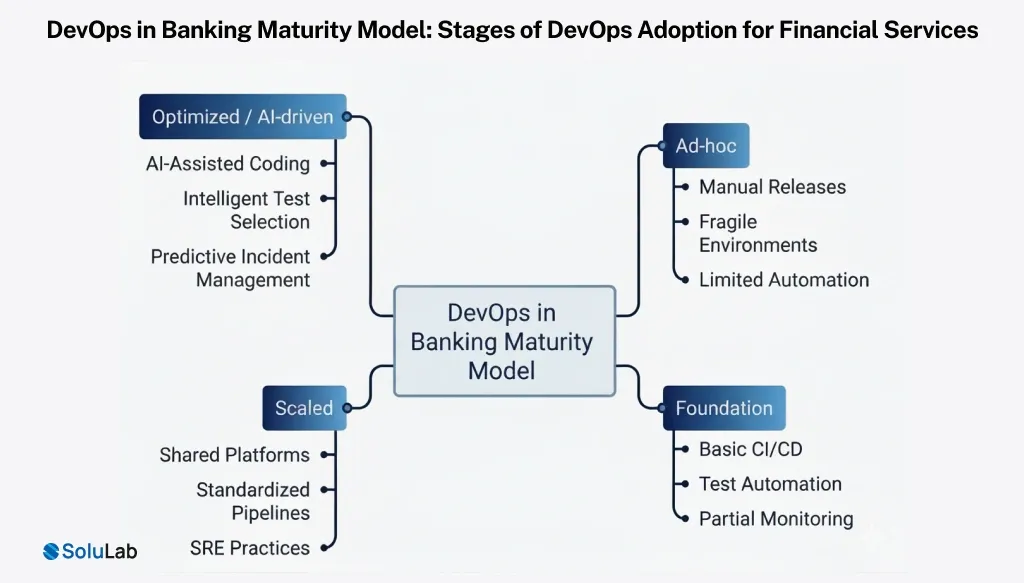
It helps to think of DevOps in banking as a maturity journey, not a binary switch. Most institutions we see fall into four broad stages.
1. Ad‑hoc
- Manual releases, fragile environments, frequent change freezes.
- Limited automation, little visibility into DevOps Costs in Banking because everything is buried in project budgets.
2. Foundation
- Basic CI/CD pipelines, some test automation, partial monitoring.
- Starting to implement DevOps in banking for a few flagship products, while others stay on legacy processes.
3. Scaled
- Shared platforms, standardized pipelines, strong SRE practices.
- Clear Benefits of DevOps for Banks in metrics like deployment frequency and incident rate, and closer DevOps implementation services partnerships with external vendors.
4. Optimized / AI‑driven
- AI‑assisted coding, intelligent test selection, predictive incident management.
- The Role of AI and Machine Learning in Banking DevOps is now baked into daily work: anomaly detection in logs, auto‑tuning infrastructure, and automatic policy checks as code moves through environments.
At higher maturity levels, Enterprise Banking DevOps is measured like any other business investment: cost per feature, time‑to‑market, risk capital savings, and customer experience outcomes.
This is also where differences in Banking DevOps from General DevOps become clear, because regulators expect you to prove that your automated pipelines are at least as safe as the manual processes they replaced.
A 12-Month Roadmap for DevOps Implementation in Banking Software Development
If you are leading change, what you want is a plan that feels ambitious but survivable. Here is a pragmatic 12‑month arc we often follow when we implement DevOps in banking programs.
Months 0–2: baseline and risk‑aligned design
- Map current value streams, environments, outages, and release frequency.
- Quantify current DevOps Costs in Banking: infra, tools, people, incidents.
- Design an initial target architecture and control framework for Compliance in banking DevOps.
Months 3–6: prove value on two or three journeys
- Pick 2–3 journeys (e.g., digital onboarding, card issuance, SME lending).
- Stand up pipelines, test automation, and basic monitoring with DevOps implementation services.
- Start to integrate DevOps and AI where the payoff is obvious, like AI‑generated tests or log‑based anomaly detection.
Months 7–12: scale and institutionalize
- Extend patterns to more teams; introduce platform teams and golden paths as Enterprise DevOps Services.
- Align compensation and KPIs so business, tech, and risk all own shared metrics.
- Formalize your AI guardrails to support the Role of AI and Machine Learning in Banking DevOps without surprising your model risk committee.
Once this is in motion, the Future of DevOps for your organization becomes less theoretical and more about how fast you can adopt Future Trends in DevOps for banking, like platform engineering, internal developer platforms, and autonomous pipelines.
Common Pitfalls in DevOps in Banking Software Development
Most failed or stalled transformations do not fail because the tooling is wrong. They fail because of misaligned incentives, underestimating the social side of DevOps in the banking sector, or not being honest about legacy constraints.
A few patterns we see again and again:
1. Optimizing tools, not outcomes
Teams buy CI/CD tools but keep old approvals and release windows, so the real Benefits of DevOps for Banks never materialize.
2. Ignoring compliance upfront
If Compliance in banking DevOps is not designed in, risk officers will eventually slow or stop your pipelines. Strong policy‑as‑code and evidence trails avoid this.
3. Misreading DevOps Implementation cost in banking
Leaders often see tooling and consulting spend but miss the hidden savings from reduced incidents, faster recovery, and fewer failed releases over 2–3 years. Good DevOps Consulting Services will push you to model both the investment and the avoided losses.
4. Treating AI as a bolt‑on
Without solid pipelines, the role of AI and Machine Learning in Banking DevOps gets stuck in proofs‑of‑concept. You want AI embedded in tests, monitoring, and architecture decisions from the start, not as a separate lab project.
If you avoid these, the advantages of DevOps for banks compound over time: every team that adopts the patterns makes the next transformation easier.
How Our Enterprise DevOps Services Help Banks Implement DevOps Successfully?
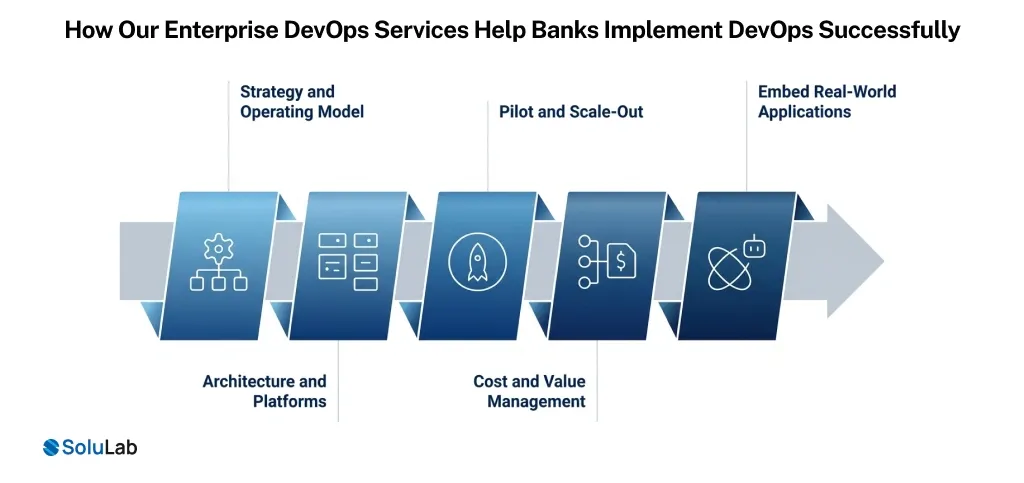
From a service‑provider perspective, our job is to reduce risk and increase signal, not to flood you with frameworks. In practice, that means our DevOps Consulting Services for banks focus on four levers.
1. Strategy and operating model
We help you define what DevOps in Financial Services actually means in your institution: who owns what, where the platforms sit, and how risk and compliance plug into the flow.
2. Architecture and platforms
We design and implement the platform patterns described above so Enterprise Banking DevOps becomes a shared service: CI/CD, observability, environments, and security guardrails your teams can consume.
3. Pilot and scale‑out
We use DevOps implementation services to run pilots on high‑value journeys, measure the Benefits of DevOps for Banks, then build a scaling model that your internal teams can own.
4. Cost and value management
We work with your finance and transformation office to model DevOps Implementation cost in banking against savings from outages, manual work, and change risk capital. Over time, this creates a clear picture of DevOps Costs in Banking and return on investment.
This is also where we help you embed Real World Applications of DevOps in banking and AI into your stack: automated testing, intelligent monitoring, model governance, and faster delivery of AI‑enabled products for customers and internal users.

Conclusion
If you are a CXO looking at your change portfolio for the next 2–3 years, DevOps in banking is one of the few levers that simultaneously improves speed, cost, and risk. The Future of DevOps in banking Industry is not about copying Silicon Valley, it is about building a delivery engine that can handle AI‑driven change, regulatory complexity, and customer expectations without constant firefighting.
Banks that lean into AI DevOps Integration and treat DevOps in banking software development as a board‑level capability are not just an IT fad, but will be the ones that turn AI spending into a durable competitive advantage, and SoluLab can help you achieve that
FAQs
With over 3 years of experience, I specialize in breaking down complex Web3 and crypto concepts into clear, actionable content. From deep-dive technical explainers to project documentation, I help brands educate and engage their audience through well-researched, developer-friendly writing.