DevOps was built to accelerate software delivery. Automation replaced manual provisioning. CI/CD pipelines replaced release weekends. Monitoring tools replaced guesswork.
But infrastructure complexity has outpaced traditional automation.
AI in DevOps refers to the use of machine learning, predictive analytics, and intelligent decision systems across development and operations workflows. Instead of simply executing predefined scripts, AI-powered DevOps services analyze operational data, learn from patterns, and optimize infrastructure dynamically.
Why is this becoming essential? Because modern systems are:
- Distributed across multiple clouds
- Containerized and ephemeral
- Continuously deployed
- Highly interdependent
Static thresholds and rule-based alerts struggle in such environments. Automation in DevOps reduces repetition. Artificial Intelligence in DevOps reduces uncertainty.
Organizations are adopting AI-driven DevOps not for novelty, but for resilience. When infrastructure grows more complex, reactive management becomes expensive. Predictive infrastructure management becomes strategic.
Key Takeaways
- The problem: Traditional infrastructure management relies on manual monitoring, static configurations, and reactive troubleshooting—leading to downtime, slow deployments, and costly resource waste.
- The solution: AI-powered DevOps introduces predictive scaling, automated provisioning, intelligent monitoring, and automated incident response, enabling infrastructure to self-optimize and adapt to demand.
- How SoluLab helps: SoluLab develops AI-driven DevOps solutions that automate infrastructure provisioning, monitoring, and scaling by helping enterprises reduce downtime, optimize cloud costs, and accelerate software delivery with measurable ROI.
How Is AI Used in DevOps Today?
Artificial Intelligence in DevOps is already embedded in many enterprise environments, often without being labeled as such.
Here are the primary areas where AI-powered DevOps is applied:
1. AI in CI/CD Pipelines
AI-based CI/CD pipelines evaluate deployment risk before production release. Models analyze historical defect data, code churn, and dependency changes to identify high-risk builds.
This reduces failed releases and shortens rollback time.
2. AI in Infrastructure Management
AI-driven infrastructure automation monitors resource utilization, identifies inefficiencies, and predicts scaling needs.
For example:
- Detecting over-provisioned instances
- Predicting capacity bottlenecks
- Optimizing workload placement across regions
This directly supports DevOps infrastructure optimization.
3. AI for Cloud Infrastructure
AI for cloud infrastructure focuses on cost-performance balancing. Predictive analytics in DevOps environments can forecast traffic spikes, optimize instance selection, and reduce cloud waste.
In multi-cloud environments, AI models compare workload efficiency across providers to recommend optimal distribution strategies.
4. AI for IT Operations (AIOps)
AIOps applies machine learning in DevOps monitoring systems to:
- Correlate distributed events
- Reduce alert fatigue
- Identify root cause probabilities
- Prioritize incidents intelligently
Instead of reacting to alert storms, teams respond to structured intelligence.
AI in Development and Operations is no longer experimental. It is becoming embedded across the DevOps lifecycle.
Read Also: AI Agents for IT Resource Optimization
How Does AI Improve Infrastructure Management?
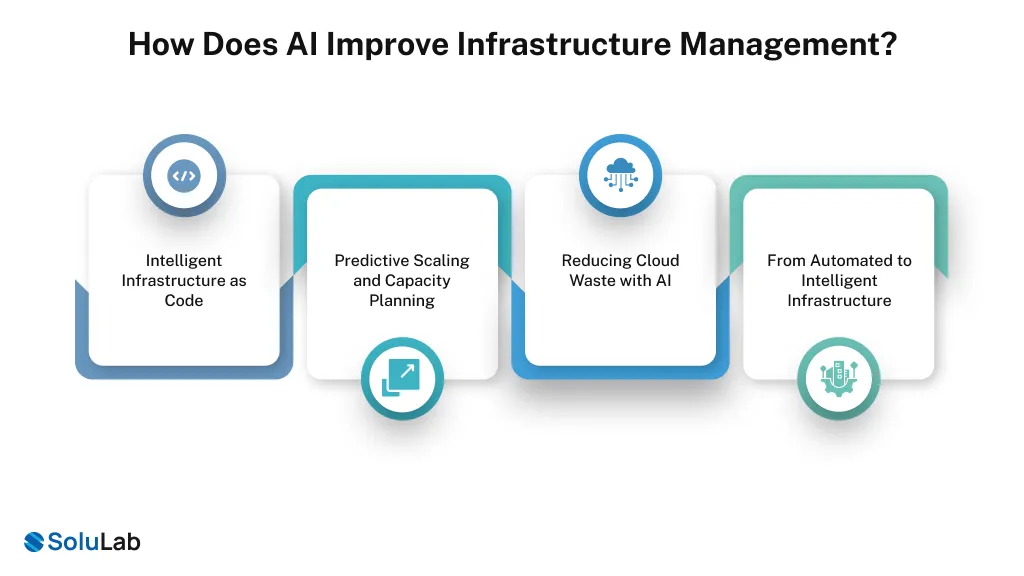
Infrastructure as Code automation transformed provisioning. But it remains declarative. It defines the desired state without evaluating the optimal state.
AI-driven infrastructure management goes further.
Intelligent Infrastructure as Code
AI-enhanced Infrastructure as Code automation can:
- Detect configuration drift patterns
- Identify inefficient instance sizing
- Predict resource saturation before threshold breaches
- Recommend optimized scaling policies
Instead of reacting to metrics, AI evaluates behavior over time.
Predictive Scaling and Capacity Planning
Predictive analytics in DevOps enables systems to scale based on anticipated demand rather than reactive thresholds.
For example:
An e-commerce platform can pre-scale infrastructure before seasonal traffic peaks based on historical trends. A SaaS platform can redistribute workloads based on behavioral usage modeling.
This improves reliability while reducing unnecessary provisioning.
Reducing Cloud Waste with AI
Cloud infrastructure waste is often subtle:
- Idle instances
- Over-allocated storage
- Unused container clusters
- Inefficient network routing
AI for cloud infrastructure analyzes usage behavior and cost patterns to identify structural inefficiencies.
DevOps infrastructure optimization becomes measurable when AI-driven models continuously refine allocation strategies.
From Automated to Intelligent Infrastructure
Automated infrastructure management executes rules. Intelligent infrastructure management evaluates trade-offs.
AI-powered DevOps enables:
- Dynamic cost-performance balancing
- Early anomaly detection
- Continuous optimization loops
- Self-improving operational models
As environments scale, the difference becomes significant.
Automation keeps systems running. AI-driven infrastructure management keeps systems evolving.
Read More: AI-Led Development
Can AI Automate CI/CD Pipelines?
Short answer: yes, but not in the way most teams expect.
Traditional CI/CD pipelines automate the mechanics of building, testing, and deploying software. They execute workflows reliably. But they do not evaluate contextual risk.
AI-based CI/CD pipelines introduce intelligence into release decisions.
How AI Improves CI/CD Automation?
1. Deployment Risk Prediction
Machine learning in DevOps can analyze historical release data to predict failure probability. Models assess:
- Code churn volume
- Dependency graph impact
- Past defect correlations
- Environmental change frequency
Instead of treating every release equally, AI assigns a contextual risk score before production rollout.
2. Intelligent Test Prioritization
Test suites grow over time, often becoming slow and redundant. AI-driven DevOps systems can:
- Identify high-risk code paths
- Prioritize relevant regression tests
- Reduce unnecessary test execution
This shortens pipeline duration without sacrificing reliability.
3. Automated Rollback Decisions
Traditional pipelines rely on static thresholds. AI-powered DevOps monitors anomaly trajectories post-deployment.
If performance degradation trends match historical failure patterns, the system can trigger early rollback before customer impact escalates.
4. Continuous Learning Feedback Loops
The most powerful aspect of DevOps AI is iteration. Every deployment outcome feeds back into the model.
Over time, pipelines become more accurate at predicting instability. This is where DevOps process automation becomes adaptive rather than mechanical.
What Is AIOps and How Does It Fit into DevOps?
AIOps, or AI for IT Operations, is often confused with enhanced monitoring.
It is more than that.
AIOps applies artificial intelligence to operational telemetry in order to detect anomalies, correlate events, and identify probable root causes in complex infrastructure environments.
Why Traditional Monitoring Breaks Down?
Modern cloud systems generate enormous volumes of data:
- Logs
- Metrics
- Traces
- Security events
- Deployment signals
Static rule-based monitoring produces alert storms. Engineers spend more time filtering noise than solving problems.
AIOps changes the model.
What AIOps Actually Does?
AI for IT Operations introduces:
- Event correlation across distributed services
- Anomaly detection using time-series modeling
- Probable root cause inference
- Alert prioritization and noise suppression
- Intelligent incident routing
Instead of responding to isolated alerts, teams respond to structured incident narratives.
An intelligent DevOps solution surfaces a unified probable cause rather than three unrelated alerts. This significantly reduces mean time to detect and resolve issues.
What Are the Real Benefits of AI-Powered DevOps?
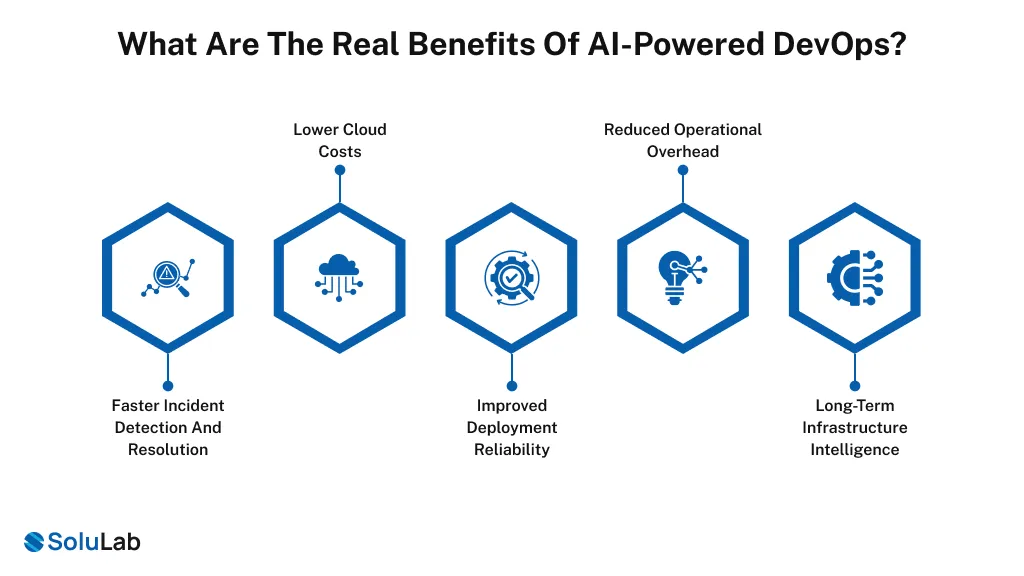
The value of AI in DevOps is not abstract. It is measurable.
1. Faster Incident Detection and Resolution
AI-driven infrastructure automation reduces alert noise and accelerates root cause identification.
Teams spend less time diagnosing and more time resolving.
2. Lower Cloud Costs
AI for cloud infrastructure identifies inefficient resource allocation patterns and predicts demand more accurately.
This leads to:
• Reduced over-provisioning
• Smarter instance selection
• Improved workload placement
• Optimized scaling strategies
DevOps infrastructure optimization directly impacts operational expenditure.
3. Improved Deployment Reliability
AI-based CI/CD pipelines reduce failed releases through predictive risk scoring and automated rollback triggers.
Engineering teams gain higher deployment confidence.
4. Reduced Operational Overhead
Intelligent Infrastructure Management automates repetitive diagnostics and anomaly correlation.
Operational teams can focus on architecture improvements rather than firefighting.
5. Long-Term Infrastructure Intelligence
Perhaps the most strategic benefit is cumulative learning.
Every deployment, incident, and performance event trains the system. Over time, AI in Development and Operations creates a continuously improving operational model.
Infrastructure evolves from reactive to anticipatory.
How Do You Implement AI in DevOps Successfully?
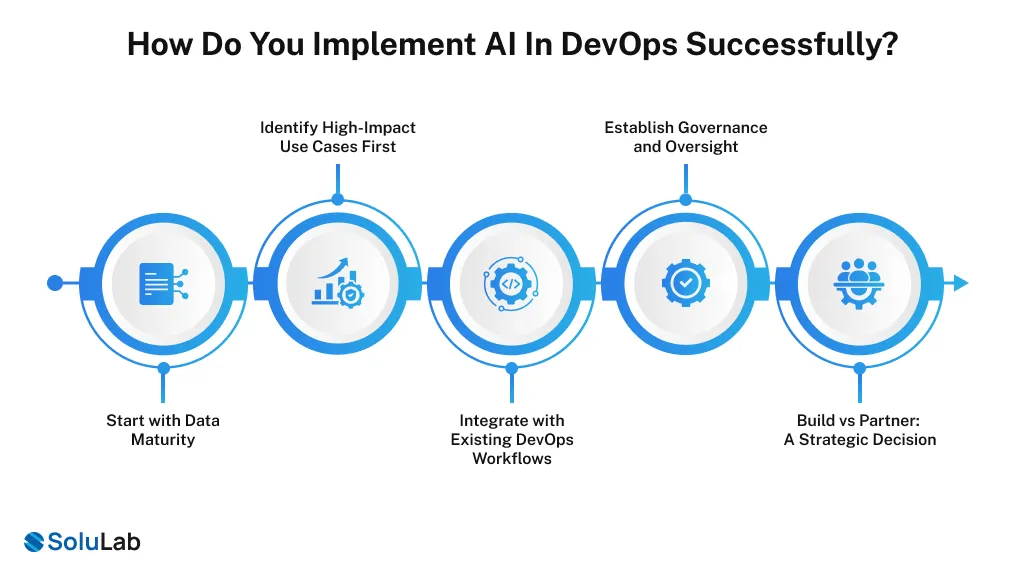
Adopting AI in DevOps is not about installing a new tool. It is about restructuring how infrastructure data is collected, interpreted, and acted upon.
Many organizations fail because they experiment with isolated models without building the foundation required for intelligent DevOps.
Successful implementation follows a structured path.
1. Start with Data Maturity
AI-driven DevOps depends on high-quality telemetry. That includes:
• Logs
• Metrics
• Traces
• Deployment metadata
• Incident history
• Cloud cost data
If observability is fragmented, AI models will produce unreliable insights.
Before implementing AI-powered DevOps, organizations should unify operational data into a centralized platform that supports structured analysis.
2. Identify High-Impact Use Cases First
Rather than automating everything, begin with targeted applications such as:
• Predictive analytics in DevOps monitoring
• Cloud cost optimization
• Deployment risk scoring in CI/CD
• Intelligent alert noise reduction
These use cases offer measurable ROI and validate the AI-driven infrastructure automation strategy.
3. Integrate with Existing DevOps Workflows
AI in Development and Operations must integrate directly into:
- CI/CD pipelines
- Infrastructure as Code automation
- Monitoring and incident systems
- Cloud provisioning platforms
If AI outputs remain disconnected from operational controls, intelligence becomes passive rather than actionable.
The goal is decision integration, not dashboard augmentation.
4. Establish Governance and Oversight
AI-powered DevOps introduces new control challenges:
- Model drift over time
- False positives in anomaly detection
- Over-automation risk
- Compliance visibility gaps
Governance mechanisms should include:
- Audit logs for automated decisions
- Human-in-the-loop escalation paths
- Periodic model validation
- Defined rollback boundaries
Especially in regulated sectors, AI for IT Operations must strengthen control frameworks, not weaken them.
5. Build vs Partner: A Strategic Decision
Organizations often underestimate integration complexity.
Implementing AI in DevOps requires:
- Machine learning expertise
- Data engineering capability
- Infrastructure architecture depth
- MLOps lifecycle management
For enterprises with complex environments, partnering with a custom AI development company can reduce experimentation risk and accelerate implementation.
AI development services become particularly valuable when compliance, scalability, and phased deployment matter.
The most effective strategy is often incremental:
- Begin with predictive monitoring
- Expand into AI-based CI/CD pipelines
- Introduce intelligent infrastructure management
- Mature into full AIOps integration
Controlled expansion ensures operational stability.
What Challenges and Risks Should You Consider?
AI-driven DevOps offers significant advantages, but it is not risk-free.
Understanding potential pitfalls is critical.
1. Model Drift
Infrastructure behavior changes over time. Traffic patterns evolve. Deployment frequency increases. If models are not retrained regularly, predictions degrade.
Continuous monitoring of model accuracy is essential.
2. Over-Automation
Fully autonomous remediation without human oversight can create cascading failures if models misinterpret signals. AI-powered DevOps should operate within defined control boundaries.
3. Data Quality Issues
Incomplete or inconsistent telemetry leads to unreliable predictions. Strong observability foundations are non-negotiable.
4. Integration Complexity
AI in infrastructure management touches:
- CI/CD systems
- Cloud providers
- Security tools
- Monitoring platforms
Misaligned integrations can increase operational fragility rather than reduce it.
5. Organizational Readiness
DevOps AI is not just technical. It requires cultural adaptation.
Engineering teams must trust AI-driven recommendations. Governance teams must understand automated decision flows.
Adoption fails when intelligence is perceived as opaque.
FAQs About AI in DevOps and Infrastructure Automation
Conclusion
DevOps automation transformed how software is delivered. AI in DevOps transforms how infrastructure is understood.
As systems grow more distributed and dynamic, static rules and reactive monitoring struggle to keep pace. AI-powered DevOps introduces predictive analytics, intelligent infrastructure management, and adaptive control into operational workflows.
The result is not just faster deployments or lower cloud bills. It is infrastructure that learns.
Organizations that seek professional DevOps consultation for thoughtful implementation, with governance and phased adoption, position themselves for scalable resilience in an increasingly complex digital landscape.
Bhavya is driving growth through data-backed demand generation for AI and Web3 solutions. With 9+ years in digital marketing, he has spearheaded initiatives that led to a 40% increase in qualified inbound leads. Bhavya shares insights on marketing ROI and scaling a digital presence via AI workflows. He is open to connecting with startups and enterprise teams to help them overcome their challenges.