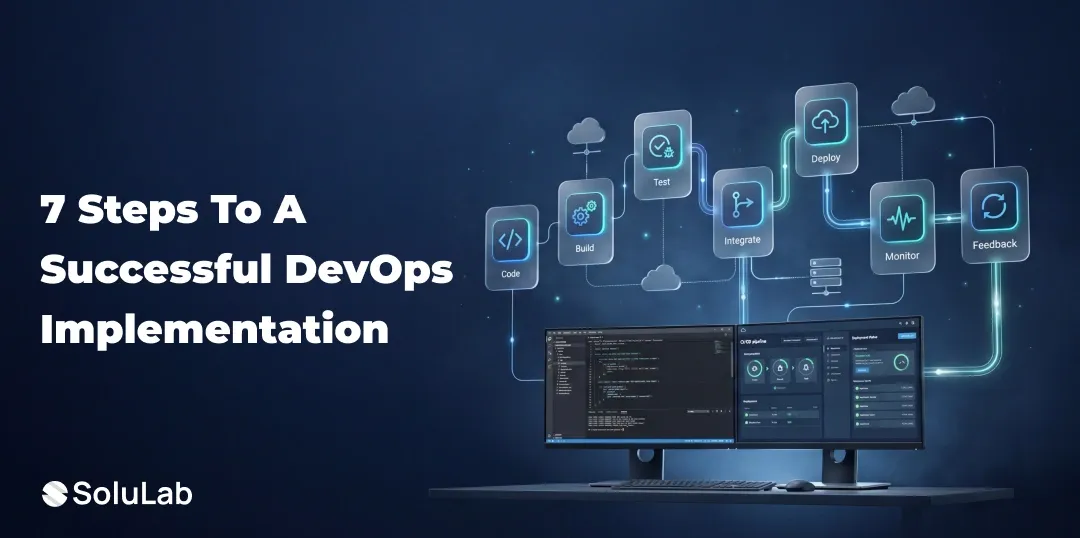
Digital companies today are not just going agile; they are going cloud‑native, observable, and automated, which is why DevOps consulting services are becoming the backbone of enterprise transformation.
| By 2026, the DevOps market is projected to grow into the $19.57–25 billion range, with 80–85% of organizations already practicing DevOps workflows in some form, and the remaining lagging behind actively planning or starting their journey. |
If you are a CXO, product head, or founder, you are not just choosing a vendor – you are choosing a long‑term engineering partner that will shape how fast, safe, and lean your product engine runs.
Key Takeaways
- The problem: Most enterprises are stuck in tool chaos (CI/CD, infra‑as‑code, monitoring, cloud) without a clear DevOps implementation roadmap or ROI‑focused partner.
- The solution: Partner with a DevOps consulting company that can design, automate, and govern your pipelines, Kubernetes platform, cloud‑cost efficiency, and security posture.
- How SoluLab helps: As a DevOps consulting service provider with cloud‑native and DevOps consulting for cloud migration expertise, SoluLab aligns your goals with a structured transformation focused on enterprise DevOps consulting solutions and measurable business outcomes.
What Modern DevOps Consulting Services Look Like in 2026?
A DevOps consulting partner is not just a fixer for pipelines – they are a strategic operator who helps you design, automate, and stabilize your entire software lifecycle.
- They help you define your DevOps maturity level, what culture shifts are needed, and what tools and practices will actually move the needle.
- They design and implement your DevOps platforms, including CI/CD, infra‑as‑code, observability, and security embedding (DevSecOps).
- They run DevOps consulting services and solutions from strategy to day‑to‑day operations, so you move from manual firefighting to predictable, automated releases.
For you, this means no more pipeline heroes or ad‑hoc deployments; instead, you get a repeatable, auditable, and scalable delivery model that aligns with your commercial goals.
Key Trends Driving DevOps Consulting Services in 2026
You can’t pick a DevOps consulting company without understanding how DevOps itself is evolving in 2026.
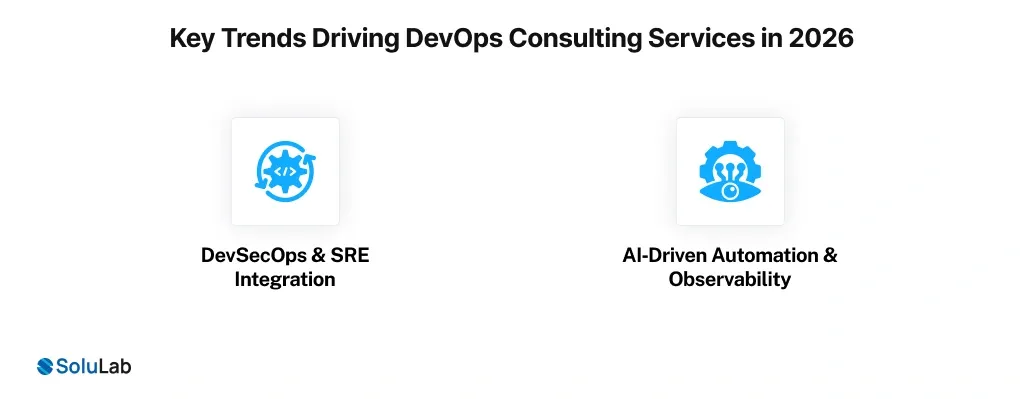
1. DevSecOps & SRE Integration
Security is no longer a separate gate before production. Today’s enterprise DevOps consulting solutions embed security into the pipeline itself – DevSecOps, with policy‑as‑code, automated vulnerability scanning, and compliance‑driven pipelines.
At the same time, SRE‑inspired practices are being baked into DevOps engagements, helping teams define error budgets, SLOs, and observability‑driven dashboards instead of 100% uptime guesswork.
A DevOps consulting firm in 2026 must be able to talk about DevSecOps, SLOs, and security automation, not just Docker and Kubernetes.
2. AI‑Driven Automation & Observability
By 2026, AI‑driven automation and observability will become standard in leading DevOps consulting service providers. AI is used to:
- detect anomalies and predict failures before they impact users.
- suggest infrastructure and pipeline optimizations based on real‑time metrics.
- improve documentation and code quality by analyzing patterns across branches.
If your shortlisted DevOps consulting companies with proven ROI are not talking about AIOps or AI‑assisted incident management, you should question how future‑proof they really are.
A Step-by-Step Framework to Choose the Right DevOps Service Provider in 2026
As a founder, you don’t need a perfect checklist – you need a practical, operator‑grade framework that you can apply across 3–5 serious vendors.
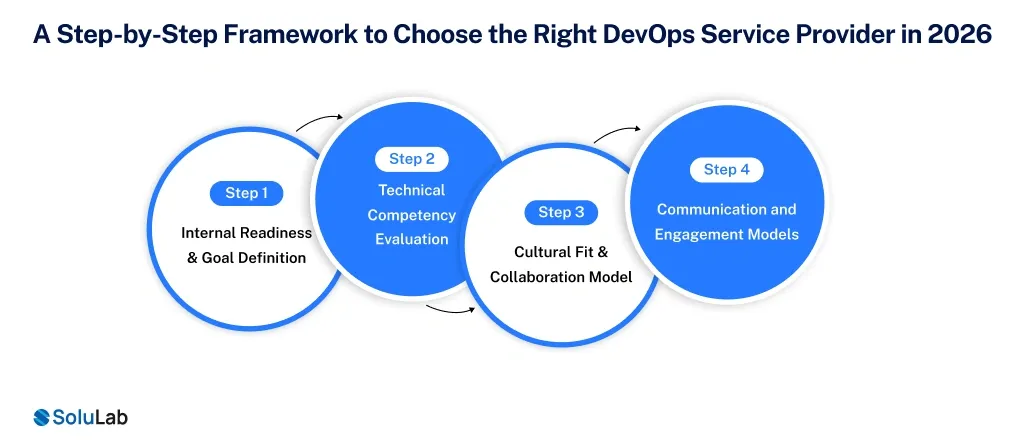
1. Internal Readiness & Goal Definition
Before you start hire DevOps consultants, ask yourself: What is my primary goal?
Is it:
- faster time‑to‑market?
- lower cloud spend?
- compliance and security‑first releases?
- cloud migration stability?
Once you define that, you can filter for DevOps consulting companies that specialize in that area.
For example:
- If cloud migration is your priority, focus on firms with explicit DevOps consulting for cloud migration and cloud DevOps consulting.
- If you are moving from legacy to cloud‑native, you should prefer DevOps consulting services experts who can combine platform engineering, Kubernetes, and FinOps‑style cost governance.
You can’t expect a DevOps consulting provider to magically read your mind, you must give them a clear mission.
That’s why SoluLab starts every engagement with a goal‑mapping workshop, where we translate your business KPIs into DevOps‑specific metrics.
2. Technical Competency Evaluation
Here’s how to evaluate whether a DevOps consulting firm is actually competent, not just a sales‑heavy branding shop:
- Do they have cloud devops consulting capability across AWS, Azure, and GCP?
- Do they talk about DevOps implementation roadmap components like phased migrations, dark launches, canary deployments, and rollback strategies?
- Do they show real examples of enterprise DevOps consulting solutions they’ve delivered, not just logos, but numbers – reduced MTTR, increased deployment frequency, cloud‑cost savings?
Look for DevOps consulting service providers who can walk you through:
- a CI/CD toolchain tailored to your stack (GitHub Actions, GitLab, Azure DevOps, Jenkins).
- an infrastructure‑as‑code strategy (Terraform, Pulumi, CDK) that is version‑controlled and peer‑reviewed.
- observability and monitoring (Prometheus, Grafana, ELK, Datadog, etc.) that are not just installed but actually tuned to your business flows.
If they can’t explain why a specific tool is chosen, treat that as a red flag.

3. Cultural Fit & Collaboration Model
Technical excellence is half the battle. The other half is how they work with your teams.
Ask yourself:
- Will they act as DevOps consulting providers who parachute in, deliver a pipeline, and vanish, or will they embed with your engineering leadership?
- Do they have a communication model you can actually live with – weekly standups, shared dashboards, and clear escalation paths?
- Do they invest in DevOps consulting for digital transformation culture, including training, enablement, and change management?
Enterprise DevOps consulting solutions are only as good as your team’s ability to own and maintain them after the consultants leave. That’s why the best DevOps consulting companies design their work to be teachable and sustainable by your own people.
4. Communication and Engagement Models
In 2026, you’ll rarely be hiring a single DevOps consultant – more often, you are engaging a DevOps consulting firm as a retained partner.
Ask explicitly: Do they operate on a staff‑augmentation model, a fixed‑scope model, or a managed DevOps engagement?
How do they track and report the ROI of DevOps consulting companies with proven ROI?
Examples:
- deployment frequency before vs after.
- lead time to production.
- MTTR (mean time to recovery).
If they can’t align their engagement model with your finance and engineering leadership, you risk getting stuck in cost-centre debates instead of value‑centre conversations.
Technical Capabilities to Check Before You Hire DevOps Consultants in 2026
When you shortlist DevOps consulting firms, run them through this quick technical checklist.
1. Tool Expertise (CI/CD, IaC, Monitoring)
Look for DevOps consulting services and solutions that are not tool‑agnostic in the risky sense; they should be opinionated but flexible.
Ideally, they should be able to:
- Design and maintain CI/CD pipelines on AWS DevOps, Azure DevOps, or similar platforms.
- Implement IaC (infrastructure‑as‑code) using Terraform, Crossplane, or AWS CloudFormation, treating your infra like version‑controlled code.
- Set up observability and monitoring stacks that answer business questions, not just is the server up?
If you’re hiring a DevOps services expert, they should be able to explain how they choose tools based on your scale, compliance needs, and team skills, not just because it’s trendy.
2 Multi‑Cloud & Hybrid Support
Today’s businesses are not all‑in on AWS or all‑in on Azure anymore. Most CXOs are managing multi‑cloud and hybrid environments, and your DevOps consulting company must be able to support that.
Ask them:
- How do they design cloud devops consulting architectures that are portable across cloud vendors?
- Do they have experience with Azure DevOps consulting if you use Microsoft workloads?
- How do they handle AWS DevOps consulting for workloads that are already AWS‑centric?
If they only talk about one cloud, treat that as a constraint. Modern DevOps consulting providers must be cloud‑agnostic by design, not cloud‑dependent.
Red Flags to Avoid When Choosing DevOps Consulting Companies with Proven ROI
Even the most polished DevOps consulting firms can hide structural weaknesses. Here are some red flags to watch for:
- They promise full DevOps automation in 3 months for a large, legacy enterprise; this almost always underestimates the cultural and technical debt.
- They don’t talk about AI in DevOps implementation roadmap phases, quick wins, or pilot projects. Transformation is a journey, not a one‑off sprint.
- They focus only on tools, not on your DevOps consulting for digital transformation KPIs – speed, reliability, cost, security.
If a DevOps consulting company cannot clearly articulate how they will measure success and failure, assume they haven’t built enough enterprise DevOps solutions with proven ROI to know what good looks like.
Enterprise DevOps Consulting Companies vs Boutique DevOps Service Providers
When you do a vendor search, you’ll usually see two buckets:
- Large global DevOps consulting companies (e.g., Accenture, Deloitte, IBM Consulting, Capgemini).
- Boutique or mid‑sized DevOps consulting firms that focus narrowly on cloud‑native, containers, and automation.
Both have strengths:
- Enterprise firms bring brand, scale, and global reach, but they can be slower, more process‑heavy, and less flexible for startups or fast‑moving scale‑ups.
- Boutique specialists are often more hands‑on, agile, and closer to code, but you must be careful about their capacity, governance, and long‑term support.
DevOps consulting service providers like SoluLab aim for a middle ground – deep technical expertise, but without the consulting‑factory overhead.
If you’re a mid‑sized company or a fast‑growing startup, you’re often better off with a DevOps consulting firm that can move quickly and communicate directly with your CTO, not just with your procurement department.
What to Ask Before You Hire DevOps Consultants for Your Business?
Before you hire DevOps consultants, make sure you have a shortlist of questions that will reveal their real capability and intent. Here are a few that CXOs should ask:
1. How do you define success for a DevOps consulting engagement?
- Look for specific metrics – deployment frequency, MTTR, lead time to production, and cloud‑cost benchmarks.
2. Can you walk me through a DevOps implementation roadmap you’ve delivered?
- You want to see phases, quick wins, and risk‑mitigation plans.
3. Do you have experience with DevOps consulting for cloud migration?
- How do you handle legacy workloads?
4. How do you embed knowledge into our team so we’re not dependent on you forever?
- This is where enterprise DevOps consulting solutions separate theory from practice.
If the answers are vague or generic, you’re likely talking to a DevOps consulting provider that sells stories, not outcomes.
Why SoluLab is the Right DevOps Consulting Partner for You?
SoluLab is a DevOps consulting service provider built for CXOs and founders who care about real outcomes, not just DevOps buzzwords.
- We offer DevOps consulting services and solutions across cloud‑native, Kubernetes, CI/CD, DevSecOps, and cost optimization.
- We specialize in DevOps consulting for digital transformation, helping you connect faster releases to business growth, not just technical metrics.
- Our engagement models are flexible, from DevOps consulting services expert roles to long‑term managed DevOps partnerships.
If you’re:
- a startup that wants to scale infrastructure without adding a huge DevOps team,
- an enterprise that is stuck in legacy and cloud‑cost chaos, or
- a product‑centric company that wants to ship faster without breaking things,
Then hiring DevOps consultants from SoluLab gives you a clear edge; you get a partner who understands both the DevOps implementation roadmap and the business context behind it.

Conclusion
By 2026, DevOps services are no longer a nice‑to‑have; they will be a core capability for companies that want to ship faster, more securely, and more efficiently.
The key is to choose a DevOps consulting company that:
- aligns with your business goals, not just your tech stack;
- has a clear DevOps implementation roadmap and measurable ROI;
- understands DevOps consulting for cloud migration and cloud DevOps consulting in multi‑cloud environments;
- and can operate as a true DevOps consulting service provider that stays with you through the journey.
If you’re evaluating vendors right now, remember: the best Enterprise solution providing firms are not the ones with the flashiest deck; they are the ones who can explain how their work will move your KPIs, not just add tools.
FAQs
With over 3 years of experience, I specialize in breaking down complex Web3 and crypto concepts into clear, actionable content. From deep-dive technical explainers to project documentation, I help brands educate and engage their audience through well-researched, developer-friendly writing.