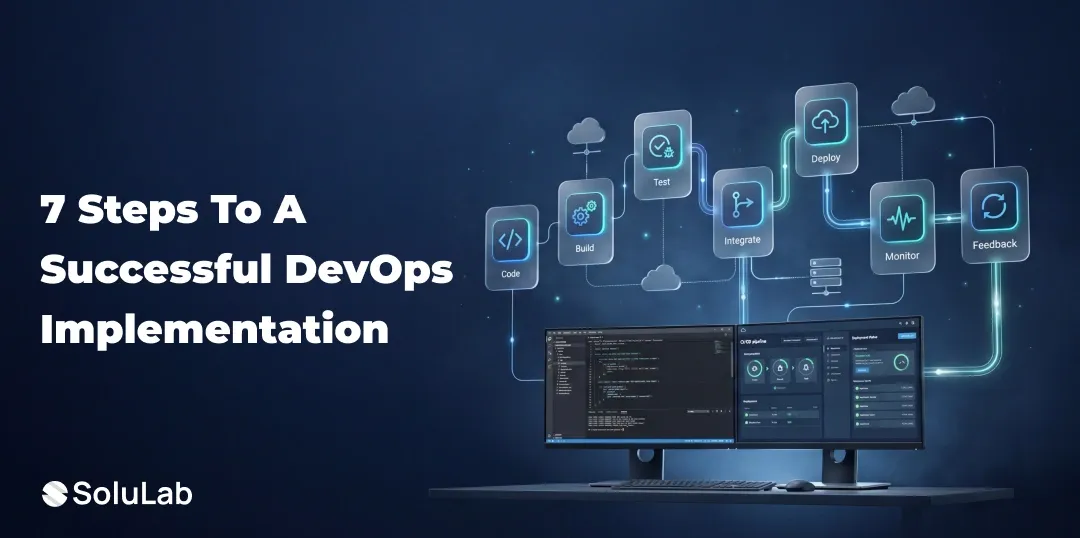
Most teams don’t struggle with DevOps because they lack the right tools or skilled engineers. They struggle because their delivery system was never designed to scale. Releases feel risky, rollbacks are stressful, and small changes somehow turn into all-hands fire drills.
The data backs this up. According to the 2024 State of DevOps Report from Google and DORA, teams with mature DevOps practices ship more often, recover faster, and spend far less time fighting production issues. The difference isn’t effort, it’s how the system is built.
If your deployments still depend on heroics or tribal knowledge, or you don’t touch it on Fridays, this guide is for you. We’ll walk through what DevOps implementation actually looks like in 2026, where teams usually go wrong, and how to build a setup that works reliably as your product and team grow.
Key Takeaways
- The Problem:
- Most companies approach DevOps as a tool decision. Buy the right platform, plug it in, done. It never works that way. DevOps is an organizational shift, and without a plan, you end up with more tools and the same chaos.
- The Solution:
- A structured DevOps implementation roadmap and strategies that sequence people, process, and technology in the right order. Not all at once.
- How SoluLab Helps:
- SoluLab works as a DevOps solutions provider from your first infrastructure audit through to full pipeline deployment, so your team doesn’t spend six months figuring out what an experienced partner can execute in eight weeks.
What It Really Takes to Implement DevOps in 2026?
Real DevOps software development is not about having a Jenkins pipeline. It means your development and operations teams share genuine ownership of the delivery lifecycle, from code commit to production monitoring. It means environments are reproducible, deployments are automated, and incidents have runbooks instead of war rooms.
The baseline has shifted in 2026. Enterprise DevOps strategy now routinely includes AI-assisted test generation, automated security gates, and cost-aware scaling policies. What was considered “advanced” in 2023 is now the minimum bar for competitive engineering organizations.
Statista projects the global DevOps market will reach $57.9 billion by 2030, up from roughly $10.4 billion in 2023. That growth is enterprise adoption at scale, not experimentation. Forbes notes that organizations implementing DevOps report up to 60% reduction in time-to-market and significant drops in failure rates.
When You Actually Need a DevOps Implementation Roadmap?
Not every team needs the full stack from day one. Here’s how to read your situation honestly:
You need DevOps now if your team is dealing with:
- Deployments that take days and require multiple people in a room
- Production outages caused by manual steps or missing config
- Environments that behave differently (classic “works on my machine” problems)
- QA cycles that block every release by days
You can probably wait if:
- You’re a two-person team still validating a product idea
- Your release cadence is genuinely quarterly, and users aren’t asking for more
That said, even early-stage companies benefit from starting DevOps implementation for startup habits early. Retrofitting DevOps into a tangled codebase six months later is significantly more painful and more expensive than building the habit from the first deployment.
Pre-Implementation Checklist for Your DevOps Implementation Roadmap
Before you look at a single tool, run through this:
- Team readiness: Do you have someone who owns infrastructure decisions? If not, that’s your first hiring or outsourcing call.
- Container readiness: Is your application containerized, or are you deploying bare metal? Container maturity matters for almost every modern pipeline.
- Observability baseline: Do you have meaningful visibility into what’s running right now? If not, you’ll run a faster pipeline into the same blind spots.
- Budget honesty: DevOps implementation cost ranges from $15K for a basic startup pipeline to $250K+ for a full enterprise rollout. This is not vendor padding; scope drives cost.
- Leadership alignment: If your CTO or VP of Engineering isn’t actively behind this, the initiative will die somewhere between Step 3 and Step 4. Cultural change needs top cover.
If these things are in the right place, now you can proceed with these 7 steps:
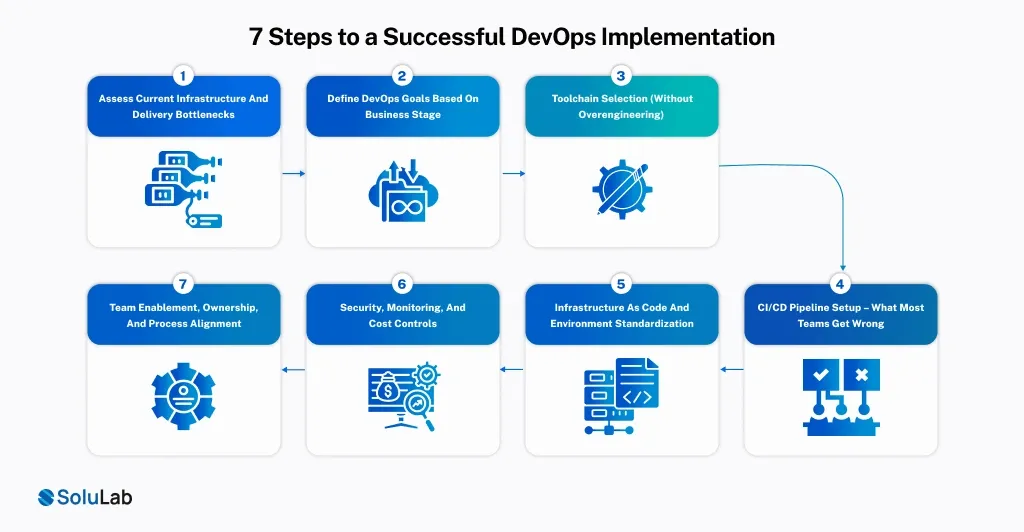
Step 1: Assess Current Infrastructure and Delivery Bottlenecks
This is the step most teams skip entirely. They go straight to tooling.
Don’t.
The DevOps implementation steps that actually work start with an honest audit of where delivery currently breaks.
- What’s your mean time to deploy?
- What’s your rollback story?
- Where do human handoffs create delays or errors?
Use DORA metrics with deployment frequency, lead time for changes, mean time to recovery, and change failure rate as your baseline. Without this baseline, you’re solving a problem you haven’t defined.
Challenges in DevOps adoption almost always begin here. Teams skip the audit, jump to tools, and then six months later can’t explain why deployments are still slow, whereas numbers give you direction.
That’s why we say guesses give you busy work.
Step 2: Define DevOps Goals Based on Business Stage
A seed-stage startup trying to ship faster has fundamentally different needs than an enterprise trying to reduce the mean-time-to-recovery across 40 microservices. When you implement DevOps for businesses at different growth stages, the goals need to match:
- Startup: Faster iteration, consistent environments, less deployment anxiety
- Scale-up: Team autonomy, reduced cross-team dependencies, reliable staging environments
- Enterprise: Audit trails, compliance automation, multi-cloud orchestration, cost governance
The mistake that kills momentum is applying a full Enterprise DevOps services framework onto a 15-person engineering team. It creates overhead that kills the very velocity you were trying to improve; that’s why we suggest right-sizing the approach to the stage.
Step 3: Toolchain Selection Without Overengineering
This is where vendors pitch well, and decisions go sideways.
The best DevOps tools for enterprises aren’t the most feature-rich ones; they’re the ones your team will actually maintain, monitor, and trust. Here’s a practical baseline that works for most engineering organizations:
| Layer | Recommended Tools |
| Source Control | GitHub, GitLab, Bitbucket |
| CI/CD | GitHub Actions, Jenkins, CircleCI |
| Containers | Docker, Podman |
| Orchestration | Kubernetes, AWS ECS |
| Infrastructure as Code | Terraform, Pulumi |
| Monitoring & Observability | Datadog, Grafana, Prometheus |
| Security (DevSecOps) | Snyk, Trivy, HashiCorp Vault |
A good DevOps automation platform connects these layers without requiring your team to write custom glue code between every tool. When evaluating options, the integration story matters more than any individual feature list.
Ask specifically: how does this talk to the rest of your stack?
Step 4: CI/CD Pipeline Setup What Most Teams Get Wrong
Most CI/CD pipelines get built once, work well enough, and never get revisited. That’s the root problem.
A serious DevOps implementation strategy for enterprises treats the pipeline as a living system. It should run tests automatically on every commit, fail fast on bad builds, deploy to staging without human triggers, and have clear gated approvals before production.
What teams consistently get wrong here:
- No automated rollback when a deployment fails
- Tests that get skipped under deadline pressure (“just this once” becomes policy)
- Staging environments that don’t mirror production behavior
- No canary or blue/green deployment logic, so every release is all-or-nothing
Providers delivering quality DevOps implementation services typically spend 35–40% of engagement time on pipeline architecture alone. That’s where the operational ROI lives.
Step 5: Infrastructure as Code and Environment Standardization
If your ops team is still SSH-ing into servers to make manual config changes, that problem compounds quietly, until it doesn’t.
Infrastructure as Code means your entire environment is version-controlled and reproducible.
- New team member joins? Run one command.
- Need a staging replica? Run one command.
- Disaster recovery scenario? Same command, different region.
This is central to how you build a DevOps roadmap that scales: environments that can be recreated exactly, by anyone with access, any time. Terraform and Pulumi handle this well at scale. The discipline part, with no manual provisioning ever, is what separates teams that scale from teams that accumulate technical debt in their infrastructure.
DevOps use cases in enterprises consistently cite environment standardization as one of the highest-ROI changes they’ve made. It works less in development and more in production, with faster onboarding and cleaner disaster recovery.
Step 6: Security, Monitoring, and Cost Controls
Security that gets added after shipping is just cleanup with a different name.
DevOps security best practices (DevSecOps) mean security is embedded in the pipeline: static code analysis, container vulnerability scanning, secrets detection, and dependency audits happen automatically on every build, not as periodic reviews. Tools like Snyk and Trivy integrate directly into CI/CD pipelines without requiring security teams to manually review every deployment.
- On monitoring: you need metrics, logs, and traces – all three. Metrics tell you something is wrong. Logs tell you where. Traces tell you why. A solid observability stack built at this stage pays dividends every time an incident happens.
- On cost: cloud spending without guardrails is one of the quieter casualties of fast-moving teams. Set budget alerts, enforce auto-scaling policies, and tag every resource consistently. DevOps implementation cost savings often come from governance built into the pipeline, not just the efficiency of individual deployments.
Step 7: Team Enablement, Ownership, and Process Alignment
Tools without people alignment simply don’t work. You can automate the pipeline, but you can’t automate accountability.
The final and honestly most important step in any real Enterprise DevOps strategy is making sure your teams understand what they own, what success looks like, and how to respond when things break. This means:
- Clear on-call rotations with documented runbooks, not tribal knowledge
- Blameless post-mortems after every significant incident
- Development teams owning their services end-to-end, including production
- Regular retrospectives on pipeline health and delivery metrics
Benefits of DevOps for Enterprises compound over time, but only when the cultural foundation is solid. Teams that go through this step properly are the ones who actually sustain the gains two years later.

How to Implement DevOps in 90 Days?
Here’s a realistic rollout timeline for a mid-sized engineering team:
- Days 1–30: Infrastructure audit, delivery baseline, toolchain decisions, environment inventory, team alignment workshops
- Days 31–60: CI/CD pipeline construction, IaC scaffolding, monitoring configuration, initial security gates
- Days 61–90: DevSecOps integration, team training, cost controls activation, first production deployment through the new pipeline
This is the minimum viable timeline for most teams. Enterprise programs with compliance requirements like SOC2, HIPAA, and PCI-DSS, which typically run 120–180 day engagements. The key is that each phase produces a measurable deliverable, not just progress reports.
A DevOps implementation roadmap and strategies structured this way give leadership visible milestones. Whereas executives can track what shipped, not just what’s in progress.
The Most Common DevOps Adoption Mistakes in Startups and Enterprises
Across hundreds of implementations, the patterns that kill DevOps initiatives are remarkably consistent:
- Toolchain before process – buying platforms before defining workflows
- No ownership model – tools deployed with nobody accountable for maintaining them
- Skipping environments – going from local development straight to production without a real staging layer
- Underestimating cultural resistance – challenges in DevOps adoption are usually political, not technical. Teams protecting turf, slow decisions, and no executive sponsor.
- One-time project thinking – DevOps is an ongoing practice. Teams that treat it as a deployment project lose the gains within a year.
Build vs Outsource: Choosing the Right DevOps Implementation Strategy for Enterprises
Building internal DevOps capability makes sense when you have the talent, the time, and the sustained volume of engineering work to justify a dedicated infrastructure team.
Partnering with a DevOps consulting company makes sense when speed matters more than the learning curve, when the tools have real depth and getting them wrong is expensive, or when you’ve tried building it internally and hit the same walls twice.
The model most growing companies choose is hybrid, the internal team owns day-to-day operations, and the DevOps solutions provider handles architecture, toolchain setup, and edge case resolution.
Read more – How to Choose the Right DevOps Consulting Partner in 2026?
How Much Does DevOps Implementation Actually Cost?
Here are the Real numbers for you:
| Business Stage | Typical Engagement Cost |
| Startup (1–3 services) | $15,000 – $30,000 |
| Scale-up (5–15 services) | $30,000 – $50,000 |
| Enterprise (20+ services, compliance) | $45,000 – $60,000+ |
These figures reflect external DevOps implementation services engagements. Internal team costs like salaries, training, and licensing are separate.
DevOps implementation cost also carries a hidden component that rarely appears in the initial conversation: the cost of failing to implement it. Delayed releases, repeated incident recovery, and developer attrition from frustrating tooling all of these have measurable dollar values.
WEF’s Future of Jobs Report 2025 notes that automation and DevOps adoption are among the top drivers of engineering team productivity gains through 2026.
How SoluLab Helps Businesses Implement DevOps Without Tool Chaos?
SoluLab has worked with companies ranging from Series A startups to Fortune 500 subsidiaries on DevOps software development transformation programs. The pattern that works and the one we follow looks like this:
- Infrastructure audit to understand what you actually have, not what the docs say you have
- Toolchain design based on your stack, team skills, and scale requirements
- Pipeline engineering, like CI/CD, IaC, and monitoring, is built right the first time
- DevOps security best practices (DevSecOps) are embedded from day one, not added at the end
- Team enablement with your engineers to run the system confidently before we step back
We also bring perspective on AI in DevOps where AI-assisted pipeline optimization are already reducing operational overhead for clients in 2026.
If you’re thinking about AI Software development integration into your pipeline alongside DevOps, we handle that too. How to implement DevOps without drowning in tooling complexity is genuinely what we do every day, for startups moving fast and enterprises moving carefully.
DevOps implementation for startups programs with SoluLab typically reach a functional CI/CD pipeline in the first 30 days. Enterprise programs with compliance layers typically close out in 90 – 120 days.

Conclusion
A strong DevOps strategy for enterprises and early-stage startups alike comes down to one thing: discipline over tools. The teams that succeed aren’t running the fanciest stacks; they choose the right tools, commit to them, and build a culture where shipping is safe, fast, and repeatable.
The benefits are measurable: faster releases, fewer incidents, lower infrastructure costs, and teams that collaborate instead of pointing fingers. But none of this happens without a clear roadmap and real ownership.
Even the best enterprise DevOps tools fall flat without execution discipline. What works in practice is a simple sequence: assess first, adopt tools second, and reinforce culture at every step.
SoluLab, as a DevOps solutions provider, has been in this space long enough to know where teams usually stumble. We help startups and enterprises build practical DevOps roadmaps and automation strategies that improve delivery without forcing a full rebuild.
FAQs
With over 3 years of experience, I specialize in breaking down complex Web3 and crypto concepts into clear, actionable content. From deep-dive technical explainers to project documentation, I help brands educate and engage their audience through well-researched, developer-friendly writing.