Key Takeaways
- Mainframe modernization helps businesses update legacy systems while preserving critical applications, data, and business logic.
- Organizations can choose from approaches such as rehosting, replatforming, refactoring, rewriting, and replacing based on their goals and existing infrastructure.
- Modernization costs depend on factors including application complexity, data volume, migration approach, integration requirements, and ongoing maintenance.
- A phased modernization strategy can reduce migration risks, downtime, and operational disruption compared with a large-scale system replacement.
- Cloud migration, APIs, microservices, automation, and modern development tools can improve scalability, flexibility, and integration with newer technologies.
Mainframe modernization solutions move COBOL and other legacy core systems onto modern cloud or hybrid platforms without breaking the business logic that runs on them. The main paths are rehost, replatform, refactor, rearchitect, and replace. Each trades speed against long term flexibility, and the right choice depends on cost, risk tolerance, and how tightly the workload couples to z/OS.
SoluLab plans and delivers these migrations as part of our cloud application development services, pairing modernization architects with AI assisted code translation so regulated cores move safely and stay compliant.
What is Mainframe Modernization?
Mainframe modernization is the process of updating legacy mainframe applications, data, and infrastructure so they run on current platforms, integrate through APIs, and cost less to operate. It usually means migrating COBOL, PL/I, or JCL workloads off z/OS toward cloud or distributed environments, or wrapping them so newer systems can consume them. IBM frames it as moving core code and data to more agile, cost effective foundations while preserving decades of business rules.
Organizations do it now for a specific reason. The systems still work, but they are expensive to change and hard to staff. OpenLegacy describes modernization as adapting legacy mainframe systems to new technology as part of broader digital transformation. The goal is rarely to throw the mainframe away on day one. It is to make its logic reachable, testable, and cheaper to evolve.
Definition box: A mainframe workload is a batch or online transaction system, often written in COBOL and scheduled through JCL, running on IBM zSystems under z/OS. Modernization changes where and how that workload runs, not necessarily what it does.
Why Modernize the Mainframe instead of keeping it?
You modernize when the cost of keeping the system frozen exceeds the risk of changing it. Three pressures usually force the decision: rising infrastructure and licensing costs, a shrinking pool of COBOL and z/OS specialists, and the inability to ship features at the speed the business now expects.
The talent gap is the sharpest of these. Much of the workforce that built and maintains these systems is retiring, and universities stopped teaching COBOL at scale years ago. That leaves critical logic understood by fewer and fewer people each year. Analyst data puts the scale in context: a large share of core enterprise systems are over 20 years old, and U.S. enterprises carry an estimated $1.52 trillion in technical debt, yet only 16% of enterprises have a clear, funded legacy modernization roadmap, SoluLab, citing McKinsey and IDC.
Cloud economics add the pull factor. Instead of paying for peak MIPS capacity year round, a modernized workload can scale elastically and use managed services for storage, security, and observability. High performing organizations already direct 57% of their application spending toward modernization and new capabilities, SoluLab, citing McKinsey. The mainframe is not the villain here. It is a reliable but rigid asset that no longer matches modern business velocity.
What are the main mainframe modernization approaches?
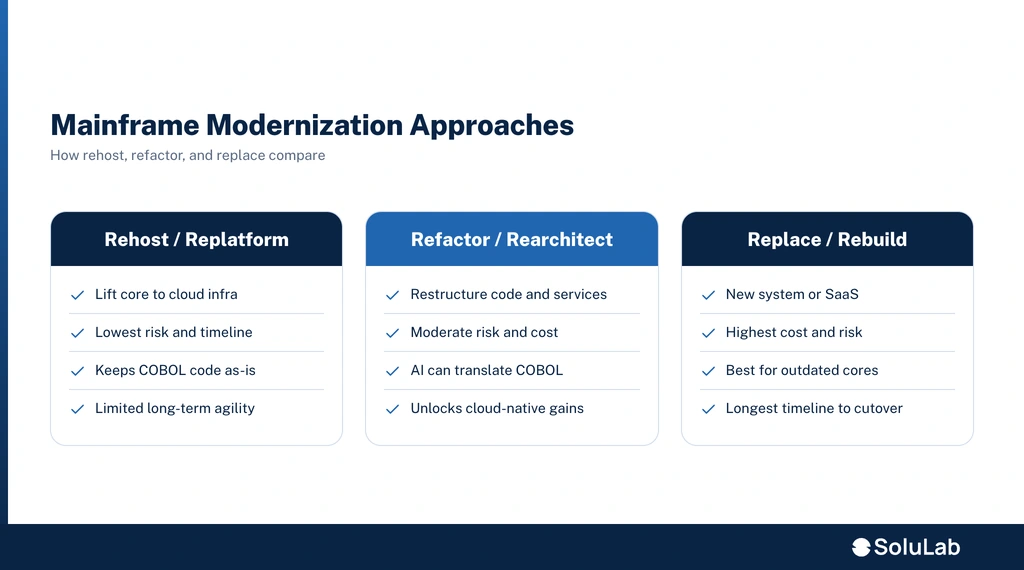
There are five core approaches, and most real programs use more than one across a portfolio. They sit on a spectrum from lowest change and lowest reward to highest change and highest reward.
- Rehost (lift and shift): Move the workload to a new environment, often an emulator or cloud instance, with minimal or no code change. Fastest to execute, lowest immediate risk, but it carries the old architecture with it.
- Replatform: Move to a new runtime or database while making light adjustments, for example running COBOL on a cloud managed service instead of z/OS. More benefit than rehosting, still moderate effort.
- Refactor: Restructure the existing code to improve it and often translate it to a modern language such as Java, keeping behavior intact. Higher effort, real long term payoff.
- Rearchitect: Redesign the application into modern patterns such as microservices and APIs. Highest engineering cost, highest flexibility.
- Replace: Retire the custom system and adopt a commercial or SaaS product. Right when the logic is not a differentiator.
Cloud vendors describe the same taxonomy. AWS Mainframe Modernization supports refactoring, replatforming, and transforming legacy workloads against business objectives (TAFF, on AWS Mainframe Modernization), and migration frameworks commonly organize the choice as the “6 Rs”: Rehost, Refactor, Rewrite, Replace, Retain, and Retire (TCS).
Rehost vs Replatform vs Refactor vs Rearchitect vs Replace: How do they compare?
The short version: rehost is fastest and cheapest but changes nothing structural, replace is cleanest but risks losing custom logic, and refactor sits in the middle as the most common long term choice. The table below maps each approach to its migration risk, relative cost signal, typical timeline signal, and the situation it fits. Treat cost and timeline as directional, since both depend heavily on portfolio size and complexity.
| Approach | Migration risk | Relative cost signal | Timeline signal | When to use it |
|---|---|---|---|---|
| Rehost (lift and shift) | Low | Low | Short | You need off the physical mainframe fast and can defer refactoring |
| Replatform | Low to medium | Low to medium | Short to medium | You want quick cloud wins with light runtime or database changes |
| Refactor | Medium | Medium to high | Medium to long | The logic is valuable, you want a modern language and maintainability |
| Rearchitect | High | High | Long | The app is strategic and needs microservices, APIs, and elastic scale |
| Replace | Medium to high | Varies | Medium | A commercial or SaaS product covers the need better than custom code |
Kyndryl offers a practical way to sort a portfolio: decide per application whether to refactor, replace, or replatform rather than forcing one approach across everything (Kyndryl). Most enterprises end up with a mix, rehosting the workloads they need moved now and refactoring the ones worth investing in.
For a deeper look at how modernization partners package these approaches, see our review of the top legacy system modernization companies.
How does AI help Modernize Mainframe code?
AI coding agents now read, explain, and translate legacy code that no current staff member fully understands, which removes the biggest bottleneck in most mainframe projects. They can map dependencies across a COBOL codebase, generate documentation for undocumented logic, translate routines to Java or another target, and write tests that check the new code behaves like the old code.
This is a genuine shift in the economics, not a marketing claim. On February 23, 2026, Anthropic announced that Claude Code could read, analyze, and modernize COBOL systems at scale, and the market reaction was immediate: IBM’s stock dropped about 13.2%, erasing roughly $36 billion in market value in a single move tied to legacy modernization exposure (SoluLab). AWS built agentic tools to help rebuild mainframe architecture, and Anthropic published a Code Modernization Playbook focused on COBOL SoluLab.
Where AI actually earns its place in a project:
- System audit: Agents parse the codebase, build a dependency graph, and surface dead code and hidden coupling before anyone writes a line of new logic.
- Translation: They convert COBOL routines to modern languages with human review on business critical paths.
- Validation: They generate regression tests so the modernized code can be checked against the mainframe’s real outputs.
AI does not remove the need for architects. It shifts their time from reverse engineering to design and review. We go deeper on this in our guide to AI coding agents for legacy code refactoring.
What are the biggest risks and how do you de-risk a migration?
The largest risk is data integrity, followed by unnoticed behavioral drift, where the new system computes a slightly different result than the mainframe and no one catches it until a customer does. Both are controllable with discipline rather than luck.
The core de-risking technique is the parallel run. You keep the mainframe live and run the modernized system alongside it on the same inputs, then compare outputs until they match within tolerance for a sustained period. Only then do you cut over. Pair that with a tested rollback plan so any release can return to the last known good state within minutes, not days.
A practical risk playbook looks like this:
- Freeze a golden dataset and reconcile record counts and checksums before and after every migration wave.
- Run the old and new systems in parallel and diff outputs automatically, not by spot check.
- Migrate in small waves by business capability, never a single big bang cutover.
- Keep rollback scripts tested and version controlled, and rehearse them before go live.
- Bring compliance and audit in early for regulated cores, so sign off does not stall the cutover.
For banking, insurance, and other regulated cores, treat the compliance evidence trail as a deliverable, not an afterthought. Our work on DevOps in banking covers the automated testing and deployment discipline that makes frequent, low risk releases possible after modernization.
How much does mainframe modernization cost?
There is no honest single price for mainframe modernization, because cost tracks the approach, the portfolio size, and the compliance burden more than any list rate. Anyone quoting a flat number before an assessment is guessing. What you can plan around are the cost drivers, and a proper assessment converts those drivers into a real range for your estimate.
The main cost drivers:
- Approach mix: Rehosting a workload costs far less than rearchitecting it into microservices. Your blend of the five approaches sets the baseline.
- Portfolio size and coupling: The number of programs, their interdependencies, and how much undocumented logic exists all raise effort.
- Data volume and quality: Migrating and reconciling large or dirty datasets adds time and tooling cost.
- Parallel run duration: Running two systems at once has a real infrastructure and staffing cost for the overlap period.
- Compliance and audit: Regulated cores carry validation, evidence, and sign off costs that unregulated systems do not.
- AI assistance: AI code translation can compress the labor heavy phases, changing the cost curve on translation and testing.
The honest framing for a budget conversation: expect the assessment to pay for itself by replacing a guessed number with a scoped one, and expect AI assisted translation to move the biggest cost line, human effort on code conversion.
How do you choose a mainframe modernization vendor?
Choose the vendor that can prove domain fit, migration discipline, and a real plan for your regulated data, not the one with the loudest brand. The SERP for this topic is crowded with product marketing, so screen on evidence rather than positioning.
Use this selection checklist:
- Domain fit: Have they modernized systems in your industry, especially regulated ones like banking or insurance?
- Approach neutrality: Do they recommend rehost, refactor, or replace based on your portfolio, or do they push a single product?
- Migration discipline: Can they show parallel run, automated output diffing, and tested rollback as standard practice?
- AI capability: Do they use AI code translation with human review, and can they explain where it applies and where it does not?
- Compliance handling: Do they treat audit evidence and sign off as part of the plan?
- Outcome proof: Can they point to a real migration with a measurable result?
SoluLab meets these on the back of enterprise software development and cloud delivery experience, and we scope every engagement against your portfolio rather than a template. For the broader vendor field, our list of cloud computing consulting partners is a useful starting point.
What does a mainframe modernization roadmap look like?
A modernization roadmap is a phased plan that moves from understanding the system to cutting over safely, with value delivered in each wave rather than at the end. Skipping the assessment phase is the single most common cause of failed programs.
The phases, in order:
- Assess: Inventory applications, map dependencies, classify each workload by approach, and produce a scoped cost and timeline. AI agents accelerate the code analysis here.
- Plan and prioritize: Sequence waves by business value and risk, define the target architecture, and set the parallel run and rollback strategy.
- Build and translate: Refactor or rehost the first wave, using AI-assisted translation with human review on critical paths, and generate regression tests.
- Validate in parallel: Run the modernized workload alongside the mainframe, diff outputs, and reconcile until results match within tolerance.
- Cut over and optimize: Switch traffic wave by wave, decommission retired mainframe components, and tune the new environment for cost and performance.
Each wave is small enough to roll back and large enough to prove value, which keeps sponsors funded and teams confident through a multi-quarter program.
FAQs
Shipra Garg is a tech-focused content strategist and copywriter specializing in Web3, blockchain, and artificial intelligence. She has worked with startups and enterprise teams to craft high-conversion content that bridges deep tech with business impact. Her work translates complex innovations into clear, credible, and engaging narratives that drive growth and build trust in emerging tech markets.