
Key Takeaways
- Almost every “best RPC provider” list is written by a provider. Chainstack ranks Chainstack first on its own blog; Dwellir ranks Dwellir first on cost. Useful pages, but not neutral ones.
- Advertised request volumes are not comparable. Providers bill in different units, and the same call can carry wildly different weights. Two identical-looking allowances can differ several-fold in real capacity.
- Compare cost per call for your own call mix. Instrument your app for a week, apply each provider’s published method weights, divide plan price by effective consumption. An afternoon’s work that routinely changes the answer.
- Archive calls are the usual source of a surprise bill. They are weighted far more heavily than standard reads and can dominate spend on analytics-heavy products. Price them separately.
- The right answer is usually two providers, not one. A hardcoded single endpoint makes your uptime identical to theirs. Primary plus fallback from a different provider removes an entire category of outage.
- Your provider sees every address you query and every IP that queried it. For a wallet that is a deanonymisation surface. Proxy through your own backend rather than letting user requests reach the provider directly.
Choosing between Ethereum RPC providers looks like a simple comparison, and it is not. An RPC provider is the endpoint your application talks to when it reads the chain or broadcasts a transaction. The advertised numbers are not comparable, because one provider’s “compute unit” can cost many times another’s for the same call. On top of that, almost every comparison online is published by one of the providers being compared. So the useful question is not which provider is best. Instead, it is what your workload costs on each one. It is also what happens to your product when one of them goes down.
This guide first explains what an RPC provider does and why advertised volumes mislead. Then it covers the real comparison criteria, the failover setup most teams skip, the privacy trade-off, and when to run your own node.

What Does an Ethereum RPC Provider Actually Do?
Running an Ethereum node means syncing and storing the chain, keeping it updated, and serving queries against it. Ethereum RPC providers do that for you and expose a JSON-RPC endpoint that your application calls instead.
Every read your dApp performs goes through it: balances, contract state, event logs and transaction receipts. Every transaction your users send is broadcast through it too. As a result, it is the most load-bearing external dependency in most Ethereum applications. It is also the one teams spend the least time choosing.
Three service tiers matter:
- Full node access. Current state and recent history. Covers the majority of application queries.
- Archive node access. Historical state at any past block. Needed for analytics, accounting, indexing and some DeFi calculations, and materially more expensive.
- Enhanced APIs. Provider-specific layers on top — token metadata, NFT data, webhooks, transaction simulation. Convenient, and the main source of lock-in.
Applications built through dApp development and Ethereum blockchain development depend on this layer regardless of what is built on top.
Why Advertised Free Tiers and Request Limits Mislead
This is the part most comparisons bury. Yet it is the only pricing insight that really matters.
Ethereum RPC providers do not bill in the same unit. Some bill per request. Most bill in “compute units” or “credits”, where every RPC method carries a different weight. A simple eth_call might cost one unit on one platform and dozens on another. As a result, two providers advertising the same monthly allowance can differ several-fold in what your application actually gets.
So do not compare advertised volumes. Compare cost per call, for your call mix.
Here is the method, step by step:
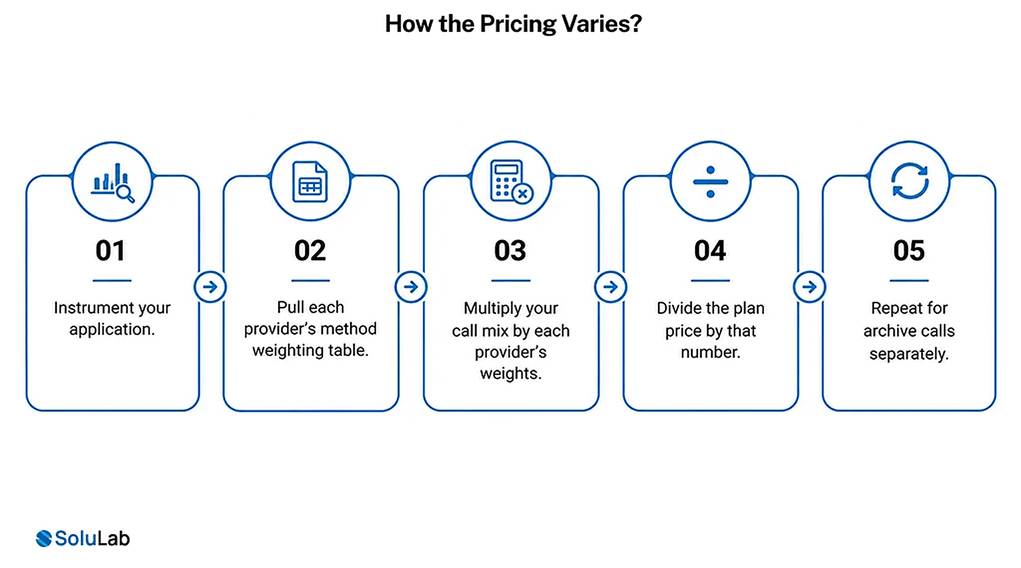
- Instrument your application and count calls by method over a representative week. Most teams have never done this and are surprised by the distribution.
- Pull each provider’s method weighting table from their own documentation, on the day you compare.
- Multiply your call mix by each provider’s weights to get effective monthly consumption per provider.
- Divide the plan price by that number to get cost per million calls, provider by provider.
- Repeat for archive calls separately. They are weighted far more heavily and can dominate the bill on analytics-heavy products.
This takes an afternoon, and it routinely changes the answer. For example, two providers a few dollars apart on headline price can differ several times over on real usage.
How to Compare the Best Ethereum RPC Providers
Once you know your call mix, you can compare the best Ethereum RPC providers on nine criteria. The table below shows what to check and why each one matters.
| Criterion | What to check | Why it matters |
| Cost for your call mix | Method weights against your own instrumented distribution | The only price comparison that means anything |
| Latency from your users’ regions | Test from where your traffic originates, not from your laptop | Published averages hide regional variance |
| Rate limits and burst behaviour | Sustained RPS and what happens when you exceed it | Throttling during a mint or a market move is when it hurts |
| Archive access | Whether included, and at what weighting | The most common source of unexpected cost |
| WebSocket stability | Connection persistence under load | Polling over HTTP compounds latency and cost |
| Method coverage | trace_, debug_, and any method your product needs | Coverage varies more than headline features suggest |
| Uptime history | Published status page and incident history, not the SLA number | An SLA is a refund policy, not a guarantee |
| Compliance posture | SOC 2 or ISO where you have enterprise obligations | Matters for regulated clients, irrelevant otherwise |
| Exit cost | How much provider-specific API you have adopted | Enhanced APIs are convenience now and lock-in later |
You will meet Ethereum RPC providers such as Alchemy, Infura, QuickNode, Chainstack, Ankr, GetBlock and dRPC, plus smaller entrants. Each has genuine strengths. However, every ranked list weights those strengths differently, usually toward whoever published it. So test two or three against your own workload instead of adopting anyone’s ordering.
The Architecture Question Nobody Puts in the Listicle
Choosing a provider is the smaller decision. Depending on only one is the bigger mistake.
A hardcoded single RPC endpoint means your application’s availability is exactly your provider’s availability. So when a major provider has degraded, large parts of the ecosystem have gone down with it. That includes wallets with no fallback configured. This is a known and repeated failure mode, not a hypothetical.
What production applications do instead:
- Configure a primary and at least one fallback from a different provider, with automatic failover on error or timeout.
- Route by method. Send cheap high-volume reads to your cost-efficient provider and specialist calls to whoever supports them best.
- Never hardcode an endpoint in a deployed contract or a shipped client. Make it configurable so it can be changed without a release.
- Monitor your own error rate and latency, not the provider’s status page. You will notice degradation first.
- Keep a public endpoint as a last-resort fallback, accepting the rate limits, so the application degrades rather than dies.
So the right answer to “which of the Ethereum RPC providers should we use?” is usually two of them. That costs slightly more, but it removes an entire category of outage.

The Privacy Trade-Off of Using Ethereum RPC Providers
Your RPC provider sees every request your application makes. That includes which addresses you query, which contracts you read and which transactions you broadcast. It also includes the IP address behind each request.
For an analytics dashboard, that is not a problem. For a wallet, however, it means a single company can link user IP addresses to wallet addresses at scale. That is a real deanonymisation risk, and it sits at the heart of a technology sold on decentralisation.
Practical mitigations, in rough order of effort:
- Batch and proxy requests through your own backend so user IPs never reach the provider directly.
- Avoid one hardcoded endpoint for all users, which concentrates the entire picture with one company.
- Consider decentralised RPC networks where the request routing is distributed rather than held by a single operator. They are newer and less mature, and that is a real trade-off.
- Read the data retention terms, which vary considerably and are rarely mentioned in comparisons.
If you are building a wallet or anything privacy-sensitive, this belongs in the selection criteria alongside price and latency. Teams working through blockchain consulting usually raise it at the architecture stage rather than after launch.
When to Run Your Own Node Instead of Using Ethereum RPC Providers
Managed Ethereum RPC providers suit most teams, but not every team. The table below shows where each option fits.
| Situation | Managed provider | Own node |
| Prototype or MVP | Yes | No |
| Standard dApp, moderate traffic | Yes | No |
| Very high sustained read volume | Compare — provider costs can exceed infrastructure at scale | Worth modelling |
| Hard data residency or privacy requirement | Limited | Often the only option |
| Deep archive and tracing workloads | Expensive on most plans | Frequently cheaper |
| No dedicated infrastructure engineer | Yes | No — the operational burden is real |
Running your own node means sync time, storage growth, client upgrades on the network’s schedule, monitoring and on-call. For most applications, a managed provider with a fallback is the right answer. The exceptions are high-volume, privacy-constrained or archive-heavy workloads. In short, the honest test is simple: do you have someone whose job includes keeping the node running at 3am?
Frequently Asked Questions
Shipra Garg is a tech-focused content strategist and copywriter specializing in Web3, blockchain, and artificial intelligence. She has worked with startups and enterprise teams to craft high-conversion content that bridges deep tech with business impact. Her work translates complex innovations into clear, credible, and engaging narratives that drive growth and build trust in emerging tech markets.
![How to Choose a Blockchain Development Company [2026 Edition]](https://www.solulab.com/wp-content/uploads/2026/09/Banner-Before-You-Hire-Check-These-Blockchain-Essentials.webp)