Key Takeaways
- The Problem. Most blockchain projects are burning budgets on the wrong infrastructure, like high Ethereum gas fees, slow finality, and chains that weren’t designed for business-grade deployment. The tooling has matured, but the platform mismatch still hasn’t gone away.
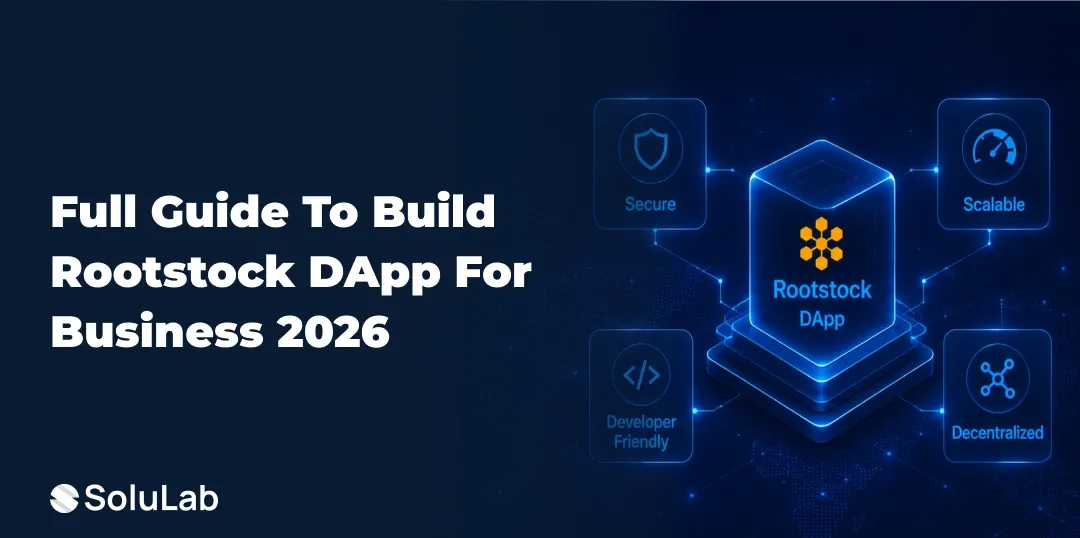
- The Solution. Rootstock gives you EVM-compatible smart contracts anchored to Bitcoin’s security layer with faster, cheaper, and more credible with regulators than most teams expect. It’s the answer for teams that want programmable Bitcoin without rebuilding their Solidity knowledge from scratch.
- How SoluLab Can Help. We’ve taken 200+ companies from idea to live product. We handle architecture, smart contract development, security audits, and post-launch support end-to-end without fragmented vendor coordination.
Over $1 trillion in Bitcoin sits largely idle today, earning nothing, powering no transactions, and sitting still while developers keep flooding into Ethereum and watching gas fees quietly eat into their margins.
That’s the gap Rootstock was built to close. If you’re a CXO or a founder thinking about your next blockchain development in 2026, this is a straight answer to the questions your team keeps circling back to:
- What is rootstock, actually?
- How do you build on it?
- What does it cost?
- Whether it’s the right fit?
Here is everything you need to know to start building today. Don’t thank us after that.
Why Use Rootstock for Decentralized Apps Instead of Ethereum?
Here’s something most blockchain developers skip when they’re picking a chain: regulatory credibility travels with your infrastructure choice.
Bitcoin has regulatory clarity in more countries than any other digital asset class. When you build on Rootstock, a Bitcoin sidechain, your product inherits some of that credibility. That matters when you’re selling to enterprises, navigating compliance teams, or operating in markets where regulatory risk is a real concern.
Beyond compliance, the economics are straightforward. RSK gas fees run significantly lower than Ethereum mainnet, and because the network uses merge-mining with Bitcoin, you get Bitcoin-grade security without paying Bitcoin-grade infrastructure costs.
The benefits of Rootstock for businesses go well beyond fee savings. Bitcoin’s 15+ year track record of zero downtime, growing institutional familiarity with Bitcoin as an asset class, and EVM compatibility that lets your existing Solidity team hit the ground running, these are material advantages, not marketing copy.
According to reports, the global blockchain market is projected to reach $469 billion by 2030. Within that, Bitcoin-native infrastructure is seeing renewed enterprise interest as regulatory clarity improves globally. The blockchain development services market is still relatively uncrowded compared to Ethereum, and that’s an opportunity, not a warning sign.
First movers on RSK are finding less competition and more attention from early adopters.
If you are unaware of where the market is heading in 2026, please read web3 development trends and understand why Bitcoin-native infrastructure is gaining ground.

Rootstock dApp Architecture Overview for Business-Grade Applications
Let’s talk about what a Rootstock dApp actually looks like under the hood, not the idealized version but the real one your engineering team will build and maintain.
The Rootstock dApp architecture follows a pattern that’ll feel familiar if you’ve shipped anything on Ethereum. Your smart contracts are written in Solidity and deployed to the RSK network. Your frontend connects via ethers.js or web3.js through MetaMask or a custom wallet. Gas is paid in RBTC with Bitcoin-pegged, 1:1, custodied through the PowPeg bridge.
The Powpeg is RSK’s two-way peg system, maintained by a federation of hardware security modules. It’s what lets Bitcoin move onto the RSK chain and back, and understanding it is central to understanding what RSK is and how it works at a protocol level. Most introductions stop at its EVM-compatible. That’s the beginning of the story, not the whole story.
A typical RSK dApp stack looks like this:
- Smart Contracts — Solidity 0.8. x, deployed to RSK mainnet or testnet
- Frontend — React + ethers.js, connected via MetaMask with RSK network config
- Gas Token — RBTC (Bitcoin-pegged, 1:1)
- Indexing—The Graph for on-chain data queries
- Storage — IPFS or Filecoin for decentralized file storage
- Off-chain Logic—Node.js or Python API layer where needed
One thing that catches teams off guard: RSK block time is around 30 seconds, slower than most Ethereum L2 blockchain layers. That’s the tradeoff for merge-mined Bitcoin security. Your UX layer needs to account for this, like optimistic updates, clear pending transaction states, and graceful loading behavior.
The Rootstock dApp architecture also supports OpenZeppelin’s TransparentUpgradeableProxy pattern, which works cleanly on RSK and is essential for production deployments where post-launch bug fixes can’t require user migration.
If you want to understand how RSK fits within the broader decentralized landscape and what that means for your product’s composability, please read “Decentralized Web3 Ecosystem.”
A Step-by-Step Implementation Guide to Build Your First DApp on Rootstock
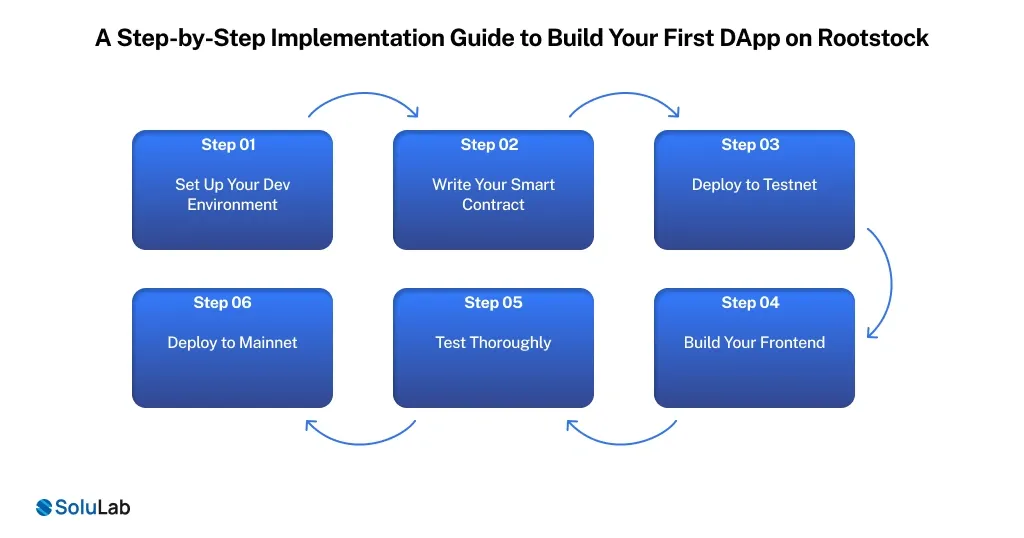
This is the section most articles rush through. We won’t.
Step 1 — Set Up Your Dev Environment
Install Node.js (v18+) and Hardhat. Add the RSK Testnet to MetaMask:
- RPC URL: https://public-node.testnet.rsk.co
- Chain ID: 31
- Currency: tRBTC
Get testnet RBTC from the RSK faucet at faucet.rsk.co. It is free, takes five minutes, and you will need it to pay for test transactions.
Step 2 — Write Your Smart Contract
Standard Solidity 0.8. x and RSK support it without modification. A basic ERC-20 or escrow contract is a solid starting point. Compile it, verify no errors, and then move to deployment.
Step 3 — Deploy to Testnet
Configure hardhat.config.js with the RSK testnet RPC endpoint, then run npx hardhat run scripts/deploy.js –network rsktestnet. Watch the transaction confirm on RSK Explorer.
Step 4 — Build Your Frontend
React + ethers.js is the most common stack. Connect MetaMask, read contract state, and execute transactions. The flow is byte-for-byte compatible with Ethereum because RSK is EVM-compatible; the code is literally the same.
Step 5 — Test Thoroughly
Unit tests in Hardhat, integration tests against the testnet. Gas estimation on RSK differs slightly from Ethereum’s mainnet, so always validate your transaction flows in staging before touching mainnet funds.
Step 6 — Deploy to Mainnet
Switch to RSK mainnet config (RPC: https://public-node.rsk.co, Chain ID: 30), fund your deployer wallet with real RBTC, and deploy. Monitor with RSK Explorer at explorer.rsk.co.
That’s the core of how to build a dApp, and it’s genuinely more accessible than most teams expect going in. If your team has Ethereum experience, the learning curve is days, not months.
If you want to understand a broader checklist for going live on Web3 in 2026, beyond just the technical deployment steps, please read the launch Web3 app guide.
Production-Ready Best Practices for Building Secure Rootstock dApps at Scale
Getting a dApp live is one milestone. Getting it production-ready for real business use is a different conversation entirely, and this is where most teams underinvest.
Security Audits, which are Non-Negotiable:
If your dApp touches real funds, which most do, get an audit from a firm with RSK-specific experience. RSK’s EVM has minor behavioral differences that generic Ethereum auditors can miss. Budget for this from day one, not as an afterthought.
Gas Optimization:
RBTC fees are low, but inefficient smart contracts still waste user money and slow UX. Avoid unnecessary storage operations, use events instead of on-chain storage for data you only need to read, and profile your contracts before deploying.
Built-in Upgradability:
Proxy patterns let you fix bugs post-launch without migrating users or redeploying state. For any production system, this is non-negotiable. OpenZeppelin’s proxy contracts work cleanly on RSK.
Monitor Actively:
RSK Explorer, Grafana dashboards, and automated alerting on failed transactions. Know what’s happening on your contract at all times; don’t wait for a user complaint to discover something broke.
The benefits of Rootstock for businesses show up most clearly at this production stage: predictable fees, stable network performance, and a security model that doesn’t change with market conditions.
Understanding what RSK is and how it works at a protocol level, specifically the merge-mining mechanism and how it ties to Bitcoin’s hash rate, informs better architectural decisions throughout. The protocol’s design choices directly shape how you should structure your contracts and your UX.
Rootstock dApp Architecture Mistakes to Avoid When Building for Production
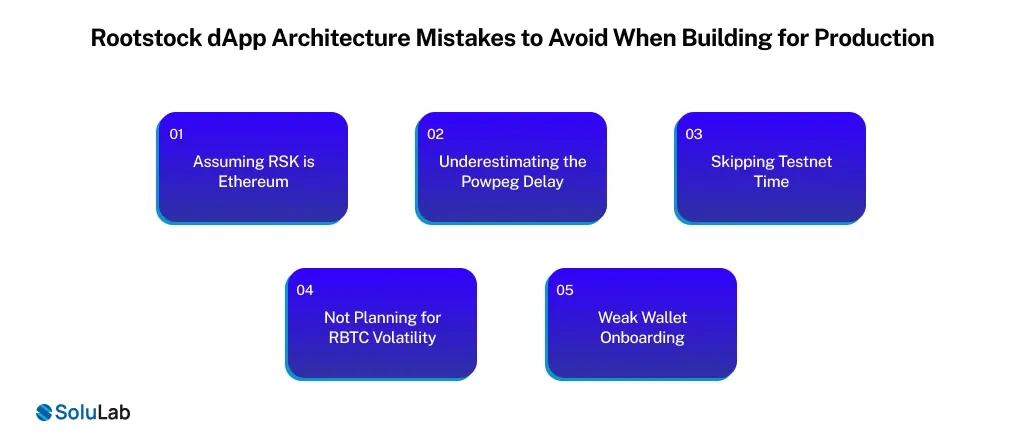
Every team hits the same walls when building on RSK. Here’s what to watch for before you start, not after you’ve already spent the budget.
Assuming RSK is Ethereum
It’s close intentionally but not identical. Block time, gas behavior, and specific precompiles differ in ways that matter for production. Build for RSK specifically, not as an afterthought adaptation of Ethereum code.
Underestimating the PowPEG Delay
Moving BTC onto RSK via the Powpeg currently takes 15–60 minutes, depending on confirmation requirements. Design your UX to handle this gracefully with clear messaging, good loading states, and no assumptions that BTC will arrive instantly.
Skipping Testnet Time
We’ve seen teams deploy to mainnet after minimal testnet testing. This always ends badly, and it always costs more to fix than it would have cost to test properly. Spend the time wisely.
Not Planning for RBTC Volatility
RBTC tracks BTC price, which moves. If you’re doing any kind of fee abstraction or subsidizing gas for users, your cost models need to account for BTC price movement, not just the current price point.
Weak Wallet Onboarding
Most mainstream users don’t have RSK configured in MetaMask. If your onboarding assumes they do, you’ll lose them in the first 60 seconds. Build wallet setup directly into your product flow.
These pitfalls come up in almost every engagement a qualified RSK dApp development company runs. Knowing them up front saves real money downstream and real embarrassment in front of enterprise clients.
Proven Rootstock dApp Use Cases for Real Business Growth
Theory is useful. But what are businesses actually building on RSK right now, and what’s generating real revenue?
1. DeFi Lending & Borrowing
Platforms like Sovryn have proven that Bitcoin holders want yield without leaving the Bitcoin ecosystem. RSK makes that possible, and the demand is real and growing, not just speculative.
2. Cross-Border Payments
Low fees and Bitcoin security make RSK a strong candidate for remittance and B2B payment rails. This is particularly relevant in Latin America and Southeast Asia, where Bitcoin adoption is accelerating fastest.
3. Tokenized Real-World Assets
Tokenizing property, receivables, or commodities on RSK gives enterprises a regulated, Bitcoin-anchored platform for asset management. This use case is attracting serious institutional attention heading into 2026.
4. Enterprise Supply Chain
Immutable record-keeping with Bitcoin-level security, without the overhead and political complexity of permissioned chains. Enterprises are particularly drawn to the Bitcoin association for compliance storytelling.
This is how businesses use Rootstock blockchain, looking in practice with real revenue and real users, not proof-of-concept demos gathering dust in a GitHub repo.
When teams ask about Rootstock vs Ethereum for dApp development, this is where the answer lives. If your users are Bitcoin-native, if regulatory clarity matters to your compliance team, or if you’re operating in markets where Bitcoin has stronger institutional recognition, RSK often wins.
Ethereum L2s are the better fit if you need the widest possible DeFi ecosystem, and Bitcoin security isn’t a differentiator for your users.
Why Our Rootstock Blockchain Development Services Make Us the Right Partner?
We could tell you we’re the right dApp development company for your project. But let’s make that concrete because the phrase means very different things coming from different shops.
It means we’ve solved the hard problems before your project starts. We’ve built on RSK when the tooling was still rough, and we know where the edge cases live, which third-party integrations work cleanly on RSK, where things break under production load, and which audit firms actually understand RSK versus those with Ethereum-only experience.
We operate full-stack and end-to-end: smart contracts, frontend, backend, security audits, deployment, and post-launch support. No vendor juggling. No finger-pointing. One team, one contract, full accountability from day one.
If you’re evaluating web3 partners, ask one thing: Have they shipped on RSK mainnet, and can they show it live?
That answer filters everything.
Conclusion
Bitcoin is growing up. The narrative has shifted from “digital gold” to programmable financial infrastructure, and Rootstock is one of the clearest expressions of that shift happening in real products, with real users, right now.
If you’re building a blockchain app that needs EVM flexibility, low transaction costs, and the credibility that comes with Bitcoin’s security model, RSK deserves a serious look in 2026. The ecosystem is maturing, the tooling is solid, and the businesses that move early are going to have a real advantage over those that wait for the market to get crowded.
The cost to build the Rootstock dApp is lower than most teams expect. Simple DeFi protocols typically land in the $30,000–$60,000 range. Full-featured enterprise applications with audits and post-launch support run $80,000–$200,000, depending on complexity and scope. A qualified team can get you to mainnet in 8–16 weeks.
Why use Rootstock for decentralized apps ultimately comes down to one combination that’s hard to beat: Bitcoin security, Ethereum-compatible tooling, and significantly lower transaction costs—all in one platform.
We’re ready when you are!
FAQs
Shipra Garg is a tech-focused content strategist and copywriter specializing in Web3, blockchain, and artificial intelligence. She has worked with startups and enterprise teams to craft high-conversion content that bridges deep tech with business impact. Her work translates complex innovations into clear, credible, and engaging narratives that drive growth and build trust in emerging tech markets.