
Something fundamental is shifting in web3 space, and DAOs are taking the lead. As per DeepDAO, the combined treasury value held across active DAOs surpassed $25 billion in 2024, and that figure doesn’t include the governance power those DAOs exercise over some of the most significant protocols in Web3. For context, that’s more capital under community control than many Series C and Series D venture rounds combined.
And yet, most startup founders are still asking the same early question: is a DAO actually right for my business, or is it just a trend? That’s a fair question. Because DAO development has moved well past the whitepaper stage. In 2026, it’s a genuine organisational option with real legal frameworks, real tooling, and real case studies, but it’s also not the right answer for every startup.
This guide is for founders who want an honest answer to that question. We’ll walk through what DAO development services actually involve, the specific benefits of DAO for startups, where DAOs fall short, and what a realistic build process looks like, including costs, timelines, and the decisions that matter most.
Key Takeaways
- The Problem: Most startups hit the same wall, like opaque decision-making, slow fundraising, and governance structures that don’t scale with community growth. Whereas traditional corporate models were built for a different era.
- The Solution: DAOs replace top-down control with transparent, on-chain governance by giving token holders real voting power, automated treasury management, and a community-aligned incentive structure that traditional cap tables can’t replicate.
- How SoluLab Can Help: As a full-service DAO development company, SoluLab designs and builds governance systems, smart contracts, and tokenomics tailored to your startup, from PoC through production, so you launch with confidence.
What Is DAO Development for Startups?
A Decentralized Autonomous Organization or DAO is an organisation whose rules are encoded in smart contracts on a blockchain. Instead of a board of directors or a founding team making all the calls, governance power is distributed to token holders who vote on proposals, allocate treasury funds, and steer the organisation’s direction.
For startups, DAO platform development means building the technical infrastructure that makes this possible: the governance contracts, the voting mechanisms, the treasury management layer, and, crucially, the tokenomics model that determines how power is earned, distributed, and used.
Understanding how DAO works for startups goes beyond the technical definition. In practice, it means your community of users, investors, and contributors can participate in decisions that traditionally stayed behind closed doors. New feature roadmaps, partnership approvals, grant allocations, protocol upgrades – all of these can be governed on-chain with full transparency and auditability.
It’s worth drawing a clear line here: a DAO is not just a multi-sig wallet or a Discord community with a voting bot.
A properly built DAO has enforceable, on-chain governance, separation of treasury from core operations, and a token model that aligns incentives over the long term. The difference between a well-built DAO and a poorly built one is exactly the kind of decision that a strong Blockchain Development Company helps you get right from the start.
Why Startups Are Adopting DAO Models in 2026?
The honest answer is that several pressures have converged at the same time, and for a certain type of startup, the DAO model solves multiple problems simultaneously.
1. Community-Led Growth Is Now a Competitive Advantage
Traditional startups pay for growth. DAO-structured startups can incentivise it. When users own governance tokens, they’re not just customers – they’re stakeholders with real skin in the game.
That changes how people refer to your product, contribute code, support new users, and advocate for the brand. It’s the difference between a user base and an ownership community, and the latter is significantly harder to copy.
2. Decentralised Fundraising Has Matured
Token launches, governance token sales, and DAO treasury grants have become legitimate funding mechanisms in 2026, with legal frameworks emerging in jurisdictions like the Marshall Islands, Wyoming, and the Cayman Islands that provide real structural options.
Startups that understand the advantages of decentralized autonomous organizations for fundraising can tap a global investor base without the limitations of traditional VC gatekeeping, though this comes with its own regulatory responsibilities.
3. Transparency Builds Institutional Trust
For startups operating in fintech, DeFi development, supply chain, or any sector where counterparty trust matters, a DAO governance model is a trust-building tool.
- Every treasury transaction is on-chain.
- Every vote is publicly auditable.
- Every proposal is archived permanently.
For enterprise clients and institutional partners increasingly asking about governance quality, that level of transparency has become a genuine differentiator.
Key Benefits of DAO Development Services for Modern Web3 Startups
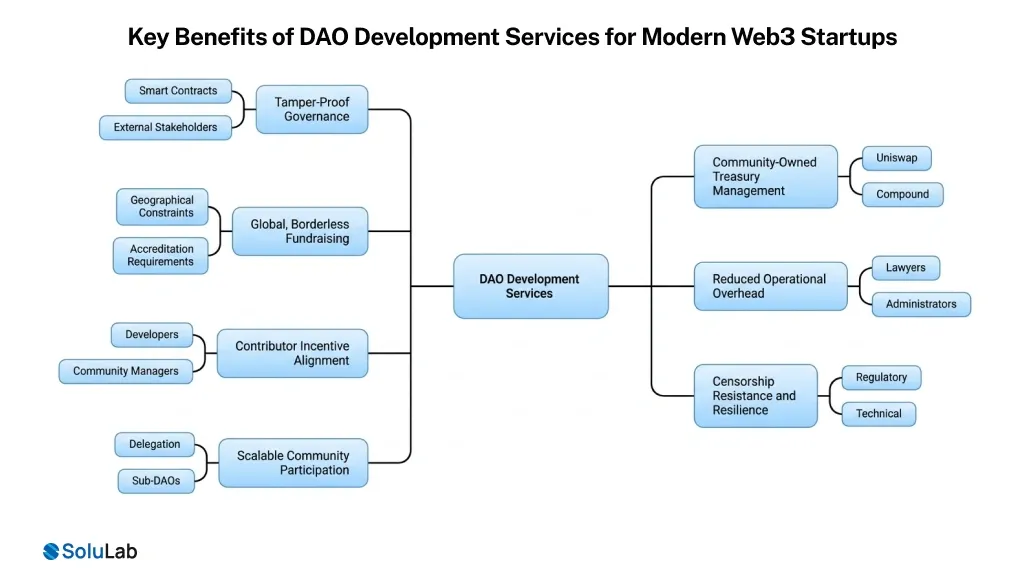
This is the section most guides get wrong, they list generic benefits without explaining the real-world mechanics behind each one. Let’s fix that.
1. Tamper-Proof Governance
One of the foundational Decentralized Autonomous Organizations (DAOs) Benefits is that governance rules are enforced by code, not by trust. Bylaws and board resolutions can be selectively interpreted or quietly revised in a traditional company.
A DAO’s smart contracts execute exactly as written, every time. This matters not just for internal trust but also for external stakeholders, regulators, and partners who need to verify how decisions are made.
2. Community-Owned Treasury Management
DAO treasuries are governed collectively, which means no founder or small inner circle can unilaterally move significant funds without community approval. For startups raising from a community of supporters rather than a small set of VCs, this is a fundamental advantage of a DAO, and it’s the model that protocols like Uniswap and Compound have used to manage treasuries worth hundreds of millions of dollars with full public accountability.
3. Global, Borderless Fundraising
Traditional equity fundraising is constrained by geography, accreditation requirements, and intermediary structures. A properly designed DAO token model, combined with appropriate legal structuring, allows startups to access a global contributor base from day one.
This is one of the most practically significant benefits of DAO development for startups in the early stage, because it removes the geographical bottleneck that limits traditional fundraising rounds.
4. Reduced Operational Overhead
Smart contracts automate what would otherwise require lawyers, administrators, or third-party escrow services. Fund releases tied to milestone completion, automatic royalty distributions, governance proposal execution, contributor reward payouts – all of these can be handled on-chain with no manual intervention.
For lean startups watching burn rate, the operational cost reduction is real and compounding.
5. Contributor Incentive Alignment
Governance tokens give early contributors a stake in the outcome, and that changes behaviour at a fundamental level.
- Developers who hold governance tokens review code more carefully.
- Community managers who earn tokens advocate more authentically.
- Investors who govern alongside the team are more likely to support rather than simply extract.
This alignment mechanism is one of the advantages of decentralized autonomous organizations that is hardest to replicate with traditional equity structures, particularly for globally distributed teams.
6. Censorship Resistance and Resilience
A DAO with sufficiently decentralised governance is structurally resistant to single points of failure – regulatory, technical, or operational.
- No single jurisdiction can shut it down.
- No single key-holder can drain the treasury.
- No individual departure breaks the governance system.
For startups building in politically sensitive or cross-border regulated environments, this resilience is a meaningful architectural advantage.
7. Scalable Community Participation
As a startup scales, traditional governance structures struggle to accommodate growing stakeholder bases. DAOs for investor ready governance are designed to scale participation. Delegation, sub-DAOs, working group structures, and tiered governance models all allow a DAO to evolve from a handful of founding contributors to thousands of active participants without rewriting the governance rules from scratch.
DAO vs Traditional Startup Structure
Before deciding whether a DAO model fits your startup, it helps to see the structural differences in plain terms:
| Dimension | Traditional Startup | DAO-Structured Startup |
| Governance | Board of directors with the founding team | Token holder votes via smart contract |
| Treasury control | Founders / CFO discretion | On-chain, community-approved proposals |
| Fundraising | VC rounds, accredited investors | Token sales, global contributor base |
| Decision speed | Fast (small decision group) | Slower (requires quorum + voting period) |
| Transparency | Internal (cap table, financials private) | Fully public and on-chain auditable |
| Legal structure | Corp, LLC, Ltd – well established | Emerging (Wyoming DAO LLC, Marshall Islands) |
| Contributor incentives | Equity (illiquid until exit) | Governance tokens (liquid, transferable) |
| Operational costs | Admin, legal, intermediaries | Reduced via smart contract automation |
| Resilience | Dependent on key people | Structurally distributed and redundant |
Neither structure is universally better. But the comparison makes clear why founders exploring use cases of DAO in startups are increasingly treating the DAO model not as an ideological choice but as a practical organisational architecture – one that solves specific problems around transparency, incentive alignment, and decentralised fundraising that traditional structures genuinely struggle with.
When DAO Development Is Not the Right Fit for Startups?
Good DAO consulting means being honest about this. Not every startup should build a DAO, and some that are tempted to wrap a DAO structure around a fundamentally centralised product are setting themselves up for governance theatre, not real decentralisation.
Avoid DAO If Any of These Apply
- You need fast, decisive execution.
DAOs require proposal periods, quorum requirements, and voting windows. For startups in hyper-competitive markets where speed is a daily competitive advantage, governance by committee can be a fatal bottleneck.
- Your product doesn’t benefit from community ownership.
If your users have no real stake in governance outcomes, token-based incentives don’t change behaviour. The DAO overhead adds cost without adding value.
- You’re pre-product-market fit.
Building DAO governance before you’ve validated your core product is building the org chart before you’ve built the product. It’s a distraction, and tokenomics mistakes made at this stage are very expensive to unwind.
- You’re in a heavily regulated sector without legal clarity.
Healthcare, financial services, and securities-adjacent products require specific legal structuring that DAO frameworks are still catching up to in most jurisdictions. This doesn’t mean it’s impossible, but it requires specialist legal guidance from day one.
When DAO Development Makes Sense for Your Startup?
Conversely, there’s a set of startup profiles where the use cases of DAO in startups are genuinely compelling and where building a DAO early creates durable structural advantages.
- DeFi protocols and Web3 financial products.
Governance-by-community is the expected norm in DeFi ecosystem. Users actively prefer platforms where token holders govern protocol changes and the trust premium is real and measurable in TVL and user retention.
- Community platforms and creator economies.
Content platforms, creator toolkits, and social apps where contributor ownership changes the product dynamics meaningfully. Mirror, Zora, and Lens are early examples of what this looks like in practice.
- Open-source protocol development.
Projects where a distributed contributor base needs a fair mechanism for funding allocation, roadmap decisions, and contributor rewards. A DAO treasury replaces the foundation model with direct community control.
- Multi-stakeholder supply chains and consortium networks.
When multiple organisations need shared infrastructure but no single participant should control it, a DAO governance model provides a neutral coordination layer, which is why enterprise blockchain consortiums are increasingly using DAO structures.
- Cross-border fundraising and global contributor communities.
Startups with a genuinely global user base that wants to participate in ownership, not just usage. The token model creates a contribution pathway that no traditional cap table can accommodate at scale.
How the DAO Development Process Works?
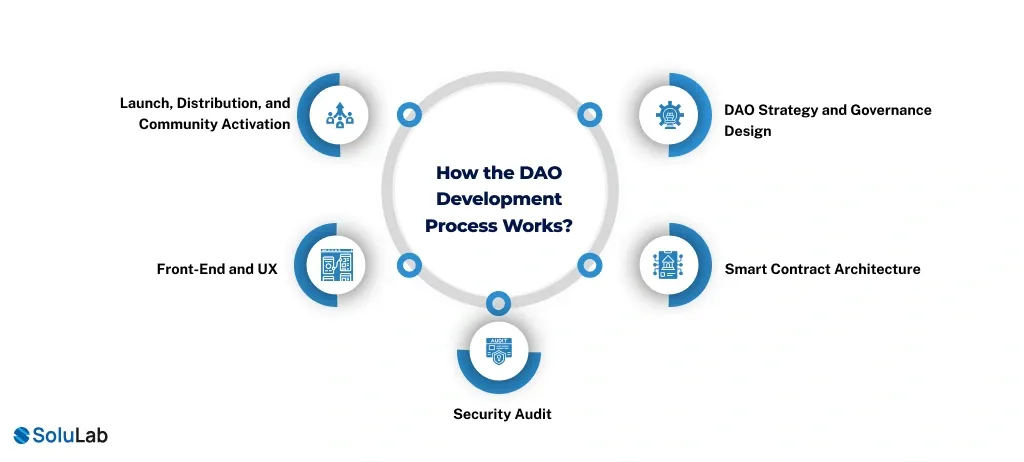
Most agencies skip this section or give it one paragraph. But understanding the actual build process is how you evaluate vendors, set expectations with your team, and avoid the mistakes that turn a good DAO concept into a governance disaster.
Phase 1 — DAO Strategy and Governance Design
Before a single line of code is written, the governance model needs to be designed. This means defining:
- Who can submit proposals
- What quorum is needed to pass them
- How voting power is allocated
- What happens to the treasury under different vote outcomes?
These aren’t technical questions, they’re organisational ones, and they shape every technical decision that follows.
Tokenomics design happens here too: total supply, distribution schedule, vesting for the founding team and early contributors, and the economic mechanisms that keep the governance token valuable over time.
Getting this wrong is expensive. A poorly designed token model that concentrates voting power in a small group or creates perverse incentives can destroy community trust faster than any technical bug.
Phase 2 — Smart Contract Architecture
The governance model is then encoded into smart contracts. This typically involves governance contracts (proposal creation, voting, execution), treasury management contracts, token contracts, and timelock controllers that add a delay between a vote passing and its execution, giving the community a window to react to potentially harmful proposals.
Industry-standard frameworks like OpenZeppelin Governor are often used as the base layer because smart contract development from scratch introduces unnecessary risk. The art is in customising these frameworks to fit your specific governance model without introducing new vulnerabilities.
Phase 3 — Security Audit
No DAO should launch without a third-party security audit. DAO governance contracts control treasury funds. A single vulnerability can drain everything. Budget $10,000–$40,000 for a quality audit, depending on contract complexity, and factor this into your timeline.
A good DAO Development Company builds with audit-readiness from day one, structuring contracts to minimise the audit scope and duration, rather than treating it as a last step.
Phase 4 — Front-End and UX
A DAO governance system that requires command-line interaction has a community participation problem. The front-end interface – the governance dashboard, proposal explorer, voting UI, and treasury tracker determines whether token holders actually engage or just hold. Good UX design is not a nice-to-have in DAO development. It’s a governance success factor.
Phase 5 — Launch, Distribution, and Community Activation
The technical build is only part of the job. Token distribution mechanics (airdrop, liquidity mining, contributor grants), initial governance proposals to test the system, and community onboarding all need to happen in a coordinated way. The first 90 days of a DAO’s governance activity set the participation norms that persist for years.
Cost and Timeline to Build a DAO
One of the most common questions for any startup exploring custom DAO development solutions is simply: what does this actually cost, and how long does it take?
The honest answer depends heavily on governance complexity, tokenomics requirements, and how much custom engineering is involved. But here are realistic 2026 benchmarks.
| Build Tier | What’s Included | Typical Cost | Timeline |
| Basic DAO | Standard governance contracts, basic voting, token contract, simple UI | $15,000 – $30,000 | 2–4 weeks |
| Mid-Tier DAO | Custom governance model, treasury management, delegation, audit, full UI | $20,000 – $50,000 | 4–8 weeks |
| Full Production DAO | Complex tokenomics, sub-DAOs, multi-chain, legal structuring support, full audit | $50,000 – $100,000+ | 6–10 weeks |
| Enterprise DAO | Consortium governance, compliance layers, legacy integration, multi-sig treasury | $50,000 – $150,000+ | 10–12 weeks |
These figures include development, audit, and basic front-end. Legal structuring (if you need a DAO LLC or foundation wrapper), exchange listings for your governance token, and ongoing maintenance are additional.
As with any DAO development services engagement, the single biggest cost variable is governance complexity – the more custom the model, the more engineering, audit time, and documentation it requires.
| Budget reality check: A $15,000 DAO is not a production-grade governance system for a project handling real community funds. If your DAO will control a treasury or govern a live protocol, budget for the mid-tier or above and include a formal audit. The audit is not optional. |
How SoluLab Can Help Startups Get Started With DAO Development?
SoluLab has been building Web3 systems since 2014 – across fintech, healthcare, logistics, DeFi, and enterprise platforms. Our DAO development services aren’t a new practice area we added when DAOs became trendy.
They’re built on the same foundation we’ve used to deliver production-grade smart contract systems, tokenization platforms, and enterprise blockchain infrastructure for clients ranging from funded startups to Fortune 500 enterprise teams.
How We Work?
Every engagement starts with a governance strategy session because the most expensive DAO mistakes happen before any code is written. We help you design the governance model, stress-test the tokenomics, identify the regulatory considerations relevant to your jurisdiction, and scope a build plan that fits your timeline and budget.
Only then do we write the first line of code.
We also offer flexible engagement models: full-service DAO builds for teams that want end-to-end delivery, or specialist augmentation for teams that have an internal engineering lead and need experienced DAO architects to fill specific gaps.
And because we’re a full-service DAO Development Company, we can handle the blockchain infrastructure, the front-end, the security audit coordination, and the post-launch governance support under one roof.
Conclusion
DAO development in 2026 is past the hype cycle. The tooling is mature, the legal frameworks are emerging, and the case studies, from billion-dollar DeFi protocols to enterprise supply chain consortiums are real and auditable. But it’s also not a default choice.
A DAO is an organisational architecture with specific strengths and specific constraints, and the startups that benefit most from it are the ones that adopt it for the right reasons. If you’re building a product where community ownership changes user behaviour, where transparent governance is a trust-building tool, or where decentralised fundraising opens doors that traditional VC structures close, then the benefits of DAO development for startups are concrete, measurable, and worth the investment to build properly.
And building properly is the operative phrase. That’s what SoluLab brings to every DAO engagement. Not a template, but a build process shaped by real production experience across the full stack of DAO development services from governance design through smart contract audit through community launch.
FAQs
With over 3 years of experience, I specialize in breaking down complex Web3 and crypto concepts into clear, actionable content. From deep-dive technical explainers to project documentation, I help brands educate and engage their audience through well-researched, developer-friendly writing.