Key Takeaways
- Cross-border tokenization compliance means meeting securities, KYC/AML, tax, and data rules in every jurisdiction where a token is issued or held.
- Token classification isn’t fixed. The same asset can be a security in one country and completely unregulated in another.
- A working compliance framework starts with jurisdiction mapping, not smart contract code.
- Investor eligibility controls, licensed custody, and automated KYC/AML aren’t optional if you’re selling across borders.
- Teams that treat compliance as a design input, not an afterthought, tend to launch faster and skip the costly relaunch.
Say you’re raising money for a tokenized real estate fund and investors show up from five different countries. Congratulations, you now answer to five different regulators, not one.
Cross-border tokenization compliance is the discipline of meeting securities, anti-money-laundering, tax, and data protection rules in every jurisdiction tied to a token issuance or transfer.
Miss a piece of it, and a platform can end up with frozen accounts, forced buybacks, or a market ban before it’s had a chance to prove the model works.
What Is Cross-Border Tokenization Compliance?
Cross-border tokenization compliance is the set of legal, regulatory, and operational controls a business needs when it issues, distributes, or trades a tokenized asset to investors in more than one country. It covers how the token gets classified, who’s allowed to buy it, how identity gets verified, and how the underlying asset gets taxed once it crosses a border.
A single-market RWA tokenization platform has it relatively easy. A cross-border build has to reconcile rules that were never written with each other in mind. A token that behaves like a security under the U.S. Howey test might read as a utility instrument in Singapore, then land under a completely separate custody regime in the UAE. Three answers, one token.
How Does Cross-Border Tokenization Work?
Tokenization converts ownership rights in a real-world asset, real estate, private credit, a fund share, into a digital token recorded on a blockchain technology. The compliance layer sits on top: smart contracts enforce who can actually hold the token, transfer agents track ownership for tax purposes, and off-chain legal agreements spell out investor rights.
Add jurisdiction-aware logic on top of that, geo-fenced wallets, resale restrictions for specific markets, region-specific KYC routing, and you’ve got a cross-border deployment instead of a domestic one.
Why Is Cross-Border Tokenization Compliance Important?
Regulators stopped treating this as a niche problem a while ago. Deloitte’s Center for Financial Services projects the tokenized real estate market could grow from under $300 billion today to roughly $4 trillion by 2035, a 27% compound annual growth rate driven by tokenized debt, private funds, and land development assets.
Gartner’s 2026 predictions echo that: stablecoins, deposit tokens, and tokenized real-world assets are moving into the financial mainstream, but fragmented standards and inconsistent regulatory frameworks across borders will slow adoption for issuers who haven’t planned around them.
In other words, compliance isn’t sitting quietly behind product development anymore. It’s the thing deciding which markets a token can even reach.
1. Different Jurisdictions Classify Tokens Differently
The same token can be a regulated security in one country and an unregulated digital collectible in another, and that’s rarely obvious from the outside. A fractionalized real estate token might trigger prospectus requirements under EU MiCA rules, fall under SEC securities law in the U.S., and require an entirely separate digital asset license in the UAE or Singapore. Teams that assume one legal opinion covers every market usually find out the gap exists after launch, which is the expensive way to learn it.
2. Investor Access Can Trigger Additional Requirements
Marketing a token to retail investors in one country while restricting it to accredited investors in another isn’t a nice-to-have; it’s often a hard legal line. A platform that doesn’t segment investor access by residency and accreditation status can end up soliciting an offering in a jurisdiction where it holds no license at all, without ever meaning to.
3. Non-Compliance Can Restrict Market Access
Regulators have gotten faster at this: freezing token contracts, blacklisting wallet addresses, ordering a platform to unwind an offering entirely. There’s also the quieter cost. A compliance misstep chips away at the credibility a tokenization platform needs to eventually pull in institutional capital.
What Are the Key Compliance Requirements for Cross-Border Tokenization?
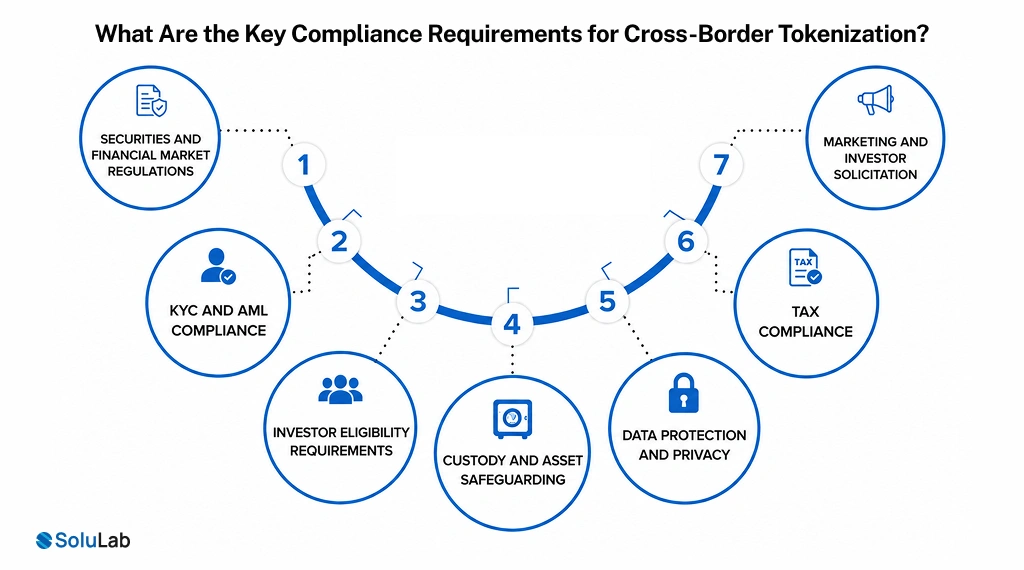
Gartner predicts legal, risk, and compliance functions will double their technology spend by 2027 as regulatory complexity keeps climbing, and tokenization teams building multi-jurisdiction platforms are a big part of where that spend is going. Here’s what it usually covers.
1. Securities and Financial Market Regulations
If a token represents an ownership stake, a right to profits, or a debt obligation, it likely falls under securities law everywhere it’s offered. This shapes registration obligations, prospectus requirements, and which investors can legally participate. It’s usually the first thing a cross-border tokenization compliance consulting engagement works through, well before anyone writes a line of code.
2. KYC and AML Compliance
Every investor onboarded needs identity verification and screening against sanctions and politically exposed persons lists, and what counts as “sufficient” varies by country. A platform built around solid tokenization KYC AML compliance usually automates this through API-based identity providers instead of manual review. Manual review works fine for fifty investors. It falls apart at five thousand.
3. Investor Eligibility Requirements
Accreditation thresholds, minimum investment amounts, retail-versus-institutional restrictions- all of these differ by jurisdiction and need enforcement at the smart contract level. A terms-of-service clause nobody reads doesn’t count as enforcement.
4. Custody and Asset Safeguarding
Most major markets require licensed custodians for regulated digital securities, and the custody model needs to match the asset. Physical real estate needs a different safeguarding setup than a tokenized bond, and treating them the same is a common shortcut that backfires.
5. Data Protection and Privacy
GDPR in the EU, CCPA in California, and similar rules elsewhere govern how investor identity data collected during onboarding gets stored, processed, and shared across borders. This matters more than teams expect once KYC data starts moving between vendors in different countries.
6. Tax Compliance
Token transfers can trigger capital gains, withholding tax, or transaction-level tax obligations depending on where the issuer and investor are domiciled. Getting this wrong doesn’t blow up at launch; it surfaces months later as a liability nobody budgeted for.
7. Marketing and Investor Solicitation
Even a simple landing page or a social post can count as a regulated financial promotion in some jurisdictions. Marketing copy needs a market-by-market review before it goes live, not after a regulator flags it.
How Do You Determine Which Regulations Apply to a Tokenized Asset?
Figuring out which rules apply takes a structured process, not one legal memo that tries to cover everything. Here’s the sequence most compliance teams follow, from identifying the asset to mapping the licenses it actually triggers.
Step 1: Identify the Underlying Asset
Start with what the token represents, since asset type drives nearly everything that follows.
- Confirm whether it’s equity, debt, or real asset
- Document the asset’s income or profit rights
- Check if it involves physical custody needs
Step 2: Define the Token Holder’s Rights
What a holder can actually do with the token, vote, redeem, earn yield, shapes its legal classification more than the underlying tech ever will.
- List voting or governance rights granted
- Specify redemption or buyback conditions
- Note any profit-sharing or dividend rights
Step 3: Identify the Issuer’s Jurisdiction
The issuer’s home jurisdiction sets the baseline every other market gets layered on top of.
- Confirm the entity’s country of incorporation
- Identify the issuer’s primary regulator
- Check existing licenses already held
Step 4: Identify Target Investor Jurisdictions
Every country where investors get marketed to or onboarded from adds its own layer of applicable law, whether the platform accounted for it or not.
- List every country investors reside in
- Flag jurisdictions with strict securities law
- Note countries with outright token bans
Step 5: Determine the Token’s Regulatory Classification
Combine the asset type and holder rights to classify the token under each relevant jurisdiction’s framework, one market at a time.
- Run the security-test analysis per market
- Classify token as security or utility type
- Document classification reasoning in writing
Step 6: Map Licensing and Compliance Obligations
Turn the classification into an actual list: what licenses, what filings, what ongoing obligations.
- List required licenses per jurisdiction
- Identify recurring reporting obligations
- Assign compliance ownership internally
How to Launch a Compliant Cross-Border Tokenization Platform?
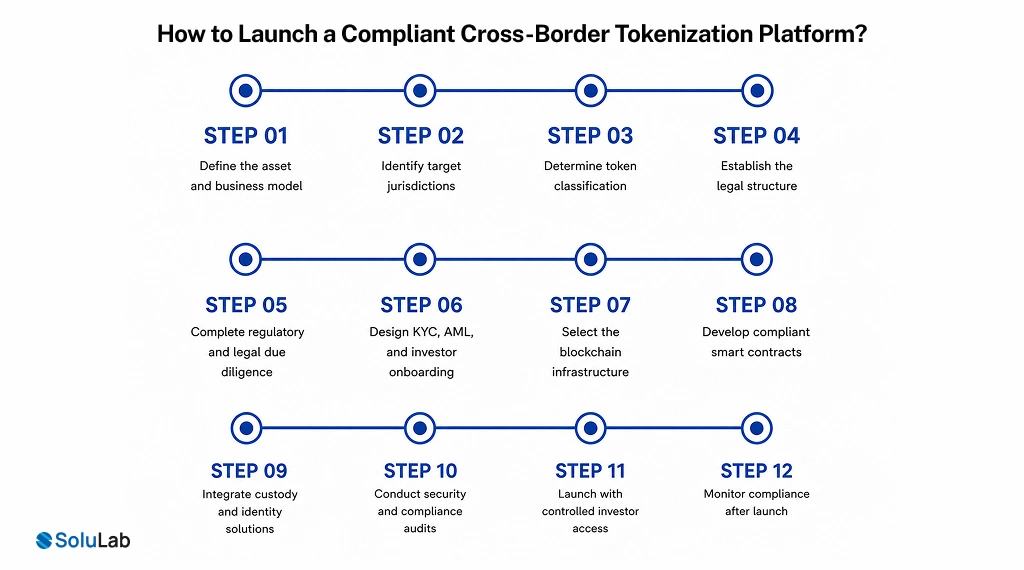
Launching across borders is a sequence, and skipping ahead is where most relaunches come from. Jumping straight to smart contract development because it feels like progress, before jurisdiction mapping is even done, is the single most common mistake we see teams make.
Step 1: Define the Asset and Business Model
Pin down exactly what’s being tokenized and how returns flow to investors before any legal work starts.
- Document the asset class precisely
- Define investor return mechanics clearly
- Confirm the business model is viable
Step 2: Identify Target Jurisdictions
Pick launch markets based on regulatory clarity first, investor demand second.
- Rank markets by regulatory clarity
- Assess licensing timelines per market
- Prioritize jurisdictions with existing precedent
Step 3: Determine Token Classification
Get a formal legal opinion on classification in each priority market before development even begins.
- Commission jurisdiction-specific legal opinions
- Classify token under each framework
- Document classification for future reference
Step 4: Establish the Legal Structure
Set up the entity, or entities, that will legally issue and manage the token.
- Choose issuing entity structure
- Register in the primary jurisdiction
- Draft investor-facing legal agreements
Step 5: Complete Regulatory and Legal Due Diligence
Confirm licensing requirements and any available exemptions before a single contract gets written.
- Identify applicable licensing exemptions
- Confirm required regulatory filings
- Engage local counsel per jurisdiction
Step 6: Design KYC, AML, and Investor Onboarding
Build onboarding around the strictest applicable jurisdiction, then relax it where allowed. Building it backward creates rework nobody wants to redo later.
- Select KYC and AML vendors
- Design tiered investor verification flow
- Set sanctions and PEP screening rules
Step 7: Select the Blockchain Infrastructure
Pick a chain and token standard that can actually enforce jurisdiction-based transfer restrictions, not just theoretically support them.
- Evaluate permissioned versus public chains
- Confirm transfer restriction capabilities
- Assess network cost and scalability
Step 8: Develop Compliant Smart Contracts
Encode eligibility rules into the contract itself. Relying on manual enforcement after the fact defeats the point.
- Build wallet whitelisting logic
- Add jurisdiction-based transfer restrictions
- Include pause and freeze functions
Step 9: Integrate Custody and Identity Solutions
Connect licensed custody providers and identity verification systems directly to the platform.
- Integrate licensed custodian APIs
- Connect identity verification providers
- Test custody-to-contract data flow
Step 10: Conduct Security and Compliance Audits
Bring in independent auditors to review both the smart contracts and the compliance controls, separately.
- Commission third-party smart contract audit
- Run compliance controls testing
- Remediate findings before launch
Step 11: Launch With Controlled Investor Access
Go live in phases. Opening every market on day one sounds efficient and rarely is.
- Launch in lowest-risk jurisdiction first
- Gate access by verified eligibility
- Monitor early transactions closely
Step 12: Monitor Compliance After Launch
Compliance doesn’t end at launch; it just changes shape.
- Track regulatory changes per market
- Audit transactions on a schedule
- Update contracts as rules evolve
How Can Businesses Build a Cross-Border Tokenization Compliance Framework?
A one-time legal review isn’t a framework. It’s a snapshot that starts going stale the day it’s finished. Businesses that stay compliant as they expand into new markets build something repeatable instead.
1. Establish a Regulatory Governance Model
Give someone actual ownership of compliance decisions, a named lead who signs off before any new market goes live, instead of leaving it to whoever’s free that week.
2. Create a Jurisdiction Mapping Framework
Keep a living document tracking every jurisdiction the platform touches: licensing requirements, regulatory contacts, open obligations. Update it as markets get added rather than rebuilding it from scratch each time.
3. Build Compliance Into the Token Design
Encode eligibility and transfer restrictions directly into smart contracts. Compliance enforced automatically beats compliance that depends on investors self-reporting honestly.
4. Implement Automated KYC and AML
Manual review doesn’t scale past a few hundred investors. Automated identity verification and sanctions screening, through an established travel tokenization provider, keeps onboarding fast without cutting corners on the checks that matter.
5. Establish Legal and Compliance Reviews
Schedule reviews on a recurring basis, not just at launch. Rules change quietly, and a platform compliant on day one can drift out of compliance a year later without anyone noticing until it’s a problem.
6. Maintain Ongoing Regulatory Monitoring
Track regulatory announcements in every active jurisdiction and have someone whose job it is to turn policy changes into platform updates, before they turn into violations.
What Are the Best Practices for Cross-Border Tokenization Compliance?
Statista’s research on cross-border payments found that regulatory compliance at customs and inconsistent standards between countries rank among the top pain points professionals report, and the same fragmentation shows up in tokenization, just with higher stakes. A few practices consistently help teams get ahead of it.
1. Conduct Regulatory Analysis Before Token Design
Get legal opinions on classification before a single line of smart contract code is written. Retrofitting compliance onto a finished architecture is possible, but it’s rarely cheap.
2. Define Investor Eligibility Before Launch
Decide exactly who can invest, from where, under what conditions, before marketing even begins. Build the onboarding flow around that decision, not the other way around.
3. Use Jurisdiction-Specific Access Controls
Geo-fence wallet access and enforce transfer restrictions programmatically, so eligibility rules can’t get bypassed with a simple wallet-to-wallet transfer.
4. Build KYC and AML Into the Platform
Treat identity verification as core infrastructure, not something bolted on the week before launch under deadline pressure.
5. Maintain Clear Legal Documentation
Keep investor agreements, classification opinions, and licensing records organized and easy to retrieve. Regulators and auditors will ask for them eventually, usually at an inconvenient time.
6. Separate Digital and Physical Asset Custody
For deals involving real estate tokenization, keep legal title to the physical asset clearly separated from the digital token representing ownership, with documented links tying the two together.
Conclusion
Cross-border tokenization compliance isn’t something you check off after the product ships. It’s what decides which markets a token can actually reach and how long it stays welcome there. Getting jurisdiction mapping, KYC/AML, and licensing right from the start costs a fraction of fixing them after a regulator steps in.
SoluLab works as a cross-border tokenization development company, helping businesses design compliant token structures, build the smart contract logic that enforces jurisdiction-specific rules, and launch platforms built to hold up as they scale into new markets.
Book a free consultation with SoluLab’s tokenization compliance team to map your regulatory requirements before you build.
FAQs
Neha is a curious content writer with a knack for breaking down complex technologies into meaningful, reader-friendly insights. With experience in blockchain, digital assets, and enterprise tech, she focuses on creating content that informs, connects, and supports strategic decision-making.