Few corners of tech moved as fast as the world of NFTs (Non-Fungible Tokens). It changed how people think about owning and trading digital assets, almost overnight. More demand for NFTs means more demand for marketplaces and platforms that can actually hold up under the traffic. That’s the gap whitelabel NFT development companies fill: they give you a customizable base to launch your own NFT marketplace on. This guide covers how to pick the best whitelabel NFT development company for your project, and what to check before you commit.
What is a Whitelabel NFT Development Company?
A Whitelabel NFT Development Company is a specialist firm in the NFT (Non-Fungible Token) space. Its whole business is customizable NFT marketplace solutions: ready-made software, tools, and services that let businesses and founders launch their own NFT platforms quickly. You skip building from the ground up. You buy a whitelabel base, then shape it around your brand.
Why “whitelabel”? Because you rebrand the product and present it as your own. In NFT terms, that means a pre-built NFT marketplace platform you can tailor to your brand’s identity and requirements. If speed matters to you, the appeal is obvious. You get into the NFT market without the long timeline and heavy budget a fully custom build demands.
Whitelabel NFT development companies specialize in white-label NFT marketplace software and the services around it. The good ones know blockchain well, including the networks most NFT projects run on, like Ethereum and Binance Smart Chain. Their products usually ship with a set of features you can configure to fit your needs. And the reputable ones don’t disappear after launch. They keep supporting and maintaining the platform so it stays secure and current.
Read Our Blog Post: Why Should You Start Your Own NFT Marketplace Business?
Put simply, a whitelabel NFT development company sells businesses and entrepreneurs a fast, efficient way into the NFT space. They build the platform ahead of time; you rebrand it and adjust it to your requirements. New to NFTs and short on time? Then a lot of the groundwork is already done for you.
Why Choose a Whitelabel NFT Solution?
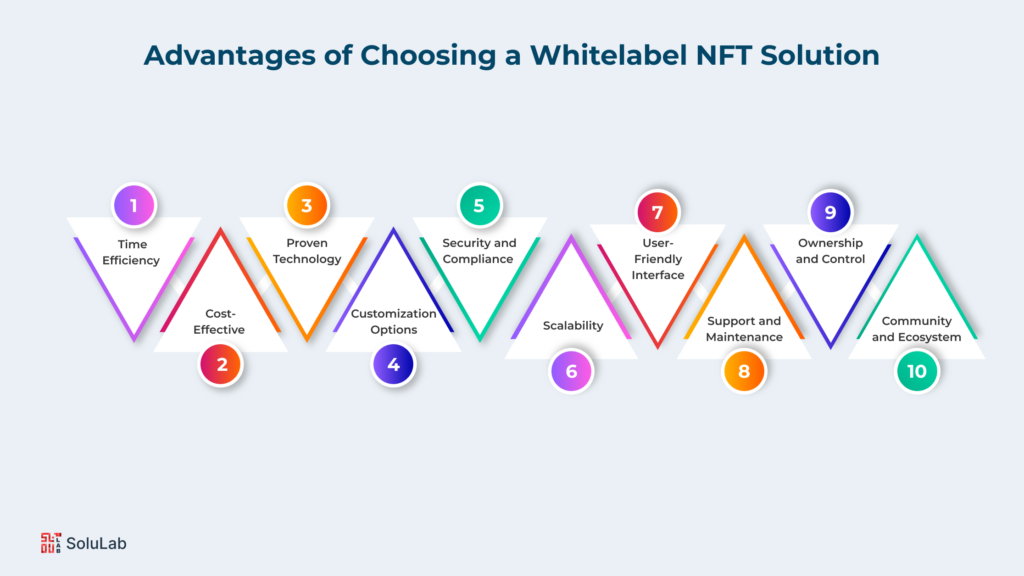
Here’s what you actually gain by going with a Whitelabel NFT Development Company:
- Time Efficiency: Building a custom NFT marketplace from scratch is slow. Development, testing, rework, more testing. A whitelabel solution cuts most of that out, so you launch sooner and catch market openings a slower build would miss.
- Cost-Effective: A bespoke NFT platform gets expensive fast, between development, testing, and maintenance that never really ends. Whitelabel options usually cost less, because they run on technology and infrastructure that already exists.
- Proven Technology: Whitelabel NFT solutions sit on technology that’s already been tested and proven. Pick a reputable whitelabel NFT development company and you borrow their experience, which gets you a more stable, more secure platform. In the NFT space, where security and reliability decide whether users stick around, that’s a big deal.
Check Our Blog Post: Top NFT Development Companies To Look At In 2024
- Customization Options: Pre-built doesn’t mean fixed. You can reshape a whitelabel platform to match your brand and your specific requirements, and you stay in charge of the design, the features, and the user experience.
- Security and Compliance: People trade valuable digital assets on these platforms, so security comes first. Whitelabel NFT development companies usually build in serious protections: encryption, multi-factor authentication, and regular security audits. Many also track regulatory changes and can help keep your platform in line with the laws that apply to it.
- Scalability: Growth is the whole point, so your NFT marketplace has to cope with more traffic and more transactions as users arrive. Reputable whitelabel solutions are built to scale, letting the platform expand without major disruption.
- User-Friendly Interface: A confusing interface drives users away. Simple as that. Plenty of whitelabel NFT solutions come with well-designed front ends that feel intuitive and look good from day one.
- Support and Maintenance: Launch day is the start, not the finish line. Running an NFT marketplace takes ongoing support and maintenance, and reliable whitelabel NFT development companies provide it, handling issues and updates as they come up. Your platform stays current, secure, and responsive to what users need.
- Ownership and Control: Go with a whitelabel NFT marketplace and the platform is yours. You decide how it develops, how it makes money, and how it’s branded, instead of living inside a third-party platform’s limits.
- Community and Ecosystem: Many whitelabel NFT development companies already have communities of users and developers around them. Plugging into that network can bring useful contacts, possible partnerships, and an early read on where the industry is heading.
Key Factors to Consider When Choosing a Whitelabel NFT Development Company
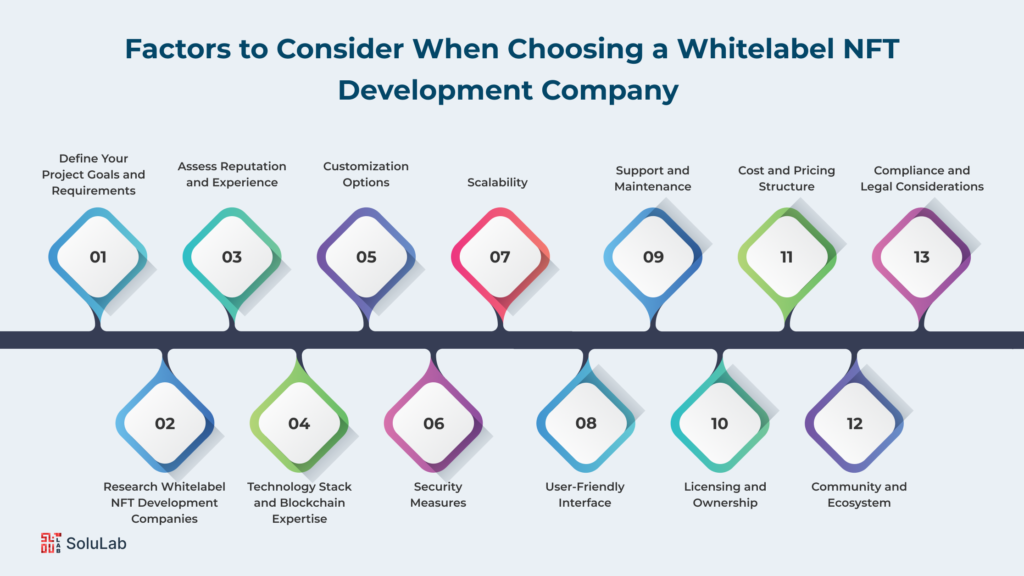
Picking the best whitelabel NFT development company is one of the biggest calls you’ll make for your NFT marketplace. Get it right and a lot of later headaches never show up.
1. Define Your Project Goals and Requirements
Before you look at a single vendor or start your search for a whitelabel NFT development company, get clear on your own project’s goals and requirements. Ask yourself:
- Which niche or industry is your NFT marketplace aimed at (e.g., art, music, gaming, collectibles)?
- Which features and functions does your NFT platform genuinely need?
- How much can you spend on development, maintenance, and support over time?
- Are there legal or regulatory issues to plan for, like compliance with local laws or licensing agreements?
- A tight scope and clear goals will focus your search. They also make it far easier to spot the company that fits.
2. Research Whitelabel NFT Development Companies
Next, build a longlist of possible whitelabel NFT development companies. There are a few good places to look:
- Online searches: Search engines, NFT forums, and online communities will turn up companies offering whitelabel NFT solutions.
- Industry referrals: Ask peers, fellow founders, or NFT enthusiasts who have worked with these companies. Firsthand experience beats marketing copy every time.
- NFT marketplaces: Look at marketplaces that already exist. Some offer whitelabel solutions themselves or partner with development firms.
- Then trim the list down to the companies that look promising and match your project goals.
Know More: How to Build the Best White-Label NFT Marketplace?
3. Assess Reputation and Experience
When you’re choosing a whitelabel NFT development company, reputation and experience count for a lot. So how do you check them?
- Portfolio: Go through their past projects. Look for NFT marketplaces they’ve built and launched successfully, and notice how many different industries and niches they’ve covered.
- Client testimonials: Read the reviews and testimonials. Better still, if you can, contact past clients directly and ask how the work actually went.
- Case studies: Some firms publish detailed case studies laying out the problems they hit and how they solved them. Read them. They tell you more about a team’s problem-solving than a sales call will.
- A company with a solid track record is more likely to ship a quality product, and to still be around to support it.
4. Technology Stack and Blockchain Expertise
NFTs live on blockchains, so blockchain expertise isn’t optional for an NFT development company. Check:
- Their knowledge of blockchain networks: Make sure they know the network you plan to build your NFT marketplace on, whether that’s Ethereum, Binance Smart Chain, Flow, or another.
- Smart contract proficiency: Smart contracts are what make NFTs work. Find out whether the company can write smart contracts and audit them for security and reliability.
- Scalability: Ask whether they can design an NFT platform that keeps up as user traffic and transaction volumes grow.
- Without a real grasp of blockchain technology, you can’t count on your NFT marketplace being secure or efficient.
5. Customization Options
Your NFT marketplace should look and behave like your brand, not like the vendor’s demo. Evaluate:
- How much customization the whitelabel NFT solution really allows. Can you change the platform’s design, features, and functionality to match your vision?
- User interface and user experience (UI/UX): Check that the UI/UX can be adjusted to create an engaging, easy-to-use environment.
- White labeling options: Confirm that you’re free to rebrand the platform completely, so it comes across as your own product.
- Customization is how you stand apart from competitors and keep the marketplace on-brand.
6. Security Measures
Your NFT marketplace will hold valuable digital assets, so its security comes before almost everything else. Ask what the company puts in place, including:
- Encryption: Data encryption that protects user information and transactions.
- Multi-factor authentication (MFA): Extra layers of verification that block unauthorized access.
- Regular security audits: Scheduled reviews that find vulnerabilities and fix them.
- Compliance with industry standards: Check that the company follows security best practices and meets the relevant industry standards.
- A breach can do serious damage to your reputation and your finances. Don’t skip this part.
7. Scalability
As your user base grows, your NFT marketplace has to keep up with more traffic and more transactions. Assess:
- The platform’s scalability options: Will it cope with rising demand without slowing down or going offline?
- Load testing: Ask whether the company runs load tests to confirm the platform can survive peak usage periods.
- Scalability lets your NFT marketplace grow at the same pace as your success.
Read Also: How will White-Label NFT Marketplace Development Benefit your Business?
8. User-Friendly Interface
A good interface is what brings users in and keeps them coming back. Evaluate:
- The platform’s user interface (UI) design: Is it intuitive, attractive, and easy to find your way around?
- User experience (UX): Does using the platform feel smooth, even enjoyable?
- Strong UI/UX has a direct effect on engagement and conversion rates.
9. Support and Maintenance
An NFT marketplace is never really finished. Ask what support and maintenance the company provides, including:
- How quickly they respond to issues or questions.
- Whether updates and improvements keep coming after launch.
- Which technical support channels exist, and how responsive they are.
- Dependable support is what keeps your NFT marketplace secure and up to date.
10. Licensing and Ownership
Read the licensing terms and ownership rights for the whitelabel solution closely. Make sure that:
- You have full control and ownership of your NFT marketplace, so there are no legal surprises down the road.
- The licensing agreements are clear and fit your business goals and objectives.
- Clear legal terms protect your interests over the long run.
11. Cost and Pricing Structure
Lower cost is one of the main reasons to go whitelabel. Even so, read the pricing structure and fees carefully. Watch for:
- Initial development costs.
- Ongoing maintenance and support fees.
- Hidden or unexpected costs that show up during development or once the platform is live.
- If you can’t see the full cost up front, you can’t manage your budget properly.
Related: What are the Key Features of the White-Label NFT Marketplace?
12. Community and Ecosystem
In the NFT world, a strong community around your vendor can be worth a lot. Check whether the whitelabel NFT development company has:
- An active community of users or developers.
- Partnerships or collaborations inside the NFT industry.
- A network of experts and enthusiasts who can offer insight and help.
- A lively community can lead to useful connections and keep you close to industry trends.
13. Compliance and Legal Considerations
NFT regulation differs from one jurisdiction to the next. Confirm that the whitelabel solution meets the laws and regulations of your target market. Unsure? Talk to a legal expert before launch, not after.

Conclusion
Choosing the best whitelabel NFT development company will shape how your NFT marketplace performs, arguably more than any other single decision you make. Look hard at each company’s reputation, experience, technology stack, customization options, security measures, and support services.
The NFT space keeps shifting, so keep an eye on new trends and developments. Pair the right whitelabel NFT development company with a well-thought-out strategy, and your NFT marketplace has a real shot at thriving in a fast-moving market, with fresh opportunities for your brand and your users.
If you’re building toward an NFT-driven future, SoluLab can be a dependable partner, drawing on its experience in whitelabel NFT marketplace development services to help businesses get there. Innovation sits at the center of how the team works: helping companies try new ideas, rethink how they sell, and carve out a distinct presence online.
Working with SoluLab means turning plans into a live product. Connect with SoluLab today to get started on a white-label NFT marketplace of your own, built around what your business actually needs.
FAQs
Shipra Garg is a tech-focused content strategist and copywriter specializing in Web3, blockchain, and artificial intelligence. She has worked with startups and enterprise teams to craft high-conversion content that bridges deep tech with business impact. Her work translates complex innovations into clear, credible, and engaging narratives that drive growth and build trust in emerging tech markets.