
Key Takeaways
- MiCA has transformed the euro stablecoin market into a regulated infrastructure, accelerating enterprise adoption and enhancing safety.
- Revenue now comes from reserve yield, transaction fees, and programmable treasury efficiency gains.
- Multichain deployment and real-time Proof of Reserves are becoming standard in EUR stablecoin development services.
If you are running treasury, payments, or fintech operations in Europe right now, something has changed.
In early 2026, euro-backed stablecoin development is a part of how money moves across businesses. Over 58% of European institutions are already testing or using EUR-pegged stablecoins in treasury flows. Liquidity has crossed a point where these assets are usable, not just tradable. What most enterprises are realizing now is that this is not about crypto adoption. This is about control over money movement.
If you rely only on banks, you wait. If you control your own EUR-pegged stablecoin, you decide how and when money moves.
- Every transaction above a certain threshold for non-EU currency tokens (like a USD token used in the EU) is capped at €200M/day.
- But Euro-pegged EMTs have no such cap.
This is a huge selling point for why a company should build a Euro-backed asset instead of a Dollar-backed one for EU trade.
You are building a regulated financial product. And that changes everything.
Why Euro-Backed Stablecoins Are Gaining Enterprise Adoption in 2026?
Most enterprises did not adopt stablecoins earlier because of uncertainty. That problem is now gone. No people understand what are stablecoins and their importance is increasing in various regions like Europe, MENA, the US, and more.
1. MiCA Removed the Biggest Barrier: Trust
With MiCA fully enforced, a euro-backed stablecoin is treated as regulated financial infrastructure.
- Clear classification
- Defined reserve rules
- Mandatory redemption guarantees
This gives enterprises confidence to move real treasury flows on-chain.
2. Liquidity Has Finally Arrived
Between late 2025 and early 2026, major EUR stablecoins like EURC and EURCV saw volume growth above 1000%.
This matters because:
- Payments need depth
- Treasury needs exit liquidity
- Enterprises need predictable pricing
Without liquidity, no system works. Now it does.
3. The Banking Layer Has Entered
A new trend is shaping the market.
Large European banks are no longer watching. They are building.
Consortium-backed euro stablecoin platforms are emerging, aiming to:
- Compete with USD dominance
- Control settlement infrastructure
- Build internal programmable money systems
For enterprises, this means one thing:
Stablecoins are becoming part of traditional finance, not separate from it.
Core Architecture of a MiCA-Compliant Stablecoin Platform
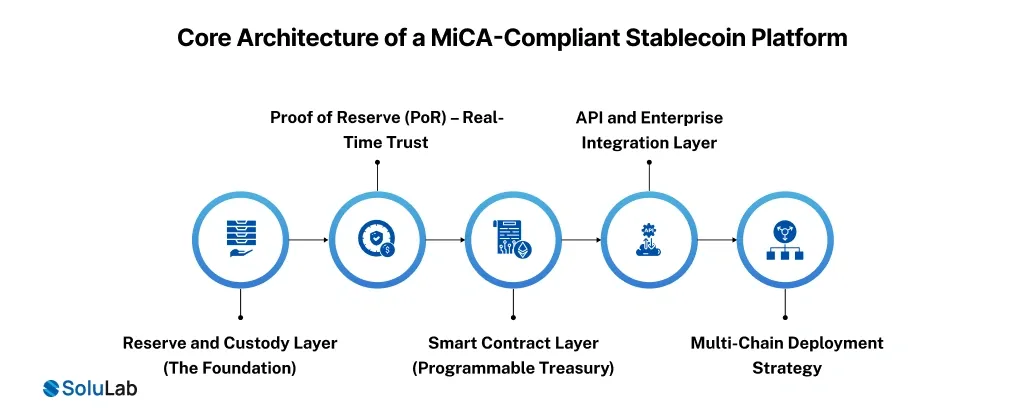
When enterprises think about stablecoin payment platform development, the real question is not “which blockchain?”
The real question is: How do we ensure compliance, trust, and scalability from day one?
Here is what a 2026-ready architecture looks like. Before going deeper, one decision matters more than technology.
Are you building this for payments, internal treasury, or as a platform for external users? Because each of these requires a different architecture priority.
1. Reserve and Custody Layer (The Foundation)
A compliant EUR-pegged stablecoin must be backed 1:1.
Typical reserve structure includes:
- Short-term Euro government bonds
- ECB-linked deposits
- Tier-1 bank custody accounts
This is where the revenue model starts. Enterprises earn yield from these reserves while maintaining full backing.
2. Proof of Reserve (PoR) – Real-Time Trust
Audits are no longer quarterly PDFs. In 2026, blockchain-powered stablecoin development includes real-time Proof of Reserve systems.
- On-chain attestation feeds
- Automated verification
- Public transparency dashboards
This reduces risk perception instantly.
3. Smart Contract Layer (Programmable Treasury)
This is where real value is created.
Smart contracts enable:
- Automated payments
- Conditional settlements
- Escrow logic
Example:
Payment triggers automatically when goods are delivered and verified digitally.
This reduces reconciliation costs by up to 40%.
4. API and Enterprise Integration Layer
A stablecoin development today must build beyond crypto wallets.
Enterprises need:
- ERP integrations (SAP, Oracle)
- Treasury dashboards
- Payment APIs
- Compliance reporting tools
Without this layer, adoption fails.
5. Multi-Chain Deployment Strategy
Enterprises are not choosing one chain anymore.
They are deploying across:
- Ethereum (security + liquidity)
- Stellar (low-cost payments)
- Solana (high throughput use cases)
This improves reach and reduces dependency.

Navigating the 2026 Regulatory Landscape: EMTs vs. ARTs
This is where most projects fail. Not because of tech. Because of classification.
1. Electronic Money Tokens (EMTs)
In 2026, EMTs have become the “Safe Haven” for enterprise cash. They are no longer viewed as “crypto” but as digital versions of cash (funds).
- The “Funds” Status: Crucially, under MiCA, EMTs are legally classified as “funds.” This means they fall under the Payment Services Directive (PSD2/PSD3).
- The 2026 Banking Integration: Mention that as of March 2, 2026, the EBA transition period for “no-action” letters ended. Now, any platform (CASP) handling Euro EMTs must either have a Payment Institution (PI) license or a direct partnership with a bank.
- The 30/70 Split: At least 30% of the fiat must be deposited in separate accounts at credit institutions. The remaining 70% can be invested in low-risk, highly liquid assets (like German or French gov-bonds).
- Revenue Model Tip: Leads should know they can earn the “spread” between the interest on those bonds and the 0% interest paid to token holders.
2. Asset Referenced Tokens (ARTs)
For enterprises, ARTs are rarely the first choice. ARTs are used for niche use cases, like “stable” baskets for global trade that aren’t tied to a single currency.
- Higher Regulatory Hurdle: Unlike EMTs (which can be issued by any authorized bank/EMI), ARTs require a specific MiCA Authorization that can take 6-9 months to obtain.
- The “Significant” Threshold: If an ART hits 10 million holders or €5 billion in reserve, it is classified as “Significant” (sART).
- ARTs must hold 3% of their own funds (capital buffer) instead of the standard 2%.
- Why Enterprises Avoid Them: In 2026, liquidity is fragmented for ARTs. Most European exchanges (CASPs) prioritize Euro-EMTs because they are easier to list under “Passporting” rules.
3. The July 1, 2026, Deadline
This is not flexible.
Any euro-backed cryptocurrency operating without authorization after this date risks:
- Market exclusion
- Legal penalties
- Liquidity shutdown
If you are planning euro-backed token development, compliance must be built into the architecture from day one. So, what do you have to check before the July 1, 2026, deadline:
White Paper Approval: Does your development partner provide the MiCA-mandated legal/technical white paper framework?
Reserve Segregation: Are assets held in a remote-bankruptcy vehicle separate from the company’s operating capital?
The “1/100th” Rule: Mention that for “Significant EMTs,” issuers must hold 3% of their own funds as a buffer (K-factor).
Revenue Model: How Enterprises Actually Make Money
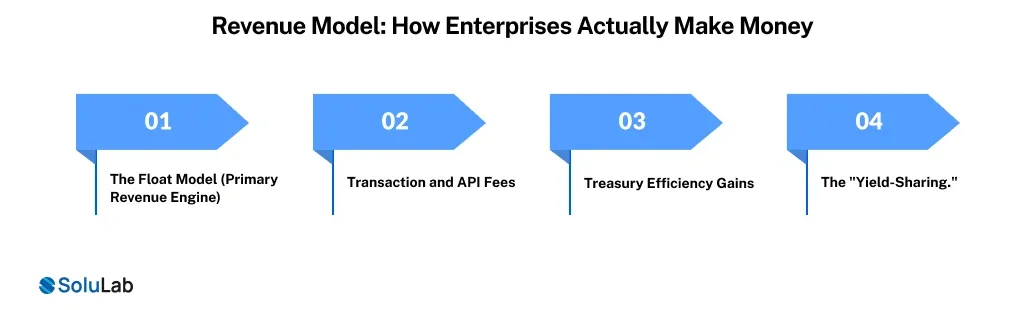
This is the real driver behind EU-compliant enterprise stablecoin development ROI and passive income generation are integral to enterprise development. Let’s see how companies in the European region are making money through stablecoin services.
1. The Float Model (Primary Revenue Engine)
Enterprises hold reserves in high-quality assets.
Typical yield range: 2%–4%
At scale, this becomes significant.
Example: €500M supply → €10M–€20M annual yield potential
2. Transaction and API Fees
Revenue streams include:
- Minting and burning fees (0.1%–0.5%)
- API usage fees for partners
- White-label integrations
This creates recurring income.
3. Treasury Efficiency Gains
This is often underestimated.
By using EUR stablecoin development services, enterprises reduce:
- Settlement delays (2–3 days → minutes)
- Reconciliation costs
- Cross-border fees
Savings directly improve margins.
4. The “Yield-Sharing.”
In 2026, the “Float Model” is standard, but the Yield-Sharing Model is the lead-generator. Enterprises want to know how to incentivize partners to use their token.
| Revenue Stream | Mechanism | Enterprise Benefit |
| Net Interest Margin (NIM) | Earn 2.5%–3.8% on Euro Treasury Bills backing the token. | Primary treasury income. |
| Incentivized Liquidity | Share 10% of the yield with “Power Users” (distributors/merchants). | Drives rapid ecosystem adoption. |
| Gas-less Transaction Fees | Charging a small fee in EUR stablecoin to “sponsor” the blockchain gas. | Seamless UX for non-crypto users. |
High-Impact Enterprise Use Cases: From Supply Chain to Treasury
This is where things become practical. In 2026, EU tax authorities are exploring “Real-Time Tax.” When a B2B payment happens in your EUR Stablecoin, a smart contract automatically splits the 20% VAT and sends it to a government-locked wallet, while the 80% net goes to the vendor.
This eliminates manual tax reconciliation and prevents fraud.
1. On-Chain Supply Chain Payments
Imagine this flow:
- Goods shipped
- Digital Bill of Lading signed
- Smart contract verifies
- Payment released instantly
No manual intervention. This is already being tested across European logistics networks.
2. Intercompany Treasury Settlement
Large organizations struggle with internal transfers.
A EUR-pegged digital asset development approach solves this.
- Instant settlement between subsidiaries
- No banking delays
- Real-time visibility
This alone can transform treasury operations.
3. Cross-Border Payments Inside SEPA and Beyond
Even within SEPA, delays exist. Stablecoins reduce this to near real-time.
For global payments, the impact is bigger:
- Lower FX friction
- Faster settlement
- Reduced intermediary dependency
4. White-Label Financial Products
Banks and fintechs are launching their own euro-backed stablecoin products.
Use cases include:
- B2B payments
- Merchant settlement systems
- Embedded finance platforms
This creates new revenue lines, not just cost savings.

Why Partner with an Enterprise Stablecoin Development Expert?
This is not just a development problem. It is a combination of regulatory, financial, and infrastructure problems. To make the things in your stablecoin development checklist, you need expert support. SoluLab experts have been serving the stablecoin development for over 10 years. Let’s see what you can achieve through partnering with SoluLab.
1. Compliance-First Development
A strong euro-backed stablecoin development company builds:
- MiCA-ready architecture
- Licensing support
- Audit and reporting systems
Without this, scaling becomes impossible.
2. Passporting Advantage Across the EU
One license. Entire EU access. But only if done correctly.
An experienced partner helps structure the system so your EUR stablecoin can operate across all 27 member states.
3. Faster Time to Market
Building internally takes time. Markets move faster.
With the right stablecoin development services, enterprises:
- Launch faster
- Reduce risk
- Optimize cost
4. Integration with Existing Systems
A real-world system must connect with:
- Banking infrastructure
- Compliance tools
- Enterprise software
This is where most internal builds fail.
FAQs
Deepika is a content writer who blends storytelling with strategic thinking. She explores topics across digital innovation, emerging tech, and the evolving blockchain industry. She enjoys breaking down complex ideas into simple, engaging narratives in the growing global markets.