Key Takeaways
- Agentic AI platform development should focus on business workflow execution, not only LLM chat.
- An AI orchestration platform must coordinate agents, tools, APIs, data, policies, memory, and humans.
- A strong enterprise agentic AI platform needs governance, observability, security, audit trails, and role-based access.
- A scalable multi-agent AI platform should support task planning, agent routing, tool calling, human approval, and continuous evaluation.
- SoluLab can support businesses that want to build agentic AI platform solutions with custom agents, LLM integration, enterprise AI systems, and flexible AI developer engagement models.
Agentic AI platform development is now a board-level priority because enterprises do not want another chatbot. They want AI systems that can plan, reason, use tools, work across departments, and complete business workflows with control. An agentic AI orchestration platform is a system that coordinates multiple AI agents, LLMs, enterprise data, tools, approvals, and workflows to execute complex tasks safely.
UpdateIA is a useful benchmark because it positions itself as an enterprise agentic AI orchestration platform for assessing AI readiness, identifying high-value use cases, integrating enterprise data, and deploying custom AI solutions across business functions. Its agent pages also describe purpose-built AI agents for processes such as customer inquiries, compliance, claims validation, and operational optimization. This guide explores how to build an Agentic AI Platform Development Solution like UpdateIA.
What Makes UpdateIA a Strong Enterprise Agentic AI Platform Example?
UpdateIA is designed as an enterprise agentic AI platform that brings multiple business functions into one orchestrated AI ecosystem.
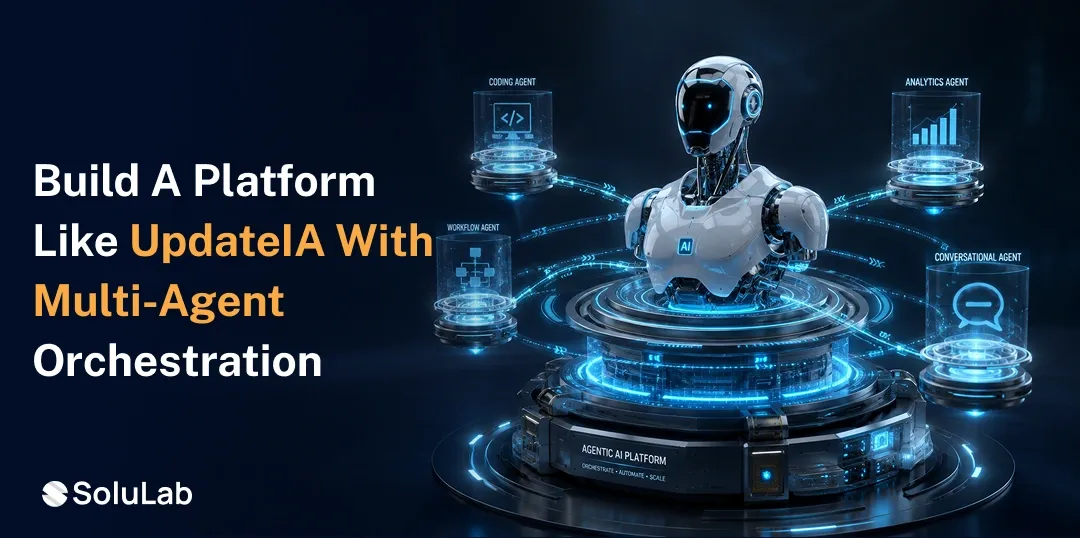
The client wanted a unified AI operating system for enterprises because companies still depend on separate tools for HR, CRM, Finance, and Legal. This creates confusion, slows productivity, and makes compliance harder to track. UpdateIA was built to solve this with Jarvis, a central orchestrator that coordinates agents, manages task routing, tracks events, and supports compliance dashboards in real time.
The product is relevant for businesses planning to build agentic AI platform solutions. It shows the real enterprise pattern: one central orchestration layer, many specialized agents, deep tool integrations, and human fallback when automation is not enough.
Why Enterprises Need an AI Agent Orchestration Platform?
An AI agent orchestration platform helps companies manage many AI agents as one controlled system. IBM defines AI agent orchestration as coordinating multiple specialized agents within a unified system to achieve shared objectives. That definition fits modern enterprise needs because one general-purpose AI tool cannot handle every department, policy, system, and approval flow.
For example, a finance agent may validate invoices. A legal agent may review contract clauses. A CRM agent may update leads. A support agent may classify tickets. A compliance agent may check rules. Without orchestration, these agents become isolated tools. With orchestration, they become a coordinated business operating layer.
A good platform answers five practical questions:
- Which agent should handle this task?
- What data should the agent access?
- Which tool should it use?
- Does the action need human approval?
- How can the business audit the result later?
SoluLab’s UpdateIA Model: What Businesses Can Learn
SoluLab developed UpdateIA as a GenAI-powered AI workflow orchestration platform with Jarvis as the central intelligence unit. The case study says UpdateIA coordinates 14+ specialized AI agents built as microservices for HR, CRM, Finance, Legal, and Customer Support. These agents automate repetitive tasks such as data entry, billing, lead nurturing, and compliance checks.
Businesses can learn three important lessons from this model.
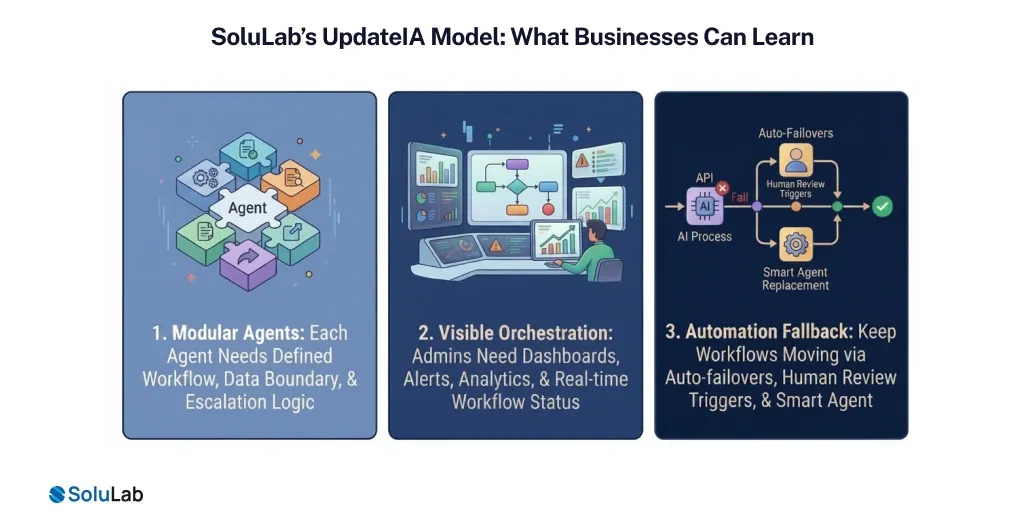
- First, agents should be modular. Each agent needs a defined function, workflow, data boundary, and escalation logic.
- Second, orchestration must be visible. Admins need dashboards, alerts, analytics, and real-time workflow status.
- Third, automation needs a fallback. UpdateIA includes auto-failovers, human review triggers, and smart agent replacement to keep workflows moving when AI or APIs fail.
This is what separates enterprise AI from basic automation.
Core Architecture of an AI Orchestration Platform
An AI orchestration platform needs a layered architecture. If the architecture is weak, the platform may work in demos but fail in production.
| Architecture Layer | What It Does | Why It Matters |
| User interface | Chat, dashboards, mobile apps, web portals, Slack, Teams, email | Gives users simple access to agents |
| Central orchestrator | Routes tasks, monitors workflows, assigns agents, and manages fallback | Controls the whole AI ecosystem |
| Agent layer | Runs specialized agents for departments and use cases | Keeps work focused and accurate |
| LLM layer | Connects models for reasoning, language, classification, and generation | Powers agent intelligence |
| Enterprise data layer | Uses documents, databases, CRM, ERP, HRMS, and knowledge bases | Grounds outputs in a business context |
| Tool integration layer | Connects Salesforce, Microsoft 365, Google Workspace, Slack, Teams, and APIs | Let’s agents take action |
| Workflow engine | Creates no-code and configurable workflows | Gives admins control without coding |
| Governance layer | Adds compliance, permissions, audit logs, approvals, and monitoring | Makes the platform enterprise-ready |
| Fallback layer | Supports human review, retry logic, failover, and agent replacement | Protects business continuity |
UpdateIA follows this type of structure with Jarvis, modular agents, a no-code workflow engine, integrations, dashboards, and fallback logic.
Step-by-Step: How to Build an Agentic AI Platform Like UpdateIA
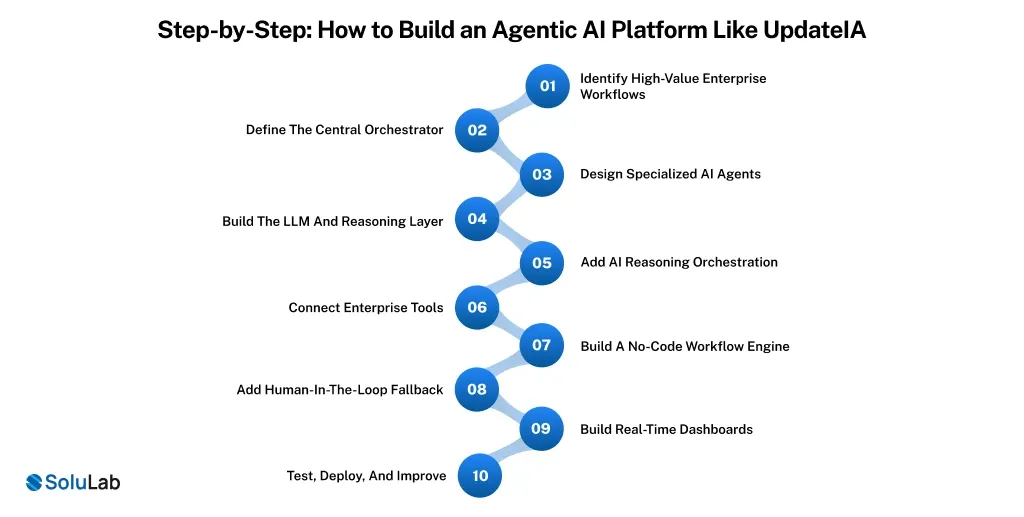
- Identify High-Value Enterprise Workflows
To build agentic AI platform solutions, businesses should begin with workflows that waste time, create delays, or require repeated coordination. Good AI use cases include invoice processing, lead qualification, compliance checks, contract review, onboarding, support ticket routing, employee requests, and billing follow-ups.
The goal is not to automate everything on day one. The better move is to choose workflows where AI agents can reduce manual work, improve speed, and create measurable ROI.
- Define the Central Orchestrator
UpdateIA uses Jarvis as the central orchestrator. A similar platform should also have one control layer that manages agents, tasks, events, approvals, analytics, and compliance visibility.
The orchestrator should decide which agent handles each task, when a human must review an action, how errors are handled, and how the final workflow outcome is tracked.
- Design Specialized AI Agents
A multi-agent AI platform works best when every agent has a narrow purpose. A finance agent should not behave like a legal agent. A marketing agent should not approve payments. A compliance agent should not write sales emails without controls. Each agent should have:
- A clear role
- Approved data access
- Defined tools
- Output rules
- Escalation conditions
- Human review triggers
- Performance metrics
This structure improves accuracy, safety, and accountability.
- Build the LLM and Reasoning Layer
The LLM orchestration platform layer decides how the system uses language models. Some workflows need fast classification. Others need deep reasoning. Some need document extraction. Others need summarization, email drafting, or code-based actions.
A strong platform can route work across different LLMs based on cost, speed, accuracy, privacy, and reasoning depth. This prevents overusing expensive models for simple tasks.
- Add AI Reasoning Orchestration
AI reasoning orchestration helps agents plan steps before acting. For example, a vendor onboarding workflow may need one agent to read documents, another to check compliance, another to verify bank details, and another to update the ERP.
The orchestrator should manage the order of these steps. It should also stop the process when data is missing or the risk is high.
- Connect Enterprise Tools
UpdateIA connects with enterprise tools such as Google Workspace, Microsoft 365, Salesforce, Personio, and Yousign. It has 20+ enterprise tool integrations and a roadmap for 40+ connectors.
This is essential. Agents become useful only when they can work inside existing systems. The AI platform should connect with CRM, ERP, HRMS, email, document storage, ticketing tools, finance systems, analytics tools, and approval apps.
- Build a No-Code Workflow Engine
UpdateIA includes a drag-and-drop no-code workflow interface that allows admins to build workflows, connect integrations, and monitor agents without writing code.
This feature is important because business users know the workflows better than developers. A no-code layer helps operations, HR, finance, sales, and support teams modify processes faster.
- Add Human-in-the-Loop Fallback
Enterprise agents should not act without limits. When the system sees high-risk decisions, failed API responses, missing data, unusual requests, or compliance issues, it should route the workflow to a human reviewer. This protects the business while still preserving automation speed.
- Build Real-Time Dashboards
A strong enterprise AI agent platform needs dashboards for task progress, agent performance, compliance alerts, workload, system health, automation savings, and user activity.
UpdateIA supports web and mobile access for dashboards, analytics, alerts, and controls. This gives teams real-time visibility across departments.
- Test, Deploy, and Improve
Before launch, teams should test real business scenarios, failed APIs, incomplete data, adversarial prompts, conflicting instructions, and edge cases. After launch, they should measure automation rate, cycle time, cost savings, user adoption, agent accuracy, and escalation rate.
Must-Have Features of an AI Workflow Orchestration Platform
A competitive AI workflow orchestration platform should include features that support actual enterprise use. These features turn an AI product into an AI-native platform.
| Feature | Description |
| Central orchestrator | Controls task routing, agent coordination, monitoring, and escalation |
| Specialized agents | Automates HR, CRM, Finance, Legal, Marketing, Support, and Operations workflows |
| No-code workflow builder | Allows admins to build and change workflows without a development dependency |
| Enterprise connectors | Integrates CRM, ERP, HRMS, email, document tools, and communication platforms |
| Human fallback | Routes sensitive or failed tasks to human reviewers |
| Role-based access | Controls who can access agents, workflows, tools, and data |
| Compliance dashboard | Tracks risk, approvals, logs, and policy actions |
| Mobile and web access | Let’s users manage agents from any device |
| Agent observability | Tracks prompts, decisions, tools, outputs, latency, and failures |
| Model routing | Sends tasks to the right LLM based on cost and complexity |
| Analytics layer | Shows ROI, workload savings, process speed, and adoption |
Why Businesses Should Work With an Agentic AI Development Company?
An agentic AI development company helps businesses move faster because agentic AI requires many skills at once. Teams need AI engineers, backend developers, cloud architects, integration experts, UX designers, security specialists, data engineers, and QA teams.
SoluLab’s AI agent development page states that it builds custom AI agents, AI agent integrations, model optimization, intelligent behavior training, and support services. It also positions its AI agents around enterprise systems, workflows, and data environments.
This matters because a platform like UpdateIA is not only an AI model. It is enterprise software with AI at the center.
Technology Stack for a
A reliable multi-agent AI platform needs a flexible AI technology stack. The exact stack depends on the business, but most enterprise builds include these layers:
| Stack Area | Common Choices |
| LLMs | GPT, Claude, Gemini, Llama, Mistral, domain-specific models |
| Agent frameworks | LangGraph, CrewAI, AutoGen-style frameworks, Microsoft Agent Framework |
| Vector databases | Pinecone, Weaviate, Milvus, pgvector, Elasticsearch |
| Backend | Python, Node.js, Java, Go |
| Frontend | React, Next.js, mobile apps, admin dashboards |
| Workflow engine | Custom workflow builder, BPMN tools, event-driven orchestration |
| Cloud | AWS, Azure, Google Cloud, private cloud, hybrid cloud |
| Data layer | RAG pipelines, document ingestion, metadata, data warehouse access |
| Security | SSO, RBAC, IAM, encryption, secrets management |
| Observability | Logs, traces, model monitoring, cost monitoring, evaluation dashboards |
Microsoft’s Azure Architecture Center covers orchestration patterns for multi-agent architectures, and this reflects where enterprise design is moving: choosing the right coordination pattern based on workflow complexity, control, and collaboration needs.
How an LLM Orchestration Platform Controls Cost and Quality?
An LLM orchestration platform should not send every task to one expensive model. That creates high cost and uneven performance.
A better design routes work based on task type:
- Simple classification goes to a smaller model.
- Complex reasoning goes to a stronger model.
- Private data tasks go to secure or private models.
- Document-heavy tasks use RAG and extraction agents.
- Multimodal tasks use models that can understand images, PDFs, and forms.
This approach improves speed, reduces cost, and gives teams better control. For enterprise buyers, this matters because the AI platform cost can grow quickly after launch. Model routing, caching, batching, prompt optimization, and evaluation help keep the system commercially sustainable.
How an Enterprise AI Agent Platform Creates Business Value?
An enterprise AI agent platform creates ROI by reducing manual effort and speeding up work across departments.
| ROI Area | Business Impact |
| Faster process execution | Shortens approval, support, finance, HR, and legal workflows |
| Lower manual workload | Reduces repeated data entry, follow-ups, and document handling |
| Better compliance visibility | Tracks approvals, risks, logs, and policy actions |
| Reduced tool switching | Brings scattered workflows into one orchestrated ecosystem |
| Improved decision-making | Combines enterprise data, AI reasoning, and human review |
| Higher productivity | Lets teams focus on judgment-heavy work |
| Scalable automation | Expands from one workflow to many departments |
SoluLab’s AI agent service page highlights benefits such as faster process execution, lower manual workload, and ROI within 6–9 months for enterprise-grade AI agents.
Common Mistakes to Avoid When Building an AI-Native Enterprise Platform
- Starting With Agents Before Workflows
Many teams start by asking, “How many agents should be built?” The better question is, “Which workflow is slow, expensive, or risky?” Workflow-first design creates better adoption.
- Making One Agent Do Everything
A single super-agent becomes hard to control. Specialized agents improve performance, safety, and accountability.
- Ignoring Human Fallback
Autonomous systems still need human approval for sensitive actions. UpdateIA’s fallback logic is a good pattern because it protects business continuity.
- Skipping Integrations
Agents are weak when they cannot connect to CRM, ERP, HRMS, communication tools, and document systems. Integrations turn AI into operational value.
- Forgetting Compliance Visibility
Enterprises need audit trails, dashboards, approvals, and logs. Without them, teams cannot prove what the AI did or why.
- Not Measuring ROI
Every workflow should track time saved, cost reduced, completion rate, escalation rate, and user satisfaction.
Takeaway
Building an AI agent platform development solution is like building an enterprise operating layer where AI agents can coordinate, reason, use tools, follow rules, and complete workflows safely. The strongest AI orchestration platform will not be the one with the most agents. It will be the one with the clearest orchestration logic, strongest integrations, safest governance, best fallback design, and most visible ROI.
UpdateIA shows a strong pattern for businesses: central orchestrator, modular agents, no-code workflows, enterprise connectors, real-time dashboards, compliance visibility, and human fallback. That is the structure modern enterprises need as they move from AI experiments to AI-native operations.
Build an Update IA-Like Platform With SoluLab!
If you want to create your own AI operating system for enterprise workflows, SoluLab, the #1 AI development company in USA, can help you build autonomous agents, orchestration layers, no-code workflow tools, enterprise connectors, and real-time analytics. You can launch a platform designed for productivity, compliance, and long-term scalability.
FAQs
Agentic AI platform development is the process of building AI systems where autonomous agents can plan, reason, use tools, access enterprise data, and complete workflows with limited human supervision
An AI orchestration platform coordinates AI agents, LLMs, tools, workflows, enterprise data, approvals, and monitoring so businesses can automate complex operations safely.
UpdateIA is an enterprise agentic AI platform because it uses Jarvis as a central orchestrator to manage 14+ autonomous agents across HR, CRM, finance, legal, marketing, and customer support workflows.
An AI agent orchestration platform manages how different AI agents work together, share tasks, use tools, escalate issues, and complete business workflows.
A multi-agent AI platform uses several specialized AI agents instead of one general AI assistant. Each agent handles a specific role, department, or task.
An LLM orchestration platform helps route tasks to the right model, reduce AI cost, improve response quality, support fallback, and avoid dependency on one model provider.
SoluLab is a strong AI agent development company because it builds custom AI agents, multi-agent systems, enterprise integrations, workflow automation, and UpdateIA-like AI orchestration platforms.
Businesses should hire AI developers when they need custom agent development, enterprise integrations, LLM workflows, orchestration logic, AI dashboards, secure deployment, or ongoing AI platform support.
Shipra Garg is a tech-focused content strategist and copywriter specializing in Web3, blockchain, and artificial intelligence. She has worked with startups and enterprise teams to craft high-conversion content that bridges deep tech with business impact. Her work translates complex innovations into clear, credible, and engaging narratives that drive growth and build trust in emerging tech markets.