Key Takeaways
- A custom GPT is a version of ChatGPT pre-loaded with your business’s instructions, tone, and context, so your team gets consistent answers instead of starting from a blank prompt every time.
- Simple, single-purpose GPTs (an FAQ assistant, an internal writing tool) can often be built in an afternoon using ChatGPT’s own builder — no developer required.
- The moment a GPT needs to touch your live data, your customer records, or your actual systems, it stops being a weekend project and starts being a software project.
- 58% of small businesses now use generative AI, up from just 23% two years ago, but a lot of that use is still one person, one chat window, no real system behind it.
- SoluLab builds custom GPT and chatbot solutions that go beyond the free-tier version, connected to your CRM, your support tickets, your product data, for businesses that have outgrown the DIY stage.
If you’ve typed “build me a GPT for my business” into a search bar, you’re not alone, and you’re probably not looking for a lecture on how large language models work. You want to know: can I actually have my own AI assistant, does it take a developer, and how much of my week does this eat up? Here’s the straight answer, no jargon required.
Whether you want to automate customer support, streamline operations, empower employees with instant knowledge, or create personalized user experiences, the right AI development partner can make the process faster and more cost-effective. This guide explains how to build a GPT for your business, the key steps involved, common challenges to avoid, and why partnering with an experienced AI development company like SoluLab can help you launch a secure, scalable, and business-ready GPT solution.
What “Building a GPT” Actually Means for a Business?
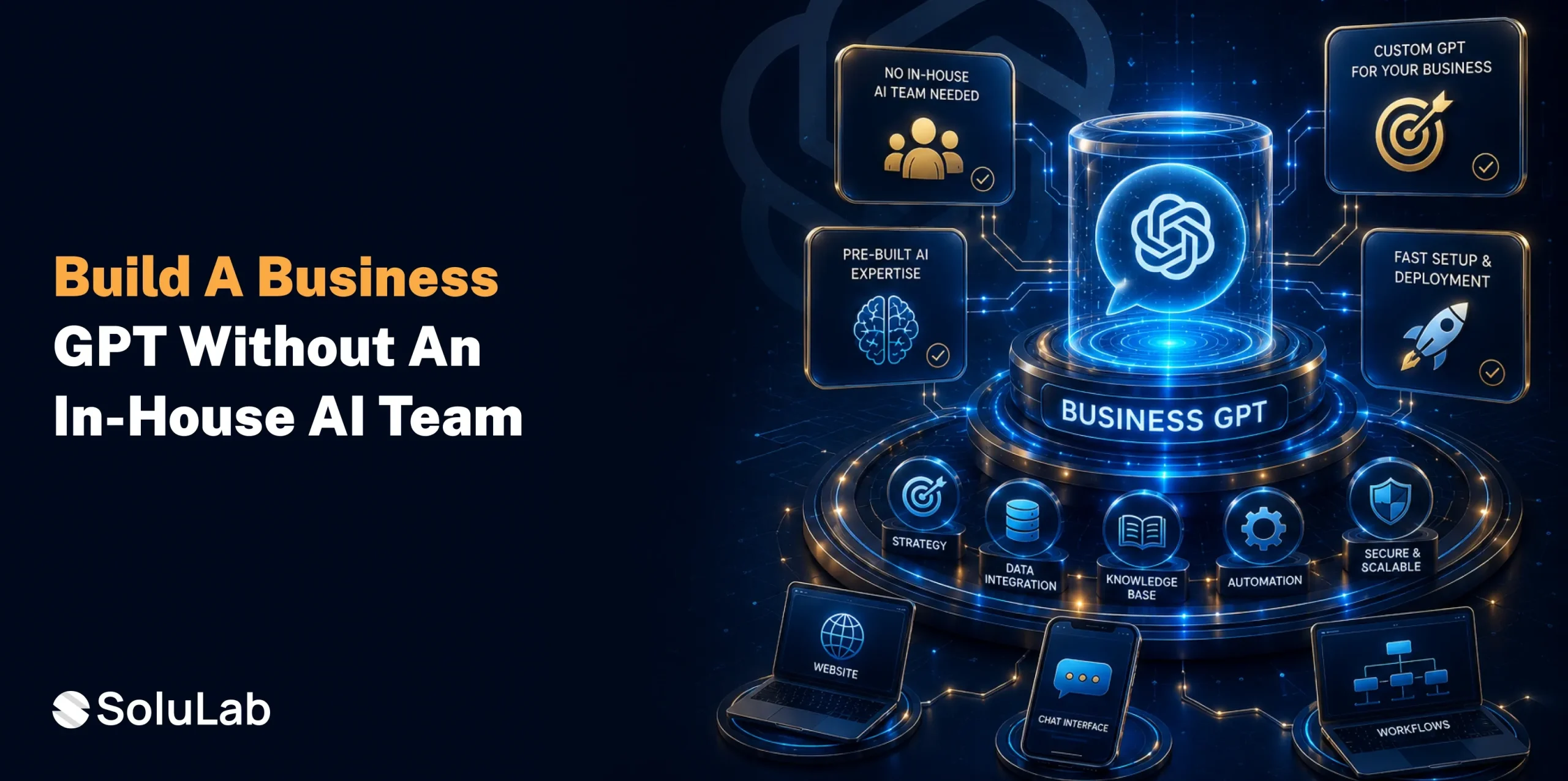
Forget the technical explanation. In plain terms, a custom GPT is ChatGPT with your business’s playbook already loaded in. Instead of a generic AI assistant that needs to be told your tone, your policies, and your product details every single time, a custom GPT already knows them. Someone on your team opens it, types a request, and gets an answer that already sounds like your business, not a stranger’s.
That distinction matters more than it sounds like it should. According to the U.S. Chamber of Commerce’s 2025 Empowering Small Business report, 58% of small businesses now say they use generative AI, up from 40% in 2024 and 23% in 2023 — a near-tripling in two years. But a lot of that “use” is one employee, one browser tab, retyping the same instructions every morning. A custom GPT is what turns that habit into something the whole team can actually rely on.
Two very different paths, and most businesses only need to know which one they’re on
Path 1: The DIY GPT (fine for single, well-defined tasks)
If the job is narrow, turning call notes into a summary, drafting the same three types of email, answering a fixed list of FAQs, you genuinely don’t need a developer for this. ChatGPT’s own GPT builder, Google’s Gems, or Claude’s Projects can get a basic assistant running in under an hour. You describe what you want it to do, feed it a few examples of the tone and format you’re after, test it against a real input, and share the link with your team.
This path works well for:
- Turning testimonials or reviews into social posts
- Drafting first-pass client emails or proposals
- Summarizing meeting notes into action items
- Writing job ads or onboarding checklists in your company’s voice
The catch: these tools only know what you tell them in the chat window. They don’t see your CRM, your support tickets, your order history, or your live inventory. They’re a smarter notepad, not a system.
Path 2: The business-grade GPT (this is where it gets real)
The moment your idea is “I want a GPT that can look up a customer’s order status” or “I want it to answer questions using our actual product database,” or “I want it live on our website answering real customers,” you’ve left the DIY zone. That’s not a criticism of the free tools; it’s just not what they’re built for. Connecting an assistant to live systems, keeping customer data secure, and making sure it doesn’t confidently make things up in front of a real customer is a development project, the same way building any piece of customer-facing software is.
This is the gap SoluLab’s ChatGPT development work exists to close, building assistants that plug into your actual business, not just a chat window.
Where A Business-Grade Custom GPT Actually Pays Off?
Customer support that doesn’t sleep. A GPT wired into your knowledge base and ticketing system can resolve the repetitive 60% of tickets — order status, return policy, account questions, and hand the harder ones to a human with full context already attached.
Sales and lead qualification. A travel company that partnered with SoluLab built an AI-powered solution that handles travel recommendations and initial customer conversations, freeing up the human sales team for the conversations that actually need a person.
Internal knowledge and onboarding. Instead of new hires digging through outdated wikis, a GPT trained on your actual SOPs, policies, and product docs can answer “how do I…” questions instantly, and stays current as those documents get updated.
Content and reporting at scale. Drafting product descriptions, meeting summaries, or first-pass reports across a whole team, in a consistent voice, without every person re-explaining the brand tone from scratch.
Industry-specific assistants. Financial services teams use custom GPTs for first-pass document review; legal teams use them to speed up contract read-throughs; retail teams use them for personalized shopping guidance. In each case, the underlying pattern is the same: the same task, done constantly, now handled faster and more consistently.
What it actually costs to get this right?
Cost depends entirely on which path you’re on. A DIY GPT built inside ChatGPT costs nothing beyond your existing subscription. A business-grade assistant, one that’s connected to your systems, secured properly, and built to handle real customers, is a software investment, and it scales with complexity: a single-purpose internal tool costs far less than a customer-facing assistant wired into your CRM, payment system, and support stack.
SoluLab’s ChatGPT app development cost guide breaks down what actually drives that number up or down, so you’re not guessing at a quote.
What To Check Before You Build (Or Hire Someone To Build It)
- Is the task actually repetitive? If it only comes up once a month, a GPT isn’t worth the setup time. If it comes up daily across multiple people, it is.
- Does it need to touch real data? If yes, you need an AI development partner, not a chat window.
- Who’s accountable for what it says? Customer-facing assistants need guardrails, escalation paths, and a way to catch it when it’s wrong—that’s a design decision, not an afterthought.
- Do you actually own it? A GPT built inside someone else’s account, with no documentation, is a liability the day that person leaves. Build it so your business owns and controls it, not one employee’s login.
How SoluLab builds custom GPTs and AI assistants for business?
SoluLab works with businesses at both ends of this spectrum—from a first custom GPT to a fully integrated AI assistant running across a customer base. In practice, that looks like:
- ChatGPT and GPT-4 integration built around your actual workflows, not a generic template, through SoluLab’s ChatGPT development services.
- Pre-vetted developers who can start fast. Through Hire ChatGPT Developers, teams can bring in a specialist skilled in OpenAI API integration, chatbot logic, and workflow automation, typically starting within 48 hours of sharing requirements.
- Real-world deployment across industries—SoluLab’s ChatGPT and AI agent work spans healthcare, fintech, eCommerce, real estate, and customer support, including the travel-industry assistant mentioned above.
- A path beyond single-assistant tools, into full AI agent development for businesses that eventually want an assistant that doesn’t just answer questions, but takes multi-step actions across their systems.
Conclusion
Building a GPT for your business isn’t really an AI question; it’s a “which of my repetitive tasks is worth fixing first?” question. If the task is narrow and self-contained, you can genuinely build it yourself this afternoon. If it needs to touch real customer data, live systems, or your actual sales pipeline, it’s a development project worth doing properly, because a broken or over-confident assistant in front of a real customer costs more than the build would have.
Either way, the businesses getting the most out of this aren’t the ones with the fanciest AI. They’re the ones who picked one real bottleneck and actually fixed it.
FAQs
Shipra Garg is a tech-focused content strategist and copywriter specializing in Web3, blockchain, and artificial intelligence. She has worked with startups and enterprise teams to craft high-conversion content that bridges deep tech with business impact. Her work translates complex innovations into clear, credible, and engaging narratives that drive growth and build trust in emerging tech markets.